Why Is My Sciatica Worse in the Morning? | Poway, CA
For many people dealing with sciatica, mornings are miserable.
You may go to bed feeling reasonably comfortable, only to wake up with a stiff lower back and pain running into the buttock or leg. Getting out of bed is difficult. Putting on socks and shoes is worse. Sometimes the first few steps hurt enough that you wonder what happened overnight.
Then you move around for 15 or 20 minutes and things start to improve.
Dr. Cassidy James Boelk, DC has treated lumbar disc injuries and sciatica for more than 22 years and has performed more than 100,000 spinal decompression treatments. This is a pattern he sees regularly. It doesn't tell him everything about the condition, but it does provide another piece of the puzzle.
The first thing to understand is that your spine isn't exactly the same when you wake up as it was when you went to bed. The discs in the lower back naturally take on fluid while you are lying down overnight. For a healthy disc, this usually isn't something you would ever notice. When a disc is already injured, bulging or herniated, the first part of the morning can be a different story.
There is also the simple fact that you haven't moved much for several hours. Then, within minutes of waking up, you are asking your back to bend repeatedly while getting dressed, putting on shoes, leaning over the bathroom sink and starting your day.
For an already irritated lower back or sciatic nerve, that combination can make mornings particularly difficult.
When Sciatica Starts Taking Over Your Life
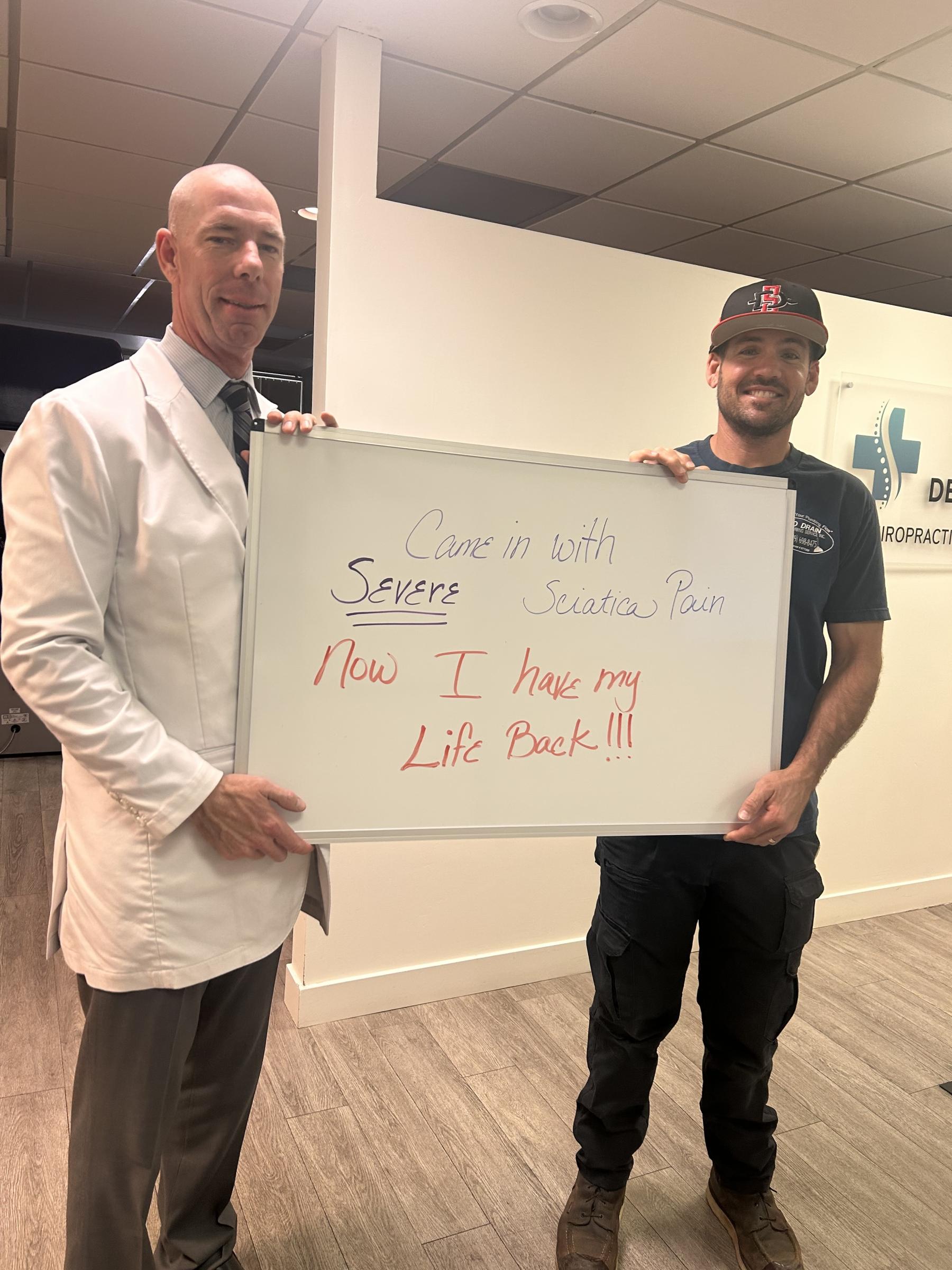
Jayson Yavorsky dealt with severe sciatica for more than a year before coming to The Spinal Decompression & Chiropractic Center of San Diego.
“There isn't enough room to fully explain the relief Dr. Boelk has brought to me and my family.
I found him after suffering from severe sciatica for more than a year. The pain shot from my hip all the way down to my left foot and became almost unbearable. I could no longer enjoy the activities I loved, including hockey, golf, and surfing.
Over the years, I had seen numerous chiropractors and experienced only temporary relief. Acupuncture helped somewhat, physical therapy was difficult to tolerate, and nothing seemed to provide lasting results. I couldn't sleep well, and my quality of life was steadily declining.
Then I met Dr. Boelk.
Through a structured treatment plan, adjustments, rehabilitation exercises, and lifestyle modifications, my life completely changed.
To this day, I tell people that Dr. Boelk saved my life.
Since my own recovery, I have referred my wife, daughter, mother, father, numerous friends, and many clients to his office. Every one of them has thanked me for the recommendation. Most recently, a firefighter friend of mine who was suffering from severe sciatica began treatment and is now making tremendous progress.
If you are considering surgery, I strongly encourage you to have Dr. Boelk evaluate your condition first.
What I respect most is his honesty. If he believes you are not a candidate or that another option would be better, he will tell you.
I trust him with my life and with my back.”
— Jayson Yavorsky, San Diego, CA
Start With a No-Charge Consultation
If mornings have turned into a routine of slowly getting out of bed, avoiding certain movements and waiting for the leg pain to calm down before you can start your day, it may be worth finding out what is causing it.
Patients from Poway can begin with a No-Charge, No-Obligation Consultation with Dr. Cassidy James Boelk, DC.
This isn't a treatment appointment and there is no requirement to sign up for spinal decompression. It is a chance to sit down with Dr. Boelk, explain what has been happening and let him review the information you already have.
He will want to understand when the problem started, where the pain travels, whether there is numbness or tingling, and whether you have noticed any change in strength. What happens first thing in the morning is important, but so is what happens during the rest of your day.
Can you sit comfortably? How long can you drive? Does walking help or make things worse? What happens when you bend forward? Are you sleeping through the night?
Previous treatment is also important. If you have already tried physical therapy, chiropractic care, medications, injections or other treatment, bring that history with you.
If you have a lumbar MRI, bring the actual images as well as the written report. Dr. Boelk prefers to review the images himself and compare them with your symptoms. If you don't have an MRI, you can still schedule the consultation.
From there, he can discuss whether further examination or imaging makes sense and whether Non-Surgical Spinal Decompression appears to be an appropriate option.
Not everyone is a candidate. If Dr. Boelk does not believe decompression is right for your condition, he will tell you.
Because he personally performs these consultations and reviews the available imaging, only a limited number of No-Charge Consultation appointments are available during the weekly clinic schedule.
Call 619-298-0800 to ask about the next available appointment.
What Happens to Your Discs While You Sleep?
The discs between the vertebrae contain water. During the day, normal loading from standing, sitting and moving causes them to gradually lose some fluid. When you lie down for several hours at night and that loading is reduced, the discs rehydrate.
This is normal.
It is also one reason people tend to be slightly taller in the morning than they are at the end of the day.
When a lumbar disc is already injured, however, the changes that occur overnight may contribute to why some patients with disc-related pain feel more sensitive when they first get up.
That does not mean morning sciatica automatically equals a herniated disc. It doesn't. There are several possible causes of sciatica, and the pattern has to be considered along with the rest of the history and, when appropriate, imaging.
What is interesting clinically is what happens after you get moving.
Someone who wakes up hurting but feels considerably better after a short walk presents differently from someone whose leg pain becomes progressively worse the longer they stand or walk.
Both patients may tell you they have sciatica. They may not have the same underlying problem.
The First 20 Minutes of Your Morning May Be Part of the Problem
Consider what most people do shortly after waking up.
You sit up. You bend over to put on underwear or pants. You reach toward the floor for your socks. You bend again for your shoes. You lean over the sink.
None of these movements are inherently bad. The problem is that an irritated back may not tolerate repeated bending particularly well first thing in the morning.
If you notice that walking around the house feels fairly comfortable but sitting down and bending toward your feet immediately sends pain down your leg, don't ignore that pattern.
Try changing the way you start the day.
Instead of doing a forceful sit-up to get out of bed, roll onto your side and use your arms to help yourself come upright. Give yourself a few minutes to move around before repeatedly bending toward the floor.
When putting on shoes, bring the foot toward you when possible rather than folding your entire torso down toward the shoe.
A short, easy walk around the house may also feel better than immediately starting a stretching routine.
This isn't about avoiding bending forever. People need to bend. It is about not repeatedly provoking an irritated area when it is already at its most sensitive.
Be Careful With Aggressive Morning Stretching
A lot of people wake up with sciatica and think, “My hamstring is incredibly tight. I need to stretch it.”
Sometimes what feels like a tight hamstring is actually related to an irritated nerve.
There is an important difference between feeling a comfortable stretch through a muscle and producing burning, tingling or radiating pain farther down the leg.
If you stretch your hamstring and your leg feels better afterward, that's useful information.
If every time you stretch, the pain travels farther toward your calf or foot, your toes begin tingling or the leg becomes more painful, continuing to push harder probably doesn't make much sense.
The same principle applies to exercises you find online. An exercise may be perfectly appropriate for one type of back problem and aggravating for another.
Pay Attention to How the Symptoms Change
One of the most useful things you can do before an evaluation is simply pay attention.
If the first ten minutes are terrible but you can walk comfortably once you get moving, remember that.
If the back pain settles down but the foot remains numb all day, remember that too.
If sitting through the drive from Poway into central San Diego makes the leg considerably worse, mention it.
If you feel good sitting but develop leg pain after ten minutes of standing or walking, that is also important.
These details often tell Dr. Boelk considerably more than simply saying, “My sciatica hurts.”
The same goes for sleep. Some people sleep comfortably and hurt only when they get out of bed. Others are awakened several times during the night because of leg pain. Some cannot tolerate lying on one side.
There isn't one sleeping position that is best for every person with sciatica. What matters is how your particular symptoms respond.
When Morning Sciatica Has Been Going On for Weeks
If this happens once after an unusually active weekend, that is different from waking up with radiating leg pain every morning for two months.
Persistent numbness also deserves attention.
Weakness is more concerning. If you are beginning to catch your toes while walking, one leg or foot is noticeably weaker than the other, or lifting the front of the foot is becoming difficult, that should be evaluated rather than simply stretching more and hoping it eventually disappears.
Rapidly progressing weakness, new bowel or bladder dysfunction, difficulty urinating, or numbness around the groin or saddle area requires prompt medical attention rather than waiting for a routine spinal decompression consultation.
Where Non-Surgical Spinal Decompression May Fit
When sciatica is being caused by an appropriate lumbar disc or degenerative condition, Non-Surgical Spinal Decompression may be one conservative treatment option.
The Spinal Decompression & Chiropractic Center of San Diego uses the DRX9000 exclusively. Dr. Boelk considers the level and location of the problem, the patient's symptoms, imaging, treatment position, angle, starting force, body size and how the patient responds.
But the decision to use decompression comes after determining whether the patient is a reasonable candidate.
A disc bulge or herniation on an MRI does not automatically qualify someone for treatment.
An unhealed fracture, significant osteoporosis, unstable spondylolisthesis, abdominal aortic aneurysm, pregnancy for lumbar treatment, certain malignancies and other conditions may make decompression inappropriate. Previous surgery needs to be looked at carefully as well, particularly when fusion or metal hardware is present at the level that would need treatment.
Sometimes Dr. Boelk recommends another conservative approach. Sometimes he wants additional imaging. There are also patients he refers for a surgical opinion.
Not Every Consultation Ends With Treatment
Jan H. came to Dr. Boelk after a neck injury and was hoping spinal decompression might be an option. After evaluating the situation, Dr. Boelk determined that treatment in the office was not appropriate because of the fracture involved.
Rather than proceeding with treatment, he recommended that she obtain another neurosurgical opinion.
That same approach applies to patients with lower back pain and sciatica. The purpose of the consultation is not to find a reason to put every patient on a decompression table. It is to decide whether the treatment makes sense for that particular person.
Patients Come From Outside San Diego as Well
The office regularly hears from people outside the immediate San Diego area who have been dealing with disc injuries or sciatica and are looking for another option.
For someone traveling from outside the area, candidacy becomes even more important. It makes no sense to travel for treatment without first determining whether the condition is something Dr. Boelk believes is appropriate for decompression.
When possible, patients should have their MRI images and other records available for review. The same basic questions still need to be answered: What is causing the symptoms? Do the imaging and symptoms make sense together? Is the condition appropriate for this type of treatment?
The distance someone is willing to travel does not change the criteria for accepting them as a patient.
About Dr. Cassidy James Boelk, DC
Dr. Cassidy James Boelk, DC has more than 22 years of experience with Non-Surgical Spinal Decompression and has performed more than 100,000 spinal decompression treatments.
His professional background includes:
-
Doctor of Chiropractic (DC)
-
Certified Spinal Decompression Doctor
-
Certified Pain-Free Performance Specialist (PPSC)
-
Founder, Non-Surgical Spinal Decompression Training Academy
-
Trains other doctors in spinal decompression protocols and techniques
-
Founding Member, American Spinal Decompression Society
-
Member, International Disc Education Association
-
California X-Ray Radiation Supervisor & Operator
His experience with spinal injuries began long before he started treating patients. Dr. Boelk suffered an L5 compression fracture at age 16 and later dealt with disc injuries and sciatica himself.
That experience is one reason he understands how frustrating it can be when back or leg symptoms begin interfering with exercise, work, sleep and the activities someone normally enjoys.
Morning Sciatica Help for Poway Patients
If you're waking up every morning with the same leg pain, numbness or tingling and spending the first part of the day waiting for it to calm down, don't assume you simply have to live with it.
The first step is figuring out why it is happening.
Patients from Poway can schedule a No-Charge, No-Obligation Consultation with Dr. Cassidy James Boelk, DC.
Bring your MRI images and report if you have them. If you don't have imaging, you can still schedule the consultation.
If Dr. Boelk believes you are a candidate for Non-Surgical Spinal Decompression, he can explain what treatment would involve. If he doesn't believe you are a candidate, he will tell you and discuss what he believes should happen next.
Because Dr. Boelk personally performs these consultations, the number of new-patient No-Charge Consultation appointments available each week is limited.
Call 619-298-0800 to ask about the next available appointment.
The Spinal Decompression & Chiropractic Center of San Diego
5095 Murphy Canyon Road, Suite 300
San Diego, CA 92123
619-298-0800
SanDiegoBackCare.com
Live 24/7 Answering Service • Hablamos Español