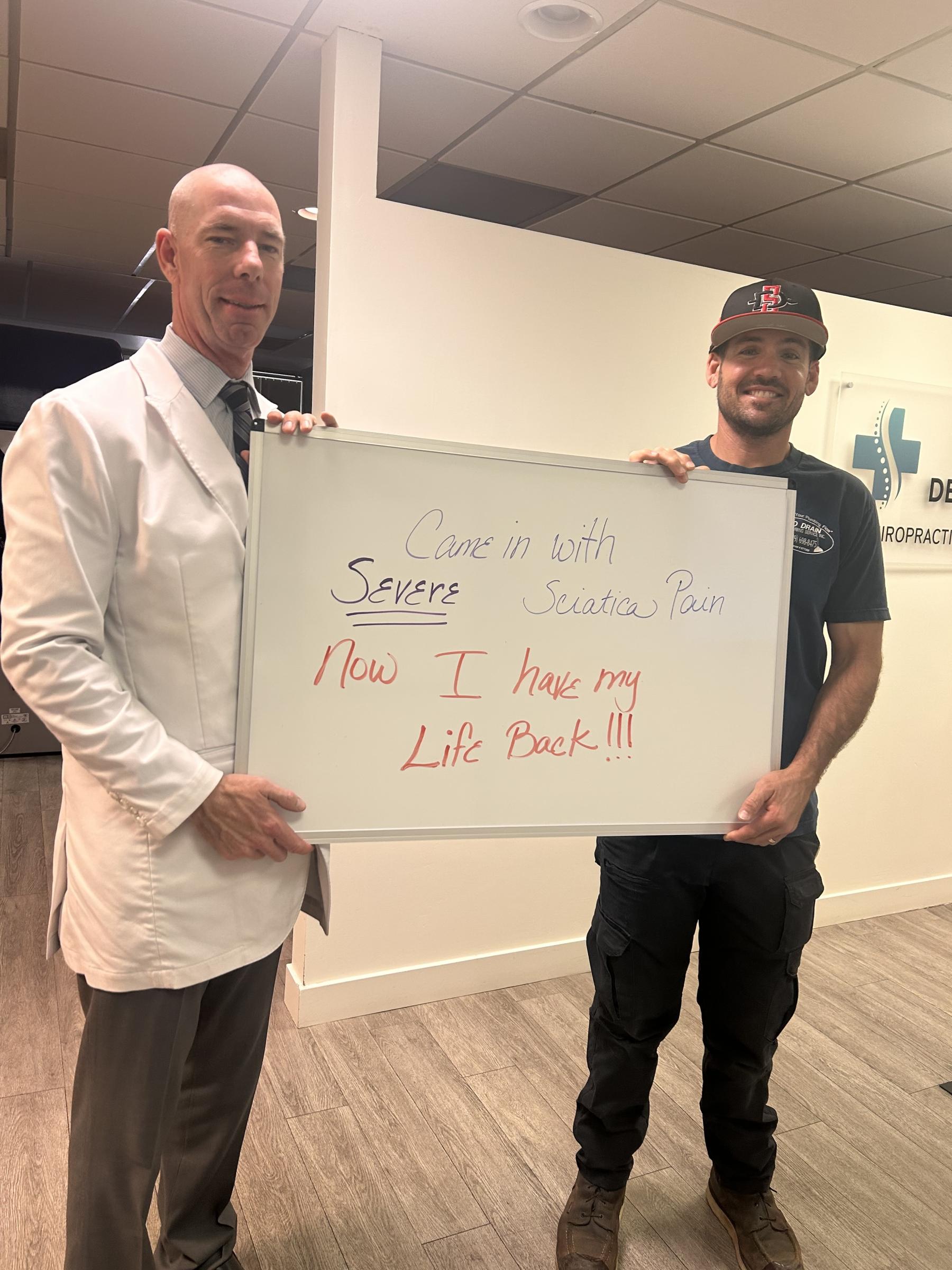
Why Is My Sciatica Not Going Away? Poway, CA
If your sciatica has been going on for a month, three months, six months or longer, at some point you start wondering why it isn't getting better.
A lot of patients who come to see Dr. Cassidy James Boelk, DC have already tried something. Often several things. Physical therapy, chiropractic care, medications, stretching, massage, acupuncture or an epidural injection. Some have been told to give it time. Others have an MRI showing a herniated disc and aren't sure what to do with that information.
What Dr. Boelk has found after more than 22 years of treating disc injuries and sciatica is that you have to get past the word sciatica.
Sciatica tells you what you're feeling. It doesn't necessarily tell you why you're feeling it.
A herniated or bulging lumbar disc is one possible cause. Degenerative changes and narrowing around a nerve can also be involved. Sometimes several things are happening at the same time.
And sometimes the biggest clue is simply listening carefully to what the patient says.
“I can walk, but I can't sit.”
“My back doesn't really hurt anymore, but my foot is still numb.”
“I feel pretty good in the morning, but by the afternoon my leg is on fire.”
“The injection worked great for a month. Then everything came back.”
Those details are important.
⭐⭐⭐⭐⭐ Michael Langsdale — San Diego, CA
“I have had a wonderful experience with Dr. Boelk and his staff at the Spinal Decompression and Chiropractic Center of San Diego. They have a great protocol and the best decompression machines. I’ve been to other places with sub par machines and didn’t get any benefit. Dr. Boelk is very attentive and cares about each person, you can see it in how he interacts with everyone. Been undergoing treatment for about 12 sessions now and the sciatica is gone and I’m almost back to normal, didn’t think it would ever heal but even after the first session I had tremendous relief and could sleep mostly pain free for the first time in months. Definitely worth the investment! Thank you!”
— Michael Langsdale, San Diego, CA
If you're in Poway and your sciatica isn't going away, Dr. Boelk offers a No-Charge, No-Obligation Consultation at The Spinal Decompression & Chiropractic Center of San Diego.
If you've had an MRI, bring it with you. Dr. Boelk prefers to see the actual images along with the report when possible.
5095 Murphy Canyon Road, Suite 300, San Diego, CA 92123
Phone: 619-298-0800
www.SanDiegoBackCare.com
Live 24/7 Answering Service • Hablamos Español
Your Back May Not Hurt Much at All
This throws people off.
If the problem is in the lower back, why does the calf hurt? Why is the foot tingling? Why does one buttock hurt every time you sit?
Because the location of the symptoms and the location of the problem aren't necessarily the same.
With sciatica, symptoms can travel along the course of an irritated nerve. Depending on the nerve involved, a patient may feel pain, burning, tingling or numbness in the buttock, thigh, calf, ankle, foot or toes.
Some patients have considerable lower-back pain along with it.
Some don't.
This is one reason Dr. Boelk asks patients to show him exactly where the symptoms travel rather than simply saying their sciatica is a 7 out of 10.
If you have an appointment coming up, pay attention to that yourself.
Where does it start? Where does it stop? Does it ever reach the foot? Which part of the foot? Is it pain, numbness, tingling, or all three?
You don't need to diagnose yourself. Just notice what's happening.
Sitting Can Tell You a Lot
A very common pattern with disc-related sciatica is difficulty sitting.
Someone may be able to walk around Costco without much trouble but can't drive 30 minutes without pain running down the leg.
Another patient feels pretty good at work because they move around all day, then sits on the couch at night and the leg starts burning.
If that's happening, don't ignore the pattern.
Breaking up long periods of sitting can be a simple place to start. Get up periodically. Walk for a few minutes if walking feels comfortable. On a longer drive, take a break when practical rather than sitting through increasing leg pain for hours.
Also look at your car seat. Some patients are sitting extremely low with the seat reclined and their lower back rounded the entire drive. A small change in position can sometimes make the drive more tolerable.
That doesn't fix a herniated disc. It simply means you aren't spending as much time in a position that clearly aggravates you.
And Stop Assuming Every “Sciatica Stretch” Is Good for You
This is one Dr. Boelk sees regularly.
The back of the leg feels tight, so the patient stretches the hamstring.
They feel pulling, burning or tingling down the leg and think, “Wow, I really need to loosen this up.”
Then they stretch harder.
An irritated sciatic nerve can feel tight too.
If a stretch causes symptoms to shoot farther down your leg, produces tingling in your foot or makes you noticeably worse afterward, don't keep forcing it just because it was labeled a sciatica stretch online.
The same applies to exercises.
There are excellent exercises for back pain and sciatica, but the right exercise depends on what is actually going on.
What About the MRI?
This is where things often start making more sense.
A patient may bring in an MRI that shows an L4-L5 protrusion, an L5-S1 herniation, degenerative changes, foraminal narrowing or spinal stenosis.
Sometimes there are findings at three or four levels.
That does not mean every finding on the MRI is causing pain.
Dr. Boelk reviews the images and compares them with the symptoms.
If someone has pain and numbness traveling into a particular part of the leg or foot, he wants to see whether there is something on the MRI that could reasonably affect the nerve supplying that area.
He also looks at where the disc material is located and how much room there is around the nerve.
This is why the millimeter measurement on the MRI report isn't the whole story.
Patients frequently come in worried because they have a 5 mm or 6 mm herniation. Size matters, but location matters too. A smaller disc protrusion sitting in the wrong place can potentially irritate a nerve significantly.
The MRI has to be put together with the person sitting in front of you.
If Something Helped Temporarily, That's Worth Talking About
Suppose an epidural injection reduced your sciatica by 80%, but the pain returned six weeks later.
That's worth knowing.
Maybe physical therapy improved your mobility but didn't change the numbness in your foot.
Maybe chiropractic treatment helped your back but the leg pain continued.
Maybe you were doing well until a certain exercise repeatedly flared everything up.
These aren't failed treatments that need to be dismissed. They are part of your history and can help Dr. Boelk understand how the condition has behaved.
The same goes for medication. If medication controls the symptoms but everything returns as soon as you stop taking it, mention that.
What Can You Do While You're Trying to Figure This Out?
Keep it simple.
If walking feels good, take comfortable walks.
If sitting makes you worse, break up your sitting time.
If a particular stretch sends pain or tingling farther down the leg, stop forcing it.
For sleep, try different positions. Many patients prefer lying on their side with a pillow between the knees. Others are more comfortable on their back with some support underneath the knees.
Most importantly, watch the trend.
Are you able to sit longer than you could two weeks ago?
Is the pain still going all the way into your foot?
Are you sleeping better?
Is the numbness changing?
Can you walk farther?
Those things often tell Dr. Boelk more than whether today's pain happened to be a 5 instead of a 6.
⭐⭐⭐⭐⭐ Rosa Algravez — Calexico, CA
“Hi my name is Rosa Algravez. I have suffered from leg numbness and low back pain for 4 years. I haven’t been able to do groceries or even take baths without pain. I looked for relief with various doctors with no luck. I have done treatments ranging from chiropractic to acupuncture. My husband found Dr. Boelk in the newspaper and we decided since we had tried everything else that we were going to give this a try. After my first few treatments, I feel as though I have returned to 100%. Life for me is completely different.
My husband and I have returned to enjoying life. We travel 300+ miles everyday from Calexico. I can do things now with little to no limitations. The staff makes you feel welcomed and it’s a very family environment. The payments are easy and I would recommend this to anyone suffering with low back pain. Thank You”
— Rosa Algravez, Age 58, Calexico, CA
Where Non-Surgical Spinal Decompression Comes In
Not every person with sciatica needs Non-Surgical Spinal Decompression.
But when the history, symptoms and imaging point toward a disc-related problem that is appropriate for decompression, it may be an option.
Dr. Boelk has been working with Non-Surgical Spinal Decompression for more than 22 years and has performed more than 100,000 treatments.
His office uses the DRX9000 exclusively, with four lumbar and three cervical systems.
One thing he feels strongly about is that decompression shouldn't be approached as simply putting someone on a machine and pushing a button.
The disc level matters. The treatment angle matters. Positioning matters. Starting force matters. How the patient responds matters.
Two patients can both walk in with “L4-L5 herniated disc and sciatica” written on their MRI reports and need different approaches.
That experience is also why Dr. Boelk founded the Non-Surgical Spinal Decompression Training Academy, where he trains other doctors in decompression protocols and techniques.
There Are Also Patients Dr. Boelk Will Not Treat
This is an important part of the evaluation.
An unhealed fracture, unstable spondylolisthesis, significant osteoporosis, abdominal aortic aneurysm, pregnancy for lumbar decompression, certain malignancies and certain spinal hardware can make someone inappropriate for treatment.
Previous spinal surgery has to be looked at carefully, particularly when hardware is present at the level that would need to be treated.
Dr. Boelk also pays close attention to neurological changes.
If a patient is developing progressive weakness, that isn't something to simply ignore while continuing conservative care.
Toni W. came to the office hoping decompression might be an option, but her previous surgery and hardware changed the recommendation.
⭐⭐⭐⭐⭐ Toni W. — Lake Elsinore, CA
“Very nice Dr. and Honest ! I would definitely recommend anyone who hasn't had metal put in there back in a surgery to go to him and give his program a shot. I believe it would definitely help. Just not in my personal case. As I have a lot of hardware in my back. But I'm glad I took the time to meet with him. It was very informative all around.”
— Toni W., Lake Elsinore, CA
Sometimes the most useful thing that happens during a consultation is finding out that decompression isn't the right treatment.
A Quick Word About Weakness, Numbness and Emergency Symptoms
Pain is miserable, but weakness gets Dr. Boelk's attention.
If your foot is starting to slap when you walk, you are having difficulty lifting the front of the foot, the leg is giving way, or you notice a meaningful loss of strength, get it evaluated.
And there are several symptoms that should not wait for a routine office appointment.
New bowel or bladder dysfunction, difficulty urinating, numbness around the groin or saddle region, or rapidly progressing weakness require prompt medical attention.
Why Dr. Boelk Chose to Focus on Disc Injuries
Dr. Boelk's interest in difficult back problems isn't purely academic.
He suffered an L5 compression fracture at age 16 and later dealt with disc injuries and sciatica himself. He spent thousands of hours over the years on his own rehabilitation and eventually made spinal decompression a major focus of his practice.
Today he is a Certified Spinal Decompression Doctor and Certified Pain-Free Performance Specialist, a Founding Member of the American Spinal Decompression Society and a member of the International Disc Education Association. He also holds California X-ray radiography credentials.
But for a patient sitting across from him with sciatica, the credentials aren't the starting point.
The starting point is figuring out what's wrong and whether he believes he can help.
If You're in Poway and the Sciatica Just Isn't Going Away
If you've been waiting for the leg pain to disappear and it hasn't, or you've already tried treatment and the relief hasn't lasted, it may be worth taking another look at the problem.
Bring your MRI images and report if you have them. Bring previous X-rays if they're available. Tell Dr. Boelk what you've tried and exactly what happened.
Dr. Boelk offers a No-Charge, No-Obligation Consultation to determine whether Non-Surgical Spinal Decompression may be an appropriate option.
And if he doesn't think you're a candidate, he'll tell you.
The Spinal Decompression & Chiropractic Center of San Diego
5095 Murphy Canyon Road, Suite 300
San Diego, CA 92123
Phone: 619-298-0800
www.SanDiegoBackCare.com
Live 24/7 Answering Service • Hablamos Español
Call 619-298-0800 to schedule a No-Charge, No-Obligation Consultation.