Can Spinal Decompression Help Sciatica Nerve Pain? Poway, CA
A lot of people with sciatica reach the same frustrating point.
They've rested. They've stretched. Maybe they've gone through physical therapy, chiropractic care, medications or an injection. The pain may have improved for a while, but then a long drive, workout, day at work or seemingly ordinary movement brings it right back.
Eventually the question becomes:
Is there something else I can do before considering more invasive treatment?
For certain patients, Non-Surgical Spinal Decompression may be worth considering.
Dr. Cassidy James Boelk, DC has more than 22 years of experience with Non-Surgical Spinal Decompression and has performed more than 100,000 decompression treatments. He regularly evaluates patients with sciatica associated with lumbar disc herniations, disc bulges, degenerative disc changes and narrowing around the spinal nerves.
But having sciatica doesn't automatically make someone a candidate.
Dr. Boelk first wants to understand what is irritating the nerve and whether decompression makes sense for that particular problem.
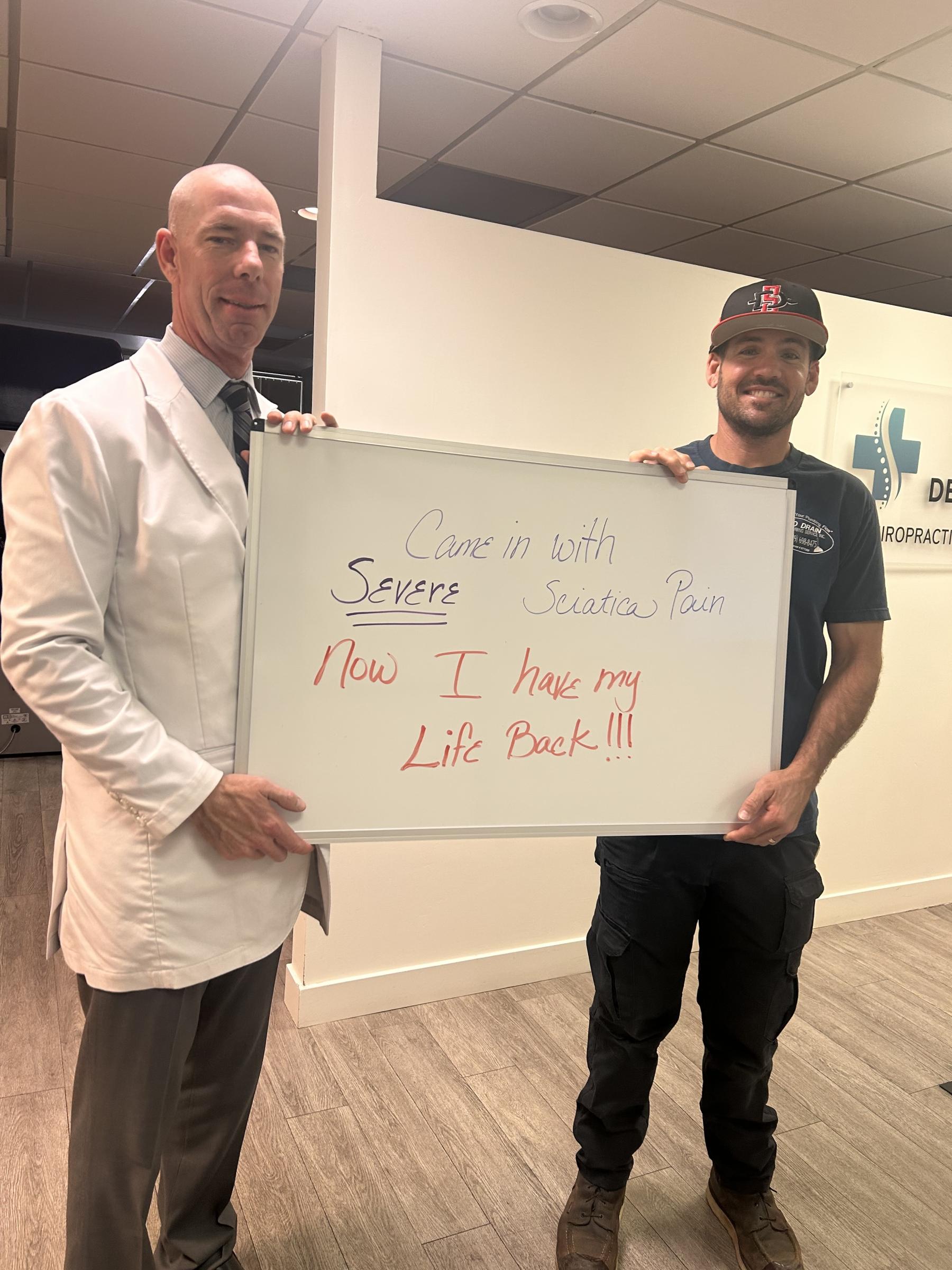
⭐⭐⭐⭐⭐ Brian Perrotta — San Diego, CA
“I highly recommend Dr. Cassidy Boelk, DC and the team at The Spinal Decompression and Chiropractic Center. I came in with severe sciatica and a herniated disc, and his treatments have made a world of difference. He and his staff are both professional and genuinely caring, creating a welcoming and supportive environment. The treatments were not only highly effective but also tailored to my specific needs. I’m grateful for the care I received and the significant improvement in my quality of life.”
— Brian Perrotta, San Diego, CA
If You're in Poway and Dealing With Sciatica, Start With the Cause
Dr. Boelk offers a No-Charge, No-Obligation Consultation for patients who want to find out whether Non-Surgical Spinal Decompression may be an option.
If you've already had an MRI, bring the images and report with you.
Don't have an MRI? That's okay too.
The consultation is an opportunity to discuss what you're feeling, where the symptoms travel, how long they've been present and what you've already tried.
The Spinal Decompression & Chiropractic Center of San Diego
5095 Murphy Canyon Road, Suite 300
San Diego, CA 92123
Phone: 619-298-0800
www.SanDiegoBackCare.com
Live 24/7 Answering Service • Hablamos Español
Sciatica Can Feel Very Different From One Person to Another
One patient describes a sharp line of pain from the buttock into the calf.
Another doesn't have much pain at all anymore. Their biggest problem is numbness in the foot.
Someone else feels fine standing but can't sit in the car for more than 20 minutes.
Another person can sit comfortably but develops leg pain every time they walk a certain distance.
These aren't minor details.
When Dr. Boelk evaluates someone with sciatica, he wants to know exactly what happens during an ordinary day.
Can you put your shoes on?
Can you sleep?
What happens when you drive?
Can you walk around the grocery store?
What happens when you bend forward?
Does coughing or sneezing bother the leg?
Where exactly is the numbness?
Has the leg become weaker?
The answers help build a much clearer picture than the word “sciatica” alone.
A Herniated Disc Is One Possible Reason
A lumbar disc can bulge or herniate into an area near a spinal nerve.
When that nerve becomes irritated or compressed, symptoms can travel away from the lower back and into the buttock, thigh, calf or foot.
L4-L5 and L5-S1 are common areas where Dr. Boelk sees disc problems associated with leg symptoms.
That doesn't mean every abnormal L4-L5 or L5-S1 disc seen on an MRI is causing pain.
People can have multiple abnormalities on the same MRI.
Dr. Boelk may see degenerative changes at one level, a disc bulge somewhere else and a more significant herniation at another.
The question is which finding, if any, corresponds with the patient's symptoms.
That's why he prefers to review the actual MRI images whenever they're available rather than relying only on the written report.
What Is the DRX9000 Doing?
The Spinal Decompression & Chiropractic Center of San Diego uses the DRX9000 exclusively.
Dr. Boelk's office has seven systems: four lumbar and three cervical.
For lumbar treatment, the patient is positioned on the DRX9000 and the system applies controlled decompression and relaxation cycles.
Treatment is generally comfortable, and many patients find the sessions relaxing.
But there is an important distinction between having a decompression machine and knowing how to use decompression appropriately.
After more than 100,000 treatments, Dr. Boelk doesn't use one generic protocol for every patient who walks through the door with sciatica.
He considers the level being treated, treatment angle, positioning, starting force, the patient's size, symptoms and tolerance.
Then he watches how the patient responds.
The treatment can be modified as the patient's condition changes.
You Should Be Able to Describe More Than “It Still Hurts”
If you're trying to determine whether your sciatica is improving, look at your daily life.
Suppose three weeks ago you couldn't sit for more than 15 minutes.
Now you can sit for 45.
That's worth noticing.
Maybe the pain used to travel all the way into your toes, but now you're mostly feeling it around the buttock and thigh.
Maybe you slept through the night for the first time in months.
Maybe you walked farther than usual without thinking about your leg.
Or perhaps nothing is changing.
That's useful information too.
Dr. Boelk wants patients paying attention to these changes because pain doesn't always improve in a perfectly straight line.
Stop Testing the Nerve All Day Long
This is something patients sometimes do without realizing it.
They wake up and bend forward to see whether the pain is still there.
Then they stretch the hamstring.
An hour later they raise the leg again.
Later they bend over and touch their toes to “check” the sciatica.
By the end of the day, they've repeatedly reproduced the exact movement that irritates the nerve.
You don't need to spend the day proving to yourself that your leg still hurts.
If a particular movement consistently produces burning, electrical pain, numbness or tingling down the leg, pay attention to that.
The same goes for stretching.
A tight sensation behind the thigh doesn't necessarily mean the hamstring needs to be aggressively stretched. Nerve irritation itself can produce a pulling or tight sensation.
Keep Moving—Within Reason
Sciatica doesn't automatically mean you should lie in bed until everything goes away.
If walking is comfortable, short walks can be a simple way to keep moving.
If sitting is the problem, break up long periods in the chair.
For someone commuting between Poway and central San Diego, the drive itself may be one of the biggest aggravating factors of the day. If that's you, pay attention to your seat position and take breaks when practical on longer drives.
For sleep, some people are more comfortable on their side with a pillow between their knees. Others prefer lying on their back with support underneath the knees.
You don't need 20 new exercises.
You need to know which activities your body is tolerating and which ones are consistently making the neurological symptoms worse.
“My MRI Looks Terrible. Does That Mean I Need Surgery?”
Not necessarily.
An MRI can contain a long list of findings, and reading the report by yourself can be unsettling.
Disc desiccation. Disc protrusion. Extrusion. Foraminal narrowing. Degenerative changes. Facet arthropathy. Stenosis.
The words add up quickly.
Dr. Boelk looks at the images in the context of the patient.
What is actually happening around the nerve?
Does it correspond with the side and location of the symptoms?
How is the patient functioning?
Is there neurological weakness?
What has already been tried?
There are certainly patients who need a surgical evaluation. There are others who may still have reasonable conservative options.
The MRI is an important piece of the decision, but it isn't the entire decision.
⭐⭐⭐⭐⭐ Calder Pearce — San Diego, CA
“Dr. Boelk and his team are the best in the business! I have had lower back problems for over 5 years and been to 6 other doctors seeking options other than surgery. I came in early January not able to bend and walking with a limp. By February I was able to bend again with minimal pain and by March I am now able to bend without any pain and am able to walk normally.
I am EXTREMELY happy I did not have surgery and found Dr. Boelk. Trust him and the process and he will get you feeling better. He also said from the beginning that if at any stage in the process he felt like progress wasn't happening he would let me know which was not the case with other specialist I have seen in the past so I appreciate that.”
— Calder Pearce, San Diego, CA
Who Shouldn't Have Non-Surgical Spinal Decompression?
This is just as important as discussing who may benefit.
There are patients Dr. Boelk will not treat with decompression.
An unhealed fracture, significant osteoporosis, unstable spondylolisthesis, abdominal aortic aneurysm, pregnancy for lumbar decompression, certain malignancies and other conditions may make treatment inappropriate.
Previous spinal surgery requires careful review as well, particularly when hardware or a fusion is present at the level that would need to be treated.
Sometimes the best recommendation is to wait.
Sometimes another specialist needs to be involved.
And sometimes decompression simply isn't the right treatment.
⭐⭐⭐⭐⭐ Jan H. — San Marcos, CA
“I decided to see Dr. Boelk after a pretty gnarly motocoss neck injury. At the Hospital I was at, I felt I was getting pressured into a surgery which I refused. A friend of a friend referred him after Dr. Boelk successfully treated his broken back.
Dr. Boelk is a compassionate individual who truly cares about his patients. He looked at my MRI images, explained what he saw and potential routes for recovery. He could not treat me as I have to wait until the fracture in my neck heals, but the level of professionalism, compassion, caring and knowledge displayed by him was exceptional.
He also recommended to seek an additional opinion form another neurosurgeon. My experience was that he really cares and he's not someone who would take advantage of the situation someone's in (unlike some other doctors). I will definitely be back and already recommended him to others as well! Thank you Dr. Boelk!”
— Jan H., San Marcos, CA
That is what candidacy is supposed to mean.
It's not about finding a reason to put everyone on the DRX9000. It's determining whether the treatment makes sense for the individual patient.
Don't Wait on Progressive Weakness
There is a big difference between a painful leg and a leg that is progressively losing strength.
Tell your healthcare provider if you're noticing changes such as the foot beginning to slap when you walk, increasing difficulty lifting the foot or toes, the leg repeatedly giving way, or a meaningful difference in strength from one side to the other.
And there are certain symptoms that require prompt medical attention rather than waiting for a routine decompression consultation.
These include new bowel or bladder dysfunction, difficulty urinating, numbness around the groin or saddle area, or rapidly progressing weakness.
More Than Two Decades Working With Spinal Decompression
Dr. Boelk's interest in spinal injuries started with his own.
He suffered an L5 compression fracture at age 16 and later experienced disc injuries and sciatica.
Over the years, that developed into a professional focus on Non-Surgical Spinal Decompression and rehabilitation.
Dr. Boelk is a Certified Spinal Decompression Doctor and Certified Pain-Free Performance Specialist. He founded the Non-Surgical Spinal Decompression Training Academy, where he trains other doctors in decompression protocols and techniques.
He is a Founding Member of the American Spinal Decompression Society, a member of the International Disc Education Association, and holds California X-ray radiography credentials.
Today, after more than 22 years and more than 100,000 decompression treatments, he still starts in the same place:
Is this patient actually a good candidate?
Find Out if Spinal Decompression May Be an Option for Your Sciatica
If you live in Poway and sciatica is interfering with work, driving, sleep, exercise or everyday life, bring your MRI images and report if you have them.
Dr. Boelk can review your symptoms, history and imaging and discuss whether Non-Surgical Spinal Decompression may be an appropriate option.
If you don't have an MRI, you can still schedule a consultation.
Not every patient is a candidate. If Dr. Boelk doesn't believe decompression is appropriate for your condition, he'll tell you.
No-Charge, No-Obligation Consultation
The Spinal Decompression & Chiropractic Center of San Diego
5095 Murphy Canyon Road, Suite 300
San Diego, CA 92123
Phone: 619-298-0800
www.SanDiegoBackCare.com
Live 24/7 Answering Service • Hablamos Español
Call 619-298-0800 to schedule your No-Charge, No-Obligation Consultation.