Why Is My Sciatica Worse in the Morning? | La Jolla, CA
If your sciatica is at its worst when you first get out of bed, you are not alone.
Some patients describe the first 15 or 20 minutes of the morning as the hardest part of their day. The lower back feels stiff, pain runs into the buttock or leg, or the foot may feel numb or tingly. Bending forward to put on socks and shoes can be especially uncomfortable.
Then, after a shower, a little walking and some normal movement, the symptoms may begin to settle down.
Dr. Cassidy James Boelk, DC has treated patients with lumbar disc injuries and sciatica for more than 22 years and has performed more than 100,000 spinal decompression treatments. When a patient tells him that the pain is consistently worse first thing in the morning, he pays attention to that pattern.
It does not automatically mean the patient has a herniated disc. But in someone with a disc injury or irritated lumbar nerve, there are several reasons mornings may be particularly difficult.
Ten Years of Back Pain and Sciatica
Toni H. had been dealing with sciatica and back pain for 10 years before coming to The Spinal Decompression & Chiropractic Center of San Diego.
“For the first time in 10 years, I am completely pain-free. My sciatca is gone, and I no longer have back pain.
Before finding Dr. Boelk, I tried chiropractic care, acupuncture, pain medications, and several other therapies that simply didn't work. I was one step away from back surgery when I discovered spinal decompression treatment at The Spinal Decompression & Chiropractic Center of San Diego.
The results have been incredible. Every visit was comfortable, relaxing, and completely pain-free. Dr. Boelk and Patty always took the time to explain everything and made me feel genuinely cared for throughout the process.
They are warm, welcoming, and truly dedicated to helping their patients.
Thank you, Dr. Boelk and Patty!”
— Toni H., San Diego, CA
Start With a No-Charge Consultation
If sciatica is making it difficult to get out of bed, put on your shoes, drive, work, walk or exercise, patients from La Jolla can begin with a No-Charge, No-Obligation Consultation with Dr. Cassidy James Boelk, DC.
The purpose of the consultation is not to assume that you need spinal decompression. It is to understand what has been happening and determine whether your condition appears appropriate for the type of care provided in the office.
During the consultation, Dr. Boelk may review:
-
When and how the symptoms began
-
Where the pain starts and how far it travels
-
Numbness, tingling or burning in the leg or foot
-
Any changes in leg or foot strength
-
What the symptoms are like when you first get out of bed
-
Whether the symptoms improve after you begin moving
-
How sitting, driving, standing, walking and bending affect you
-
What treatment you have already tried and how you responded
-
Existing MRI images, X-rays and radiology reports
-
Whether the imaging findings correspond with your symptoms
-
Whether further examination or imaging may be appropriate
-
Whether Non-Surgical Spinal Decompression may be an option
-
What Dr. Boelk believes would be an appropriate next step
If you already have a lumbar MRI, bring the actual images along with the radiology report. Dr. Boelk prefers to review the images himself rather than relying only on the written report.
If you do not have an MRI, you can still schedule the consultation.
There is no obligation to begin treatment. Not every patient is a candidate for Non-Surgical Spinal Decompression, and if Dr. Boelk believes another approach is more appropriate, he will tell you.
Dr. Boelk personally performs these consultations and reviews each patient's available imaging. Because of the time involved, a limited number of No-Charge Consultation appointments are available within the weekly clinic schedule.
Call 619-298-0800 to ask about the next available consultation.
Why Can Sciatica Be Worse When You First Wake Up?
One possible reason involves what happens to the discs in your lower back while you sleep.
The spinal discs contain a significant amount of water. During a normal day of sitting, standing and moving, the discs are subjected to loading and gradually lose some fluid. While you are lying down for several hours at night, that loading is reduced and the discs rehydrate.
That is a normal process.
If a lumbar disc is already irritated, bulging or herniated, however, changes in hydration and pressure may be one factor contributing to why some patients with disc-related pain notice greater sensitivity after several hours of sleep.
This does not mean that waking up with sciatica proves you have a disc herniation. Morning symptoms are one part of a much larger clinical picture.
Dr. Boelk also wants to know what happens next.
Does the pain begin improving after five or ten minutes of walking?
Does the back loosen up while numbness remains in the foot?
Does the pain become worse when you sit down for breakfast?
Does bending forward immediately send pain farther down the leg?
Those details can be very useful.
The Problem May Be What Happens Right After You Get Out of Bed
The first half hour of the morning often involves a surprising amount of bending.
You get out of bed, bend forward to put on clothing, reach toward the floor for socks, bend again to put on shoes, lean over the bathroom sink and perhaps pick things up around the house.
For a healthy lower back, none of that is particularly remarkable.
For someone with an irritated lumbar disc or nerve, repeatedly bending forward immediately after several hours of sleep may be much less comfortable.
A patient may tell Dr. Boelk that standing and walking in the morning actually feels reasonably good, but the moment they sit down and bend forward to put on a shoe, the pain shoots into the leg.
That is useful information.
It does not mean bending is inherently bad. Bending is a normal part of life. The issue is whether a particular movement is repeatedly provoking an already irritated nerve.
What Should You Do When You First Get Out of Bed?
There is no single morning routine that works for every person with sciatica, because the underlying cause of the symptoms can be different.
A reasonable starting point is to avoid making the first movement of the day a forceful sit-up or an aggressive stretch.
Instead, roll onto your side and use your arms to help yourself come upright. Once standing, give your body a few minutes to begin moving.
Some patients tolerate a short, comfortable walk better than immediately sitting down and performing a long stretching routine.
When putting on socks and shoes, bringing the foot toward you may be more comfortable than repeatedly folding the entire torso toward the floor.
Pay attention to what happens to the leg symptoms.
If something causes pain to travel farther down the leg or noticeably increases tingling or numbness, that response is worth paying attention to rather than repeatedly forcing the movement.
Your “Tight Hamstring” May Not Just Be a Tight Hamstring
This is particularly relevant in the morning.
Patients with sciatica often wake up feeling extremely tight through the back of the thigh or calf. The natural response is to stretch.
Sometimes that is fine.
But an irritated sciatic nerve can create a pulling or tight sensation that feels similar to muscular tightness.
If you bend forward into a hamstring stretch and feel a normal stretch through the muscle without increasing your neurological symptoms, that is one thing.
If the same movement causes burning, tingling or pain to shoot farther toward the calf or foot, that is different.
Repeatedly stretching harder because the leg “still feels tight” may not address what is actually causing the sensation.
Does Sleeping Position Matter?
It can.
Some patients with sciatica are more comfortable sleeping on their side with their knees slightly bent. Others prefer sleeping on their back with support beneath the knees.
There is no single sleeping position that is best for every lumbar condition.
What Dr. Boelk wants to know is what happens to you.
Can you sleep through the night without pain?
Does lying on one side consistently cause the leg to hurt?
Do you feel good while lying down but develop symptoms almost immediately after standing?
Does the pain wake you after several hours and force you to change position or get out of bed?
Those patterns can help provide a better understanding of the problem.
When Morning Sciatica Is Happening Every Day
Waking up stiff after an unusually active day is one thing.
Waking with pain traveling down the leg every morning for weeks or months is different.
The same is true for persistent numbness.
Weakness deserves even more attention. If one leg or foot is becoming noticeably weaker, you are beginning to catch your toes while walking, or lifting the front of the foot is becoming more difficult, the condition should be evaluated rather than simply continuing the same home stretches indefinitely.
Rapidly progressing weakness, new bowel or bladder dysfunction, difficulty urinating, or numbness involving the groin or saddle region requires prompt medical attention rather than waiting for a routine spinal decompression consultation.
When Non-Surgical Spinal Decompression May Be an Option
When sciatica is associated with an appropriate lumbar disc or degenerative condition, Non-Surgical Spinal Decompression may be considered as a conservative treatment option.
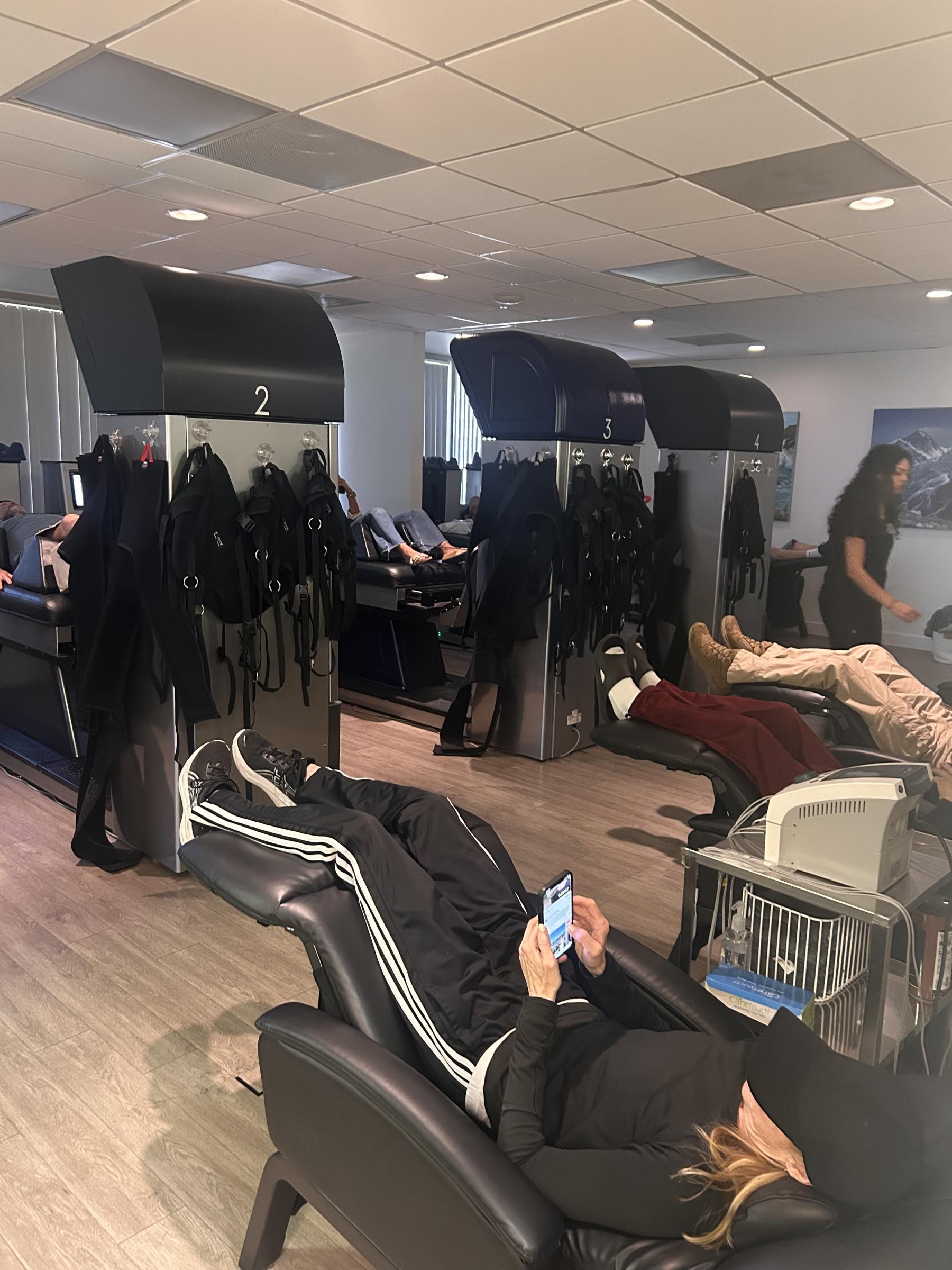
The Spinal Decompression & Chiropractic Center of San Diego uses the DRX9000 exclusively, with four lumbar and three cervical systems.
Treatment is not based simply on seeing the words “disc bulge” or “disc herniation” on an MRI report.
Dr. Boelk considers the location of the disc problem, the patient's symptoms, neurological findings, treatment level, positioning, angle, starting force, body size, tolerance and response to care.
Candidacy comes first.
An unhealed fracture, significant osteoporosis, unstable spondylolisthesis, abdominal aortic aneurysm, pregnancy for lumbar decompression, certain malignancies and other conditions may make treatment inappropriate. Previous spinal surgery also requires careful evaluation, particularly when fusion or metal hardware is present at the level that would need to be treated.
There are patients who come to the office expecting to begin spinal decompression and are told not to proceed.
Sometimes the Right Decision Is Not to Treat
Jeff J. traveled from Tucson, Arizona to meet with Dr. Boelk about his back condition. After reviewing his situation, they determined that spinal decompression was not the appropriate option.
“I found this terrific practice on social media. I followed up and did my own research so I decided to pay them a visit. The place is clean, well organized and run by a very efficient receptionist. I met with the doctor and after a honest and forthright conversation, we both determined that surgery was my only option to correct my back issues. I will return as a customer when the time is right.”
— Jeff J., Tucson, AZ
That consultation did not result in a decompression treatment plan, but it did result in a clearer direction.
Patient selection is an important part of responsible spinal decompression care. There are circumstances where another conservative approach makes more sense, additional diagnostic evaluation is needed, or a surgical opinion is appropriate.
Patients Travel to San Diego for Disc and Sciatica Care
Although the office is located in San Diego, some patients travel from considerably farther away for an evaluation and treatment.
For an out-of-town patient, the process begins the same way: Dr. Boelk needs to understand the condition and determine whether the patient appears to be an appropriate candidate before recommending treatment.
Patients traveling from outside San Diego should bring any available MRI images, X-rays and reports. Depending on the situation, records and imaging may also be reviewed as part of determining the appropriate next step.
The objective is not to have someone travel a long distance simply because they have sciatica. It is to determine whether their particular condition fits the type of care provided by the office.
About Dr. Cassidy James Boelk, DC
Dr. Cassidy James Boelk, DC has more than 22 years of experience with Non-Surgical Spinal Decompression and has performed more than 100,000 spinal decompression treatments.
His professional background includes:
-
Doctor of Chiropractic (DC)
-
Certified Spinal Decompression Doctor
-
Certified Pain-Free Performance Specialist (PPSC)
-
Founder, Non-Surgical Spinal Decompression Training Academy
-
Trains other doctors in spinal decompression protocols and techniques
-
Founding Member, American Spinal Decompression Society
-
Member, International Disc Education Association
-
California X-Ray Radiation Supervisor & Operator
His experience with spinal injuries is also personal. Dr. Boelk suffered an L5 compression fracture at age 16 and later dealt with disc injuries and sciatica himself. His own experience with injury and rehabilitation has influenced his approach to helping patients remain active while dealing with significant spinal problems.
Morning Sciatica Help for La Jolla Patients
If every morning starts with the same routine—slowly getting out of bed, avoiding certain movements, struggling to put on your shoes and waiting for the leg pain to calm down—it may be time to find out why it keeps happening.
Patients from La Jolla can begin with a No-Charge, No-Obligation Consultation with Dr. Cassidy James Boelk, DC.
If you already have an MRI, bring the actual images and report. If you do not have imaging, you can still schedule the consultation.
There is no obligation to begin treatment, and not every patient is accepted for Non-Surgical Spinal Decompression.
Because Dr. Boelk personally conducts these consultations and reviews the patient's available imaging, only a limited number of new-patient consultation appointments are available during the weekly clinic schedule.
Call 619-298-0800 to ask about the next available No-Charge Consultation.
The Spinal Decompression & Chiropractic Center of San Diego
5095 Murphy Canyon Road, Suite 300
San Diego, CA 92123
619-298-0800
SanDiegoBackCare.com
Live 24/7 Answering Service • Hablamos Español