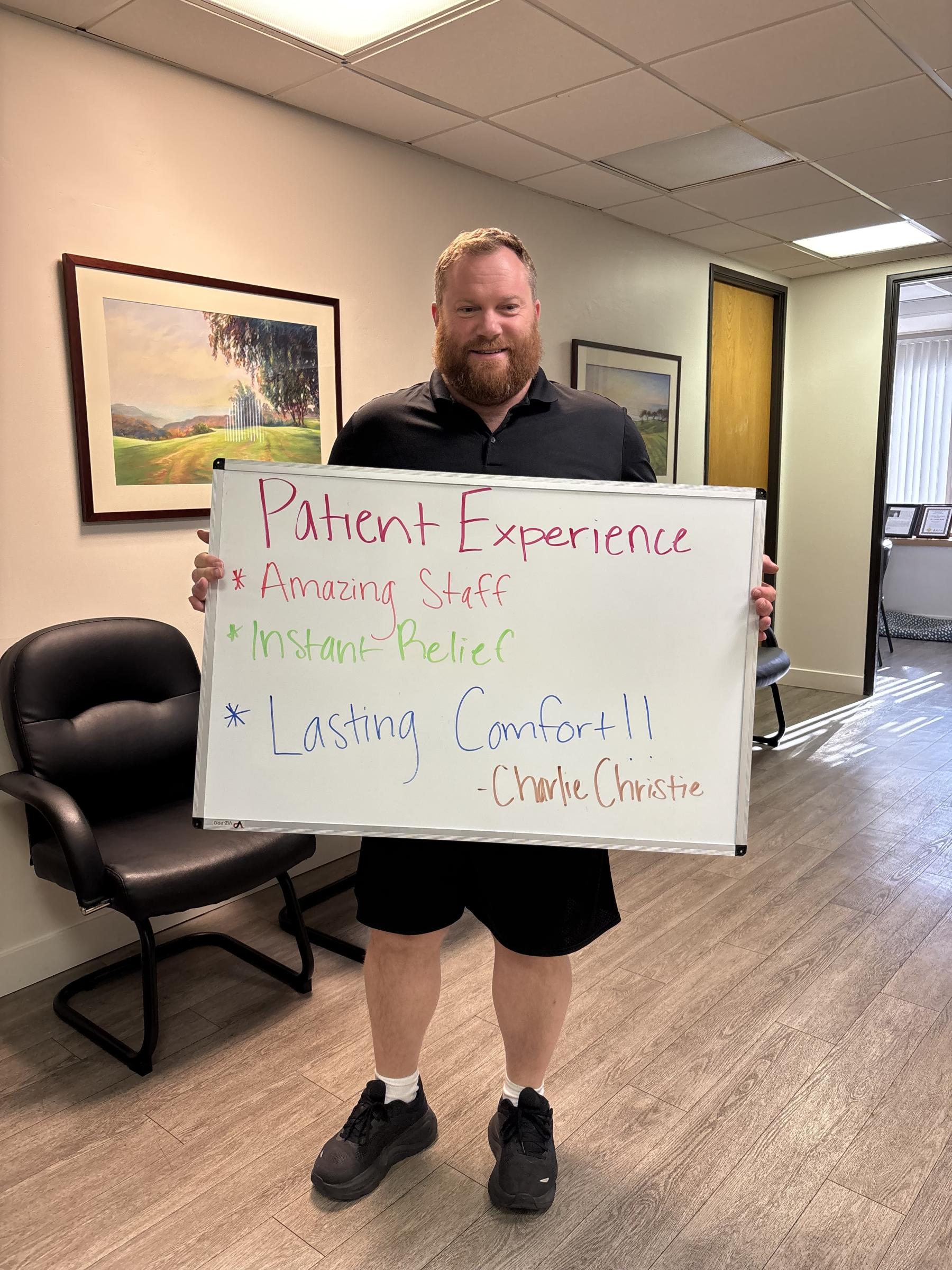
Why Is My Sciatica Not Going Away? La Jolla, CA
One of the more frustrating things about sciatica is that it can hang around much longer than people expect.
A patient may come in and say, “My back is actually better, but I still have this pain going down my leg.”
Another may have almost no back pain at all. Their problem is burning in the calf, tingling in the foot, or pain in the buttock every time they sit or drive.
Some have been dealing with it for three weeks. Others have been dealing with it for six months or longer and have already tried physical therapy, chiropractic treatment, medications, injections, stretching, massage or simply waiting for it to go away.
Dr. Cassidy James Boelk, DC has been treating patients with disc injuries and sciatica for more than 22 years. When sciatica isn't improving, he doesn't automatically assume the patient needs another treatment.
He wants to know why the nerve is still being irritated.
That usually starts with listening to the patient and, when available, looking at the actual MRI images.
⭐⭐⭐⭐⭐ Renee Hotchkiss
“I had severe sciatic pain a few years ago. I followed his recommended treatment and was out of pain after the first visit; there was light at the end of the tunnel. I see him now every 6 or 8 weeks, and it is keeping my pain at bay. The therapy itself is relaxing, and I always feel a little more human when I leave. I highly recommend Dr. Boelk, his team and his health approach.”
If Your Sciatica Isn't Going Away, Bring Your MRI and Let's Look at It
Dr. Boelk offers a No-Charge, No-Obligation Consultation for La Jolla and San Diego patients who want to find out what may be behind their ongoing sciatica.
If you already have an MRI, bring the images and the report. Don't worry if you don't understand the terminology in the report. Most patients don't.
And if you haven't had an MRI, you can still come in.
The consultation gives Dr. Boelk a chance to hear what has been happening, review any imaging you already have, and determine whether Non-Surgical Spinal Decompression may be an option or whether something else should be investigated.
The Spinal Decompression & Chiropractic Center of San Diego
5095 Murphy Canyon Road, Suite 300
San Diego, CA 92123
Phone: 619-298-0800
www.SanDiegoBackCare.com
Live 24/7 Answering Service • Hablamos Español
First, Where Does the Pain Actually Go?
This is one of the first things Dr. Boelk wants to know.
Don't just say, “My sciatica hurts.”
Show him where it goes.
Does it start in the lower back and move into the buttock?
Does it run down the back or side of the thigh?
Does it reach the calf?
Does your heel hurt?
Do you feel tingling across the top of your foot?
Are certain toes numb?
Is there burning in the leg even though your back feels pretty good?
Those details can be much more useful than simply giving the pain a number from 1 to 10.
Sciatica is a symptom pattern. Something is irritating a nerve, and the location of those symptoms can provide clues about where the problem may be coming from.
Sometimes the Back Pain Improves Before the Leg Does
This confuses a lot of patients.
They think:
“My back is better. Why is my leg still hurting?”
The nerve can remain irritated even when the pain in the lower back has settled down.
That is why Dr. Boelk pays close attention to changes in the leg.
If the pain used to travel all the way into the foot and now stops around the buttock or thigh, that may be an important change.
If the opposite is happening—pain that was originally around the back and buttock is now traveling farther down the leg into the calf and foot—that is something he wants to know too.
Sitting Is a Big Clue
A very common story in the office sounds something like this:
“I feel pretty good when I'm moving around, but I can't sit.”
Or:
“I can sit for a little while, but driving kills me.”
For some people with disc-related sciatica, prolonged sitting can be especially aggravating.
If that sounds like you, start paying attention to time.
Can you sit for 10 minutes before the leg starts hurting?
Thirty minutes?
An hour?
Does getting up and walking relieve it?
Does sitting on your couch bother you more than sitting in a firmer chair?
Does your car bother you more than your office chair?
Those are useful things to know.
If sitting is clearly aggravating the problem, try not to spend hours in the same position. Get up periodically and move around. If you're taking a longer drive and can safely stop, getting out and walking briefly may help.
You don't have to spend the entire day lying down, either.
For many patients, that isn't the answer.
Be Careful About Stretching the Heck Out of Your Leg
This is something Dr. Boelk sees quite a bit.
The back of the leg feels incredibly tight, so the patient starts stretching the hamstring over and over.
Sometimes they are stretching aggressively because they assume the tighter it feels, the more it needs to be stretched.
But an irritated sciatic nerve can also create that pulling, tight or uncomfortable sensation.
If you stretch and feel a normal muscular pull, that's one thing.
If stretching produces burning, tingling, electrical pain or sends the symptoms farther down toward your foot, pay attention to that.
Don't automatically assume you need to stretch harder.
Your MRI Report May Not Tell the Whole Story
A patient may arrive with an MRI report that says something like:
L3-L4: disc bulge.
L4-L5: disc protrusion with foraminal narrowing.
L5-S1: degenerative disc disease.
Then they ask the obvious question:
“Which one is causing my sciatica?”
Sometimes the answer becomes clearer when the images are compared with the patient's symptoms.
Dr. Boelk likes to see the actual MRI images when possible, not just the written report.
A disc problem at L4-L5 may be important in one patient and not particularly important in another.
The same applies to L5-S1.
What is happening around the nerve? Is there room around it? Where is the disc material located? Do the patient's symptoms make sense with what is visible on the scan?
That is much more useful than simply seeing the words “disc bulge” and assuming that is the answer.
And Don't Panic Over the Millimeters
Patients regularly come in knowing the exact size of their herniation.
“My disc is 5 millimeters.”
They understandably think that means it must be severe.
The measurement is useful, but it doesn't tell the whole story.
A smaller protrusion in the wrong place can potentially irritate a nerve considerably. A larger abnormality may look dramatic on the report without producing the same symptoms.
Dr. Boelk looks at the size, but he also looks at the location and what is happening around the nerve.
Why Did the Injection Help and Then Wear Off?
Tell Dr. Boelk if that happened.
The same goes for physical therapy, chiropractic treatment or medication.
What happened after the treatment can be useful information.
Maybe an epidural took away most of the leg pain for several weeks and then it gradually returned.
Maybe chiropractic care helped the back pain but didn't change the numbness in the foot.
Maybe physical therapy was going well until one particular exercise repeatedly aggravated the leg.
Maybe medication works, but only while you're taking it.
Don't dismiss those treatments as simply “worked” or “didn't work.”
Explain what changed.
Sciatica Can Become a Pretty Big Deal
Yuri Fresia described reaching the point where sciatica had kept him away from surfing, jiu jitsu and work for months.
⭐⭐⭐⭐⭐ Yuri Fresia
“When I first came here I was suffering from sciatica pain for several months non stop. I tried many different non invasive treatments, pain killers but relief was just temporary. I heard about Dr. Boelk on social media and after reading other people testimonials about him I decided to try. It felt better since my first session. After 12 I felt I was improving a lot but still had room to get better so we decided trying 12 more. After 36 sessions I felt I was back to normal. I could get back to surf, jiu jitsu and work after 6 months away. Doctor helped me through the whole process, leaving me free to decide the next step and being honest about expectations. I totally recommend for all my friends that suffer from sciatica pain. It’s worth 100%.”
There May Be More Going On Than a Herniated Disc
Sometimes the MRI shows a straightforward disc problem.
Sometimes it doesn't.
A patient may have degeneration and loss of disc height along with a bulge. There may be narrowing where the nerve exits the spine. There may be spinal stenosis or several levels showing wear.
This becomes especially important when sciatica has been present for a long time or keeps coming back.
It may be time to look again at the diagnosis rather than repeating the same treatment indefinitely.
A Simple Thing You Can Do Before Your Appointment
For the next few days, just observe your symptoms.
You don't need a complicated journal.
Pay attention to:
-
Where the symptoms start
-
How far down the leg they go
-
What happens when you sit
-
What happens when you walk
-
Whether driving is worse than sitting at home
-
Whether coughing or sneezing changes the pain
-
Which exercises help
-
Which exercises make the pain travel farther down the leg
-
Whether numbness is constant or intermittent
-
Whether you've noticed weakness in the leg or foot
-
Which position lets you sleep most comfortably
Those details can be surprisingly helpful during an evaluation.
If walking feels comfortable, short walks may be reasonable.
For sleep, some people with sciatica prefer lying on their side with a pillow between the knees. Others feel better on their back with a pillow or support beneath the knees.
The important part is noticing what your body is telling you rather than forcing yourself into an exercise or position because somebody online said it is the “best” one for sciatica.
Where Does Spinal Decompression Fit?
If the history, examination and imaging suggest that the sciatica is related to a disc problem or another spinal condition that may respond to decompression, Dr. Boelk may recommend Non-Surgical Spinal Decompression.
His office exclusively uses the DRX9000 and has seven systems—four lumbar and three cervical.
Dr. Boelk doesn't treat every patient with the same setup.
Disc level, treatment angle, positioning, starting force, body size, symptoms and the patient's response can all affect how treatment is performed.
He has spent more than 22 years working with Non-Surgical Spinal Decompression and has performed more than 100,000 decompression treatments.
He also trains other doctors in spinal decompression protocols and techniques through the Non-Surgical Spinal Decompression Training Academy.
But Some Sciatica Patients Shouldn't Be on a Decompression Table
This is why the consultation comes first.
Certain conditions can make lumbar decompression inappropriate or require additional evaluation, including an unhealed fracture, unstable spondylolisthesis, significant osteoporosis, abdominal aortic aneurysm, pregnancy, certain malignancies, certain spinal hardware at the treatment level and other medical or structural problems.
Progressive weakness is another concern.
Dr. Boelk has also had patients come in hoping to start decompression and has told them not to.
⭐⭐⭐⭐⭐ Toni W. — Lake Elsinore, CA
“Very nice Dr. and Honest ! I would definitely recommend anyone who hasn't had metal put in there back in a surgery to go to him and give his program a shot. I believe it would definitely help. Just not in my personal case. As I have a lot of hardware in my back. But I'm glad I took the time to meet with him. It was very informative all around.”
— Toni W., Lake Elsinore, CA
Being told you're not a candidate can be just as important as being told that you are.
Don't Wait on These Symptoms
Most sciatica does not mean there is a medical emergency.
There are, however, symptoms that should be taken seriously.
Seek prompt medical attention if you develop new bowel or bladder problems, difficulty urinating, numbness around the groin or saddle area, rapidly increasing weakness, or sudden loss of control of the leg or foot.
Those aren't symptoms to simply “give another week.”
Dr. Boelk Has Been on Both Sides of Back Pain
Dr. Boelk suffered an L5 compression fracture when he was 16 and later dealt with disc injuries and sciatica himself.
That experience is part of what led to his interest in treating difficult spinal conditions.
Today his background includes:
-
Doctor of Chiropractic
-
Certified Spinal Decompression Doctor
-
Certified Pain-Free Performance Specialist
-
More than 22 years working with Non-Surgical Spinal Decompression
-
More than 100,000 decompression treatments performed
-
Founder of the Non-Surgical Spinal Decompression Training Academy
-
Founding Member of the American Spinal Decompression Society
-
Member of the International Disc Education Association
-
California X-ray radiography credentials
If Your Sciatica Is Still There, Find Out Why
If you've been dealing with sciatica for weeks or months and it isn't going away, the answer isn't necessarily to keep doing more of whatever you've already been doing.
Find out what may still be irritating the nerve.
If you live in La Jolla or elsewhere in San Diego, Dr. Boelk offers a No-Charge, No-Obligation Consultation.
Bring your MRI images and report if you have them. If you don't have imaging yet, that's okay.
Not every patient is a candidate for Non-Surgical Spinal Decompression. If Dr. Boelk doesn't think it's appropriate for you, he will tell you.
The Spinal Decompression & Chiropractic Center of San Diego
5095 Murphy Canyon Road, Suite 300
San Diego, CA 92123
Phone: 619-298-0800
www.SanDiegoBackCare.com
Live 24/7 Answering Service • Hablamos Español
Call 619-298-0800 to schedule a No-Charge, No-Obligation Consultation.