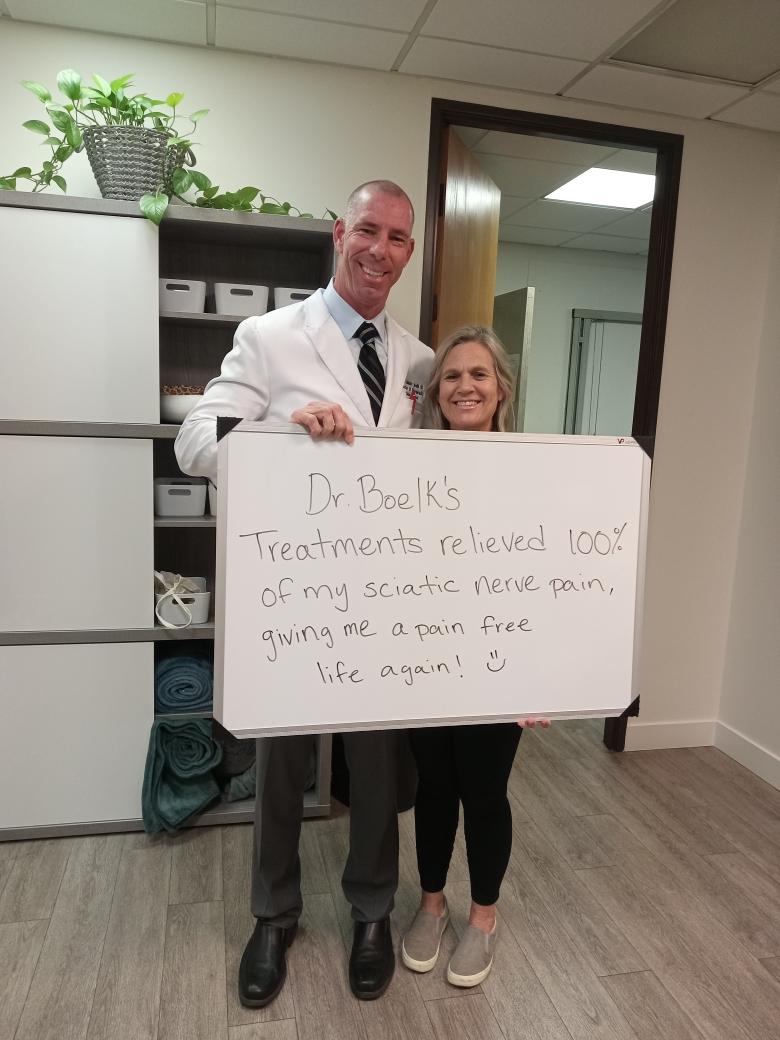
Can Spinal Decompression Help Sciatica Nerve Pain? La Jolla, CA
One of the most common questions Dr. Cassidy James Boelk, DC hears from people dealing with sciatica is pretty straightforward:
“Can spinal decompression actually help this?”
It can be a reasonable option for certain patients, especially when the sciatic symptoms are associated with a lumbar disc problem. But Non-Surgical Spinal Decompression isn't something Dr. Boelk recommends simply because someone has pain running down a leg.
First, he wants to understand why that nerve is irritated.
A patient may have an L4-L5 disc herniation pressing into an area occupied by a nerve. Another may have degenerative changes and narrowing around the nerve. Someone else may have several abnormalities on an MRI, but only one of them appears to correspond with what they're actually feeling.
After more than 22 years working with Non-Surgical Spinal Decompression and more than 100,000 decompression treatments, Dr. Boelk has seen just how different two cases of “sciatica” can be.
And that is why the evaluation comes before the treatment.
⭐⭐⭐⭐⭐ Amanda — San Diego, CA
“Last year, I spent three months constantly going back and forth between doctor’s appointments and urgent care. The pain was unbearable—I was taking medication regularly just to get through the day. Getting out of bed was excruciating, and walking or standing felt like torture. Every step filled me with dread.
In December, my doctor finally ordered an MRI. That’s when I learned I had an extruded disc pressing on my L5 nerve, which affects the leg and foot. My doctor scheduled two follow-up appointments: one for pain management (spinal injections), and another to evaluate me for surgery.
Then I discovered spinal decompression therapy. I was thrilled to find a non-invasive alternative. I never ended up needing either of those appointments.
Now, I’m walking regularly, standing up straight—something I couldn’t do before. When I first sought help, I was so hunched over that I had to use a cane just to move forward. Because of the pain, I hadn’t exercised in months. But now, I’m doing a program called 75 hard which requires not one but 2 45-minute workouts per day, and I've even gotten back to lifting weights!
I’m so thankful I found this place. It’s conveniently located near my work, which makes it easy to fit sessions into my lunch break. Dr. Boelk and the staff are incredibly friendly and polite—it’s always a pleasure to come in.
The environment is so relaxing that I look forward to each visit. I truly thank God for leading me to this alternative. It’s made such a difference in my life.”
— Amanda, San Diego, CA
Have Sciatica? Bring Your MRI and Let's Look at It
If you're in La Jolla and already have a lumbar MRI, bring the actual images and the report to your consultation.
Dr. Boelk can go through them with you.
He'll also want to know where your symptoms travel, what positions make them worse, whether you've noticed numbness or weakness, what you've already tried and how long this has been going on.
If you don't have an MRI yet, that's okay.
Dr. Boelk offers a No-Charge, No-Obligation Consultation to discuss your situation and whether further evaluation or Non-Surgical Spinal Decompression may make sense.
The Spinal Decompression & Chiropractic Center of San Diego
5095 Murphy Canyon Road, Suite 300
San Diego, CA 92123
Phone: 619-298-0800
www.SanDiegoBackCare.com
Live 24/7 Answering Service • Hablamos Español
The Location of Your Pain Tells Part of the Story
When Dr. Boelk asks where your sciatica hurts, be specific.
Point to it.
Maybe it starts deep in the buttock and runs down the outside of your thigh.
Maybe the calf burns.
Maybe your big toe tingles.
Maybe the outside of your foot feels partially numb.
Maybe you don't have much pain anymore, but your foot still doesn't feel normal.
Those details matter more than simply saying, “I have sciatica.”
The nerves leaving the lower spine travel into different areas of the leg and foot. When Dr. Boelk compares that symptom pattern with the examination and MRI, it can help him determine whether the imaging findings make clinical sense.
An MRI Abnormality Doesn't Automatically Explain Your Sciatica
This surprises some patients.
A lumbar MRI might describe abnormalities at several levels.
Maybe there's a bulge at L3-L4, a herniation at L4-L5 and degenerative changes at L5-S1.
Which one is causing the problem?
Possibly one of them. Possibly more than one. And sometimes an abnormality visible on an MRI isn't the main source of the patient's current symptoms.
Dr. Boelk doesn't want to treat an MRI report.
He wants to treat the patient whose MRI he's looking at.
That means comparing the images with the history, examination and symptom pattern.
The size of a herniation isn't the whole story either. Patients sometimes become fixated on a measurement in millimeters.
Where the disc material is located and how much room is available around the nerve may be just as important.
What Is Spinal Decompression Trying to Accomplish?
When a patient is an appropriate candidate, Non-Surgical Spinal Decompression is used to apply controlled decompressive forces to the spine.
Dr. Boelk's office uses the DRX9000 exclusively and has seven systems—four lumbar and three cervical.
The patient lies on the table while the DRX9000 goes through controlled cycles of decompression and relaxation.
For most patients, treatment is comfortable. Some find it relaxing enough that they nearly fall asleep.
But there is much more to decompression than owning the equipment.
Dr. Boelk considers the spinal level being treated, positioning, angle, starting force, the patient's size, symptoms, tolerance and response.
The treatment can then be adjusted as the patient progresses.
After more than 100,000 decompression treatments, Dr. Boelk doesn't believe there is a generic setting that should be used for every person with sciatica.
Sitting May Tell You a Lot
Some people with sciatica can walk around La Jolla without much difficulty and then struggle to sit through the drive home.
Others are exactly the opposite.
Tell Dr. Boelk what happens to you.
If you can sit for 10 minutes before the leg starts burning, that's useful information.
If sitting doesn't bother you but standing in one place does, that's useful too.
If walking makes the symptoms progressively worse but sitting quickly relieves them, mention that.
These patterns can help distinguish between different possible sources of leg symptoms.
In the meantime, if sitting is an obvious trigger, don't spend hours in the same position if you can reasonably avoid it. Get up periodically and move around.
If walking feels comfortable, short walks may be reasonable.
The objective isn't to become afraid of movement. It's to stop repeatedly doing something that clearly aggravates an already irritated nerve.
Be Careful Trying to “Stretch Out” Sciatica
This comes up all the time.
The back of the leg feels incredibly tight, so the natural reaction is to stretch it harder.
But that tight feeling isn't always coming from a short hamstring.
An irritated sciatic nerve can create pulling, burning or tight sensations through the leg.
Pay attention to what happens during the stretch.
A muscular stretch is one thing.
Burning, tingling, electrical pain or symptoms traveling farther toward the foot are different.
If an exercise or stretch repeatedly makes your neurological symptoms worse, don't assume that pushing harder will eventually make it better.
What if You've Had Sciatica for Months?
The longer symptoms have been present, the more Dr. Boelk wants to understand what has already happened.
Was there an injury?
Did it start after lifting something?
Did the pain appear gradually?
Did physical therapy help?
Did you have an epidural injection?
Did an injection eliminate the pain temporarily?
Has the pain improved while numbness remains?
Have you stopped exercising because you're afraid of setting it off again?
There is often useful information buried in that history.
Someone who says, “I've tried everything,” may have actually had several treatments that changed the symptoms temporarily. That's worth discussing.
Improvement Isn't Just a Pain Score
Patients naturally focus on pain because pain is what brought them into the office.
Dr. Boelk also pays attention to what the patient can do again.
Maybe you're sleeping through the night.
Maybe you can put your shoes on without bracing yourself against the wall.
Maybe you're sitting through dinner again.
Maybe you walked for 30 minutes and realized afterward that you hadn't thought about your leg.
Maybe the symptoms that used to reach the toes now stop around the buttock or thigh.
Those changes can tell you more than repeatedly asking yourself whether today's pain is a 3 or a 4.
⭐⭐⭐⭐⭐ Mercedes Bautista — El Centro, CA
“Hi my name is Mercedes Bautista. I found out about this treatment on the internet and I came because I was searching for a doctor for my friend. I have always had low back problems, so Dr. Boelk suggested that I have an MRI done. I decided to go ahead and do it and what I found out was astonishing. Dr. Boelk told me I had a bulging disc and that my discs were dehydrated. I went home very surprised and even scared.
That night with my husband I cried. My husband and I both talked about it and decided that the finances were worth getting my back fixed. The next thing we had to figure out was how I was going to get here, because I live in El Centro.
So we decided we were going to rent a car and I travel here 4 times a week. The girls here are wonderful and very awesome. They make you feel like family, it’s an extremely relaxing environment. I feel better and I have recommended this treatment to my family and friends. Thank You!”
— Mercedes Bautista, Age 42, El Centro, CA
Spinal Decompression Isn't Appropriate for Everyone
This is worth saying clearly.
Dr. Boelk doesn't believe every patient with a herniated disc or sciatica should automatically undergo decompression.
An unhealed fracture, significant osteoporosis, unstable spondylolisthesis, abdominal aortic aneurysm, pregnancy for lumbar treatment, certain malignancies and other medical conditions may make decompression inappropriate.
Previous spinal surgery requires additional consideration, particularly when there is hardware at the level that would need to be treated.
There are also situations where another type of care or a surgical opinion may be more appropriate.
That's why candidacy is determined before treatment.
⭐⭐⭐⭐⭐ Jan H. — San Marcos, CA
“I decided to see Dr. Boelk after a pretty gnarly motocoss neck injury. At the Hospital I was at, I felt I was getting pressured into a surgery which I refused. A friend of a friend referred him after Dr. Boelk successfully treated his broken back.
Dr. Boelk is a compassionate individual who truly cares about his patients. He looked at my MRI images, explained what he saw and potential routes for recovery. He could not treat me as I have to wait until the fracture in my neck heals, but the level of professionalism, compassion, caring and knowledge displayed by him was exceptional.
He also recommended to seek an additional opinion form another neurosurgeon. My experience was that he really cares and he's not someone who would take advantage of the situation someone's in (unlike some other doctors). I will definitely be back and already recommended him to others as well! Thank you Dr. Boelk!”
— Jan H., San Marcos, CA
Numbness Is Important. Weakness Is Even More Important.
If the sharp sciatica pain starts improving but part of your foot is still numb, tell Dr. Boelk.
Don't assume that because it doesn't hurt as badly, it doesn't matter.
And pay particular attention to changes in strength.
Is one foot harder to lift?
Is the foot slapping when you walk?
Does one leg feel substantially weaker?
Are you having trouble doing something you could easily do a few weeks ago?
Progressive neurological weakness should be evaluated.
New bowel or bladder dysfunction, difficulty urinating, numbness around the groin or saddle area, or rapidly progressing weakness can indicate a medical emergency and require prompt medical attention rather than waiting for a routine decompression appointment.
More Than 22 Years of Non-Surgical Spinal Decompression Experience
Dr. Boelk's interest in spinal injuries isn't purely academic.
He suffered an L5 compression fracture at age 16 and later dealt with disc injuries and sciatica himself.
Those experiences eventually helped shape his professional focus on spinal decompression, rehabilitation and difficult disc-related conditions.
Dr. Boelk is a Certified Spinal Decompression Doctor and Certified Pain-Free Performance Specialist. He founded the Non-Surgical Spinal Decompression Training Academy, where he trains other doctors in decompression protocols and techniques.
He is also a Founding Member of the American Spinal Decompression Society, a member of the International Disc Education Association, and holds California X-ray radiography credentials.
But credentials aren't a substitute for determining whether decompression makes sense for the individual patient.
Sometimes it does.
Sometimes it doesn't.
Find Out Whether Spinal Decompression May Be an Option for Your Sciatica
If you live or work in La Jolla and have been dealing with sciatica, leg pain, numbness or tingling, you don't have to decide on your own whether spinal decompression is right for you.
Bring your MRI images and report if you have them.
Dr. Boelk can review your symptoms, history and imaging and discuss whether Non-Surgical Spinal Decompression may be an appropriate option.
No MRI? You can still schedule a consultation.
Not every patient is a candidate. If Dr. Boelk doesn't believe decompression is appropriate for your condition, he'll tell you.
No-Charge, No-Obligation Consultation
The Spinal Decompression & Chiropractic Center of San Diego
5095 Murphy Canyon Road, Suite 300
San Diego, CA 92123
Phone: 619-298-0800
www.SanDiegoBackCare.com
Live 24/7 Answering Service • Hablamos Español
Call 619-298-0800 to schedule your No-Charge, No-Obligation Consultation.