Why Does My Sciatica Get Worse at Night? | San Diego, CA
If your sciatica is manageable during the day but gets significantly worse when you lie down at night, you're not imagining it.
Dr. Cassidy James Boelk, DC sees this quite a bit.
A patient will tell him they can get through most of the workday. They can walk around, drive, maybe even exercise a little. Then they get into bed and within 20 or 30 minutes the leg starts aching.
They roll onto the other side.
Now the buttock hurts.
They straighten the leg and get burning into the calf.
They bend the knee and get comfortable for a few minutes, then have to move again.
Some eventually get out of bed and walk around the house because standing actually feels better than lying down.
Why does that happen?
There isn't one explanation that applies to everybody. Sciatica describes symptoms involving the sciatic nerve pathway; it doesn't tell you by itself what is irritating the nerve. A lumbar disc problem is one possible cause, and when a disc or nearby nerve root is involved, position can make a substantial difference in how a patient feels.
That's one of the first things Dr. Boelk wants to know:
What position can you actually sleep in, and what happens when you change positions?
⭐⭐⭐⭐⭐ “I Was Able to Sleep Mostly Pain-Free for the First Time in Months”
“What surprised me most was that after my very first treatment, I experienced significant relief and was able to sleep mostly pain-free for the first time in months.”
“I have had an outstanding experience with Dr. Boelk and his staff at The Spinal Decompression & Chiropractic Center of San Diego.
They follow a very structured treatment protocol and utilize the best spinal decompression equipment available. I've been treated elsewhere using lower-quality decompression systems and never experienced meaningful improvement.
Dr. Boelk is attentive, professional, and genuinely cares about every patient. You can see it in the way he interacts with everyone who walks through the door.
After about 12 treatments, my sciatica was gone and I was nearly back to normal. Honestly, I wasn't sure I would ever heal. What surprised me most was that after my very first treatment, I experienced significant relief and was able to sleep mostly pain-free for the first time in months.
The improvement has allowed me to get back to hiking, traveling, and enjoying life again.
This treatment was one of the best investments I've ever made.
Thank you, Dr. Boelk and your entire team.”
— Michael Langsdale, San Diego, CA
Sleep is a bigger deal than people sometimes realize when they're dealing with sciatica.
If you wake up four or five times a night because your leg is burning, you're not just dealing with pain at night. You're exhausted the next day. Work gets harder. Exercise becomes harder. You're constantly changing positions, trying different pillows and wondering what you're doing wrong.
And then you have to do it all over again the following night.
Dr. Boelk wants to know about that because nighttime symptoms can provide useful information about what's aggravating the problem.
Sciatica Keeping You Awake? You Can Start With a No-Charge Consultation
If you're in San Diego and your sciatica gets worse when you lie down, wakes you during the night or makes it difficult to find a comfortable sleeping position, you can sit down with Dr. Boelk for a No-Charge, No-Obligation Consultation.
You don't need to know whether you have a herniated disc before you come in.
And scheduling a consultation doesn't mean you've decided to start spinal decompression.
The first step is figuring out what may be causing the symptoms.
During the consultation, Dr. Boelk can:
-
Go through how and when your sciatica started.
-
Discuss where the pain travels.
-
Ask which sleeping positions make it better or worse.
-
Discuss whether sitting, standing or walking changes the symptoms.
-
Review burning, tingling, numbness or weakness.
-
Go over treatments you've already tried.
-
Review your actual MRI images and report if you have them.
-
Compare what's on the MRI with what you're actually experiencing.
-
Discuss whether additional examination or imaging may be appropriate.
-
Determine whether Non-Surgical Spinal Decompression may be an option.
-
Tell you if he doesn't think you're a candidate.
-
Answer your questions.
No MRI? That's okay. You can still schedule.
There is no charge for the consultation and no obligation to begin treatment.
Dr. Boelk personally performs these consultations while also treating the patients already under his care, so the office can only set aside a limited number during the clinic schedule.
Call 619-298-0800 and ask for the next available No-Charge Consultation with Dr. Cassidy James Boelk, DC.
Why Can Lying Down Make Sciatica Hurt More?
This is where patients sometimes expect a simple answer like, “Your mattress is bad.”
It may not be that simple.
Your symptoms can change when the position of your lower back, pelvis or leg changes. If a lumbar nerve root is already irritated, certain positions may be much less comfortable than others.
Some patients can't tolerate lying flat on their back with both legs straight.
Others feel worse on one side.
Some feel better with the knees slightly bent.
Another patient may tell Dr. Boelk that lying down isn't the problem at all—it's rolling over in bed that sends a sudden pain down the leg.
Those differences matter.
Dr. Boelk doesn't want to know only that nighttime hurts. He wants to know exactly what you're doing when the symptoms change.
Your Day Can Catch Up With You at Night
Sometimes patients blame the bed because that's where the pain becomes obvious.
But Dr. Boelk also looks at what happened during the hours before they got into bed.
Did you sit at a desk for eight hours?
Did you spend two hours driving?
Were you bending and lifting all day?
Did you work out?
Did you spend the afternoon doing yard work and repeatedly bending forward?
Maybe you felt relatively good while you were moving around, but by the end of the day the back and nerve were already irritated.
Then you lie down and assume the mattress caused the problem.
Maybe it contributed.
But Dr. Boelk wants the whole day's history, not just the last ten minutes before the pain started.
“I Have to Get Out of Bed and Walk Around”
This is something Dr. Boelk hears from certain patients.
They lie down and the leg starts hurting.
Eventually they can't tolerate it anymore, so they stand up.
They walk around the bedroom or down the hallway for a few minutes and the symptoms ease.
Then they go back to bed.
That response is worth mentioning during an evaluation.
So is the opposite.
Some patients can't walk very far without their leg symptoms increasing, but sitting or lying down relieves them.
Those two patients may both call what they're experiencing “sciatica,” but Dr. Boelk isn't going to assume the same thing is causing both cases.
That's why the details matter.
⭐⭐⭐⭐⭐ “For the First Time in 10 Years, I Am Completely Pain-Free”
“My sciatca is gone, and I no longer have back pain.”
“For the first time in 10 years, I am completely pain-free. My sciatca is gone, and I no longer have back pain.
Before finding Dr. Boelk, I tried chiropractic care, acupuncture, pain medications, and several other therapies that simply didn't work. I was one step away from back surgery when I discovered spinal decompression treatment at The Spinal Decompression & Chiropractic Center of San Diego.
The results have been incredible. Every visit was comfortable, relaxing, and completely pain-free. Dr. Boelk and Patty always took the time to explain everything and made me feel genuinely cared for throughout the process.
They are warm, welcoming, and truly dedicated to helping their patients.
Thank you, Dr. Boelk and Patty!”
— Toni H., San Diego, CA
Toni had dealt with sciatica for years before coming to the office.
Most patients don't want to wait ten years.
They want to know why the leg hurts now, why it keeps coming back and why something as basic as getting a night's sleep has become so difficult.
That's a reasonable thing to want answered.
What Sleeping Position Is Best for Sciatica?
There isn't one position Dr. Boelk can promise will work for everybody.
But there are a few simple things worth trying.
If you sleep on your back, slightly bending the knees and supporting them with a pillow can sometimes be more comfortable than lying completely flat with both legs straight.
If you're a side sleeper, a pillow between the knees may help keep the hips and pelvis in a more comfortable position.
Some patients also discover that one side is clearly better than the other.
The important part is not forcing yourself into a position simply because somebody online said it's the “best” position for sciatica.
If you put a pillow somewhere and your leg pain gets worse, take it out.
If a position causes burning or tingling to travel farther into the foot, change positions.
You're trying to find a position that keeps you reasonably comfortable, not win a flexibility contest in bed.
And if you've reached the point where you're building a fortress out of six pillows every night and still can't sleep, it may be time to figure out what's actually irritating the nerve.
Is Your Mattress Causing the Sciatica?
Maybe it's contributing to how you feel, but Dr. Boelk would be careful about blaming the mattress for everything.
Patients sometimes spend thousands of dollars replacing mattresses while the underlying problem remains unchanged.
If your mattress is badly worn out and you sink into it unevenly, obviously that can affect comfort.
But if you have a disc herniation irritating a lumbar nerve root, buying a new mattress doesn't make the disc herniation disappear.
Dr. Boelk is much more interested in the entire pattern.
When did the problem begin?
Where does the pain go?
What positions aggravate it?
What happens when you sit?
What happens when you walk?
Is there numbness?
Is there weakness?
What does the MRI show, if you have one?
That information tells him much more than the brand name printed on the mattress.
Why Does Sciatica Sometimes Feel Worse When Everything Gets Quiet?
There is another part of nighttime pain that isn't mechanical.
During the day you're busy.
You're talking to people, working, driving, walking around, solving problems and paying attention to a hundred other things.
At night those distractions disappear.
You're lying in a dark room trying to fall asleep, and now the burning in the leg has your full attention.
That doesn't mean the pain is imaginary.
It simply means that pain can become much harder to ignore when nothing else is competing for your attention.
For some patients that's part of the nighttime experience.
For others, there is a very obvious positional component.
And sometimes it's both.
When Night Pain Deserves More Attention
Dr. Boelk doesn't assume every case of nighttime back or leg pain is simply a herniated disc.
There are certain situations where a patient needs further medical evaluation rather than assuming the symptoms are routine sciatica.
Tell your healthcare provider if your pain is severe and unrelenting regardless of position, particularly if it is accompanied by unexplained fever, significant unexplained weight loss, a history of cancer, recent significant trauma or other concerning medical symptoms.
Increasing neurological problems matter too.
If the leg is becoming weaker, you're having trouble lifting the front of the foot, your foot starts slapping the ground when you walk, or numbness is increasing, those are things Dr. Boelk wants to know.
Rapidly progressing weakness, new bowel or bladder dysfunction, difficulty urinating, or numbness around the groin or saddle area requires prompt medical evaluation.
⭐⭐⭐⭐⭐ “Dr. Boelk Has Been a Lifesaver”
“I suffered from constant low back pain and sciatica for more than eight months.”
“Dr. Boelk has been a lifesaver.
I suffered from constant low back pain and sciatica for more than eight months. Pain medications didn't help, and I was headed toward multiple injections in hopes of finding relief.
After beginning treatment with Dr. Boelk, everything changed.
Today, my pain is completely gone.
As a firefighter who depends on his body every day to help others, being pain-free has made a tremendous difference in both my career and quality of life.
The results I experienced were absolutely worth it, and I highly recommend looking into what Dr. Boelk and his team can do for you.”
— Joshua T., San Diego, CA
For someone who depends on their body for work, losing sleep night after night doesn't stay a nighttime problem for very long.
It starts affecting the next day too.
That's one reason Dr. Boelk doesn't dismiss sleep as a minor detail when taking a patient's history.
Could a Herniated Disc Be Causing Your Nighttime Sciatica?
It could.
Lumbar disc bulges and herniations can irritate or compress nerve roots that contribute to the sciatic nerve pathway.
But Dr. Boelk doesn't diagnose a herniated disc simply because somebody has leg pain at night.
He wants the history.
He wants the examination.
If there's an MRI, he wants to see whether the imaging actually makes sense with what the patient is experiencing.
Someone can have abnormalities on an MRI that aren't necessarily responsible for their current symptoms.
That's why Dr. Boelk prefers to review the actual images along with the report and compare them with the patient's clinical presentation.
Where Non-Surgical Spinal Decompression May Fit
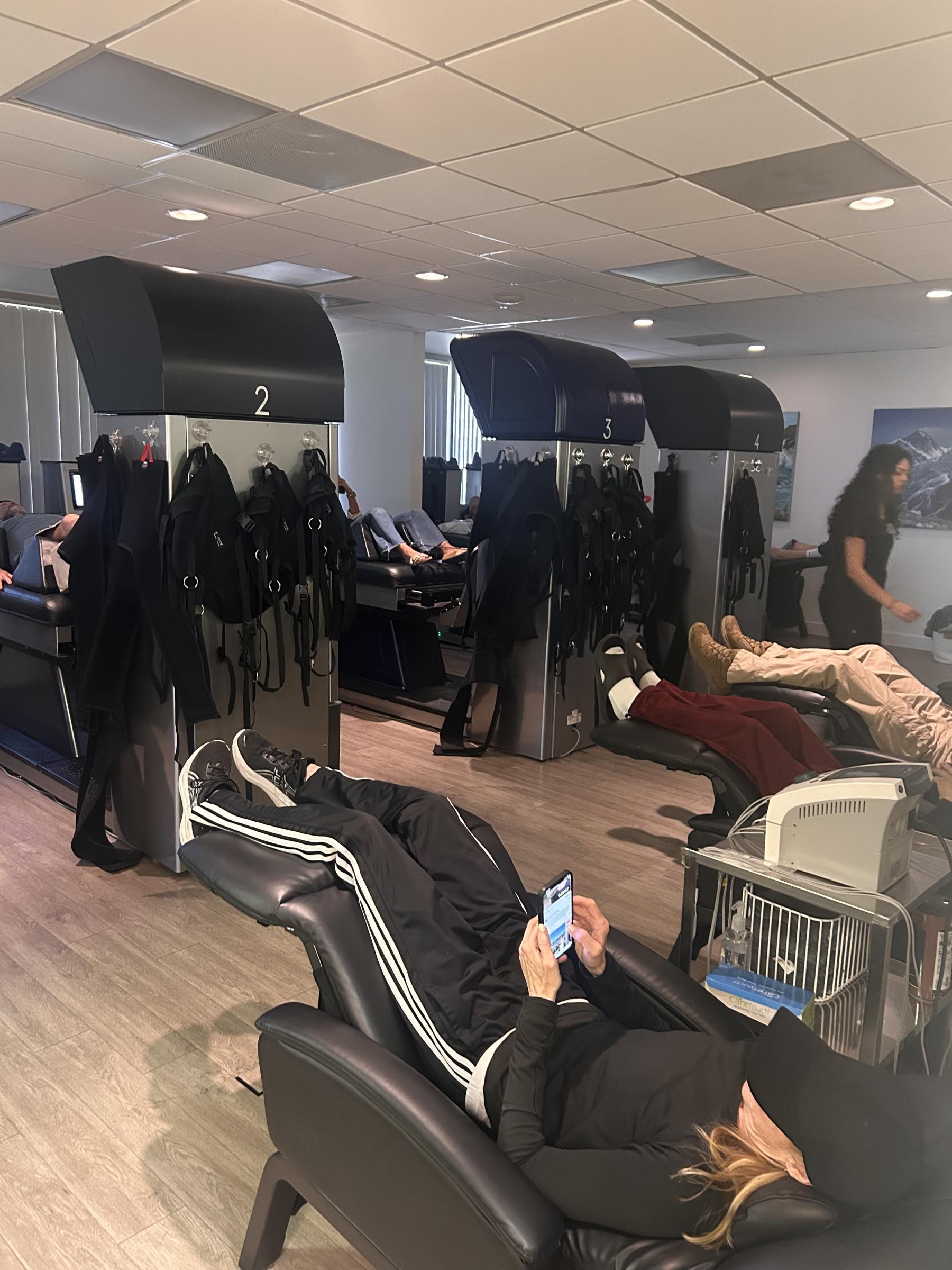
The Spinal Decompression & Chiropractic Center of San Diego uses the DRX9000 exclusively for Non-Surgical Spinal Decompression.
Dr. Boelk evaluates patients with disc bulges, disc herniations, degenerative disc disease, disc-related sciatica, foraminal narrowing and selected cases of spinal stenosis.
That doesn't mean everybody with nighttime sciatica needs spinal decompression.
It also doesn't mean everybody is a candidate.
Before recommending treatment, Dr. Boelk considers the symptoms, neurological findings, imaging when available, spinal stability, bone health, medical history and previous surgery.
There are situations where decompression may not be appropriate, including significant osteoporosis, an unhealed fracture, unstable spondylolisthesis, abdominal aortic aneurysm, pregnancy for lumbar decompression, certain malignancies and other medical or structural conditions.
Previous spinal surgery needs to be reviewed carefully as well, particularly when fusion or metal hardware is present at the level that would need treatment.
★ Not Every Consultation Ends With Spinal Decompression
“I'm glad I took the time to meet with him.”
“Very nice Dr. and Honest ! I would definitely recommend anyone who hasn't had metal put in there back in a surgery to go to him and give his program a shot. I believe it would definitely help. Just not in my personal case. As I have a lot of hardware in my back. But I'm glad I took the time to meet with him. It was very informative all around.”
— Toni W., Lake Elsinore, CA
Toni wasn't a candidate.
That's part of the purpose of meeting with Dr. Boelk before treatment is recommended.
The consultation isn't there to make every person fit spinal decompression.
It's there to figure out whether Dr. Boelk believes he can actually help.
Dr. Cassidy James Boelk, DC
Dr. Boelk has worked with disc injuries, sciatica and Non-Surgical Spinal Decompression for more than 22 years.
-
Doctor of Chiropractic
-
More than 100,000 spinal decompression treatments
-
Certified Spinal Decompression Doctor
-
Certified Pain-Free Performance Specialist (PPSC)
-
Founder, Non-Surgical Spinal Decompression Training Academy
-
Trains other doctors in spinal decompression protocols and techniques
-
Founding Member, American Spinal Decompression Society
-
Member, International Disc Education Association
-
California X-Ray Radiation Supervisor & Operator
Dr. Boelk also knows what it's like to deal with a significant back injury himself. He suffered an L5 compression fracture at 16 and later dealt with disc injuries and sciatica.
That's part of why he wants to know how the problem is affecting your actual life—not simply what number you give your pain.
If you're sleeping two hours at a time because your leg wakes you up every night, that matters.
If Sciatica Is Ruining Your Sleep, Find Out What's Going On
Maybe you've already tried putting a pillow under your knees.
Maybe you've tried sleeping on the opposite side.
Maybe you've bought a mattress topper.
Maybe you're taking medication before bed just so you can get a few hours of sleep.
And maybe you're still waking up at 2:00 or 3:00 in the morning with burning or shooting pain down your leg.
At some point, it makes sense to stop experimenting with sleeping positions and find out why the nerve is irritated.
You don't have to decide whether you want spinal decompression before coming in.
You can simply get Dr. Boelk's opinion.
Your No-Charge Consultation includes:
-
One-on-one time with Dr. Cassidy James Boelk, DC
-
Review of how and when your sciatica started
-
Discussion of where your symptoms travel
-
Review of which sleeping positions make you better or worse
-
Discussion of daytime activities that may be aggravating the problem
-
Review of numbness, tingling, burning or weakness
-
Review of treatments you've already tried
-
Review of your actual MRI images and report, if available
-
Comparison of the MRI findings with your symptoms
-
Discussion of whether additional examination or imaging may be appropriate
-
An assessment of whether Non-Surgical Spinal Decompression may be an option
-
An honest answer if Dr. Boelk doesn't believe you're a candidate
-
Time to ask questions
There is no charge and no obligation to begin treatment.
You don't need an MRI to schedule. If you already have one, bring the actual images and report.
Dr. Boelk personally performs these consultations while also treating his existing patients, so only a limited number can be set aside during the clinic schedule.
Call 619-298-0800
Ask for the next available No-Charge Consultation with Dr. Cassidy James Boelk, DC.
The Spinal Decompression & Chiropractic Center of San Diego
5095 Murphy Canyon Road, Suite 300
San Diego, CA 92123
619-298-0800
SanDiegoBackCare.com
Live 24/7 Answering Service • Hablamos Español