Why Is My Sciatica Not Going Away? San Diego, CA
Sciatica can be incredibly frustrating, especially when you have already tried to do the right things.
You rested. You stretched. Maybe you went to physical therapy or a chiropractor. You took anti-inflammatory medication. Perhaps you even had an epidural injection.
The pain improved for a while—or didn't improve much at all—and now it is still running through your buttock, leg, calf or foot.
So why isn't it going away?
Dr. Cassidy James Boelk, DC has treated patients with disc injuries and sciatica in San Diego for more than 22 years. One of the first things he explains is that sciatica is a description of symptoms, not the actual diagnosis.
The bigger question is:
What is continuing to irritate the nerve?
Until that is better understood, it can be difficult to know what to do next.
What Does Sciatica Actually Feel Like?
Sciatica doesn't feel the same for everyone.
Some people have severe lower-back pain along with leg pain. Others barely notice their back and feel most of the problem in the glute, thigh, calf or foot.
Common symptoms include:
-
Pain in one buttock
-
Pain traveling down the leg
-
Burning or electrical pain
-
Numbness
-
Tingling or pins and needles
-
Calf or ankle pain
-
Numbness or tingling in the foot
-
Difficulty sitting
-
Pain while driving
-
Trouble sleeping
-
Weakness in the leg or foot
Symptoms may be constant or come and go depending on position and activity.
For some patients, sitting is terrible but walking feels relatively good. Others can sit comfortably but have difficulty standing or walking for very long.
Those differences matter.
1. The Underlying Problem May Still Be Irritating the Nerve
One reason sciatica can linger is that the condition affecting the nerve is still present.
Common spinal causes can include:
-
A lumbar disc herniation
-
A bulging or protruding disc
-
Degenerative disc changes
-
Foraminal narrowing
-
Spinal stenosis
-
Loss of disc height
-
Other structural changes affecting a lumbar nerve
L4-L5 and L5-S1 are common areas where disc problems can contribute to symptoms extending into the leg.
If the nerve continues to be irritated, treating only the pain may provide temporary relief without fully addressing why the symptoms keep returning.
That doesn't mean every patient with sciatica needs the same treatment. It means finding the likely source is important.
Severe Sciatica Can Affect Almost Everything You Do
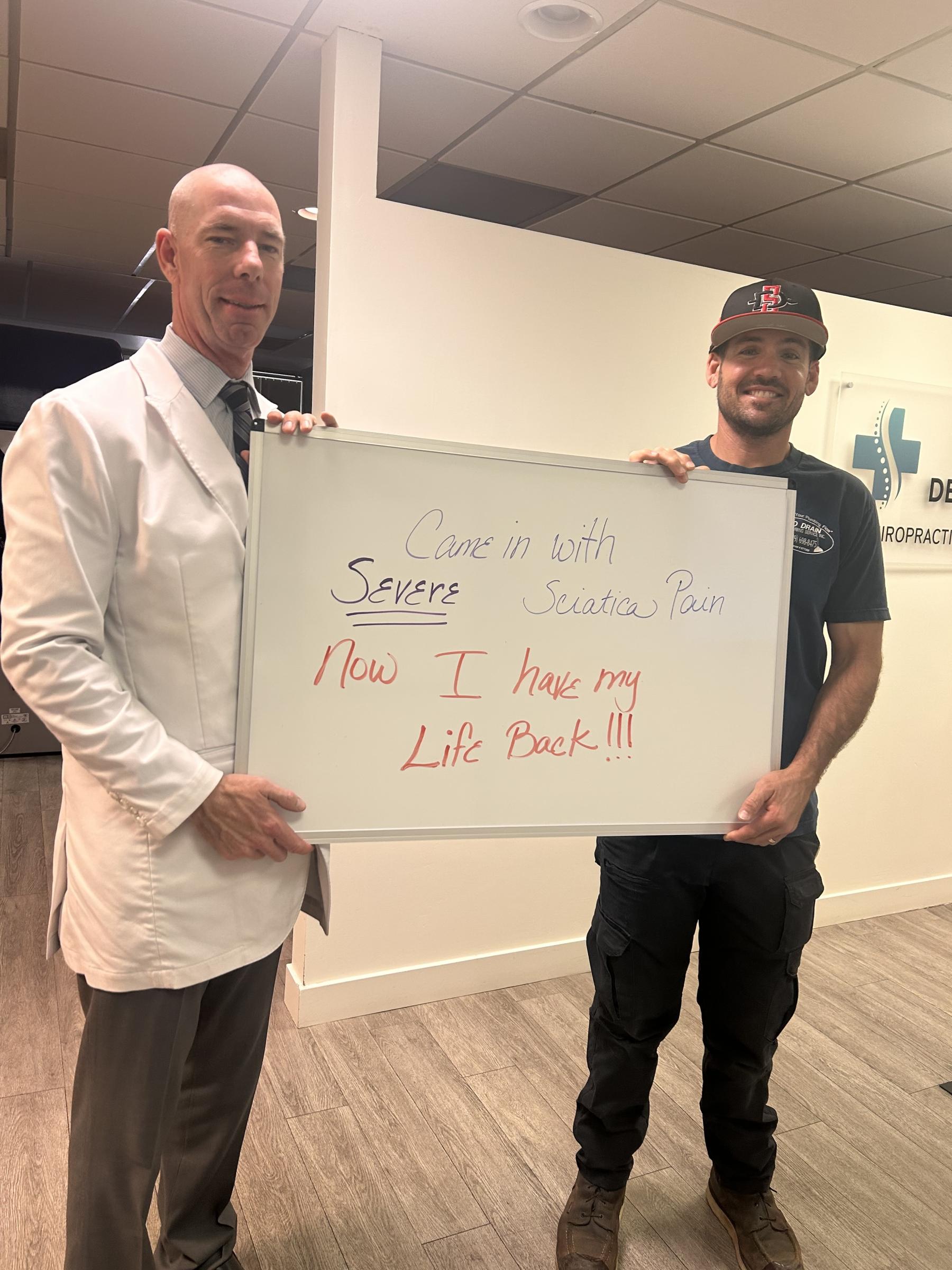
Joshua T. came to Dr. Boelk after dealing with lower-back and sciatic pain for more than eight months.
⭐⭐⭐⭐⭐ Joshua T. — San Diego, CA
“Dr. Boelk has been a life saver. Have had constant lower back and sciatica pain for over 8 plus months, no pills helped and on track for multiple shots but with the treatment given I have found relief and down to zero pain. As a firefighter that relies on his body to help others and the results I have experienced it's totally worth looking into what Dr. Boelk can do for you.”
— Joshua T., San Diego, CA
When sciatica has lasted for months, it is reasonable to take another look at why the nerve symptoms are continuing rather than simply assuming more time will solve the problem.
No-Charge Consultation for Sciatica
Dr. Boelk offers a No-Charge, No-Obligation Consultation for patients who have persistent sciatica and want to better understand what may be causing it.
If you have an MRI, bring the actual images and report if possible. Previous X-rays and other relevant imaging can also be useful.
Dr. Boelk will want to know:
-
Where your pain begins
-
How far down the leg it travels
-
Whether you have numbness or tingling
-
Whether symptoms reach the foot or toes
-
Whether you have noticed weakness
-
How sitting affects you
-
Whether driving makes it worse
-
How long you can comfortably stand or walk
-
Whether pain wakes you at night
-
How the problem started
-
What treatments you have already tried
-
What helped and what didn't
You can still schedule a consultation if you don't have an MRI. Dr. Boelk can determine whether further evaluation or imaging may be appropriate.
The Spinal Decompression & Chiropractic Center of San Diego
5095 Murphy Canyon Road, Suite 300
San Diego, CA 92123
Phone: 619-298-0800
www.SanDiegoBackCare.com
Live 24/7 Answering Service • Hablamos Español
2. Your Treatment May Be Addressing the Symptoms More Than the Source
Pain relief is valuable. If someone is miserable, reducing the pain matters.
But temporary relief doesn't always mean the underlying problem has resolved.
A patient may feel better after medication, massage, an adjustment or an injection and then notice that the sciatica gradually returns.
That pattern is useful information.
Dr. Boelk wants to know what helped, how much it helped and how long the improvement lasted.
For example, if an epidural significantly reduced leg pain but the symptoms later returned, tell him.
If lying down makes the symptoms disappear but sitting for 20 minutes brings them right back, tell him that too.
Those details help build a clearer picture.
3. Sitting May Be Continuously Aggravating Your Sciatica
For many people with disc-related sciatica, sitting is one of the biggest problems.
This can be especially noticeable during:
-
Long drives
-
Desk work
-
Air travel
-
Sitting on a soft couch
-
Long meals
-
Extended computer use
Some patients notice that they feel relatively good first thing in the morning, then symptoms build as they spend more time sitting during the day.
If sitting aggravates your sciatica, try breaking up long periods of sitting when possible.
Stand up periodically. Walk around for a few minutes if walking is comfortable. Pay attention to whether your chair or car-seat position makes a difference.
You don't necessarily need a perfect ergonomic setup. The first goal may simply be not remaining in the same aggravating position for hours at a time.
4. Aggressive Stretching May Be Making an Irritated Nerve Angrier
This surprises some patients.
The back of the leg feels tight, so they repeatedly stretch the hamstring.
But what feels like a tight hamstring can sometimes include irritation of the sciatic nerve.
Pay attention to what happens during and after stretching.
If a stretch causes burning, tingling, numbness or electrical pain to travel farther down the leg, forcing the stretch harder may not be helpful.
The same applies to exercise.
Pain in a muscle during rehabilitation and neurological symptoms traveling down a limb are not necessarily the same thing.
5. The MRI Finding May Not Have Been Connected to Your Symptoms
MRI reports can be confusing.
A report may list:
-
L3-L4 disc bulge
-
L4-L5 disc protrusion
-
L5-S1 degeneration
-
Facet arthritis
-
Foraminal narrowing
-
Central canal stenosis
Patients sometimes read the report and understandably wonder:
Which one is actually causing my sciatica?
Dr. Boelk prefers to review the actual MRI images when they are available and compare them with the patient's symptoms.
If someone has a disc problem affecting a particular nerve and symptoms traveling through the area supplied by that nerve, the pieces may fit together.
But abnormal MRI findings are common, and not everything on the report necessarily explains the patient's pain.
6. Don't Get Stuck on the Millimeter Measurement
Patients often know exactly how many millimeters their disc is bulging.
“Mine is 4 mm.”
“Mine is 6 mm.”
The measurement matters, but it isn't the entire story.
A smaller disc protrusion located in a tight area near a nerve can potentially cause substantial symptoms. Another person may have a larger abnormality without the same degree of nerve irritation.
Location, available space around the nerve, other degenerative changes and the patient's symptoms all matter.
7. There May Be More Than a Disc Herniation Involved
Not all persistent sciatica is explained by one disc.
Degenerative changes may reduce disc height. Foraminal narrowing may reduce the space where the nerve exits. Arthritic changes can also contribute to narrowing.
Some patients have several things happening at once.
This becomes particularly important when someone says:
“I've had sciatica forever, and nothing seems to work.”
That may be a reason to reassess the diagnosis and available imaging rather than simply repeating the same approach indefinitely.
When Sciatica Takes Away the Activities You Love
Jayson Yavorsky described a year of sciatic pain that prevented him from participating in hockey, golf and surfing and interfered with his sleep.
⭐⭐⭐⭐⭐ Jayson Yavorsky — San Diego, CA
“There is not enough room to explain the relief Dr. Boelk has brought to me and my entire family. I found him after a year of sciatic pain. Couldn't play the sports I loved, no hockey, golf or surfing. The pain shooting from my hip to my left foot was to the point of unbearable. I had been visiting chiropractors since I was 18, temporary relief, but nothing consistent. Acupuncture helped a bit, physical therapy was unmanageable. I couldn't get a solid night sleep and didn't care to go on. But Then I met the Dr! I tell people regularly, he saved my life.
It was a regular routine of adjuments and excersises. A change of life patterns but 110% worth every effort. I have since had my wife, daughter, mother, father and multiple friends and clients visit Dr. Boelk. All thanking me for the referral. Last one was my firefighting friend that had horrible sciatica. He is now on the recovery train.
So without a doubt, if you are on the verge of surgery, don't do it until you give this Dr a chance to examine you 1st. He is honest, he will tell you if you are beyond repair.
I trust him with my life and my back. So should you!”
— Jayson Yavorsky, San Diego, CA
8. Your Nerve May Need Time
Not every case of sciatica resolves quickly.
A nerve that has been irritated for a significant period may take time to settle down even when the patient is moving in the right direction.
This is one reason Dr. Boelk pays attention to more than a daily pain score.
He wants to know whether:
-
Leg pain is occurring less frequently
-
Symptoms are traveling less far down the leg
-
Sitting tolerance is improving
-
Sleep is improving
-
Walking is easier
-
Numbness is changing
-
Strength is stable or improving
-
Normal activities are becoming easier
Progress doesn't always happen in a perfectly straight line.
9. Your Daily Routine May Keep Re-Irritating the Problem
Sometimes the issue isn't one major activity.
It's the accumulation of smaller things throughout the day.
A patient may sit at a desk for eight hours, drive another hour, then spend the evening on a soft couch. Another patient repeatedly bends and lifts at work. Someone else keeps returning to an exercise that reproduces the leg symptoms.
That doesn't mean patients should become afraid to move.
It means identifying the movements and positions that consistently aggravate the nerve can be useful while the condition is recovering.
What Can You Do at Home?
There isn't one home exercise that is appropriate for every case of sciatica.
But a few general observations can be helpful:
-
Break up prolonged sitting if sitting aggravates your symptoms.
-
Take short, comfortable walks if walking feels good.
-
Avoid repeatedly forcing a stretch that sends symptoms farther down the leg.
-
Experiment with your car-seat position if driving is a major trigger.
-
Try sleeping on your side with a pillow between your knees or on your back with support beneath the knees if those positions are more comfortable.
-
Keep track of where your symptoms travel.
-
Pay attention to numbness and changes in strength.
Bed rest is generally not the goal, but neither is repeatedly pushing through worsening neurological symptoms.
When Could Non-Surgical Spinal Decompression Be Considered?
When persistent sciatica appears related to a disc or degenerative spinal problem that is appropriate for conservative treatment, Dr. Boelk may consider Non-Surgical Spinal Decompression.
The Spinal Decompression & Chiropractic Center of San Diego exclusively uses the DRX9000 and has seven systems—four lumbar and three cervical.
Treatment involves controlled decompression and relaxation cycles.
The protocol can be individualized according to factors such as:
-
Disc level
-
Treatment angle
-
Positioning
-
Starting force
-
Patient size
-
Symptoms
-
Tolerance
-
Response to treatment
There isn't a single “sciatica setting” that works for everyone.
Patient selection, treatment setup, progression and rehabilitation all matter.
Some People With Sciatica Are Not Candidates
This is important.
Having persistent sciatica doesn't automatically mean someone should receive spinal decompression.
Dr. Boelk screens for conditions that may make decompression inappropriate or require another type of evaluation.
These can include:
-
Unstable spondylolisthesis
-
An unhealed spinal fracture
-
Significant osteoporosis
-
Abdominal aortic aneurysm
-
Pregnancy for lumbar decompression
-
Certain malignancies
-
Certain surgical hardware at the treatment level
-
Progressive neurological weakness
-
Cauda equina syndrome
-
Other medical or structural conditions that could make treatment unsafe
Previous spinal surgery also needs to be evaluated individually.
Sometimes the Evaluation Leads Somewhere Else
Jan H. came to Dr. Boelk following a significant neck injury. His MRI was reviewed, but because his fracture still needed to heal, Dr. Boelk did not treat him and recommended another neurosurgical opinion.
⭐⭐⭐⭐⭐ Jan H. — San Marcos, CA
“I decided to see Dr. Boelk after a pretty gnarly motocoss neck injury. At the Hospital I was at, I felt I was getting pressured into a surgery which I refused. A friend of a friend referred him after Dr. Boelk successfully treated his broken back.
Dr. Boelk is a compassionate individual who truly cares about his patients. He looked at my MRI images, explained what he saw and potential routes for recovery. He could not treat me as I have to wait until the fracture in my neck heals, but the level of professionalism, compassion, caring and knowledge displayed by him was exceptional.
He also recommended to seek an additional opinion form another neurosurgeon. My experience was that he really cares and he's not someone who would take advantage of the situation someone's in (unlike some other doctors). I will definitely be back and already recommended him to others as well! Thank you Dr. Boelk!”
— Jan H., San Marcos, CA
The same principle applies when evaluating sciatica. If Dr. Boelk doesn't believe decompression is appropriate, the patient should know.
When Sciatica Needs More Urgent Attention
Persistent sciatica is one thing. Developing significant neurological changes is another.
Seek prompt medical attention for:
-
New bowel or bladder dysfunction
-
Difficulty urinating
-
Numbness around the groin or saddle region
-
Rapidly progressing weakness
-
Sudden loss of control of a leg or foot
Increasing weakness should not simply be treated as ordinary sciatica and ignored.
More Than 22 Years Working With Disc Injuries and Sciatica
Dr. Boelk's background includes:
-
Doctor of Chiropractic
-
Certified Spinal Decompression Doctor
-
Certified Pain-Free Performance Specialist
-
More than 22 years of clinical experience
-
More than 100,000 spinal decompression treatments performed
-
Founder, Non-Surgical Spinal Decompression Training Academy
-
Trains other doctors in spinal decompression protocols and techniques
-
Founding Member, American Spinal Decompression Society
-
Member, International Disc Education Association
-
California X-ray radiography credentials
Dr. Boelk's experience with spinal injuries is also personal.
He suffered an L5 compression fracture at age 16 and later dealt with disc injuries and sciatica himself. That experience, along with more than two decades treating spinal conditions, has influenced how he evaluates patients who feel like they have already tried everything.
What Should You Do if Your Sciatica Isn't Going Away?
If sciatica has been hanging around for weeks or months, keeps returning, or is interfering with sitting, driving, walking, sleeping or working, it may be time to take another look at why the nerve remains irritated.
Bring your MRI images, X-rays and reports if you already have them.
If you don't have imaging, that's okay.
Dr. Boelk offers a No-Charge, No-Obligation Consultation to review your symptoms, discuss what you have already tried and determine whether Non-Surgical Spinal Decompression may be an appropriate option.
Not every patient is a candidate. If Dr. Boelk doesn't believe decompression is appropriate, he will tell you.
The Spinal Decompression & Chiropractic Center of San Diego
5095 Murphy Canyon Road, Suite 300
San Diego, CA 92123
Phone: 619-298-0800
www.SanDiegoBackCare.com
Live 24/7 Answering Service • Hablamos Español
Call 619-298-0800 to schedule a No-Charge, No-Obligation Consultation.