Why Is My Sciatica Worse in the Morning? | San Diego, CA
For some people with sciatica, the hardest part of the day is the first 20 or 30 minutes after getting out of bed.
They wake up with a stiff lower back, pain into the buttock or leg, or tingling that seems more noticeable than it was the night before. Bending forward to put on socks and shoes may be especially uncomfortable. Even something as routine as leaning over the bathroom sink can aggravate the pain.
Then, after moving around for a while, things may begin to loosen up.
Dr. Cassidy James Boelk, DC sees this pattern frequently in patients with lumbar disc injuries and sciatica. After more than 22 years treating spinal conditions and more than 100,000 spinal decompression treatments, he has found that what happens during the first part of a patient's day can provide useful information about how the lower back is behaving.
Morning pain does not automatically mean someone has a herniated disc, and not everyone with a disc injury is worse in the morning. But there are several reasons disc-related back pain and sciatica can be more noticeable after a night of sleep.
A Patient Who Could Barely Get Out of Bed
Amanda described just how severe her symptoms had become before she found out that an extruded disc was pressing on her L5 nerve:
“Last year, I spent three months constantly going back and forth between doctor’s appointments and urgent care. The pain was unbearable—I was taking medication regularly just to get through the day. Getting out of bed was excruciating, and walking or standing felt like torture. Every step filled me with dread.
In December, my doctor finally ordered an MRI. That’s when I learned I had an extruded disc pressing on my L5 nerve, which affects the leg and foot. My doctor scheduled two follow-up appointments: one for pain management (spinal injections), and another to evaluate me for surgery.
Then I discovered spinal decompression therapy. I was thrilled to find a non-invasive alternative. I never ended up needing either of those appointments.
Now, I’m walking regularly, standing up straight—something I couldn’t do before. When I first sought help, I was so hunched over that I had to use a cane just to move forward. Because of the pain, I hadn’t exercised in months. But now, I’m doing a program called 75 hard which requires not one but 2 45-minute workouts per day, and I've even gotten back to lifting weights!
I’m so thankful I found this place. It’s conveniently located near my work, which makes it easy to fit sessions into my lunch break. Dr. Boelk and the staff are incredibly friendly and polite—it’s always a pleasure to come in.
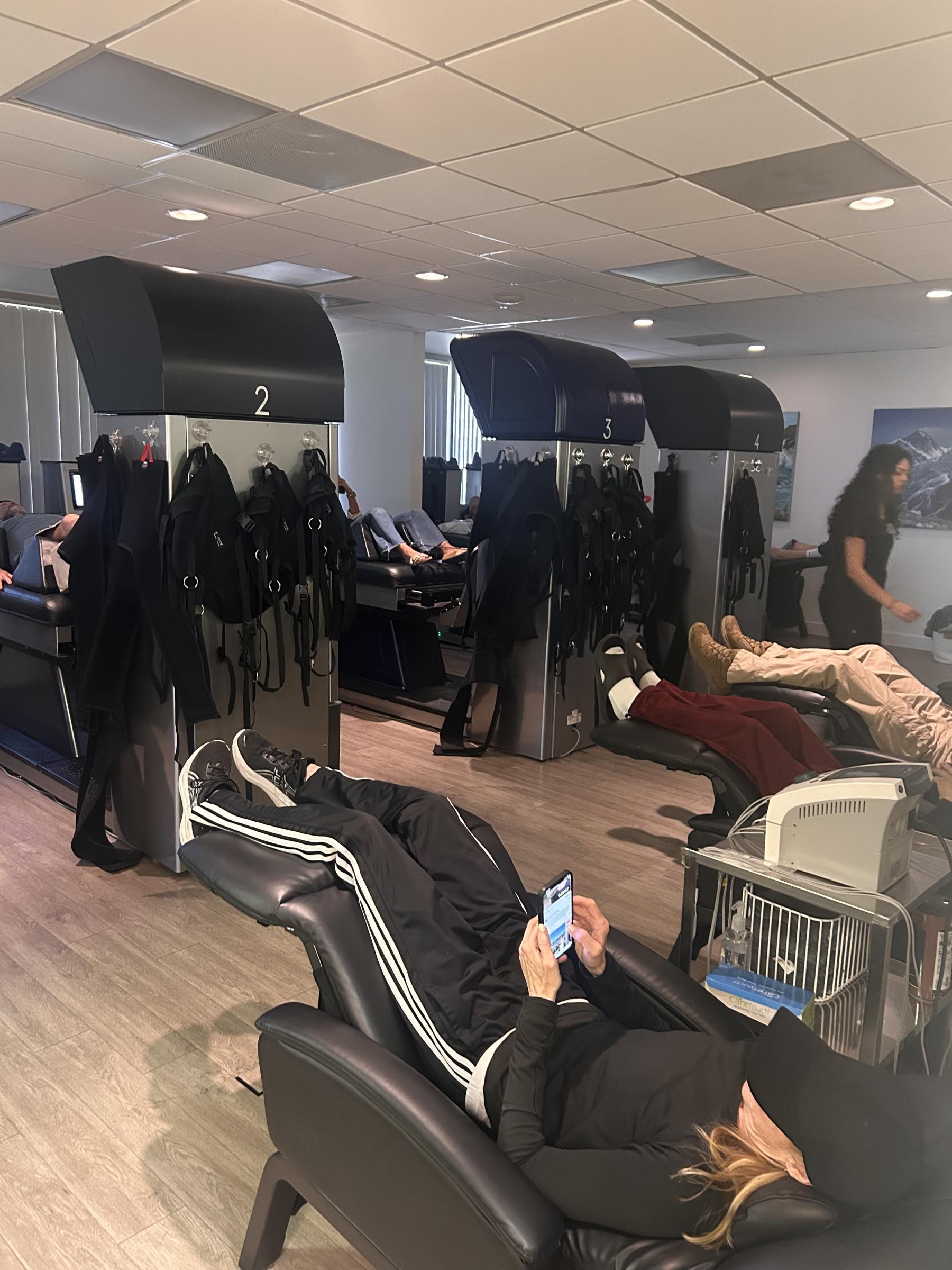
The environment is so relaxing that I look forward to each visit. I truly thank God for leading me to this alternative. It’s made such a difference in my life.”
— Amanda, San Diego, CA
Individual results vary. Amanda's experience does not mean every patient with sciatica or a disc injury will respond in the same way.
Start With a No-Charge Consultation
If sciatica is affecting the way you get out of bed, put on your shoes, walk, work or exercise, you can start with a No-Charge, No-Obligation Consultation with Dr. Cassidy James Boelk, DC.
You do not need to decide whether you want treatment before coming in. The purpose of the consultation is to understand what is happening and determine whether the office may be appropriate for your condition.
During the consultation, Dr. Boelk may:
-
Review when and how your symptoms began
-
Discuss where the pain travels
-
Identify areas of numbness, tingling or burning
-
Discuss any weakness in the leg or foot
-
Review what your symptoms are like when you first get out of bed
-
Discuss what happens with sitting, standing, walking, bending and exercise
-
Review previous treatments and how you responded
-
Review existing MRI images, X-rays and radiology reports
-
Compare your imaging findings with your actual symptoms
-
Discuss whether further examination or imaging may be appropriate
-
Determine whether Non-Surgical Spinal Decompression may be an option
-
Answer questions about your condition and possible next steps
If you already have a lumbar MRI, bring the actual images as well as the written report. Dr. Boelk prefers to review the images himself rather than relying only on the radiology report.
If you do not have an MRI, you can still begin with the consultation.
There is no obligation to start treatment. If Dr. Boelk does not believe you are an appropriate candidate for Non-Surgical Spinal Decompression, he will tell you.
Dr. Boelk personally conducts these consultations and reviews the patient's available imaging. Because of the time involved, a limited number of No-Charge Consultation appointments are available within the weekly clinic schedule.
To ask about the next available consultation, call 619-298-0800.
Why Sciatica May Feel Worse First Thing in the Morning
One possible explanation involves what happens to the lumbar discs overnight.
The discs between the vertebrae contain water and naturally change throughout the day. When someone is upright, normal daily loading gradually reduces some of the fluid within the discs. During several hours of lying down and sleeping, the discs can rehydrate and regain some of that fluid.
This is a normal process.
In a healthy back, most people never think about it. But when a disc is already irritated, bulging or herniated, changes in disc hydration and pressure may contribute to increased sensitivity after a night of lying down.
That does not mean morning sciatica proves that a disc is herniated. It is simply one piece of the patient's history that Dr. Boelk considers along with the rest of the examination and imaging.
The First Few Movements of the Day Can Matter
Another issue is what people do immediately after getting out of bed.
Many people wake up, sit on the edge of the bed and immediately bend forward to put on socks or shoes. A few minutes later they may be bending over a sink, picking clothing off the floor, loading a dishwasher or reaching into a low cabinet.
For someone whose symptoms are sensitive to lumbar flexion, repeatedly bending forward immediately after getting out of bed may aggravate the condition.
This is especially worth paying attention to if bending forward causes pain to travel farther into the buttock or leg.
A patient may say that standing upright is reasonably comfortable in the morning, but sitting down and bending forward to tie a shoe immediately produces leg pain.
That distinction can be useful.
Morning Stiffness and Morning Sciatica Are Not Necessarily the Same Thing
Almost everyone experiences occasional stiffness after sleeping in one position for several hours. That alone does not mean there is a disc or nerve problem.
Sciatica is different when symptoms extend beyond the lower back.
Pain traveling through the buttock and down the leg, burning, tingling, numbness or weakness suggests that a nerve may be involved.
Dr. Boelk wants to know whether the symptoms remain in the lower back or travel farther down the leg. He also wants to know what happens after the patient has been moving for 15, 30 or 60 minutes.
Some patients improve considerably after they begin walking. Others become progressively worse the longer they stand or walk.
Those are different clinical patterns and should not automatically be treated the same way.
A Better Morning Routine When Your Back Is Irritated
There is no single morning routine that is appropriate for every person with sciatica. The underlying cause of the symptoms matters.
There are, however, a few reasonable principles that may help some patients avoid unnecessarily aggravating an already sensitive lower back.
When getting out of bed, avoid making the first movement of the day a forceful sit-up. Rolling onto the side and using the arms to help come upright can reduce the amount of abrupt bending through the lower back.
Once standing, give the body a little time to begin moving before doing repeated deep bending or aggressive stretching.
If putting on socks and shoes is difficult, bring the foot toward you rather than repeatedly folding the entire torso forward toward the floor.
A short, comfortable walk may feel better than immediately performing a long stretching routine.
Most importantly, pay attention to what happens to the leg symptoms. If an exercise or stretch repeatedly causes pain, burning, tingling or numbness to travel farther down the leg, continuing to push harder may not be appropriate.
The goal is not to become afraid of bending. Bending is a normal part of life. The goal is to avoid repeatedly provoking an irritated nerve while trying to determine what is causing the problem.
Why Stretching First Thing in the Morning Is Not Always the Answer
People with sciatica are often told that they need to stretch more.
Sometimes stretching is useful. Sometimes it is not.
An irritated nerve can create a sensation through the hamstring or calf that feels remarkably similar to muscle tightness. A patient may spend weeks trying to stretch that sensation away without realizing that the stretch itself is increasing the neurological symptoms.
This is particularly important when a stretch causes symptoms to travel farther down the leg.
If bending forward to stretch the hamstrings consistently produces more leg pain, tingling or numbness, Dr. Boelk would want to know that.
That response may provide more useful information than how far someone can reach toward their toes.
Your Sleeping Position May Also Matter
There is no perfect sleeping position for every patient with sciatica.
Some patients are most comfortable on their side with the knees slightly bent. Others prefer lying on their back with support beneath the knees. Certain patients feel considerably worse when sleeping in one particular position.
Rather than forcing yourself into a position because an online article says it is the “best” position for sciatica, pay attention to how you actually feel.
Can you sleep through the night?
Do you wake because of leg pain?
Does one sleeping position consistently produce more numbness?
Do you feel relatively comfortable lying down but experience symptoms as soon as you stand?
Those details can help distinguish one pattern from another.
When Morning Sciatica Keeps Happening
An occasional bad morning is one thing. Repeated sciatica every morning for weeks or months deserves a closer look, particularly when the symptoms are affecting normal activities.
Persistent numbness should also be evaluated.
Weakness deserves additional attention. If one foot is becoming harder to lift, you are beginning to catch your toes while walking, or there has been a noticeable change in leg strength, do not simply continue stretching and wait indefinitely for it to resolve.
Rapidly progressing neurological weakness, new bowel or bladder dysfunction, difficulty urinating, or numbness involving the groin or saddle region requires prompt medical attention rather than waiting for a routine spinal decompression consultation.
Could Non-Surgical Spinal Decompression Help?
When sciatica is associated with an appropriate lumbar disc or degenerative condition, Non-Surgical Spinal Decompression may be considered as a conservative treatment option.
The Spinal Decompression & Chiropractic Center of San Diego uses the DRX9000 exclusively, with four lumbar and three cervical systems.
Dr. Boelk does not base treatment on the word “sciatica” alone. He considers the patient's history, symptoms, examination findings and imaging when available.
The level and location of the disc problem, treatment angle, positioning, starting force, body size, tolerance and response to care may all influence how treatment is approached.
Just as importantly, not everyone is a candidate.
An unhealed fracture, significant osteoporosis, unstable spondylolisthesis, abdominal aortic aneurysm, pregnancy for lumbar decompression, certain malignancies and other conditions can make treatment inappropriate. Previous spinal surgery also requires careful consideration, particularly when fusion or metal hardware is present at the level being considered for treatment.
Some patients need another form of conservative care. Others need additional diagnostic evaluation. There are also circumstances in which Dr. Boelk will recommend that a patient seek a surgical opinion.
Determining that is part of the consultation process.
About Dr. Cassidy James Boelk, DC
Dr. Cassidy James Boelk, DC has more than 22 years of experience with Non-Surgical Spinal Decompression and has performed more than 100,000 spinal decompression treatments.
His professional background includes:
-
Doctor of Chiropractic (DC)
-
Certified Spinal Decompression Doctor
-
Certified Pain-Free Performance Specialist (PPSC)
-
Founder, Non-Surgical Spinal Decompression Training Academy
-
Trains other doctors in spinal decompression protocols and techniques
-
Founding Member, American Spinal Decompression Society
-
Member, International Disc Education Association
-
California X-Ray Radiation Supervisor & Operator
Dr. Boelk's interest in spinal injuries is also personal. He suffered an L5 compression fracture at age 16 and later experienced disc injuries and sciatica himself. His own experience with spinal injury and rehabilitation has influenced the way he evaluates patients who want to remain active while dealing with back and leg symptoms.
Morning Sciatica Evaluation in San Diego
If you are repeatedly waking with lower back pain, sciatica, numbness or tingling that makes the beginning of your day difficult, it may be worth determining why the symptoms are occurring rather than simply trying another stretch.
If you already have an MRI, bring the images and report with you. If you do not have imaging, you can still begin with a consultation.
The No-Charge Consultation is provided without an obligation to begin treatment. Dr. Boelk will review your history, available imaging and symptoms and discuss whether Non-Surgical Spinal Decompression appears appropriate for your condition.
Because Dr. Boelk personally conducts these consultations, only a limited number of new-patient consultation appointments are available within the weekly clinic schedule.
Call 619-298-0800 to ask about the next available No-Charge Consultation.
The Spinal Decompression & Chiropractic Center of San Diego
5095 Murphy Canyon Road, Suite 300
San Diego, CA 92123
619-298-0800
Live 24/7 Answering Service • Hablamos Español