L5 Sciatica Symptoms | La Jolla, CA
Sciatica does not always begin with severe lower back pain. In some patients, the first thing they notice is pain traveling along the outside of the leg, numbness across the top of the foot, tingling into the toes, or a subtle change in the strength of one foot.
These symptoms can be associated with irritation or compression of the L5 nerve root.
Dr. Cassidy James Boelk, DC has worked with patients suffering from lumbar disc injuries, sciatica and related nerve symptoms for more than 22 years and has performed more than 100,000 spinal decompression treatments. One of the important lessons from that experience is that nerve symptoms do not always present exactly as patients expect. The lower back may hurt, but in some cases the leg and foot symptoms become the primary complaint.
A patient may initially have lower back pain that settles down while the leg continues to burn or ache. Another may notice numbness across the foot without significant back pain. In other cases, pain is not the greatest concern at all. The patient begins to notice that one foot feels weaker or less coordinated when walking.
Understanding the pattern of symptoms is an important part of determining where the problem may be coming from.
Common Symptoms Associated With the L5 Nerve
When the L5 nerve is irritated, symptoms may travel along the outside of the thigh or lower leg and into the top of the foot. Some patients notice symptoms extending toward the big toe.
Common complaints can include:
-
Pain along the outside of the leg
-
Burning, tingling or pins-and-needles sensations
-
Numbness across the top of the foot
-
Numbness or tingling toward the big toe
-
Weakness when lifting the foot upward
-
Weakness when extending the big toe
-
A change in walking or coordination
-
Difficulty walking on the heel when weakness is more pronounced
There is variation from patient to patient. Nerve symptoms do not always follow a textbook illustration, and there can be overlap between adjacent nerve roots.
For that reason, the location of the pain is only one part of the evaluation. Dr. Boelk also considers when the symptoms began, how they have changed, what positions aggravate them, what provides relief, whether weakness is present and whether the findings on imaging are consistent with what the patient is experiencing.
When the Leg Hurts More Than the Lower Back
One of the more confusing presentations occurs when a patient has significant leg symptoms but relatively little lower back pain.
This can lead people to spend considerable time treating the hip, hamstring, knee, calf or foot because that is where they feel the problem. In some cases those areas are responsible. In others, the symptoms are being produced by irritation of a nerve in the lumbar spine.
A common history is an episode of lower back pain followed by pain that begins to travel into the buttock and leg. The lower back may eventually improve while the leg pain, numbness or tingling persists.
That progression is clinically useful information.
The same is true when symptoms are affected by sitting, standing or walking. A patient whose symptoms begin after sitting in a car for 20 minutes may present very differently from someone who feels relatively comfortable sitting but develops increasing leg symptoms after several minutes of standing or walking.
These details help determine what should be examined and whether the lumbar spine is likely to be involved.
A Patient's Experience With Persistent Sciatica
Michael Langsdale described his experience after coming to The Spinal Decompression & Chiropractic Center of San Diego:
“I have had an outstanding experience with Dr. Boelk and his staff at The Spinal Decompression & Chiropractic Center of San Diego.
They follow a very structured treatment protocol and utilize the best spinal decompression equipment available. I've been treated elsewhere using lower-quality decompression systems and never experienced meaningful improvement.
Dr. Boelk is attentive, professional, and genuinely cares about every patient. You can see it in the way he interacts with everyone who walks through the door.
After about 12 treatments, my sciatica was gone and I was nearly back to normal. Honestly, I wasn't sure I would ever heal. What surprised me most was that after my very first treatment, I experienced significant relief and was able to sleep mostly pain-free for the first time in months.
The improvement has allowed me to get back to hiking, traveling, and enjoying life again.
This treatment was one of the best investments I've ever made.
Thank you, Dr. Boelk and your entire team.”
— Michael Langsdale, San Diego, CA
Individual results vary. A patient's response to treatment depends on the condition being treated and a number of individual factors.
Why an L4-L5 Disc Problem May Affect the L5 Nerve
MRI terminology is often confusing for patients. Someone may have an MRI report describing an L4-L5 disc herniation and wonder why the symptoms are being associated with the L5 nerve.
The level of the injured disc and the name of the affected nerve root are not always the same.
A disc herniation at L4-L5, depending on its location, can irritate or compress the L5 nerve root as the nerve travels through the lumbar spine. The location of the disc material can be just as important as its size.
This is also one reason Dr. Boelk prefers to review the actual MRI images whenever possible.
An MRI report may describe several findings at several levels. It is not unusual to see some combination of disc degeneration, bulging discs, herniations, facet changes or narrowing around the nerves. The presence of these findings does not establish that every abnormality is producing symptoms.
The imaging needs to be compared with the patient's history, symptoms and examination.
If someone has numbness across the top of the foot and weakness involving movements commonly associated with the L5 nerve, an L4-L5 abnormality on MRI may be highly relevant. If the symptoms and imaging do not correspond well, that discrepancy is also important.
Weakness Changes the Conversation
Pain can be severe without significant loss of nerve function. It can also improve while numbness or weakness remains.
Dr. Boelk pays particular attention when patients describe a change in strength.
This might begin as difficulty lifting the big toe, one foot becoming fatigued more quickly, or the patient noticing that walking feels different on one side. With more significant involvement, the front of the foot may become difficult to lift normally.
Progressive weakness should not simply be watched indefinitely while continuing the same exercises or stretches.
Patients with new or increasing weakness should be appropriately evaluated. Rapidly progressing neurological weakness, new bowel or bladder dysfunction, difficulty urinating, or numbness in the groin or saddle region requires prompt medical attention rather than waiting for a routine decompression consultation.
What to Pay Attention to Before an Evaluation
Patients can provide a great deal of useful information by simply observing what happens during normal activities.
Notice whether sitting, standing or walking changes the symptoms. Pay attention to how long it takes for the symptoms to begin and whether changing position relieves them.
If the foot is numb, identify the area as accurately as possible. Numbness over the top of the foot and big toe provides different information than numbness primarily affecting the outside or bottom of the foot.
It is also useful to notice whether the symptoms remain in one area or begin traveling farther down the leg during certain activities.
Aggressive stretching is not always helpful. Nerve irritation can create a sensation that patients interpret as a tight hamstring or calf. If repeatedly stretching the leg produces more burning, tingling, numbness or radiating pain, continuing to force the stretch may not be appropriate.
The objective is not to avoid movement. It is to understand which movements are tolerated and which consistently aggravate the neurological symptoms.
Evaluating L5 Sciatica for Non-Surgical Spinal Decompression
Non-Surgical Spinal Decompression may be considered when L5 nerve irritation is associated with an appropriate lumbar disc or degenerative condition.
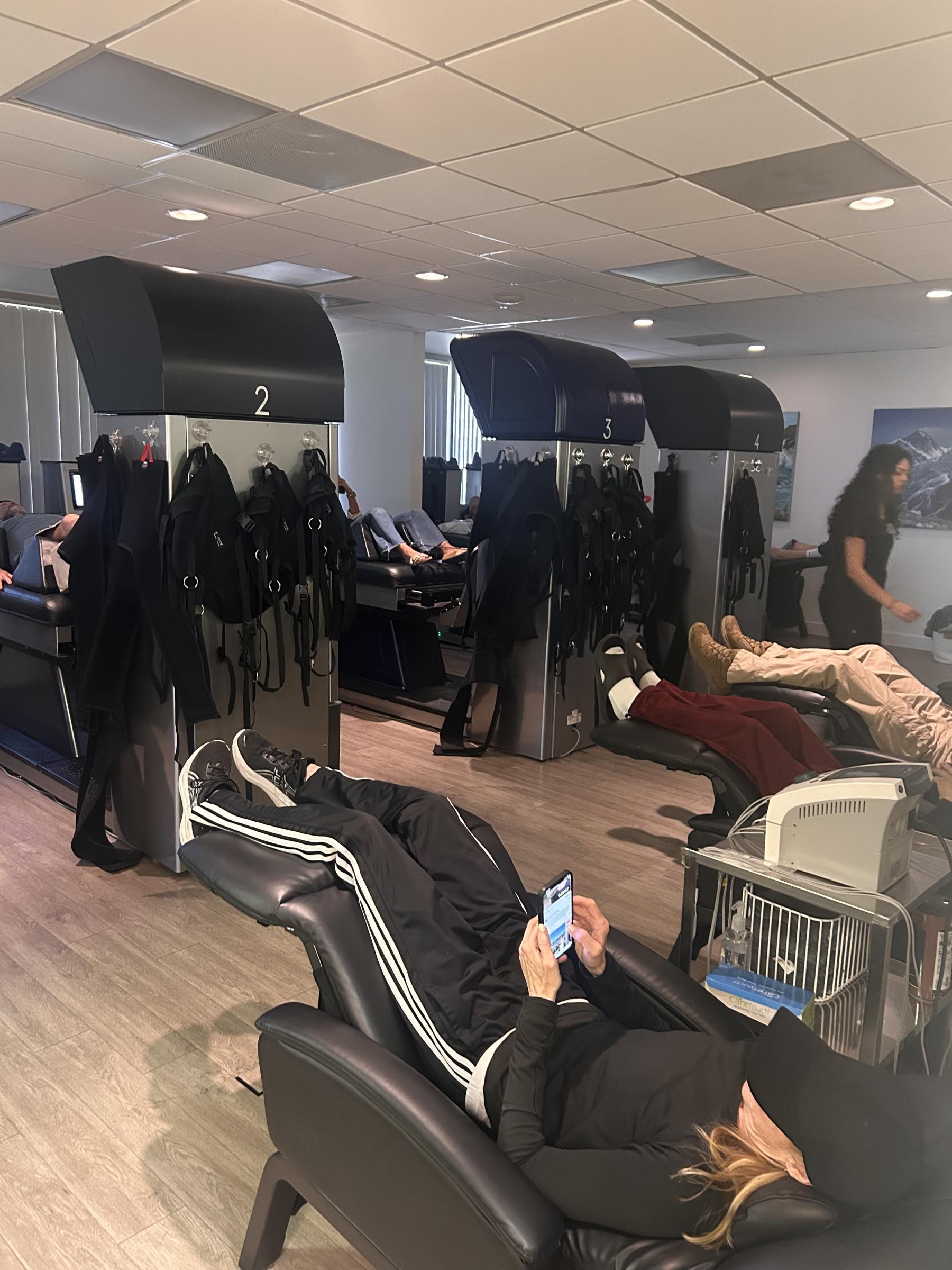
The Spinal Decompression & Chiropractic Center of San Diego uses the DRX9000 exclusively, with four lumbar and three cervical systems. Treatment is not based solely on the diagnosis written on an MRI report.
Dr. Boelk considers the patient's symptoms, the location and characteristics of the disc problem, treatment level, positioning, angle, starting force, body size, tolerance and response to care.
More importantly, candidacy is determined before recommending a treatment program.
Not every patient who has a disc herniation or sciatica is appropriate for spinal decompression. An unhealed fracture, significant osteoporosis, unstable spondylolisthesis, abdominal aortic aneurysm, pregnancy for lumbar treatment, certain malignancies and other conditions can make treatment inappropriate. Previous spinal surgery also requires careful consideration, particularly when fusion or hardware is present at the level that would need to be treated.
There are circumstances in which another form of conservative treatment is more appropriate. Additional imaging or evaluation may be necessary in other cases. Some patients need a surgical opinion.
The purpose of the evaluation is to determine which situation applies to the individual patient.
What the No-Charge Consultation Includes
Patients from La Jolla and throughout San Diego can begin with a No-Charge, No-Obligation Consultation with Dr. Cassidy James Boelk, DC.
The consultation gives Dr. Boelk an opportunity to understand the history of the problem before making any recommendation. This may include discussing when the symptoms began, where the pain travels, the location of numbness or tingling, whether weakness has developed, and which activities make the condition better or worse.
Previous treatment is also important. Dr. Boelk will want to know what has already been tried and whether it provided meaningful or temporary relief.
Patients who already have MRI images, X-rays or radiology reports are encouraged to bring them. Dr. Boelk can review the available imaging and compare those findings with the symptoms the patient is describing.
When appropriate, the consultation may also include a discussion of whether additional examination or imaging would be useful and whether Non-Surgical Spinal Decompression appears to be a reasonable treatment option.
There is no obligation to begin treatment following the consultation.
If Dr. Boelk does not believe a patient is an appropriate candidate for spinal decompression, he will tell them.
One patient who ultimately was not accepted for decompression described the experience this way:
“Very nice Dr. and Honest ! I would definitely recommend anyone who hasn't had metal put in there back in a surgery to go to him and give his program a shot. I believe it would definitely help. Just not in my personal case. As I have a lot of hardware in my back. But I'm glad I took the time to meet with him. It was very informative all around.”
— Toni W., Lake Elsinore, CA
Scheduling a Consultation
Dr. Boelk personally conducts the consultations and reviews each patient's history and available imaging. For that reason, the office reserves a limited number of new-patient consultation appointments during the clinic schedule.
Patients do not need to decide whether they want spinal decompression before scheduling. The purpose of the consultation is to first determine what may be causing the symptoms and whether the treatment is appropriate.
If you already have an MRI, bring the actual images as well as the radiology report. If you do not have an MRI, you can still schedule a consultation.
To ask about the next available No-Charge Consultation, call 619-298-0800.
About Dr. Cassidy James Boelk, DC
Dr. Cassidy James Boelk, DC has more than 22 years of experience with Non-Surgical Spinal Decompression and has performed more than 100,000 spinal decompression treatments.
His professional background includes:
-
Doctor of Chiropractic (DC)
-
Certified Spinal Decompression Doctor
-
Certified Pain-Free Performance Specialist (PPSC)
-
Founder, Non-Surgical Spinal Decompression Training Academy
-
Trains other doctors in spinal decompression protocols and techniques
-
Founding Member, American Spinal Decompression Society
-
Member, International Disc Education Association
-
California X-Ray Radiation Supervisor & Operator
His interest in spinal injuries also comes from personal experience. Dr. Boelk suffered an L5 compression fracture at age 16 and later experienced disc injuries and sciatica. That experience has influenced his approach to evaluating and treating patients who want to remain active despite a significant spinal problem.
L5 Sciatica Evaluation for La Jolla Patients
Pain along the outside of the leg, numbness across the top of the foot, symptoms involving the big toe or changes in foot strength can have several possible causes. When the pattern suggests irritation of the L5 nerve, determining whether the problem originates in the lumbar spine is an important first step.
Patients who already have an MRI can bring the images and report for Dr. Boelk to review. Patients without imaging can still begin with a consultation and discuss whether additional evaluation is appropriate.
The consultation is provided at no charge and there is no obligation to begin treatment. Because Dr. Boelk personally performs these consultations, the number of new-patient consultation appointments available during the week is limited.
The Spinal Decompression & Chiropractic Center of San Diego
5095 Murphy Canyon Road, Suite 300
San Diego, CA 92123
Call 619-298-0800
Live 24/7 Answering Service • Hablamos Español
Related Articles
L4-L5 Herniated Disc: Symptoms & Treatment Options – La Jolla, CA
Who Is a Good Candidate for Non-Surgical Spinal Decompression? La Jolla, CA