Can I Exercise With a Herniated Disc? | San Diego, CA
In many cases, yes—you can exercise with a herniated disc.
But that doesn't mean every exercise is a good idea right now.
This is where people tend to get into trouble. They either become afraid to move at all, or they decide they're going to push through the pain because they've always been active. Neither approach makes much sense without first understanding what the disc is doing and, more importantly, how your body is responding to different movements.
Dr. Cassidy James Boelk, DC has worked with disc injuries and Non-Surgical Spinal Decompression for more than 22 years. He's also dealt with spinal injuries himself and continues to surf, play hockey and exercise.
So when an active patient comes into the office and asks, “Do I have to stop working out?” the answer usually isn't simply yes or no.
Dr. Boelk wants to know what happens when you exercise.
Does your back get a little sore and settle down afterward? Does pain start traveling into your buttock or leg? Does your foot begin tingling? Does bending forward make things worse? What happens under load? How do you feel an hour later? What about the next morning?
Those differences matter.
⭐⭐⭐⭐⭐ “Now, I'm Walking Regularly, Standing Up Straight”
“I've even gotten back to lifting weights!”
“Last year, I spent three months constantly going back and forth between doctor’s appointments and urgent care. The pain was unbearable—I was taking medication regularly just to get through the day. Getting out of bed was excruciating, and walking or standing felt like torture. Every step filled me with dread.
In December, my doctor finally ordered an MRI. That’s when I learned I had an extruded disc pressing on my L5 nerve, which affects the leg and foot. My doctor scheduled two follow-up appointments: one for pain management (spinal injections), and another to evaluate me for surgery.
Then I discovered spinal decompression therapy. I was thrilled to find a non-invasive alternative. I never ended up needing either of those appointments.
Now, I’m walking regularly, standing up straight—something I couldn’t do before. When I first sought help, I was so hunched over that I had to use a cane just to move forward. Because of the pain, I hadn’t exercised in months. But now, I’m doing a program called 75 hard which requires not one but 2 45-minute workouts per day, and I've even gotten back to lifting weights!
I’m so thankful I found this place. It’s conveniently located near my work, which makes it easy to fit sessions into my lunch break. Dr. Boelk and the staff are incredibly friendly and polite—it’s always a pleasure to come in.
The environment is so relaxing that I look forward to each visit. I truly thank God for leading me to this alternative. It’s made such a difference in my life.”
— Amanda, San Diego, CA
Amanda's experience is a good example of something Dr. Boelk tries to explain to active patients.
The goal isn't necessarily to stop exercising forever.
Sometimes exercise needs to be reduced or modified for a period of time. Sometimes certain movements need to come out while others stay in. Then, as the patient improves, activity can gradually be built back up.
The right answer depends on the person and the injury.
Not Sure What You Should or Shouldn't Be Doing?
If you've been diagnosed with a herniated disc and you're afraid you're making it worse—or you've stopped exercising altogether because nobody has given you a clear answer—you can start with a No-Charge Consultation with Dr. Cassidy James Boelk, DC.
Bring your MRI if you have one.
Dr. Boelk can look at the actual images, listen to what happens when you move and exercise, and determine whether your symptoms are consistent with what appears on the MRI.
During your No-Charge Consultation, Dr. Boelk will:
-
Go through how the injury started.
-
Discuss what you're currently able to do.
-
Review which movements or exercises aggravate the problem.
-
Discuss whether symptoms stay in the back or travel into the buttock or leg.
-
Review any numbness, tingling or weakness.
-
Go over treatments you've already tried.
-
Review your actual MRI images and report, if available.
-
Compare the MRI findings with your symptoms.
-
Discuss whether additional examination or imaging may be appropriate.
-
Determine whether Non-Surgical Spinal Decompression may be an option.
-
Tell you if he doesn't believe you're a candidate.
-
Answer your questions about returning to activity.
You don't need an MRI to schedule.
There is no charge for the consultation and no obligation to start treatment.
Dr. Boelk performs these consultations himself while also treating his existing patients, so only a limited number can be set aside during the clinic schedule.
Call 619-298-0800 and ask for the next available No-Charge Consultation with Dr. Cassidy James Boelk, DC.
The Question Isn't Just “Can I Exercise?”
A better question is:
What can you do right now without aggravating the problem?
A 30-year-old who has a small disc herniation, mild localized back pain and no neurological symptoms isn't necessarily in the same situation as someone with a large extrusion, severe sciatica and weakness in the foot.
Yet both may have been told they have a “herniated disc.”
That's why Dr. Boelk doesn't like blanket advice such as “Never lift weights again” or “Just strengthen your core and push through it.”
There needs to be some context.
Walking may feel great for one patient and aggravate another.
One person tolerates extension very well while another doesn't.
A movement that eventually belongs in someone's rehabilitation program may be the wrong movement during an irritated stage.
Exercise isn't automatically good because it's exercise.
And it isn't automatically dangerous because you have a herniated disc.
Pay Attention to What Happens to the Leg
This is something Dr. Boelk wants active patients to understand.
Muscle fatigue during exercise is expected. A little stiffness can happen too.
What gets his attention is when an exercise starts changing the neurological symptoms.
Maybe you begin a set with pain mostly around the lower back, but by the end of it the pain is running into the buttock and calf.
Maybe your foot starts tingling.
Maybe numbness becomes more noticeable.
Maybe the leg feels weaker afterward.
Those are different signals than normal muscular effort.
Dr. Boelk is particularly interested when symptoms start traveling farther away from the lower back and farther down the leg.
If that keeps happening with a particular movement, continuing to hammer away at that movement because it's supposed to be “good for your back” doesn't make much sense.
Heavy Loading May Need to Wait
One of the harder conversations Dr. Boelk has with active patients involves exercises they love.
Squats. Deadlifts. Leg presses. Heavy bent-over movements.
It doesn't mean these are bad exercises.
It means there may be a time when loading an already irritated lumbar disc with a heavy barbell isn't the smartest way to prove that your back is getting better.
The same patient may eventually return to those exercises.
But there's a difference between returning to load progressively and trying to lift exactly the way you did before the injury while you're still having significant disc-related symptoms.
Dr. Boelk would rather have an athlete temporarily change the program than turn a problem that might have settled down into something that keeps getting aggravated week after week.
Don't Assume Stretching Is Always the Safe Alternative
Patients often stop lifting and start stretching everything instead.
That can create its own problems.
Someone with pain running down the back of the leg may assume the hamstring is tight and stretch it aggressively several times a day.
But if that “tight hamstring” sensation is partly related to an irritated nerve, aggressive stretching may not feel very good at all.
If a stretch causes burning, tingling or shooting pain to travel farther down the leg, Dr. Boelk wants to know about it.
The same goes for repeatedly forcing the lower back into a position simply because you saw an exercise online labeled “best exercise for a herniated disc.”
There isn't one exercise that's best for every disc injury.
Your response to the movement matters.
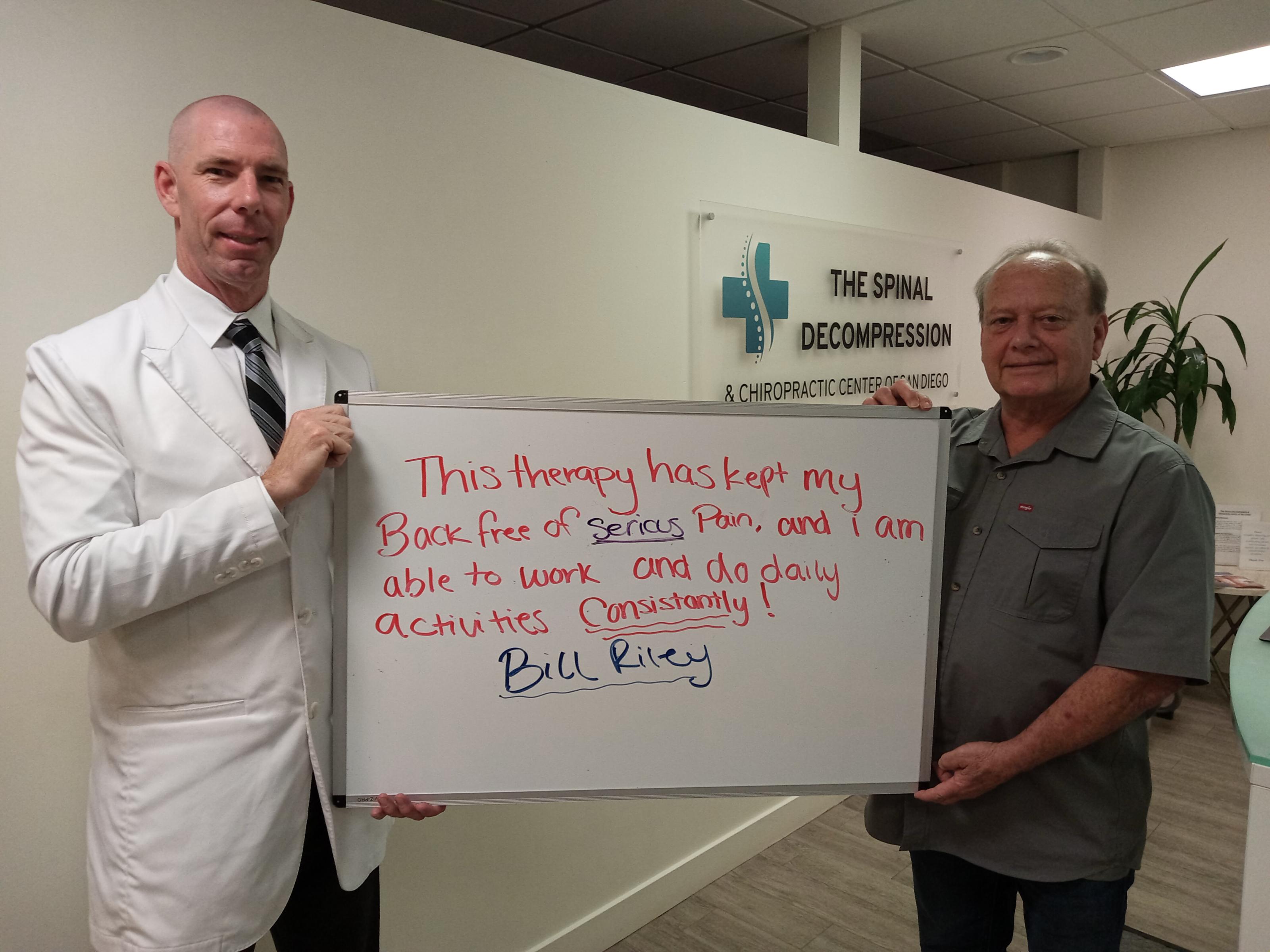
⭐⭐⭐⭐⭐ “The Improvement Has Allowed Me to Get Back to Hiking, Traveling, and Enjoying Life Again”
“My sciatica was gone and I was nearly back to normal.”
“I have had an outstanding experience with Dr. Boelk and his staff at The Spinal Decompression & Chiropractic Center of San Diego.
They follow a very structured treatment protocol and utilize the best spinal decompression equipment available. I've been treated elsewhere using lower-quality decompression systems and never experienced meaningful improvement.
Dr. Boelk is attentive, professional, and genuinely cares about every patient. You can see it in the way he interacts with everyone who walks through the door.
After about 12 treatments, my sciatica was gone and I was nearly back to normal. Honestly, I wasn't sure I would ever heal. What surprised me most was that after my very first treatment, I experienced significant relief and was able to sleep mostly pain-free for the first time in months.
The improvement has allowed me to get back to hiking, traveling, and enjoying life again.
This treatment was one of the best investments I've ever made.
Thank you, Dr. Boelk and your entire team.”
— Michael Langsdale, San Diego, CA
Getting someone active again is different from simply telling them to rest until they don't hurt.
Dr. Boelk wants to know what the patient actually needs their back to do.
A surfer has different demands than someone who wants to garden.
A nurse working a 12-hour shift has different demands than someone sitting at a computer.
Someone trying to return to deadlifting needs a different progression than someone whose goal is walking three miles with their spouse.
“Exercise” covers a lot of ground.
Resting Forever Isn't the Goal Either
When exercise hurts, people can become afraid of movement very quickly.
They stop lifting.
Then they stop walking as much.
Then they start avoiding bending.
Pretty soon every movement feels threatening.
That's not where most people want to end up.
There are situations where an irritated disc needs a period of reduced activity, but that doesn't mean the long-term goal is to protect your back from movement forever.
The goal is usually to find movements you tolerate, maintain as much safe activity as possible, address the underlying problem when appropriate, and then progressively return to more demanding activity.
That progression is different for everybody.
When Dr. Boelk Wants You to Be More Careful
Exercise questions become more important when neurological symptoms are involved.
Tell Dr. Boelk if you have persistent or increasing numbness, one leg is becoming weaker, you're having trouble lifting the front of your foot, your foot begins slapping when you walk, or you're repeatedly catching your toes.
That's not something to simply train through.
Most disc herniations and sciatica aren't emergencies, but rapidly progressing weakness, new bowel or bladder dysfunction, difficulty urinating, or numbness around the groin or saddle region requires prompt medical evaluation rather than waiting for a routine spinal decompression consultation.
Where Does Non-Surgical Spinal Decompression Fit?
Not everyone with a herniated disc needs spinal decompression.
Dr. Boelk evaluates whether the disc injury, symptoms, neurological findings, imaging and overall medical history make someone an appropriate candidate.
The Spinal Decompression & Chiropractic Center of San Diego uses the DRX9000 exclusively.
Patients Dr. Boelk evaluates commonly have problems such as:
-
Lumbar disc bulges
-
Lumbar disc herniations
-
Disc-related sciatica
-
Degenerative disc disease
-
Foraminal narrowing
-
Selected cases of spinal stenosis
-
Chronic disc-related back and leg pain
There are also patients he won't treat with decompression.
Significant osteoporosis, an unhealed fracture, unstable spondylolisthesis, abdominal aortic aneurysm, pregnancy for lumbar decompression, certain malignancies and other medical or structural conditions can make treatment inappropriate.
Previous spinal surgery also needs to be reviewed carefully, particularly when fusion or metal hardware is present at the level that would need treatment.
★ Sometimes the Consultation Ends Without Decompression
Jeff J. came from Tucson to meet with Dr. Boelk and discuss his back.
After reviewing his situation, they determined that decompression wasn't the appropriate option.
“After a honest and forthright conversation, we both determined that surgery was my only option to correct my back issues.”
“I found this terrific practice on social media. I followed up and did my own research so I decided to pay them a visit. The place is clean, well organized and run by a very efficient receptionist. I met with the doctor and after a honest and forthright conversation, we both determined that surgery was my only option to correct my back issues. I will return as a customer when the time is right.”
— Jeff J., Tucson, AZ
That's part of the reason for evaluating someone before recommending treatment.
A herniated disc on an MRI doesn't automatically mean spinal decompression is appropriate.
Dr. Cassidy James Boelk, DC
Dr. Boelk has spent more than two decades working with disc injuries, sciatica and Non-Surgical Spinal Decompression.
-
Doctor of Chiropractic
-
More than 22 years of Non-Surgical Spinal Decompression experience
-
More than 100,000 spinal decompression treatments
-
Certified Spinal Decompression Doctor
-
Certified Pain-Free Performance Specialist (PPSC)
-
Founder, Non-Surgical Spinal Decompression Training Academy
-
Trains other doctors in spinal decompression protocols and techniques
-
Founding Member, American Spinal Decompression Society
-
Member, International Disc Education Association
-
California X-Ray Radiation Supervisor & Operator
His perspective on exercise isn't purely academic.
Dr. Boelk suffered an L5 compression fracture at 16 and later dealt with disc injuries and sciatica himself. He continues to surf, play hockey and exercise.
So he understands why “Just stop exercising” isn't a very satisfying answer for an active person.
The better goal is figuring out what you can do now, what may need to change temporarily, and what it will take to get you back to the activities that matter to you.
Not Sure Whether You Should Keep Exercising?
You don't have to choose between lying on the couch and pretending nothing is wrong.
If you have a herniated disc and exercise keeps causing back pain, sciatica, numbness or tingling, come in and let Dr. Boelk look at the situation.
Your No-Charge Consultation includes:
-
One-on-one time with Dr. Cassidy James Boelk, DC
-
Review of how your injury started
-
Discussion of your current exercise and activity
-
Review of movements that aggravate or relieve the symptoms
-
Discussion of any sciatica, numbness, tingling or weakness
-
Review of treatments you've already tried
-
Review of your actual MRI images and report, if available
-
Comparison of the MRI findings with your symptoms
-
Discussion of whether further examination or imaging may be appropriate
-
An assessment of whether Non-Surgical Spinal Decompression may be an option
-
An honest answer if Dr. Boelk doesn't believe you're a candidate
-
Time to ask questions about getting back to activity
There is no charge and no obligation to begin treatment.
You don't need an MRI to schedule.
Dr. Boelk personally performs these consultations while continuing to treat his existing patients, so only a limited number can be set aside during the clinic schedule.
The decision today isn't whether you're giving up exercise or starting spinal decompression.
It's simply whether you'd like Dr. Boelk to look at what's going on and help you understand what may make sense from here.
Call 619-298-0800
Ask for the next available No-Charge Consultation with Dr. Cassidy James Boelk, DC.
Bring your MRI images and report if you have them. If you don't, that's okay.
The Spinal Decompression & Chiropractic Center of San Diego
5095 Murphy Canyon Road, Suite 300
San Diego, CA 92123
619-298-0800
SanDiegoBackCare.com
Live 24/7 Answering Service • Hablamos Español
Related Articles
L4-L5 Herniated Disc: Symptoms & Treatment Options - Kearny Mesa, San Diego