Why Is My Sciatica Worse in the Morning? | Tierrasanta, CA
If your sciatica is noticeably worse when you first wake up, the pattern itself can provide useful information about what may be irritating your lower back or sciatic nerve.
A common description is: “I feel okay while I'm lying down, but as soon as I get out of bed, my leg starts hurting.”
For someone else, the first few steps are manageable, but bending down to put on socks or shoes immediately sends pain into the buttock, thigh or calf. Some people wake with tingling or numbness in the foot that gradually improves once they start moving.
Dr. Cassidy James Boelk, DC has spent more than 22 years working with lumbar disc injuries and sciatica and has performed more than 100,000 spinal decompression treatments. He has seen this morning pattern repeatedly.
There isn't one explanation that fits every patient. But when sciatica is related to a lumbar disc problem, what happens to the discs overnight—and what you do during the first part of the morning—may help explain why those first 10 or 20 minutes can be so uncomfortable.
“After About 12 Treatments, My Sciatica Was Gone”
Michael Langsdale had reached the point where he wasn't sure his sciatica was ever going to improve.
He described his experience:
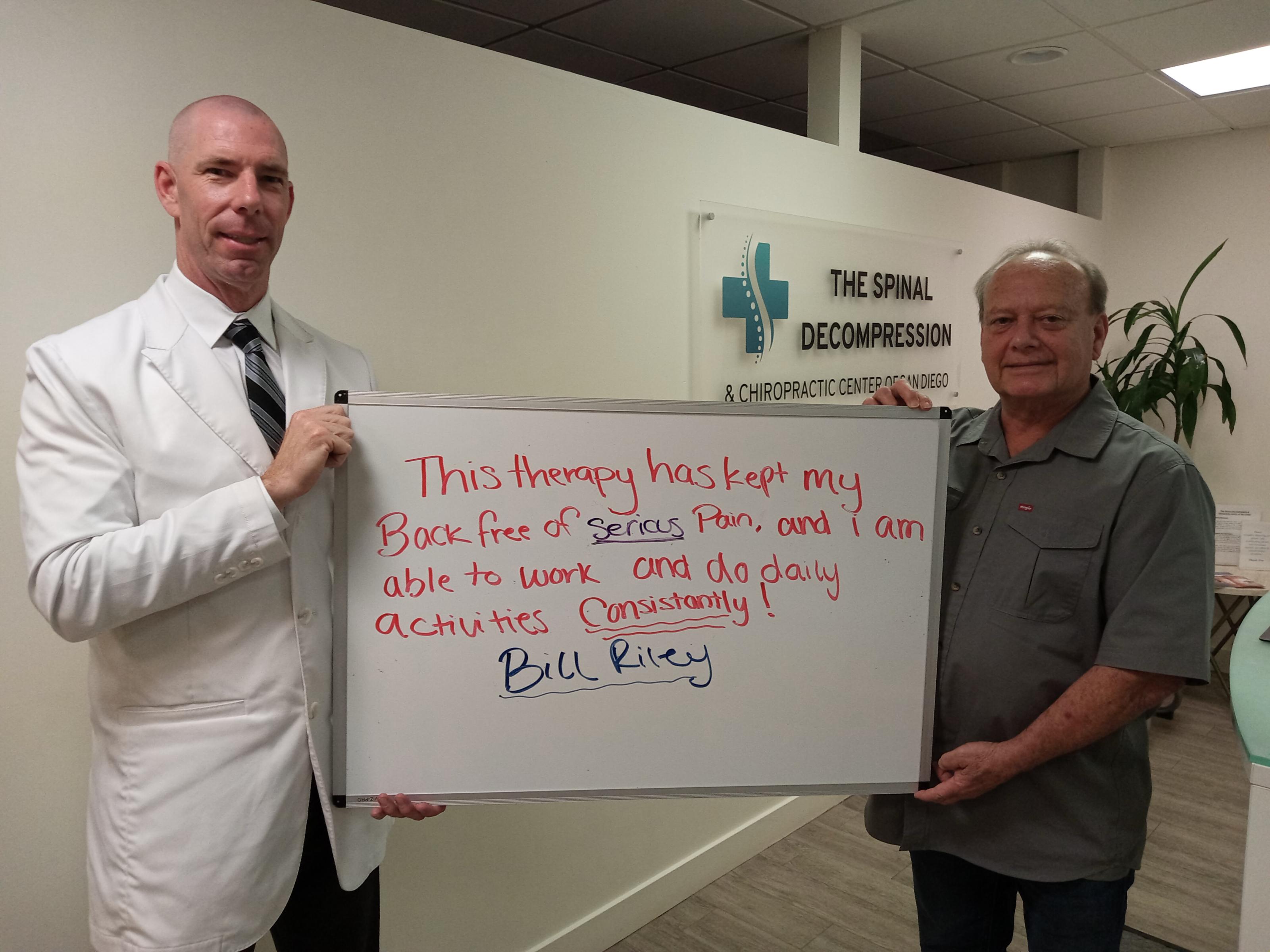
“I have had an outstanding experience with Dr. Boelk and his staff at The Spinal Decompression & Chiropractic Center of San Diego.
They follow a very structured treatment protocol and utilize the best spinal decompression equipment available. I've been treated elsewhere using lower-quality decompression systems and never experienced meaningful improvement.
Dr. Boelk is attentive, professional, and genuinely cares about every patient. You can see it in the way he interacts with everyone who walks through the door.
After about 12 treatments, my sciatica was gone and I was nearly back to normal. Honestly, I wasn't sure I would ever heal. What surprised me most was that after my very first treatment, I experienced significant relief and was able to sleep mostly pain-free for the first time in months.
The improvement has allowed me to get back to hiking, traveling, and enjoying life again.
This treatment was one of the best investments I've ever made.
Thank you, Dr. Boelk and your entire team.”
— Michael Langsdale, San Diego, CA
You Can Start With a No-Charge Consultation
If sciatica is affecting your mornings, sleep, work, walking or ability to exercise, patients from Tierrasanta can start by sitting down with Dr. Boelk for a No-Charge, No-Obligation Consultation.
You don't need to know whether spinal decompression is right for you before you come in. That's part of what the consultation is intended to determine.
Dr. Boelk will want to hear the whole story.
When did the problem begin? Is the pain mainly in your back, or does it travel into the buttock or leg? Does it reach the calf or foot? Are you dealing with numbness, tingling or burning? Has your strength changed?
He'll also want to know what happens after you wake up.
If you're terrible for the first 15 minutes but improve once you walk around, mention that. If bending forward to put on a shoe immediately triggers the leg pain, mention that too. The same applies if sitting, driving, standing or walking changes the symptoms later in the day.
If you already have an MRI, bring the images along with the written report. Dr. Boelk prefers to look at the actual images himself and compare them with what you're experiencing.
If you haven't had an MRI, that's okay. You can still schedule the consultation.
After reviewing the history and available imaging, Dr. Boelk can discuss whether further evaluation is appropriate and whether your condition appears to be one that may respond to Non-Surgical Spinal Decompression.
There is no obligation to begin treatment.
Dr. Boelk personally performs these consultations and reviews the available imaging, so only a limited number of No-Charge Consultation appointments are available during the clinic schedule.
Call 619-298-0800 to ask about the next available appointment.
Why Can a Disc Problem Feel Worse After Sleeping?
Spinal discs aren't dry cushions between the bones of the spine. They contain a considerable amount of water.
During the day, the discs experience loading as you sit, stand, walk and move. Over the course of the day they lose some fluid. When you lie down and sleep for several hours, that loading decreases and the discs naturally rehydrate.
This is normal physiology.
Most people never notice it.
But when a lumbar disc is already irritated, bulging or herniated, some patients notice that their back or leg symptoms are particularly sensitive after several hours of lying down.
This is one possible explanation for why someone can wake with significant symptoms and then gradually feel better after getting up and moving.
It doesn't mean that everyone with morning sciatica has a herniated disc.
Sciatica describes symptoms involving the sciatic nerve; it doesn't tell you by itself why the nerve is irritated. Disc problems are one possibility. Foraminal narrowing, spinal stenosis and other conditions can produce leg symptoms as well.
This is why the rest of the pattern matters.
What Happens When You Get Out of Bed?
Sometimes the first clue isn't simply that the patient hurts in the morning. It's what makes the pain suddenly become worse.
For example, a patient gets out of bed and stands comfortably.
Then he sits down, leans forward to put on a sock and gets a sharp pain through the buttock and down the leg.
He stands back up and the pain begins to settle.
That is worth knowing.
Another patient may have the opposite experience. Sitting feels fine, but after five or ten minutes of standing and walking, the leg begins to ache, burn or go numb.
Both people may describe their problem as “sciatica,” but the behavior of their symptoms is very different.
Try paying attention to these patterns rather than simply rating the pain from 1 to 10.
Don't Make Your First Move of the Day an Aggressive Stretch
When the leg feels tight in the morning, stretching seems logical.
Sometimes it feels good.
Sometimes it doesn't.
An irritated nerve can create a tight or pulling sensation through the hamstring, calf and even into the foot. That sensation isn't necessarily the same thing as having a short muscle that needs to be stretched harder.
If a gentle stretch feels comfortable and you feel better afterward, that's one thing.
If bending forward and stretching the leg causes pain to travel farther down the leg, increases burning or tingling, or makes the foot more numb, forcing the stretch harder may be doing exactly the opposite of what you intended.
The first few minutes after getting out of bed don't have to become a flexibility test.
Try moving around comfortably first.
Rolling onto your side and using your arms to help yourself out of bed may also be more comfortable than performing a forceful sit-up.
When putting on socks or shoes, try bringing the foot toward you rather than repeatedly folding your entire upper body toward the floor.
Small changes can sometimes make the morning considerably easier.
What About Walking in the Morning?
For some people with sciatica, a short walk is one of the things that helps them loosen up.
Again, watch the response.
If the first few steps are stiff but the leg gradually feels better, that's different from pain that travels progressively farther down the leg the longer you walk.
You don't need to force yourself through a long walk because someone told you walking is good for sciatica.
Start with what you tolerate.
Five or ten comfortable minutes may be more useful than pushing through 45 minutes while the leg becomes progressively more painful or numb.
When Morning Sciatica Shouldn't Be Ignored
Pain that is gradually improving is different from neurological symptoms that are getting worse.
Persistent numbness deserves evaluation, particularly when it is accompanied by weakness.
If one leg is becoming noticeably weaker, you are beginning to catch your toes when walking, or you are having increasing difficulty lifting the front of your foot, don't simply continue trying home stretches for another month.
Rapidly progressing weakness, new bowel or bladder dysfunction, difficulty urinating, or numbness involving the groin or saddle area requires prompt medical attention.
Who Is a Candidate for Non-Surgical Spinal Decompression?
Dr. Boelk evaluates patients with conditions including lumbar disc bulges and herniations, degenerative disc disease, disc-related sciatica, foraminal narrowing and selected cases of spinal stenosis.
But the diagnosis on an MRI report is only part of the decision.
A patient can have several disc bulges on an MRI while only one level appears to correspond with the actual symptoms. Another patient can have an impressive-looking MRI finding that isn't the primary source of the pain.
That is why Dr. Boelk reviews the images, history and clinical findings together rather than treating an MRI report by itself.
The Spinal Decompression & Chiropractic Center of San Diego uses the DRX9000 exclusively. When treatment is appropriate, factors such as the spinal level, positioning, angle, starting force, body size, tolerance and response to treatment are considered.
There are also patients who should not receive decompression.
Pregnancy is a contraindication for lumbar treatment. An unhealed fracture, significant osteoporosis, unstable spondylolisthesis, abdominal aortic aneurysm, certain malignancies and other medical or structural conditions can also make treatment inappropriate.
Previous surgery needs to be evaluated carefully, particularly if there is fusion or metal hardware at the level that would need treatment.
Sometimes the Most Important Answer Is “You're Not a Candidate”
Toni W. came to the office to see whether decompression could help her back. Because of the hardware from previous surgery, Dr. Boelk did not believe she was an appropriate candidate.
She later wrote:
“Very nice Dr. and Honest ! I would definitely recommend anyone who hasn't had metal put in there back in a surgery to go to him and give his program a shot. I believe it would definitely help. Just not in my personal case. As I have a lot of hardware in my back. But I'm glad I took the time to meet with him. It was very informative all around.”
— Toni W., Lake Elsinore, CA
That is why candidacy is determined before recommending a treatment program.
The goal isn't to treat everybody who walks through the door. It's to identify the people Dr. Boelk believes he can appropriately help.
What If You're Coming From Outside San Diego?
The office also sees patients who travel from outside San Diego County, other states and, on occasion, other countries.
For those patients, it becomes even more important to determine whether the condition appears appropriate for care before making extensive travel arrangements.
If you live outside the area and already have an MRI, have the images and report available. Previous treatment records can also be helpful.
Traveling farther doesn't make someone a better candidate. The same clinical criteria apply regardless of where a patient lives.
About Dr. Cassidy James Boelk, DC
Dr. Cassidy James Boelk, DC has worked with Non-Surgical Spinal Decompression for more than 22 years and has performed more than 100,000 spinal decompression treatments.
He is a Certified Spinal Decompression Doctor and Certified Pain-Free Performance Specialist (PPSC). He founded the Non-Surgical Spinal Decompression Training Academy and trains other doctors in spinal decompression protocols and techniques.
Dr. Boelk is also a Founding Member of the American Spinal Decompression Society, a Member of the International Disc Education Association and a California X-Ray Radiation Supervisor & Operator.
His interest in spinal injuries is personal as well. At 16, Dr. Boelk suffered an L5 compression fracture. He later experienced disc injuries and sciatica himself.
That background has shaped the way he approaches patients who want more than temporary relief—they want to get back to walking, exercising, working and living normally again.
Sciatica Treatment Options for Tierrasanta Patients
If you wake up with sciatica every morning and spend the first part of the day trying to get your leg to calm down, the pattern is worth understanding.
Maybe it is related to a lumbar disc problem. Maybe it isn't.
The first step is figuring that out.
Patients from Tierrasanta can schedule a No-Charge, No-Obligation Consultation with Dr. Cassidy James Boelk, DC.
Bring your MRI images and report if you have them. If you don't have an MRI, you can still come in.
If Dr. Boelk believes Non-Surgical Spinal Decompression may be appropriate, he can explain why and what treatment would involve. If he doesn't believe you're a candidate, he'll tell you.
Because these consultations are personally performed by Dr. Boelk, availability is limited within the weekly clinic schedule.
Call 619-298-0800 to ask about the next available No-Charge Consultation.
The Spinal Decompression & Chiropractic Center of San Diego
5095 Murphy Canyon Road, Suite 300
San Diego, CA 92123
619-298-0800
SanDiegoBackCare.com
Live 24/7 Answering Service • Hablamos Español