Why Is My Sciatica Worse in the Morning? | Chula Vista, CA
There is a particular pattern Dr. Cassidy James Boelk, DC hears from patients with sciatica all the time:
“I actually feel pretty good when I'm lying in bed. Then I get up in the morning and the pain shoots down my leg.”
For someone dealing with this every day, the morning can become frustrating. Getting out of bed hurts. Bending down to put on socks and shoes can be brutal. The back of the leg may feel incredibly tight, and the foot may tingle or feel partially numb.
Then you start moving around.
Ten, 20 or 30 minutes later, you may feel noticeably better.
Why?
There isn't one explanation for every patient with sciatica, but when the symptoms are coming from an irritated lumbar disc and nerve, what happens to the spine overnight may be part of the reason.
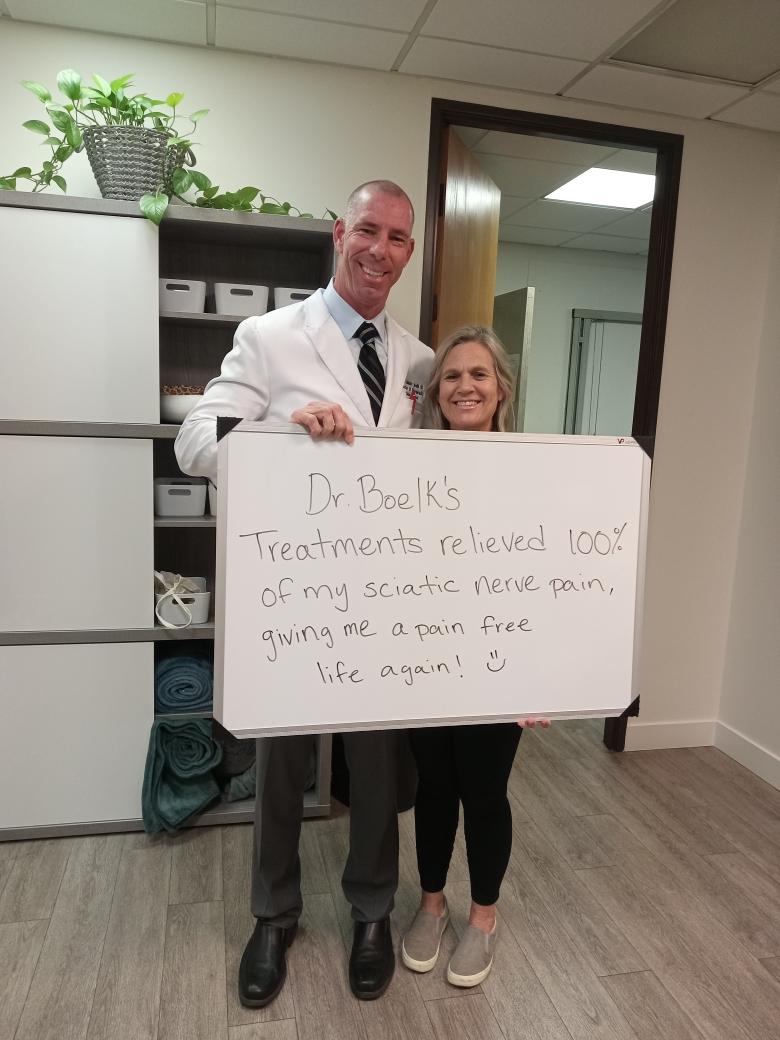
Dr. Boelk has spent more than 22 years working with lumbar disc injuries, herniated discs and sciatica and has performed more than 100,000 spinal decompression treatments. Morning symptoms are one of the patterns he looks at when trying to understand what is actually happening with a patient's back.
“Getting Out of Bed Was Excruciating”
Amanda's experience is a good example of how severe a lumbar disc injury can become.
“Last year, I spent three months constantly going back and forth between doctor’s appointments and urgent care. The pain was unbearable—I was taking medication regularly just to get through the day. Getting out of bed was excruciating, and walking or standing felt like torture. Every step filled me with dread.
In December, my doctor finally ordered an MRI. That’s when I learned I had an extruded disc pressing on my L5 nerve, which affects the leg and foot. My doctor scheduled two follow-up appointments: one for pain management (spinal injections), and another to evaluate me for surgery.
Then I discovered spinal decompression therapy. I was thrilled to find a non-invasive alternative. I never ended up needing either of those appointments.
Now, I’m walking regularly, standing up straight—something I couldn’t do before. When I first sought help, I was so hunched over that I had to use a cane just to move forward. Because of the pain, I hadn’t exercised in months. But now, I’m doing a program called 75 hard which requires not one but 2 45-minute workouts per day, and I've even gotten back to lifting weights!
I’m so thankful I found this place. It’s conveniently located near my work, which makes it easy to fit sessions into my lunch break. Dr. Boelk and the staff are incredibly friendly and polite—it’s always a pleasure to come in.
The environment is so relaxing that I look forward to each visit. I truly thank God for leading me to this alternative. It’s made such a difference in my life.”
— Amanda, San Diego, CA
If Your Mornings Are Starting Like This, Come Talk With Dr. Boelk
Patients from Chula Vista who are dealing with persistent sciatica can begin with a No-Charge, No-Obligation Consultation at The Spinal Decompression & Chiropractic Center of San Diego.
The consultation is exactly what it sounds like. It is an opportunity to sit down with Dr. Cassidy James Boelk, DC and figure out whether the problem is something he may be able to help with.
He'll go through how the problem started, where the pain travels and what your mornings are actually like.
Does your leg hurt the second you stand up?
Does bending over to put on a shoe trigger the pain?
Does the leg feel better once you have walked around for a while?
Is the problem mainly pain, or are you also dealing with burning, tingling, numbness or weakness?
He will also want to know what happens during the rest of your day. Sitting, driving, standing and walking can all provide useful information.
If you've already tried physical therapy, chiropractic care, injections, medications or other treatment, that history matters too.
Bring your MRI if you have one. Bring the actual images along with the report, because Dr. Boelk prefers to look at the images himself and compare what he sees with your symptoms.
No MRI? You can still come in.
After reviewing your history and available imaging, Dr. Boelk can discuss whether additional evaluation is needed and whether Non-Surgical Spinal Decompression may be appropriate.
There is no obligation to begin treatment, and not everyone is accepted as a decompression patient.
Because Dr. Boelk personally performs these consultations and reviews the available imaging, only a limited number of No-Charge Consultation appointments are available during the clinic schedule.
Call 619-298-0800 to ask about the next available appointment.
So Why Can Sciatica Hurt More in the Morning?
Your spinal discs contain a significant amount of water.
Throughout the day, your spine is loaded as you sit, stand, walk and go about your normal activities. The discs gradually lose some fluid.
At night, that changes.
When you lie down for several hours, the load on the spine is reduced and the discs naturally rehydrate.
That process is normal. It happens whether your back hurts or not.
But if a disc in the lower back is already injured, bulging or herniated, some patients find that their symptoms are more sensitive after spending several hours lying down.
That may help explain why someone can feel relatively comfortable in bed and then hurt significantly when they first stand up.
It is not a diagnosis by itself. Plenty of things can cause morning back pain, and sciatica can have causes other than a disc herniation.
The pattern simply gives Dr. Boelk another piece of information to work with.
What You Do Next Can Matter Too
Think about the first few minutes after you get out of bed.
You bend over to get dressed.
You sit down and reach toward your feet to put on socks.
You bend again for your shoes.
Maybe you lean over the bathroom sink.
Then you sit in a car and drive to work.
For someone whose lumbar disc and nerve are already irritated, that can be a rough way to start the day.
This doesn't mean bending is bad or that you should be afraid to move your spine. It means that repeatedly forcing an already painful movement first thing in the morning may not make much sense.
Try getting out of bed by rolling onto your side and using your arms to help yourself upright rather than doing a hard sit-up.
Move around for a few minutes.
When getting dressed, bring the foot toward you when possible rather than repeatedly folding your entire upper body toward the floor.
Some people also find a short, easy walk more comfortable than immediately sitting down and aggressively stretching.
That “Tight Hamstring” Might Be Your Sciatic Nerve
This is something Dr. Boelk sees constantly.
The back of the leg feels tight, so the patient stretches the hamstring.
It still feels tight, so they stretch harder.
Then they repeat the same stretch several times a day.
The problem is that an irritated sciatic nerve can create a pulling or tight sensation that feels a lot like a short hamstring.
A normal muscular stretch is one thing.
If bending forward and stretching the leg causes pain to shoot farther down toward the calf or foot, creates burning or tingling, or noticeably increases numbness, that is different.
Pay attention to what the movement actually does to your symptoms.
You don't get extra credit for forcing your way through a stretch that makes the leg progressively worse.
Watch What Happens After You Start Moving
Morning pain is only part of the story.
What happens after you get moving can be just as helpful.
Some patients tell Dr. Boelk the first ten minutes are terrible, but once they begin walking they feel much better.
Others are exactly the opposite. They feel reasonably good when they first stand, but the farther they walk, the more the leg begins to hurt or go numb.
Someone else may be able to walk almost indefinitely but cannot sit through the drive from Chula Vista without the leg becoming painful.
These aren't trivial details.
They can help differentiate one type of problem from another and help determine what should be examined more closely.
When Should Morning Sciatica Be Evaluated?
If the problem is happening occasionally and steadily improving, that is different from waking up with the same radiating leg pain every morning for weeks or months.
Persistent numbness deserves attention as well.
Weakness is more concerning.
If one leg or foot is clearly losing strength, your toes are starting to catch while you walk, or lifting the front of the foot is becoming difficult, don't simply keep trying different stretches you found online.
Rapidly progressing weakness, new bowel or bladder dysfunction, difficulty urinating, or numbness involving the groin or saddle area requires prompt medical attention.
Who May Be a Candidate for Non-Surgical Spinal Decompression?
When sciatica is associated with an appropriate lumbar disc or degenerative condition, Non-Surgical Spinal Decompression may be an option.
Some of the conditions Dr. Boelk evaluates include lumbar disc bulges, disc herniations, degenerative disc disease, disc-related sciatica, foraminal narrowing and selected cases of spinal stenosis.
But an MRI report that says “disc herniation” does not automatically mean decompression is appropriate.
Dr. Boelk looks at the actual images when available and compares them with the patient's symptoms and examination findings. The level involved, spinal stability, previous surgery, overall health and other factors all matter.
There are also clear situations where treatment may not be appropriate.
An unhealed fracture, significant osteoporosis, unstable spondylolisthesis, abdominal aortic aneurysm, pregnancy for lumbar decompression, certain malignancies and other medical or structural problems may rule treatment out.
Previous lumbar surgery has to be considered carefully, particularly if there is fusion or metal hardware at the level that would need to be treated.
That screening is done before treatment is recommended.
Some Patients Are Told Not to Do Decompression
Toni W. came to the office hoping spinal decompression might be an option. Because of the amount of hardware in her back, Dr. Boelk did not believe she was an appropriate candidate.
She wrote:
“Very nice Dr. and Honest ! I would definitely recommend anyone who hasn't had metal put in there back in a surgery to go to him and give his program a shot. I believe it would definitely help. Just not in my personal case. As I have a lot of hardware in my back. But I'm glad I took the time to meet with him. It was very informative all around.”
— Toni W., Lake Elsinore, CA
That is part of what the consultation is for.
Sometimes the answer is yes. Sometimes additional information is needed. And sometimes the answer is that decompression simply isn't the right treatment.
What If You Don't Live Near San Diego?
The office also sees patients who travel from outside San Diego County and, in some cases, much farther away.
For an out-of-town patient, Dr. Boelk still wants to determine candidacy first.
There is no reason for someone to arrange travel for spinal decompression simply because an MRI shows a disc problem. The imaging, symptoms and overall history still have to make sense together.
If you are coming from outside the area, have your MRI images, radiology reports and other relevant records available whenever possible.
Distance doesn't change the criteria Dr. Boelk uses to decide whether someone should be treated.
More Than Two Decades Focused on Spinal Decompression
Dr. Cassidy James Boelk, DC has more than 22 years of experience with Non-Surgical Spinal Decompression and has performed more than 100,000 spinal decompression treatments.
He is a Certified Spinal Decompression Doctor, Certified Pain-Free Performance Specialist (PPSC), Founder of the Non-Surgical Spinal Decompression Training Academy, a Founding Member of the American Spinal Decompression Society, a Member of the International Disc Education Association and a California X-Ray Radiation Supervisor & Operator.
He also trains other doctors in spinal decompression protocols and techniques.
His interest in spinal injuries started personally. Dr. Boelk suffered an L5 compression fracture when he was 16 and later dealt with disc injuries and sciatica himself.
Sciatica Help for Chula Vista Patients
If you are waking up every morning and waiting for your leg to “loosen up,” don't ignore the pattern indefinitely.
Morning sciatica does not automatically mean you have a herniated disc, and it certainly does not automatically mean you need spinal decompression.
But recurring pain, numbness, tingling or weakness is worth understanding.
Patients from Chula Vista can begin with a No-Charge, No-Obligation Consultation with Dr. Cassidy James Boelk, DC.
Bring your MRI images and report if you already have them. If you don't have an MRI, you can still schedule the consultation.
Dr. Boelk will review the situation and tell you whether he believes you may be a candidate for treatment. If he doesn't believe decompression is appropriate, he'll tell you that too.
Only a limited number of these consultations are available during the weekly clinic schedule because Dr. Boelk personally conducts them.
Call 619-298-0800 to ask about the next available No-Charge Consultation.
The Spinal Decompression & Chiropractic Center of San Diego
5095 Murphy Canyon Road, Suite 300
San Diego, CA 92123
619-298-0800
SanDiegoBackCare.com
Live 24/7 Answering Service • Hablamos Español