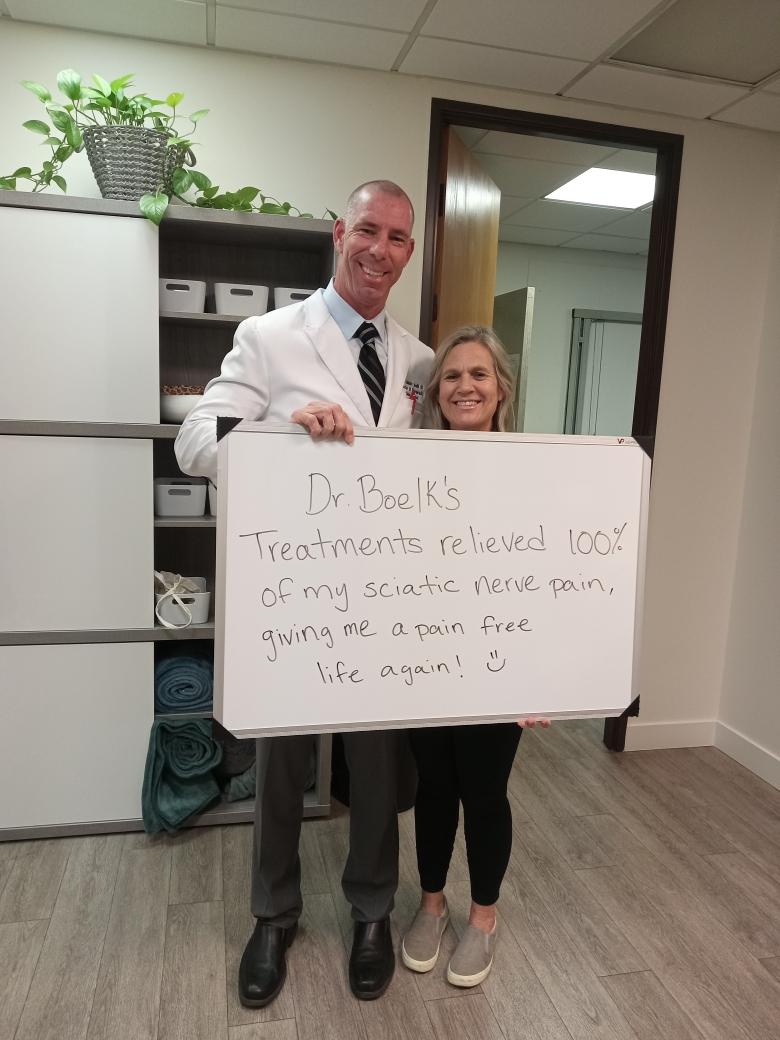
Why Is My Sciatica Not Going Away? Kearny Mesa, CA
If you have had sciatica for weeks or months, you may be wondering why something that was supposed to “settle down” is still there.
Maybe the pain isn't as severe as it was in the beginning, but you still feel it every time you sit too long.
Maybe your back feels better, but your leg still burns or tingles.
Maybe you can walk without much trouble, but getting into the car brings the pain right back.
Or maybe you have already tried physical therapy, chiropractic care, medication, injections or stretching and the sciatica keeps returning.
Dr. Cassidy James Boelk, DC sees this frequently at The Spinal Decompression & Chiropractic Center of San Diego in Kearny Mesa.
After more than 22 years treating patients with disc injuries and sciatica, one of the first things he looks at is why the nerve is still irritated.
Sciatica is not the actual diagnosis. It describes pain and other symptoms associated with irritation of the sciatic nerve or the nerve roots that eventually form it.
Finding out what is irritating that nerve is where the evaluation begins.
“I Couldn't Get a Solid Night's Sleep”
For some patients, sciatica gradually becomes much more than an annoying leg pain.
Jayson Yavorsky dealt with it for a year.
⭐⭐⭐⭐⭐ Jayson Yavorsky — San Diego, CA
“There is not enough room to explain the relief Dr. Boelk has brought to me and my entire family. I found him after a year of sciatic pain. Couldn't play the sports I loved, no hockey, golf or surfing. The pain shooting from my hip to my left foot was to the point of unbearable. I had been visiting chiropractors since I was 18, temporary relief, but nothing consistent. Acupuncture helped a bit, physical therapy was unmanageable. I couldn't get a solid night sleep and didn't care to go on. But Then I met the Dr! I tell people regularly, he saved my life.
It was a regular routine of adjuments and excersises. A change of life patterns but 110% worth every effort. I have since had my wife, daughter, mother, father and multiple friends and clients visit Dr. Boelk. All thanking me for the referral. Last one was my firefighting friend that had horrible sciatica. He is now on the recovery train.
So without a doubt, if you are on the verge of surgery, don't do it until you give this Dr a chance to examine you 1st. He is honest, he will tell you if you are beyond repair.
I trust him with my life and my back. So should you!”
— Jayson Yavorsky, San Diego, CA
If Your Sciatica Keeps Coming Back, Find Out Why
Dr. Boelk offers a No-Charge, No-Obligation Consultation for patients dealing with persistent sciatica.
If you already have an MRI, bring the actual images and report if possible. Dr. Boelk can review them with you and compare what is visible on the imaging with what you are actually feeling.
He'll want to know things such as:
-
Where the pain starts and where it ends
-
Whether you have numbness or tingling
-
Whether symptoms reach the calf, foot or toes
-
Whether sitting or driving makes it worse
-
Whether walking helps or aggravates it
-
Whether you have noticed weakness
-
Whether the pain wakes you at night
-
What treatments you've already tried
-
How long any previous relief lasted
No MRI yet? You can still come in. Dr. Boelk can determine whether additional evaluation or imaging may be appropriate.
The Spinal Decompression & Chiropractic Center of San Diego
5095 Murphy Canyon Road, Suite 300
San Diego, CA 92123
Phone: 619-298-0800
www.SanDiegoBackCare.com
Live 24/7 Answering Service • Hablamos Español
So Why Can Sciatica Last So Long?
There isn't one answer.
For some patients, a lumbar disc is still irritating a nerve.
For others, there may be narrowing around the nerve from degeneration, loss of disc height or stenosis.
And sometimes the patient's daily routine keeps aggravating an already irritated nerve.
That is why simply asking, “How do I get rid of sciatica?” can be difficult to answer without first figuring out what is causing it.
A disc problem may still be affecting the nerve
L4-L5 and L5-S1 are two common areas where lumbar disc problems can contribute to sciatica.
A disc can bulge, protrude or herniate toward an area occupied by a nerve.
Depending on which nerve is affected, symptoms may be felt in different areas of the leg or foot.
That can include pain, but it can also include:
-
Burning
-
Tingling
-
Pins and needles
-
Numbness
-
Changes in strength
Some patients are surprised when Dr. Boelk asks more questions about their foot than their back.
But where the symptoms travel can provide useful information about which nerve may be involved.
“My Back Doesn't Even Hurt That Much”
That doesn't rule out a lumbar problem.
Some people with sciatica have significant lower-back pain.
Others have relatively little back pain and feel almost everything in the buttock, leg or foot.
Dr. Boelk has evaluated patients who initially thought they had a hamstring problem, hip problem or calf problem because that was where they felt the pain.
The location where you feel the symptoms isn't always the location where the problem begins.
Sitting and Driving Can Keep Stirring Things Up
San Diego patients often tell Dr. Boelk that driving is one of their worst activities.
They may feel reasonably good walking around and then develop increasing leg pain 15 or 20 minutes after getting into the car.
If that sounds familiar, pay attention to your sitting position.
You don't need to obsess over perfect posture, but sitting for long periods with the lower back rounded can aggravate some disc-related conditions.
If possible, break up long periods of sitting.
On longer drives, getting out periodically and walking briefly may be more comfortable than staying seated continuously.
At work, changing position throughout the day may also help.
Be Careful With the “Tight Hamstring”
This is another common situation.
Your leg feels tight.
You stretch it.
It still feels tight.
So you stretch harder.
But if what you are actually feeling involves an irritated sciatic nerve, aggressive stretching may reproduce the neurological symptoms.
Pay attention to what happens.
A stretch that creates a normal pulling sensation in a muscle is different from one that causes burning, electrical pain, numbness or tingling to shoot farther down the leg.
If a stretch repeatedly sends symptoms farther toward your calf or foot, don't assume more intensity is the answer.
Your MRI May Show More Than One Problem
A lumbar MRI can look intimidating.
It may describe disc degeneration at several levels, multiple bulges, a herniation, facet arthritis, foraminal narrowing and spinal stenosis.
The natural reaction is:
“My whole back is destroyed.”
Not necessarily.
Many people have multiple abnormalities on imaging. The challenge is determining which findings are actually important to the symptoms.
Dr. Boelk looks at the actual MRI images when available and compares them with the patient's history.
If your symptoms run through a particular area of the leg and your MRI shows a disc problem affecting the corresponding nerve, that connection may be meaningful.
If they don't match, more investigation may be needed.
Don't Let One Number on the MRI Scare You
Patients frequently focus on the measurement of a disc protrusion.
3 mm.
5 mm.
7 mm.
Those measurements matter, but bigger doesn't automatically mean more painful.
Where the disc material is located can be extremely important.
A smaller protrusion near a nerve in an already narrow area may cause considerable symptoms. Someone else can have a larger disc abnormality and a completely different experience.
That is one reason Dr. Boelk prefers to look beyond the written MRI impression whenever the actual images are available.
What if You've Already Tried Physical Therapy?
Tell Dr. Boelk what happened.
Don't just say, “It didn't work.”
Did it help for three weeks?
Did your back improve but the leg pain remain?
Did a particular exercise make the symptoms travel farther down the leg?
Did you stop because the treatment hurt?
Did you finish the entire program without any meaningful change?
The same goes for chiropractic treatment, acupuncture, massage, medication or an epidural injection.
How you responded can provide useful information.
A Few Things to Pay Attention to This Week
If you are waiting for an evaluation, you don't need to perform your own neurological examination.
Just pay attention to your normal day.
Notice:
-
How long you can sit before symptoms begin
-
How far down the leg the pain travels
-
Whether walking feels better or worse
-
Which sleeping positions are most comfortable
-
Whether numbness comes and goes
-
Whether coughing or sneezing affects the pain
-
Whether certain exercises send symptoms farther down the leg
-
Whether you have noticed any change in leg or foot strength
For sleep, some patients are more comfortable on their side with a pillow between their knees. Others prefer lying on their back with support beneath the knees.
Short, comfortable walks can also be reasonable if walking doesn't worsen the leg symptoms.
You don't need to spend the entire day in bed because you have sciatica. At the same time, repeatedly pushing through worsening nerve symptoms isn't necessarily helpful.
When Other Treatments Haven't Been Enough
Toni H. had dealt with sciatica for years and had tried several different approaches.
⭐⭐⭐⭐⭐ Toni H. — San Diego, CA
“For the first time in 10 years, I am totally pain free. My sciatica is gone and I have no more back pain! I've tried other chiropractic procedures, acupuncture, pain killing drugs, and other type therapies that just did not work. I was one step before back surgery, until I discovered Dr. Boelk's therapy and his procedure, and it's a miracle! My office visits were always so relaxing and comfortable, there was never any pain involved with the therapy. Dr. Boelk and Patty are so welcoming and warm and ready to explain everything that's going on. They both take such good care of you! Thank you Dr. Boelk and Patty!”
— Toni H., San Diego, CA
Where Non-Surgical Spinal Decompression May Fit
If Dr. Boelk determines that the sciatica appears to be related to a disc or degenerative spinal condition appropriate for decompression, Non-Surgical Spinal Decompression may be considered.
The Kearny Mesa office exclusively uses the DRX9000.
There are seven systems in the office—four lumbar and three cervical.
The treatment is not simply traditional traction.
The DRX9000 uses controlled decompression and relaxation cycles, and Dr. Boelk can individualize the protocol according to the patient, disc level, symptoms, positioning, angle, starting force, tolerance and response.
There isn't one generic “sciatica setting.”
Not Everyone With Sciatica Is a Candidate
This is important, particularly for someone who has been hurting for a long time and is willing to try almost anything.
There are situations where decompression may not be appropriate.
These can include:
-
Unstable spondylolisthesis
-
An unhealed spinal fracture
-
Significant osteoporosis
-
Abdominal aortic aneurysm
-
Pregnancy for lumbar decompression
-
Certain malignancies
-
Certain surgical hardware at the treatment level
-
Progressive neurological weakness
-
Cauda equina syndrome
-
Other conditions that may make treatment unsafe
Previous spinal surgery also needs to be evaluated individually.
Sometimes Dr. Boelk Tells a Patient Not to Do Decompression
Jeff J. traveled from Tucson after finding the office online.
⭐⭐⭐⭐⭐ Jeff J. — Tucson, AZ
“I found this terrific practice on social media. I followed up and did my own research so I decided to pay them a visit. The place is clean, well organized and run by a very efficient receptionist. I met with the doctor and after a honest and forthright conversation, we both determined that surgery was my only option to correct my back issues. I will return as a customer when the time is right.”
— Jeff J., Tucson, AZ
Not every patient who comes into the office begins treatment.
If Dr. Boelk doesn't think decompression is appropriate, he tells the patient.
When Sciatica Becomes More Urgent
There is a difference between stubborn sciatica and potentially serious neurological symptoms.
Seek prompt medical attention if you develop:
-
New bowel or bladder dysfunction
-
Difficulty urinating
-
Numbness around the groin or saddle area
-
Rapidly progressing weakness
-
Sudden loss of control of the leg or foot
Increasing weakness is especially important to pay attention to.
Dr. Boelk Has Been Treating Disc Injuries and Sciatica for More Than 22 Years
Dr. Boelk's background includes:
-
Doctor of Chiropractic
-
Certified Spinal Decompression Doctor
-
Certified Pain-Free Performance Specialist
-
More than 22 years of clinical experience
-
More than 100,000 spinal decompression treatments performed
-
Founder, Non-Surgical Spinal Decompression Training Academy
-
Trains other doctors in spinal decompression protocols and techniques
-
Founding Member, American Spinal Decompression Society
-
Member, International Disc Education Association
-
California X-ray radiography credentials
He also understands the patient side of spinal injury.
Dr. Boelk suffered an L5 compression fracture at age 16 and later dealt with disc injuries and sciatica himself.
Still Dealing With Sciatica?
If your sciatica isn't going away, keeps returning, or is making it difficult to sit, drive, sleep, walk or work, the next step may be figuring out why the nerve is still irritated.
If you already have an MRI, bring the images and report.
If you don't, that's okay.
Dr. Boelk offers a No-Charge, No-Obligation Consultation to review your symptoms, discuss what you've already tried and determine whether Non-Surgical Spinal Decompression may be an appropriate option.
Not every patient is a candidate. If Dr. Boelk doesn't believe decompression is appropriate, he will tell you.
The Spinal Decompression & Chiropractic Center of San Diego
5095 Murphy Canyon Road, Suite 300
San Diego, CA 92123
Phone: 619-298-0800
www.SanDiegoBackCare.com
Live 24/7 Answering Service • Hablamos Español
Call 619-298-0800 to schedule a No-Charge, No-Obligation Consultation.