Why Is My Herniated Disc Not Getting Better? | Mira Mesa, CA
Still in Pain Even After Treatment?
If you've been dealing with a herniated disc for weeks or months and you're still hurting, it can become incredibly frustrating.
You may have already tried:
-
Rest
-
Anti-inflammatory medication
-
Physical therapy
-
Chiropractic care
-
Stretching
-
Home exercises
-
Massage
-
Acupuncture
-
Epidural injections
-
Activity modification
Maybe something helped temporarily.
Maybe nothing has helped much at all.
And now you're wondering:
“Why is my herniated disc still not getting better?”
At this point, continuing to try random treatments may not be the best next step.
It may be time to figure out why the symptoms are continuing.
Sometimes the problem isn't that you haven't tried enough.
Sometimes the problem is that the underlying reason you're still having pain hasn't been clearly identified.
Before Trying Something Else, Find Out Why You're Still Hurting
If your herniated disc or sciatica isn't improving, consider having the condition evaluated by a doctor who regularly works with difficult disc and nerve-related problems.
The first question shouldn't necessarily be:
“What treatment should I try next?”
Instead, ask:
What is actually causing my symptoms?
Does my MRI correlate with what I'm experiencing?
Is a spinal nerve still irritated or compressed?
Could spinal or foraminal stenosis be contributing?
Is there spinal instability?
Why didn't the treatment I've already tried work?
Am I actually a candidate for Non-Surgical Spinal Decompression?
And equally important:
Is there a reason I shouldn't receive spinal decompression?
Those are the questions that can change what happens next.
Find Out If You're a Candidate
If you've been dealing with persistent back pain, sciatica, or a herniated disc and aren't seeing the improvement you expected, Dr. Cassidy James Boelk, DC can evaluate your condition and help determine what may be keeping you from progressing.
📞 Call 619-298-0800
🌐 SanDiegoBackCare.com
📍 5095 Murphy Canyon Road, Suite 300
San Diego, CA 92123
Why Would a Herniated Disc Keep Hurting?
There are many possible reasons.
The important thing is that persistent pain doesn't always mean the same thing in every patient.
Here are five areas that may need to be considered.
1. A Nerve May Still Be Irritated or Compressed
When a lumbar herniated disc affects a spinal nerve, symptoms may extend beyond the lower back.
You may experience:
-
Sciatica
-
Buttock pain
-
Thigh pain
-
Calf pain
-
Foot pain
-
Numbness
-
Tingling
-
Burning
-
Weakness
A cervical disc problem may produce symptoms into the shoulder, arm, hand, or fingers.
This is important because your back may feel somewhat better while significant nerve symptoms remain.
Persistent pain, numbness, tingling, or weakness traveling into an extremity deserves a closer look.
2. You May Be Repeatedly Irritating the Same Area
This happens frequently.
You start feeling better and naturally begin doing more.
Then symptoms return.
Maybe it's after:
-
Sitting at work all day
-
Driving for several hours
-
Lifting
-
Going back to the gym
-
Playing golf
-
Running
-
Working around the house
-
Traveling
That doesn't necessarily mean you've caused a new disc injury.
But it may indicate that the area isn't yet tolerating the amount or type of stress you're placing on it.
If your recovery repeatedly looks like:
Feel better → increase activity → flare up → recover → flare up again
it's worth determining what is perpetuating the cycle.
3. The Disc May Not Be the Only Problem
Patients often focus on the phrase “herniated disc” from an MRI report.
But an MRI can contain several findings.
Depending on the patient, there may also be:
-
Degenerative disc changes
-
Foraminal narrowing
-
Spinal stenosis
-
Facet degeneration
-
Spondylolisthesis
-
Alignment changes
-
Other structural findings
That's why an MRI shouldn't be treated like a diagnosis by itself.
A more useful question is:
Do the imaging findings match the symptoms, examination, and neurological findings?
That can make a major difference when deciding which treatment is appropriate.
4. You're Getting Relief, but It Never Lasts
This can be particularly frustrating.
Treatment helps.
You feel better.
Then the pain returns.
So you go back for another treatment.
Eventually you're stuck in a cycle:
Pain → treatment → temporary relief → symptoms return → repeat.
Temporary pain relief isn't necessarily a bad thing.
But if you've repeated that cycle for weeks or months without a meaningful improvement in function, the condition may deserve another evaluation.
Instead of simply asking:
“What can make me feel better today?”
it may be time to ask:
“Why does this keep coming back?”
5. The Treatment May Not Match the Problem
There is no single treatment that is appropriate for every herniated disc.
Some people improve with time.
Some respond to appropriate rehabilitation.
Some benefit from medication.
Some benefit from injections.
Some may be candidates for Non-Surgical Spinal Decompression.
And some patients need surgical evaluation.
The objective should be to determine:
“What makes the most sense for MY condition?”
Not simply to keep working down a checklist of treatments.
What If Physical Therapy Isn't Helping?
Physical therapy can be very helpful for many disc-related conditions.
But patients sometimes complete weeks or months of therapy without the improvement they expected.
That doesn't automatically mean physical therapy was inappropriate.
And it doesn't automatically mean surgery is next.
Instead, it may be worth asking:
Why didn't I improve?
Was significant nerve irritation still present?
Were certain movements repeatedly provoking symptoms?
Is there a structural factor that changes how the condition should be managed?
Could spinal instability be present?
Would another conservative approach be appropriate?
The answer may be different for every patient.
What If I've Already Had an Epidural Injection?
Epidural injections can be appropriate for certain patients and may reduce inflammation and pain.
But outcomes vary.
Some patients experience meaningful improvement.
Some experience temporary relief.
Others experience little change.
If an injection didn't provide the improvement you expected, you may want to understand why the symptoms are continuing before simply repeating the same approach.
Could Non-Surgical Spinal Decompression Be an Option?
For appropriately selected patients, Non-Surgical Spinal Decompression Therapy may be an option for certain cervical and lumbar disc-related conditions.
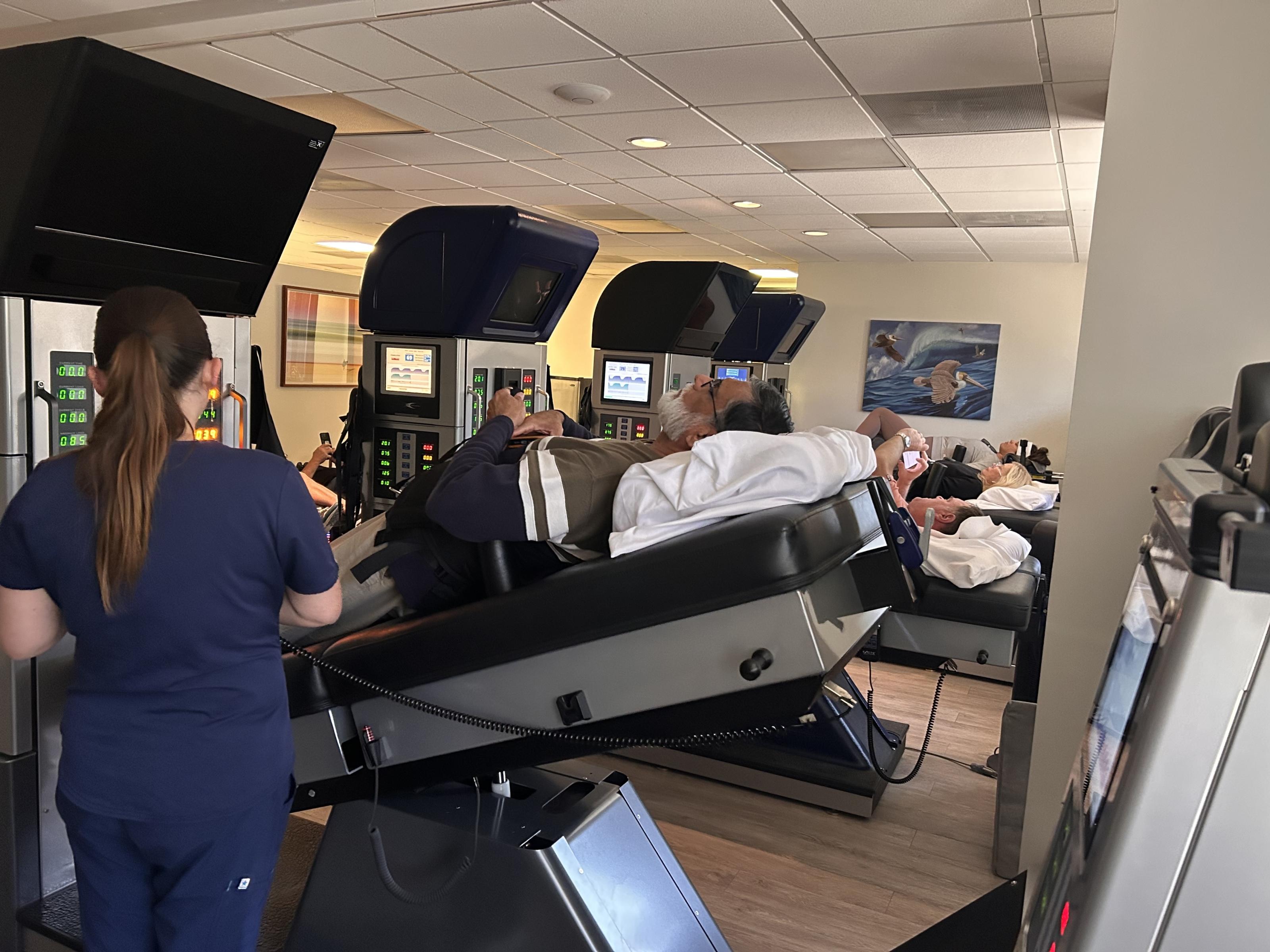
At The Spinal Decompression & Chiropractic Center of San Diego, Dr. Cassidy James Boelk, DC uses the DRX9000® Non-Surgical Spinal Decompression System.
The practice has 7 DRX9000 Spinal Decompression Systems dedicated to Non-Surgical Spinal Decompression Therapy.
Dr. Boelk is a:
✔ Certified Spinal Decompression Doctor
✔ Certified Pain-Free Performance Specialist
✔ California X-Ray Radiology Licensed Doctor
✔ Founder, Non-Surgical Spinal Decompression Training Academy
✔ Founding Member, American Spinal Decompression Society
✔ More Than 22 Years Clinical Experience
✔ More Than 100,000 Spinal Decompression Treatments Performed
✔ 7 DRX9000® Spinal Decompression Systems
✔ One of the Largest Known Non-Surgical Spinal Decompression Practices in California
He also trains other doctors in Non-Surgical Spinal Decompression protocols and techniques through the Non-Surgical Spinal Decompression Training Academy, based in his San Diego private practice.
Patients seek out the office from throughout San Diego County and beyond for evaluation of difficult disc-related conditions.
But experience and equipment are only part of the equation.
The most important question is whether you're actually an appropriate candidate.
⭐⭐⭐⭐⭐ A Patient's Experience With Difficult Back Pain
[ROTATE IN FULL VERIFIED PATIENT TESTIMONIAL HERE]
For this Mira Mesa page, use one of your stronger patient reviews that specifically talks about:
-
Long-standing pain
-
Treatments that had already been tried
-
Difficulty functioning
-
Improvement in everyday activities
-
Returning to work, exercise, walking, or normal life
Use the entire review exactly as written rather than shortening it.
What If Spinal Decompression Isn't Right for You?
This part is just as important.
Having a herniated disc on an MRI doesn't automatically qualify someone for treatment.
There are patients Dr. Boelk evaluates who are not accepted for Non-Surgical Spinal Decompression.
Sometimes another conservative treatment makes more sense.
Sometimes more testing is needed.
Sometimes the findings warrant a surgical consultation.
⭐⭐⭐⭐⭐ Not Every Patient Is a Candidate
[ROTATE IN FULL VERIFIED NON-CANDIDATE TESTIMONIAL HERE]
The purpose of the evaluation isn't to convince everyone to begin spinal decompression.
It's to determine whether the treatment makes sense for your particular condition.
If it doesn't, you deserve to know that too.
How Long Should You Keep Waiting?
There's no single timeline that applies to everyone.
But if you've been waiting for your symptoms to improve and weeks or months are passing without meaningful progress, another evaluation may make sense.
Especially if:
-
Sciatica keeps returning
-
Pain continues traveling into your leg or arm
-
Numbness or tingling persists
-
Sitting remains difficult
-
Walking or standing remains limited
-
You're unable to work or exercise normally
-
Physical therapy hasn't produced the improvement you expected
-
Injections haven't provided lasting relief
-
You've been told surgery may be your next option
-
You're tired of guessing what to do
At that point, the question may no longer be:
“How long should I wait?”
It may be:
“Why am I not getting better?”
Herniated Disc Evaluation for Mira Mesa Patients
Patients from Mira Mesa, Sorrento Valley, Miramar, Rancho Peñasquitos and surrounding San Diego communities can schedule an evaluation at The Spinal Decompression & Chiropractic Center of San Diego.
Your evaluation with Dr. Cassidy James Boelk, DC may include:
✔ Review of your symptoms and how they've changed
✔ Review of treatments you've already tried
✔ Focused orthopedic and neurological examination
✔ Review of your existing MRI or other imaging when available
✔ Digital X-rays when clinically indicated
✔ Evaluation of spinal stability when appropriate
✔ Discussion of what may be contributing to your ongoing symptoms
✔ Determination of whether you're a candidate for Non-Surgical Spinal Decompression
✔ Recommended next steps based on the findings
You don't need to assume surgery is your next step.
And you shouldn't assume spinal decompression is right for you either.
Find out first.
Ready to Find Out Why You're Still Hurting?
The Spinal Decompression & Chiropractic Center of San Diego
📍 5095 Murphy Canyon Road, Suite 300
San Diego, CA 92123
📞 619-298-0800
🌐 SanDiegoBackCare.com
Call 619-298-0800 to schedule an evaluation and find out what may be keeping you from improving—and whether Non-Surgical Spinal Decompression may be an appropriate option for your condition.
Hablamos Español.