Why Does My Leg Go Numb When I Walk? | San Diego, CA
A patient will sometimes describe it this way:
“I feel pretty good when I'm sitting. Then I start walking and after five or ten minutes my leg starts tingling. If I keep going, part of my calf or foot goes numb. When I sit down, it settles down.”
Dr. Cassidy James Boelk, DC hears variations of this regularly.
Some people can walk around a grocery store only if they lean on the cart. Some know exactly how far they can make it from their car before the numbness starts. Others used to walk several miles and now find themselves looking for somewhere to sit after a few blocks.
That pattern deserves attention.
Leg numbness that consistently comes on with walking can be related to irritation or compression of nerves in the lower back. Disc problems, foraminal narrowing and spinal stenosis are among the possibilities.
But those aren't the only possibilities.
Dr. Boelk doesn't diagnose somebody from the sentence, “My leg goes numb when I walk.”
He wants to know which leg, where it goes numb, how long you can walk before it starts, what makes it stop and whether anything else is changing—especially strength.
There's a big difference between a leg that tingles after ten minutes of walking and a leg that's beginning to lose strength or a foot that's starting to slap the ground.
That's why the history matters.
⭐⭐⭐⭐⭐ “I Have Suffered From Leg Numbness and Low Back Pain for 4 Years”
“I haven’t been able to do groceries or even take baths without pain.”
“Hi my name is Rosa Algravez. I have suffered from leg numbness and low back pain for 4 years. I haven’t been able to do groceries or even take baths without pain. I looked for relief with various doctors with no luck. I have done treatments ranging from chiropractic to acupuncture. My husband found Dr. Boelk in the newspaper and we decided since we had tried everything else that we were going to give this a try. After my first few treatments, I feel as though I have returned to 100%. Life for me is completely different.
My husband and I have returned to enjoying life. We travel 300+ miles everyday from Calexico. I can do things now with little to no limitations. The staff makes you feel welcomed and it’s a very family environment. The payments are easy and I would recommend this to anyone suffering with low back pain. Thank You”
— Rosa Algravez, Age 58, Calexico, CA
Rosa's story is a good example of why Dr. Boelk asks patients what their symptoms are preventing them from doing.
“Leg numbness” sounds pretty clinical.
Not being able to get through the grocery store is different.
Not being able to take a bath comfortably is different.
Having to decide where you can go based on how far you think you'll be able to walk is different.
Once a problem starts changing normal parts of your life, the question isn't only what the symptom is called.
It's why it's happening.
If Your Walking Distance Is Getting Shorter, You Can Sit Down With Dr. Boelk at No Charge
You don't have to decide that you want spinal decompression before coming into the office.
In fact, Dr. Boelk doesn't know whether he would recommend it until he understands your case.
The No-Charge Consultation is the first conversation.
You explain what's happening. Dr. Boelk goes through the history with you. If you already have an MRI, he can review the actual images and report.
He'll want to know things such as:
-
How far you can walk before the numbness begins.
-
Exactly where the leg or foot becomes numb.
-
Whether it's one leg or both.
-
Whether you also have pain, burning or tingling.
-
What happens if you sit down.
-
Whether leaning forward changes the symptoms.
-
Whether standing still is different from walking.
-
Whether you've noticed any loss of strength.
-
What treatments you've already tried.
-
What your MRI shows, if you have one.
-
Whether the imaging actually fits the symptoms you're describing.
You don't need an MRI to schedule.
There is no charge and no obligation to begin treatment.
And this isn't an unlimited promotional offer handed off to staff.
Dr. Boelk personally performs these consultations while continuing to care for the patients already under his care. Because of that, the office only sets aside a limited number of No-Charge Consultation appointments in the schedule.
When those openings are taken, new patients are offered the next available dates.
If you're noticing that you can walk less than you could a few months ago, you don't necessarily need to wait until you can barely walk at all before getting an opinion.
Call 619-298-0800 and ask what No-Charge Consultation appointments with Dr. Boelk are currently available.
What Happens When You Stop Walking?
This is one of the first things Dr. Boelk wants to know.
Suppose the numbness starts after ten minutes.
What do you have to do to make it stop?
Can you simply stand still?
Do you need to sit?
Does bending forward help?
How long does it take before the leg feels normal again?
Then what happens when you start walking again?
Those details can help distinguish between different patterns of nerve irritation.
For example, narrowing around the nerves in the lower back can sometimes produce symptoms that become more noticeable with standing or walking and improve when someone sits or changes position.
A disc problem can produce a different pattern.
Peripheral nerve problems and circulation problems can also produce leg symptoms.
That's why Dr. Boelk doesn't want somebody assuming, “My leg is numb, so I must have sciatica.”
Maybe.
Maybe not.
The pattern needs to make sense.
“I Can Walk Farther if I Lean on the Shopping Cart”
Tell Dr. Boelk that.
It's a very specific observation.
Some patients notice they can walk much farther through Costco or the grocery store while leaning slightly forward over a cart than they can walking upright through a parking lot.
They may not understand why.
They just know the cart helps.
That can be an important part of the history because changing the position of the lower back can change how certain people experience their leg symptoms.
It still doesn't make the diagnosis by itself.
But it's exactly the kind of detail Dr. Boelk wants to hear.
Numbness and Pain Aren't the Same Thing
This is important.
People usually pay attention to pain because pain demands attention.
Numbness can be easier to dismiss.
A patient might say, “It doesn't really hurt. My foot just goes numb.”
Dr. Boelk still wants to know about it.
Numbness means sensory function is changing somewhere along the pathway. The next question is why.
He'll also ask whether you're getting pins and needles, burning or an electrical sensation.
And then he wants to know about strength.
Can you lift the front of your foot normally?
Can you walk on your heels?
Can you push off normally?
Are you tripping?
Does one leg feel weaker on stairs?
Has your foot started slapping the ground?
Those answers may change how quickly the problem needs to be evaluated.
⭐⭐⭐⭐⭐ “By March I Am Now Able to Bend Without Any Pain and Am Able to Walk Normally”
“I came in early January not able to bend and walking with a limp.”
“Dr. Boelk and his team are the best in the business! I have had lower back problems for over 5 years and been to 6 other doctors seeking options other than surgery. I came in early January not able to bend and walking with a limp. By February I was able to bend again with minimal pain and by March I am now able to bend without any pain and am able to walk normally.
I am EXTREMELY happy I did not have surgery and found Dr. Boelk. Trust him and the process and he will get you feeling better. He also said from the beginning that if at any stage in the process he felt like progress wasn't happening he would let me know which was not the case with other specialist I have seen in the past so I appreciate that.”
— Calder Pearce, San Diego, CA
Calder's review also mentions something Dr. Boelk believes is important: knowing when treatment isn't progressing.
The goal isn't to keep treating somebody simply because they started.
Dr. Boelk wants to see whether the patient is actually responding.
Could Spinal Stenosis Cause Leg Numbness With Walking?
It can.
When the space available for the nerves becomes narrowed, some people develop leg pain, heaviness, tingling or numbness when standing or walking.
They may feel substantially better when sitting.
Foraminal stenosis—narrowing where a nerve exits the spine—can also irritate a nerve.
A bulging or herniated disc may contribute to nerve irritation as well.
Sometimes more than one finding appears on the same MRI.
This is where people can get into trouble trying to diagnose themselves from the report.
An MRI might mention:
L3-L4 disc bulge.
L4-L5 foraminal narrowing.
L5-S1 degeneration.
Facet changes.
Stenosis.
Now the patient has five abnormal-sounding things on a piece of paper and doesn't know which one matters.
Dr. Boelk prefers to look at the actual MRI images, compare them with the symptoms and then see whether the clinical picture fits.
The MRI is important.
It's still only one part of the evaluation.
What If Sitting Makes the Numbness Go Away?
That's useful information too.
Dr. Boelk may ask how quickly it happens.
Does the numbness disappear almost immediately?
Does it take five minutes?
Can you then get back up and walk roughly the same distance before it starts again?
Or does the leg stay numb even after you've stopped?
Those are different presentations.
This is also why telling a patient simply to “walk more” isn't always useful advice.
Walking is excellent exercise for many people.
But if your leg predictably becomes numb after a certain distance, Dr. Boelk wants to understand why rather than having you repeatedly push through it.
Should You Push Through the Numbness?
Dr. Boelk generally doesn't like the idea of repeatedly provoking increasing neurological symptoms just to prove you can keep going.
That doesn't mean you should become afraid of walking.
It means pay attention to what your body is doing.
If you can walk comfortably and the symptoms remain neutral or improve, that's one thing.
If every walk ends with progressively increasing numbness farther down the leg or foot, that's different.
And if you're losing strength, don't treat that like ordinary muscle soreness.
Progressive weakness deserves evaluation.
New bowel or bladder dysfunction, difficulty urinating, numbness around the groin or saddle area, or rapidly progressing weakness requires prompt medical evaluation.
Could Non-Surgical Spinal Decompression Be an Option?
Possibly, depending on what's causing the symptoms.
Dr. Boelk evaluates patients with disc bulges, disc herniations, degenerative disc disease, disc-related sciatica, foraminal narrowing and selected cases of spinal stenosis.
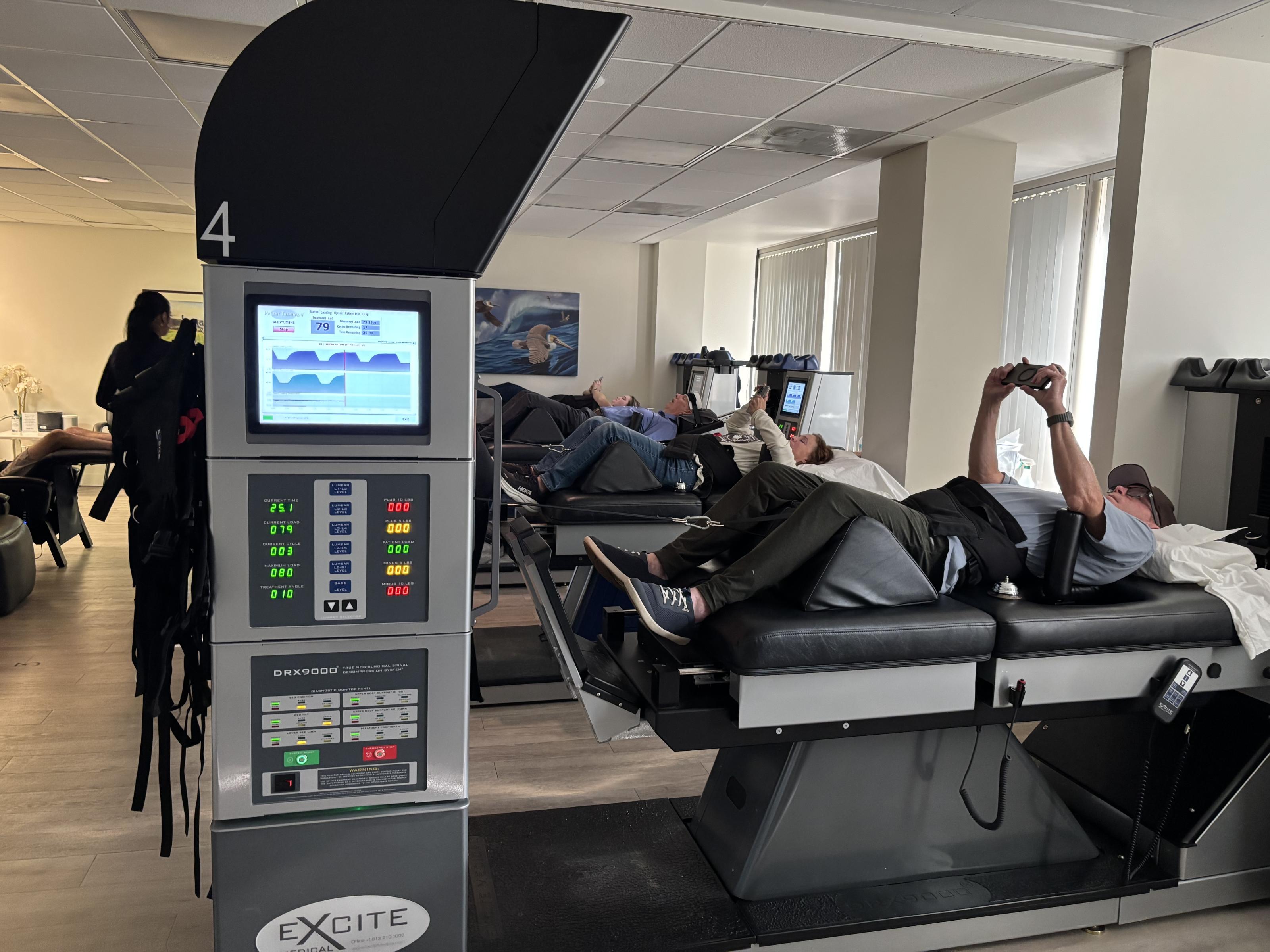
The Spinal Decompression & Chiropractic Center of San Diego uses the DRX9000 exclusively for Non-Surgical Spinal Decompression.
But Dr. Boelk doesn't recommend decompression simply because an MRI says “stenosis” or because somebody's leg goes numb.
He considers the history, examination findings, neurological status, imaging when available, spinal stability, bone health, medical history and previous surgery.
Some people should not receive spinal decompression.
Significant osteoporosis, an unhealed fracture, unstable spondylolisthesis, abdominal aortic aneurysm, pregnancy for lumbar decompression, certain malignancies and other medical or structural conditions can make treatment inappropriate.
Previous spinal surgery needs careful review too, particularly when fusion or metal hardware is present at the level that would need treatment.
★ Sometimes Dr. Boelk's Answer Is “Not Yet”
“He could not treat me as I have to wait until the fracture in my neck heals.”
“I decided to see Dr. Boelk after a pretty gnarly motocoss neck injury. At the Hospital I was at, I felt I was getting pressured into a surgery which I refused. A friend of a friend referred him after Dr. Boelk successfully treated his broken back.
Dr. Boelk is a compassionate individual who truly cares about his patients. He looked at my MRI images, explained what he saw and potential routes for recovery. He could not treat me as I have to wait until the fracture in my neck heals, but the level of professionalism, compassion, caring and knowledge displayed by him was exceptional.
He also recommended to seek an additional opinion form another neurosurgeon. My experience was that he really cares and he's not someone who would take advantage of the situation someone's in (unlike some other doctors). I will definitely be back and already recommended him to others as well! Thank you Dr. Boelk!”
— Jan H., San Marcos, CA
Jan's situation was very different, but it shows why candidacy matters.
Dr. Boelk reviewed the MRI and did not treat him because the fracture needed to heal.
That's what an evaluation is supposed to do.
Determine what makes sense for the person sitting in front of you—not find a reason to put everyone on the same treatment.
⭐⭐⭐⭐⭐ A Patient Traveled From Alaska After Pain Made Walking Difficult
“I couldn’t sleep, I could barely walk.”
“My name is Lynn. I am from Alaska, and I just want to say it was totally worth taking a trip to go to the Spinal Decompression & Chiropractic Center of San Diego. I was having pain radiating down my legs, I couldn’t sleep, I could barely walk.
After treatment I am back to shoveling snow, teaching school, taking walks. So, I just want to thank Dr. Boelk and the clinic, you guys are wonderful, and you have created such a wonderful, friendly, kind and truly caring atmosphere. I highly encourage anybody that might be considering spinal decompression therapy, it really makes a difference.”
— Lynn C., Alaska
Lynn traveled from Alaska for care.
You obviously don't need to travel from Alaska if you live in San Diego.
But her story illustrates how much walking problems can eventually change someone's life.
Being able to take a walk doesn't sound like a big deal until you can't do it anymore.
Dr. Cassidy James Boelk, DC
Dr. Boelk has spent more than 22 years working with disc injuries, sciatica and Non-Surgical Spinal Decompression and has performed more than 100,000 spinal decompression treatments.
-
Doctor of Chiropractic
-
Certified Spinal Decompression Doctor
-
Certified Pain-Free Performance Specialist (PPSC)
-
Founder, Non-Surgical Spinal Decompression Training Academy
-
Trains other doctors in spinal decompression protocols and techniques
-
Founding Member, American Spinal Decompression Society
-
Member, International Disc Education Association
-
California X-Ray Radiation Supervisor & Operator
Dr. Boelk also understands spinal injuries from the patient's side. He suffered an L5 compression fracture at 16 and later dealt with disc injuries and sciatica himself.
How Far Could You Walk Six Months Ago?
That's a simple question, but it can tell you quite a bit.
Maybe six months ago you walked for an hour without thinking about it.
Then it became 30 minutes.
Now it's 10.
Maybe you can still do everything, but you're doing it differently. You're parking closer. You're looking for chairs. You're leaning on the grocery cart. You're skipping walks you used to enjoy.
If your walking tolerance is gradually getting shorter, waiting has not been neutral.
You're already giving something up.
That doesn't mean you need spinal decompression.
It doesn't mean you need surgery either.
It means it may be time to find out why it's happening.
The No-Charge Consultation lets you do that without committing to treatment.
Sit down with Dr. Boelk.
Explain what's happening.
Bring your MRI images and report if you have them.
Let him look at the history, the symptoms and the imaging together.
Then ask the question that actually matters:
“Do you think you can help me?”
If he doesn't think you're a candidate, he'll tell you.
If he thinks he may be able to help, he'll explain why and what he recommends. You decide what happens next.
There is no charge and no obligation.
There is only a limited number of these appointments because Dr. Boelk personally performs them while continuing to treat his existing patients.
Once the available consultation times are filled, new patients are scheduled into the next openings.
If you're already noticing that you can't walk as far as you used to, you don't have to wait until a trip through the grocery store becomes difficult before getting an opinion.
Call 619-298-0800
Ask what No-Charge Consultation appointments with Dr. Cassidy James Boelk, DC are currently available.
The Spinal Decompression & Chiropractic Center of San Diego
5095 Murphy Canyon Road, Suite 300
San Diego, CA 92123
619-298-0800
SanDiegoBackCare.com
Live 24/7 Answering Service • Hablamos Español
Related Articles
Can You Have Sciatica Without Back Pain? | San Diego, CA
Can Spinal Decompression Help Sciatica Nerve Pain? | San Diego, CA