Why Do Some Spinal Decompression Treatments Fail? San Diego, CA
One of the most common questions Dr. Cassidy Boelk hears is:
"I tried spinal decompression before and it didn't work."
That's a fair question.
And honestly, sometimes patients are right.
Not every patient gets the results they hoped for.
Not every patient is a candidate.
Not every office follows the same protocols.
Not every decompression system is the same.
And not every patient completes care long enough to achieve the results they are capable of achieving.
After nearly 22 years helping patients suffering from herniated discs, bulging discs, sciatica, degenerative disc disease, cervical disc injuries, and chronic neck and back pain, Dr. Boelk has found several common reasons why some spinal decompression treatments fail.
Understanding these reasons may help you make a better decision when choosing a provider.
Reason #1: The Patient Was Never A Candidate To Begin With
This is probably the biggest reason treatment fails.
Not every patient with back pain should undergo spinal decompression.
Not every MRI finding responds the same way.
Not every condition is appropriate for conservative care.
Some patients need:
-
Additional imaging
-
Further medical evaluation
-
Different treatment approaches
-
Surgical consultation
This is one reason Dr. Boelk places such a strong emphasis on proper patient selection.
The consultation isn't designed to convince someone to start treatment.
The consultation is designed to determine whether he genuinely believes he can help.
One of the strongest testimonials our office has ever received came from a patient we never accepted for treatment.
Jeff J. from Tucson, Arizona writes:
"I found this terrific practice on social media. I followed up and did my own research so I decided to pay them a visit. The place is clean, well organized and run by a very efficient receptionist.
I met with the doctor and after a honest and forthright conversation, we both determined that surgery was my only option to correct my back issues.
I will return as a customer when the time is right."
— Jeff J., Tucson, Arizona
Many doctors would have simply started treatment.
Dr. Boelk didn't.
That's because helping the right patient is more important than accepting every patient.
Reason #2: The Wrong Diagnosis Was Being Treated
Many patients assume all back pain comes from the same source.
It doesn't.
Sciatica is not actually a diagnosis.
It's a symptom.
The cause could be:
-
Herniated Disc
-
Bulging Disc
-
Disc Extrusion
-
Foraminal Stenosis
-
Degenerative Disc Disease
-
Spinal Stenosis
Likewise, neck pain may originate from:
-
Disc Injuries
-
Facet Joints
-
Muscles
-
Nerve Irritation
-
Other Structures
This is why MRI review matters.
This is why examination matters.
This is why diagnosis matters.
Treating the wrong problem rarely produces great outcomes.
One reason patients seek out Dr. Boelk is because he personally reviews MRI studies himself rather than simply relying on reports.
The goal isn't just identifying abnormalities.
The goal is determining whether the imaging findings actually match the patient's symptoms.
Reason #3: The Patient Stopped Too Early
This happens more often than people realize.
Pain relief and healing are not always the same thing.
Many patients begin noticing improvement before maximum improvement has occurred.
Some patients start feeling better and assume they're finished.
Then symptoms return months later.
One patient who understood this process extremely well was Yuri Fresia.
Yuri had been suffering from severe sciatica for months.
He had already tried multiple treatments with only temporary relief.
Yuri writes:
"When I first came here I was suffering from sciatica pain for several months non stop. I tried many different non invasive treatments, pain killers but relief was just temporary.
It felt better since my first session.
After 12 I felt I was improving a lot but still had room to get better so we decided trying 12 more.
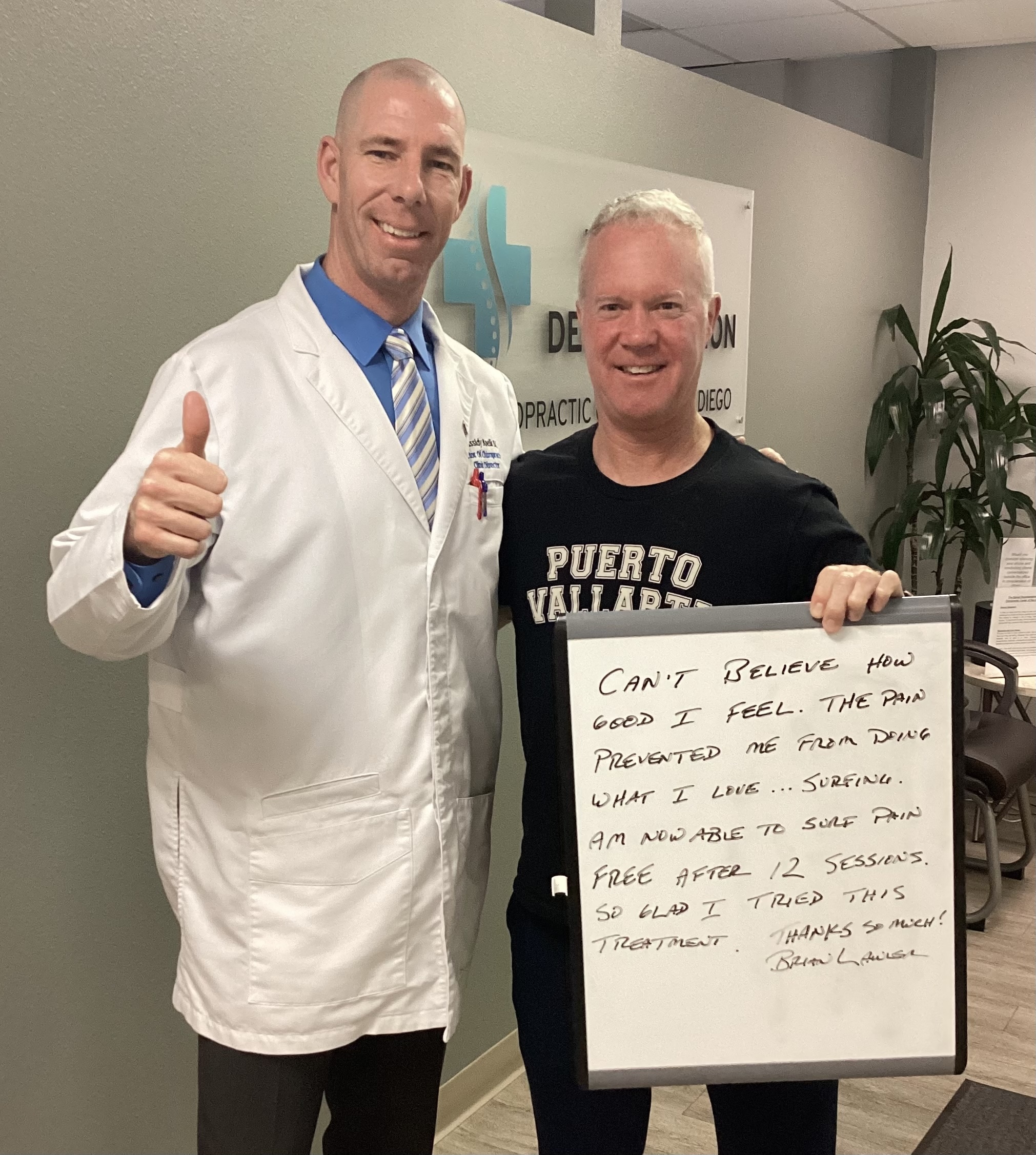
After 36 sessions I felt I was back to normal. I could get back to surf, jiu jitsu and work after 6 months away.
Doctor helped me through the whole process, leaving me free to decide the next step and being honest about expectations.
It's worth 100%."
— Yuri Fresia
One of the biggest mistakes patients make is confusing early symptom relief with complete recovery.
Reason #4: Passive Care Alone Wasn't Enough
Another common reason patients struggle is relying entirely on passive treatment.
Passive care is important.
In fact, it's often the first step.
Examples include:
-
Spinal Decompression
-
Chiropractic Adjustments
-
Soft Tissue Therapy
-
Massage
These treatments may help calm irritated tissues and reduce pain.
But passive care alone is rarely enough.
Patients also need active participation.
This may include:
-
Walking Programs
-
Mobility Exercises
-
Core Stability Training
-
Home Rehabilitation
-
Lifestyle Modifications
As Dr. Boelk frequently explains:
Passive Care Helps Calm The Fire
Active Care Helps Keep The Fire From Coming Back
The goal isn't simply helping someone feel better for a few days.
The goal is helping them stay better.
One of the most powerful examples of this comes from Jayson Yavorsky.
Jayson writes:
"There is not enough room to explain the relief Dr. Boelk has brought to me and my entire family.
I found him after a year of sciatic pain. Couldn't play the sports I loved, no hockey, golf or surfing.
The pain shooting from my hip to my left foot was to the point of unbearable.
I couldn't get a solid night sleep and didn't care to go on.
But Then I met the Dr! I tell people regularly, he saved my life.
It was a regular routine of adjustments and exercises. A change of life patterns but 110% worth every effort."
— Jayson Yavorsky, San Diego, CA
Notice he mentions both treatment and lifestyle changes.
That combination often matters.
Reason #5: Not All Spinal Decompression Programs Are The Same
This may be uncomfortable to discuss, but it is true.
There are major differences between:
-
Equipment
-
Protocols
-
Experience
-
MRI Review
-
Patient Selection
-
Follow-Up Care
Many patients assume spinal decompression is spinal decompression.
That isn't necessarily the case.
Michael Langsdale experienced this firsthand.
Michael writes:
"I have had a wonderful experience with Dr. Boelk and his staff at the Spinal Decompression and Chiropractic Center of San Diego.
They have a great protocol and the best decompression machines.
I've been to other places with sub par machines and didn't get any benefit.
Been undergoing treatment for about 12 sessions now and the sciatica is gone and I'm almost back to normal.
I didn't think it would ever heal but even after the first session I had tremendous relief and could sleep mostly pain free for the first time in months."
— Michael Langsdale, San Diego, CA
Experience matters.
Protocols matter.
Patient selection matters.
Equipment matters.
At The Spinal Decompression & Chiropractic Center of San Diego, Dr. Boelk has personally performed over 100,000 spinal decompression treatments and currently operates 7 DRX9000 systems, making the office one of the largest providers of Non-Surgical Spinal Decompression in California.
The Bottom Line
If you've tried spinal decompression before and didn't get the results you hoped for, that doesn't automatically mean spinal decompression can never help you.
It may simply mean:
-
The wrong diagnosis was being treated
-
You weren't a candidate
-
The treatment plan wasn't completed
-
The underlying cause wasn't fully addressed
-
Active rehabilitation was missing
-
The treatment approach wasn't comprehensive enough
The truth is that every case is different.
That's why Dr. Cassidy Boelk believes every patient deserves an honest consultation, a thorough review of their MRI and history, and a clear understanding of whether he genuinely believes he can help before treatment ever begins.
Because the goal isn't to treat everyone.
The goal is to help the right patients avoid unnecessary suffering, avoid unnecessary procedures when appropriate, and get back to living the life they deserve.