Why Can I Barely Walk Because of Sciatica? | Clairemont, CA
When Sciatica Makes Every Step Difficult
If your sciatica has become so painful that you can barely walk, it can be frightening.
You may be wondering whether the nerve is permanently damaged, whether you need surgery, or whether continuing to walk is making the problem worse.
These are questions I hear regularly from patients.
Some people can walk only a few minutes before the pain starts shooting from their lower back into the buttock, thigh, calf, or foot. Others feel reasonably comfortable while sitting but struggle the moment they stand up. Some begin limping or leaning forward because that is the only way they can move without severe pain.
After more than 22 years of evaluating and treating patients with sciatica, one thing I want you to understand is this:
How badly you hurt does not always tell us exactly how serious the underlying problem is.
I have seen patients with severe pain who responded very well to conservative care. I have also evaluated patients whose pain was less intense but whose examination showed significant weakness or nerve involvement that required further medical evaluation.
That is why the first step should be figuring out what is actually causing your symptoms.
Real Patient. Real Results.
⭐⭐⭐⭐⭐ Abel T. — San Diego, CA
“I was dealing with severe back pain that made it difficult to sleep, along with intense sciatica that radiated from my lower back down my leg following an accident.
When I met with Dr. Cassidy Boelk, he performed a thorough evaluation and determined that I was a good candidate for treatment.
The results were remarkable.
After just two spinal decompression sessions, my sciatic pain was gone, allowing us to focus on correcting the underlying cause of the problem. I completed 24 treatments and then progressed into rehabilitation exercises designed to strengthen my core and help prevent future flare-ups.
The office is beautiful, organized, and professional, and the customer service provided by the entire staff consistently exceeded my expectations.
Living with back and neck pain can affect every part of your life. In my case, I gained weight, relied on pain medications, struggled with depression, and dealt with significant anxiety because of my condition.
Today, I feel like a different person.
I’m sleeping better, walking comfortably, becoming active again, and enjoying life much more than before.
My experience has been excellent from start to finish.
Dr. Cassidy Boelk is truly outstanding, and I am extremely grateful I found his office.”
Why Can Sciatica Make Walking So Painful?
Sciatica occurs when one of the nerves that contributes to the sciatic nerve becomes irritated or compressed.
The problem usually begins in the lower back, even though most patients feel the worst pain in the leg.
That irritation may be caused by:
-
A bulging or herniated lumbar disc
-
Degenerative disc disease
-
Foraminal stenosis
-
Central spinal stenosis
-
Arthritis around the joints of the spine
-
Spondylolisthesis
-
Inflammation surrounding a spinal nerve
When you stand and walk, the position of your spine changes. Depending on your condition, that position may increase pressure around the irritated nerve.
This is why some patients tell me they can sit without much difficulty but can barely walk through a grocery store.
Others experience the opposite. Sitting increases their symptoms, while standing or walking gives them some relief.
Those differences matter because they help us understand what may be causing the problem.
One Clue I Pay Close Attention To
One of the questions I often ask is:
Do you feel better when you lean forward?
Some patients with spinal stenosis notice that they can walk farther while leaning over a shopping cart. They may struggle to walk upright but feel better when their spine is slightly flexed forward.
Other patients feel worse when bending forward because that position increases pressure on an injured disc.
Neither pattern gives us the entire diagnosis, but it can provide an important clue.
This is also why I do not recommend the same stretches or exercises to every patient with sciatica. A movement that helps one person may significantly aggravate another.
Is It Dangerous to Keep Walking?
This depends on what happens when you walk.
Mild discomfort that remains stable may be very different from symptoms that rapidly intensify or travel farther down the leg.
I become more concerned when walking causes:
-
Increasing numbness or tingling
-
New or worsening weakness
-
A foot that begins dragging or slapping
-
Loss of balance
-
Severe pain that continues long after you stop
-
Symptoms that are getting progressively worse each day
Pain is important, but weakness is often even more important.
If a patient tells me the leg feels weak, the knee is giving out, or the foot is no longer lifting normally, I want to evaluate that carefully.
Significant or rapidly worsening weakness may require prompt medical or surgical evaluation.
Sciatica Is a Symptom, Not the Final Diagnosis
One of the biggest mistakes I see is treating the word “sciatica” as though it explains everything.
It does not.
Sciatica describes a pattern of nerve pain. It does not tell us why the nerve is irritated.
Two patients may both have pain traveling down the right leg, but one may have a herniated disc while the other has severe foraminal stenosis.
Those are not the same condition, and they should not automatically receive the same treatment.
Before recommending care, I want to understand:
-
Where the symptoms begin and end
-
Which positions make them better or worse
-
Whether numbness or weakness is present
-
How long the problem has been occurring
-
Which treatments have already been attempted
-
What the neurological examination shows
-
Whether the imaging matches the patient’s symptoms
The goal is not simply to name the pain.
The goal is to identify the source.
Do You Automatically Need Surgery?
No.
Severe sciatica does not automatically mean you need surgery.
Many patients with disc-related sciatica improve through conservative treatment. However, surgery may be appropriate when there is progressive neurological loss, cauda equina syndrome, severe instability, or pain that remains disabling despite appropriate conservative care.
I have advised many patients to continue with non-surgical treatment.
I have also referred patients for surgical consultation when I believed that was the safest and most appropriate next step.
I do not believe patients benefit when every condition is treated the same way.
How Non-Surgical Spinal Decompression May Help
Non-surgical spinal decompression is designed to gently reduce pressure within specific spinal segments.
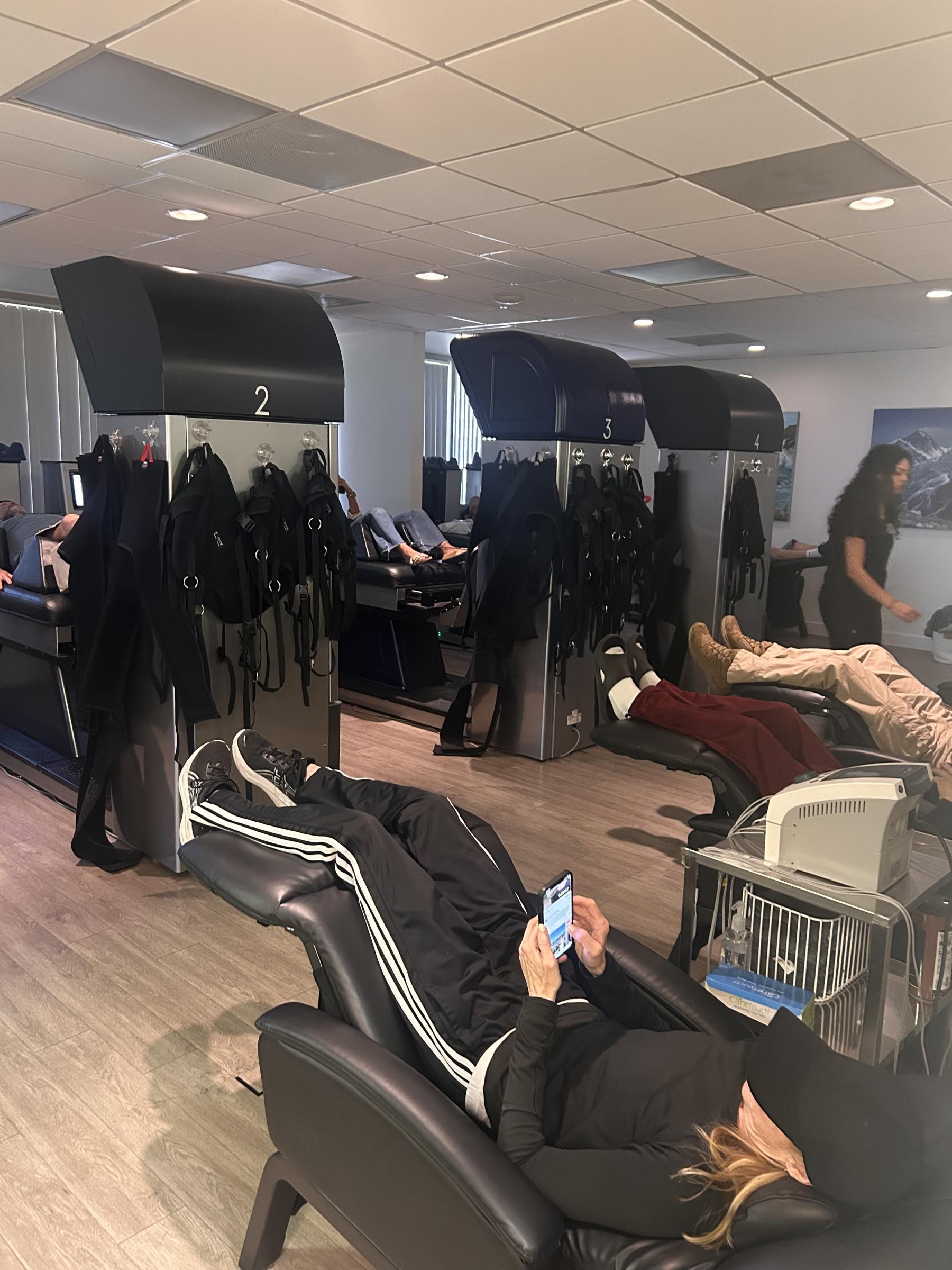
At our office, we use the DRX9000 to provide controlled, computer-guided decompression to targeted areas of the lumbar spine.
The goal is to create a gradual unloading effect that may help reduce pressure on an injured disc and irritated nerve.
For the right patient, this may help:
-
Reduce pressure around a spinal nerve
-
Improve movement of fluid and nutrients within the disc
-
Calm inflammation
-
Reduce radiating leg pain
-
Improve tolerance for standing and walking
-
Create an opportunity to progress into rehabilitation
However, spinal decompression is not appropriate for every cause of sciatica.
That is why I do not recommend treatment based only on a phone conversation or a single MRI finding.
The patient, the examination, the symptoms, and the imaging all need to make sense together.
Why Patients From Clairemont Visit Our Office
Patients come to our center from Clairemont, Bay Park, Linda Vista, Kearny Mesa, Mission Valley, and throughout San Diego because they want to know whether there is still a conservative option available before considering surgery.
Many have already tried medications, physical therapy, injections, chiropractic treatment, massage, or home exercises.
Some treatments may have helped temporarily, while others may not have changed the symptoms at all.
When someone has already tried several approaches, I do not believe the answer is simply to start another treatment without first reevaluating the diagnosis.
Sometimes the previous care was reasonable, but the condition has changed.
Sometimes the treatment was not directed at the actual source of the nerve irritation.
Sometimes the patient was never an appropriate candidate for that treatment in the first place.
What You Can Do Right Now
Until you know what is causing your symptoms, avoid forcing yourself through severe pain.
A few general suggestions may help:
-
Take shorter walks rather than pushing through one long walk.
-
Stop if the pain begins traveling farther down the leg.
-
Avoid repeated bending, twisting, or lifting.
-
Change positions regularly instead of sitting or standing for long periods.
-
Use a supportive chair rather than a low, soft couch.
-
Pay attention to whether leaning forward or standing upright changes your symptoms.
-
Seek prompt evaluation if numbness or weakness is worsening.
The goal is not complete bed rest.
The goal is avoiding repeated movements that clearly aggravate the nerve while you determine what is causing the problem.
When to Seek Immediate Medical Attention
Seek immediate medical care if you develop:
-
Loss of bowel or bladder control
-
Numbness around the groin or saddle area
-
Rapidly worsening leg weakness
-
Loss of control of the foot
-
Severe symptoms following significant trauma
-
Fever or unexplained weight loss with severe back pain
These symptoms are uncommon, but they should never be ignored.
For most patients, the next step is a careful evaluation to determine why walking has become so difficult and whether conservative treatment is appropriate.
Why Experience Matters When Treating Sciatica
Spinal decompression is not simply about placing someone on a table and pressing a button.
The diagnosis matters.
The treatment settings matter.
The patient’s response matters.
The timing and frequency of care matter.
Most importantly, knowing when not to treat someone matters.
I have specialized in non-surgical spinal decompression for more than 22 years and have performed more than 100,000 spinal decompression treatments. During that time, I have evaluated patients with everything from relatively straightforward disc injuries to complicated cases involving previous surgery, spinal stenosis, spondylolisthesis, severe degeneration, and multiple areas of nerve compression.
That experience has taught me not to make promises based on one symptom or one line from an MRI report.
Before I recommend treatment, I want to understand the entire condition.
I Understand Spine Problems Personally
My interest in spinal decompression is not only professional.
I fractured my L5 vertebra when I was 16 years old and later developed additional disc injuries and a Grade II spondylolisthesis.
I have treated my own spine conservatively with spinal decompression for more than 20 years.
Today, I still surf, play hockey, exercise, and remain active.
I do not share that story to suggest that every patient will have the same result. Every spine and every condition are different.
I share it because I understand what it feels like to worry about your back, change the way you move, and wonder whether you will be able to continue doing the things you enjoy.
That experience has influenced the way I treat patients.
My goal is not simply to reduce pain for a few days. I want to determine whether we can address the underlying source of the problem and then help the patient rebuild strength and stability as symptoms improve.
More Than Just the Decompression Table
Another misunderstanding about spinal decompression is that the table does all the work.
It does not.
The DRX9000 may be an important part of care for the right patient, but treatment should still be guided by the patient’s diagnosis, neurological findings, tolerance, and progress.
Depending on the condition, care may also include:
-
Chiropractic treatment when appropriate
-
Soft-tissue therapy
-
Mobility work
-
Core stabilization exercises
-
Postural correction
-
Guidance about sitting, sleeping, bending, and lifting
-
Gradual progression back into normal activity
-
Periodic reevaluation to measure progress
The treatment plan should also change as the patient improves.
A person who can barely walk during the first visit should not necessarily receive the same recommendations several weeks later once the severe nerve pain has decreased.
The goal is progression.
First, we work to reduce irritation and improve function.
Then, when appropriate, we begin rebuilding the support around the spine.
What If You Have Already Tried Other Treatments?
Many of the patients who visit us from Clairemont have already tried several forms of care.
They may have completed physical therapy.
They may have received epidural injections.
They may have tried chiropractic adjustments, massage, acupuncture, medications, or home exercises.
Some patients feel discouraged because nothing has worked.
Others improved temporarily, but the symptoms returned.
That does not automatically mean nothing can help.
It may mean the original diagnosis needs to be reconsidered.
It may mean the treatment did not adequately address the injured disc or compressed nerve.
It may also mean that the patient needs a different type of care entirely.
One thing I tell patients is that previous treatment failure does not prove that every conservative option will fail. But it does mean we should slow down and carefully determine what has already been tried, how the patient responded, and whether the current symptoms still match the original diagnosis.
Real Patient Experience
⭐⭐⭐⭐⭐ Anthony K. — San Diego, CA
“I have been dealing with back pain for several years. It got so bad that I had surgery five years ago for a bulging disc.
About five months ago, the disc bulged again, hitting my sciatic nerve and creating pain in my legs that made me want to cry because it hurt so badly.
After trying so many other options, I was fortunate enough to find The Spinal Decompression & Chiropractic Center of San Diego.
After just a few sessions, I noticed a difference. Now, after being there for the past few months, I’m able to go about my normal life again.
What a blessing it was to find a doctor who genuinely cares and knows how to help people in my situation.
Thank you, Dr. Boelk!”
Every patient responds differently, and no treatment can guarantee a particular outcome. However, stories like Anthony’s are a reminder that even patients who have already undergone surgery may still have conservative options, depending on their condition.
How Long Does Sciatica Take to Improve?
There is no single answer.
Some patients begin noticing changes relatively quickly.
For others, improvement is more gradual.
The timeline may depend on:
-
How long the nerve has been irritated
-
The severity and location of the disc injury
-
Whether weakness or numbness is present
-
The amount of degeneration or stenosis
-
Previous surgery
-
The patient’s age and overall health
-
Daily activities that continue irritating the spine
-
How consistently the patient follows the treatment plan
Pain may also change before it completely resolves.
For example, some patients first notice they can walk farther before the pain begins. Others may still feel discomfort but notice that it no longer travels as far down the leg.
A patient who previously had pain into the foot may begin feeling it only in the thigh or buttock.
That type of change may be meaningful, even if the patient is not yet pain-free.
This is why progress should be measured by more than a single pain number.
I also want to know:
-
Are you walking farther?
-
Are you sleeping better?
-
Is the leg stronger?
-
Is the numbness decreasing?
-
Can you sit or stand longer?
-
Are you using less medication?
-
Are you returning to normal activities?
These functional improvements often tell us more than simply asking whether the pain is a five or a six that day.
What Would Make Me Stop or Change Treatment?
Patients sometimes assume that once a treatment plan begins, it must continue exactly as originally scheduled.
That is not how I approach care.
Treatment should be modified or stopped when the patient’s response indicates that something needs to be reconsidered.
I pay close attention to:
-
Increasing weakness
-
New areas of numbness
-
Worsening balance
-
Pain traveling progressively farther down the leg
-
Symptoms that become significantly worse after treatment
-
Changes in bowel or bladder function
-
New examination findings
-
Lack of meaningful progress over an appropriate period
Sometimes the treatment settings need to be adjusted.
Sometimes the frequency needs to change.
Sometimes additional imaging or another specialist’s opinion is appropriate.
And sometimes treatment should not continue.
A good treatment plan is not rigid. It should respond to what the patient’s body and examination findings are showing us.
About Dr. Cassidy James Boelk, DC
Patients from Clairemont and throughout San Diego often visit our center because they want a doctor who focuses specifically on disc-related back and neck problems.
Dr. Cassidy James Boelk, DC is:
-
A Board-Certified Doctor of Chiropractic
-
A Certified Spinal Decompression Doctor
-
A Certified Pain-Free Performance Specialist
-
A California Licensed X-Ray Supervisor and Operator
-
Founder of the Non-Surgical Spinal Decompression Training Academy
-
A Founding Member of the American Spinal Decompression Society
He has spent more than 22 years specializing in non-surgical spinal decompression and has performed more than 100,000 treatments.
Our center has seven DRX9000 spinal decompression systems, including lumbar and cervical units, and patients travel to our office from throughout San Diego County, across the United States, and internationally.
Those credentials matter because sciatica is not always a simple condition.
The more complicated the case, the more important it becomes to have someone carefully review the symptoms, examination findings, previous treatment history, and imaging before recommending care.
Find Out If You Are a Candidate
If sciatica is making it difficult to stand, walk, work, sleep, or enjoy your normal life, you do not have to keep guessing about what is causing it.
The first step is determining whether your symptoms are coming from a condition that may respond to non-surgical spinal decompression.
We offer a Complimentary No-Charge Consultation so you can speak with Dr. Boelk, discuss your condition, and decide whether a comprehensive examination is the appropriate next step.
Your No-Charge Consultation Includes:
-
A conversation about your current symptoms
-
A review of how the condition is affecting your daily life
-
A discussion of treatments you have already tried
-
A review of any MRI or X-ray images you already have available
-
An explanation of whether your symptoms may be related to a disc or nerve problem
-
An opportunity to ask questions directly
-
An honest discussion about whether you may be a candidate
-
No pressure and no obligation to begin treatment
We do not believe every patient is a candidate for spinal decompression.
If another type of care or a surgical consultation appears more appropriate, we will tell you.
Contact Our San Diego Office
The Spinal Decompression & Chiropractic Center of San Diego
5095 Murphy Canyon Road, Suite 300
San Diego, CA 92123
Call: 619-298-0800
SanDiegoBackCare.com
Our office is a short drive from Clairemont, Bay Park, Linda Vista, Kearny Mesa, Mission Valley, and surrounding San Diego communities.
Call 619-298-0800 today to schedule your Complimentary No-Charge Consultation and find out whether you may be a candidate for non-surgical spinal decompression.