What Is the Fastest Way to Heal a Herniated Disc? | Scripps Ranch, CA
Can You Speed Up Recovery From a Herniated Disc?
If you're dealing with a herniated disc, you probably aren't just wondering whether it can get better.
You want to know:
“What is the fastest way to heal a herniated disc and get back to my normal life?”
That's especially true when the problem is keeping you from working, exercising, sleeping comfortably, traveling, playing sports, or simply sitting and walking without pain.
A herniated disc may cause pain directly in the neck or lower back. But when disc material irritates or compresses a spinal nerve, symptoms may also include:
-
Sciatica
-
Buttock and leg pain
-
Arm or shoulder pain
-
Numbness or tingling
-
Burning nerve pain
-
Muscle weakness
-
Pain with prolonged sitting
-
Difficulty bending or lifting
-
Difficulty standing or walking
The frustrating part is that two people with herniated discs can have very different symptoms and very different recovery timelines.
That's why there isn't one “fastest” treatment for everyone.
Some patients improve with activity modification, appropriate exercise, rehabilitation, and time.
Others continue experiencing significant pain despite treatments they've already tried.
For certain patients, Non-Surgical Spinal Decompression Therapy may be another conservative option to consider before moving toward more invasive procedures.
The important first step is determining what is causing your symptoms and whether you're actually a candidate.
⭐⭐⭐⭐⭐ From an Extruded Disc and Severe L5 Nerve Pain to Exercising Again
Amanda came to the office after months of severe pain.
Her MRI eventually revealed an extruded disc pressing on her L5 nerve. She already had appointments scheduled for spinal injections and a surgical evaluation when she discovered Non-Surgical Spinal Decompression.
Here is Amanda's story in her own words:
**“Last year, I spent three months constantly going back and forth between doctor's appointments and urgent care. The pain was unbearable—I was taking medication regularly just to get through the day. Getting out of bed was excruciating, and walking or standing felt like torture. Every step filled me with dread.
In December, my doctor finally ordered an MRI. That's when I learned I had an extruded disc pressing on my L5 nerve, which affects the leg and foot. My doctor scheduled two follow-up appointments: one for pain management (spinal injections), and another to evaluate me for surgery.
Then I discovered spinal decompression therapy. I was thrilled to find a non-invasive alternative. I never ended up needing either of those appointments.
Now, I'm walking regularly, standing up straight—something I couldn't do before. When I first sought help, I was so hunched over that I had to use a cane just to move forward. Because of the pain, I hadn't exercised in months. But now, I'm doing a program called 75 Hard, which requires not one but two 45-minute workouts every day, and I've even gotten back to lifting weights!
I'm so thankful I found this place. It's conveniently located near my work, which makes it easy to fit sessions into my lunch break. Dr. Boelk and the staff are incredibly friendly and polite—it's always a pleasure to come in. The environment is so relaxing that I look forward to each visit. I truly thank God for leading me to this alternative. It's made such a difference in my life.”**
— Amanda, San Diego, CA
Amanda's experience is her individual result. Results vary, and not every patient with a herniated disc will experience the same outcome or avoid injections or surgery.
But her experience illustrates why it may be worthwhile to understand your conservative options before assuming a more invasive treatment is your only choice.
Find Out If You're a Candidate
If you're dealing with a herniated disc, sciatica, or persistent neck or lower-back pain, the first step is determining whether Non-Surgical Spinal Decompression is appropriate for your specific condition.
The Spinal Decompression & Chiropractic Center of San Diego
📍 5095 Murphy Canyon Road, Suite 300
San Diego, CA 92123
📞 619-298-0800
🌐 SanDiegoBackCare.com
Call today to find out if you're a candidate.
Hablamos Español.
How Does a Herniated Disc Heal?
A herniated disc occurs when disc material extends beyond its normal boundaries.
Depending on the location and severity of the injury, the disc itself and the surrounding tissues may become irritated. If a spinal nerve is affected, symptoms can travel away from the spine into an arm or leg.
The good news is that a herniated disc doesn't automatically mean you need surgery.
Many patients improve with conservative treatment.
The body also has natural healing mechanisms. In some cases, inflammation around an injured disc can decrease and herniated disc material itself may reduce in size over time.
However, healing isn't necessarily a straight line.
Patients may experience good days and bad days during recovery, particularly as activity levels change.
The important question isn't simply whether a herniated disc can heal.
It's:
What can be done to create the best possible environment for recovery in your particular situation?
What Can Help a Herniated Disc Heal Faster?
There is no guaranteed shortcut.
But there are several important factors that may influence recovery.
1. Find Out What Is Actually Causing Your Symptoms
This may sound obvious, but it's extremely important.
Back pain, neck pain, and sciatica can have multiple causes.
Even when an MRI shows a disc bulge or herniation, the imaging finding needs to be considered along with your symptoms and examination.
An appropriate evaluation may include:
-
Health and injury history
-
Orthopedic examination
-
Neurological examination
-
Strength testing
-
Reflex testing when appropriate
-
Sensory testing
-
Functional examination
-
Review of existing imaging
The objective is to correlate what you're feeling with what is actually happening clinically.
2. Stop Repeatedly Aggravating the Area
If a particular activity repeatedly produces severe back pain, leg pain, numbness, tingling, or other neurological symptoms, continuing to provoke those symptoms may not be helpful.
Depending on the individual, aggravating activities might include:
-
Prolonged sitting
-
Repetitive bending
-
Heavy lifting
-
Loaded twisting
-
Certain gym exercises
-
High-impact activities
This doesn't mean becoming inactive.
In many cases, appropriate movement is an important part of recovery.
The goal is to determine which activities are appropriate now and which may need to be temporarily modified.
3. Reduce Pain and Nerve Irritation
Depending on the diagnosis, conservative treatment may include several different approaches.
For certain patients with disc-related conditions, Non-Surgical Spinal Decompression Therapy may be considered.
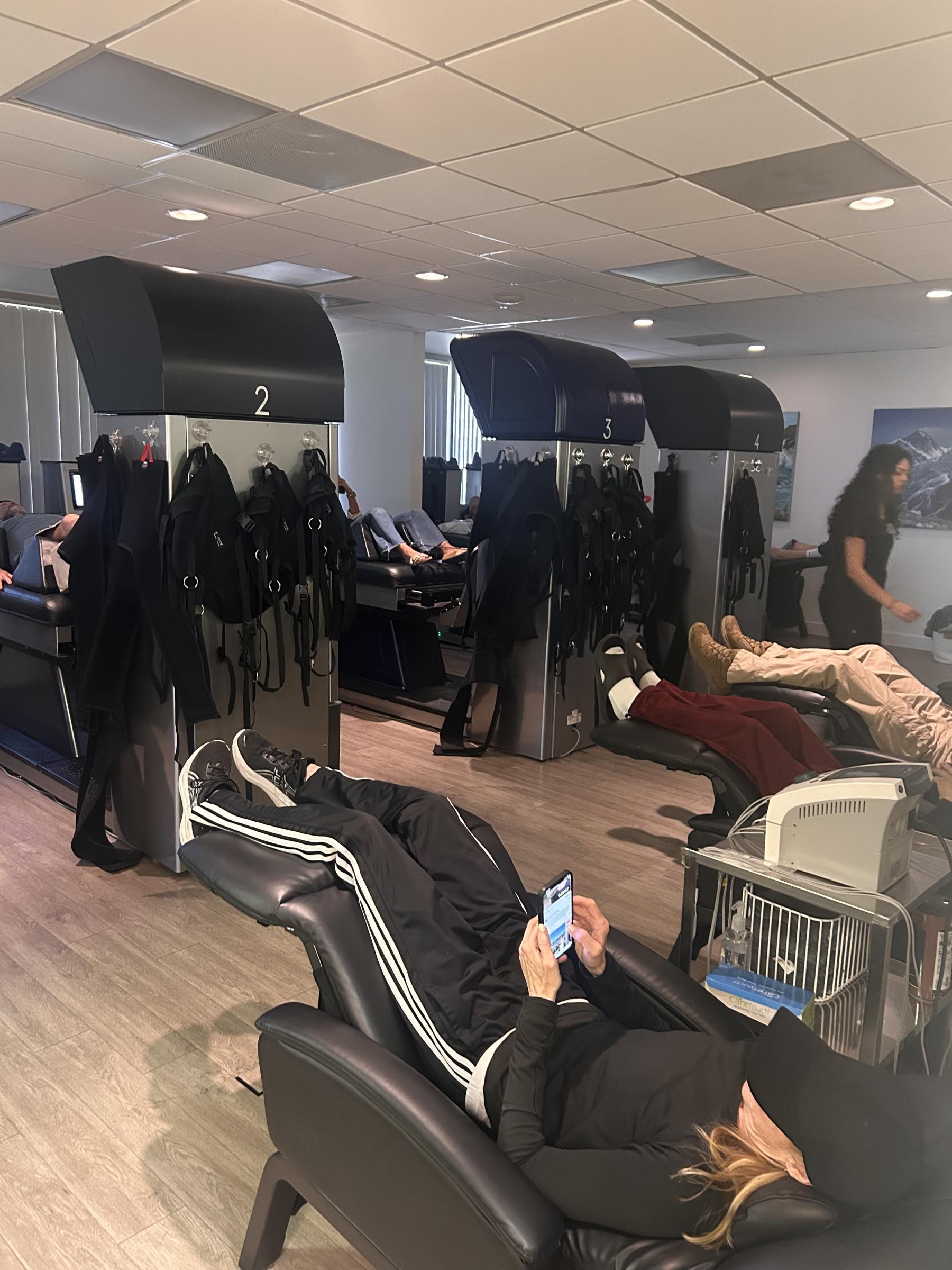
At The Spinal Decompression & Chiropractic Center of San Diego, Dr. Cassidy James Boelk, DC uses DRX9000® Non-Surgical Spinal Decompression Therapy for appropriate cervical and lumbar conditions.
The practice has 7 DRX9000 Spinal Decompression Systems dedicated to Non-Surgical Spinal Decompression.
Based on the number of dedicated DRX9000 systems in the office, it is one of the largest known Non-Surgical Spinal Decompression practices in California.
4. Progress Into Appropriate Rehabilitation
Pain reduction is important.
But if your goal is returning to work, exercise, golf, surfing, running, lifting weights, or other activities, recovery may also require rebuilding your physical capacity.
Depending on the individual, rehabilitation may address:
-
Core stability
-
Strength
-
Mobility
-
Movement patterns
-
Hip and shoulder function
-
Balance and coordination
-
Gradual return to normal activities
Dr. Boelk is both a Certified Spinal Decompression Doctor and Certified Pain-Free Performance Specialist, allowing rehabilitation to be incorporated when appropriate.
Is Bed Rest the Fastest Way to Heal a Herniated Disc?
Usually, prolonged bed rest isn't the goal.
There may be times when severe pain requires temporarily reducing activity, but staying inactive for an extended period can lead to loss of strength and conditioning.
For many patients, an appropriate amount of movement is beneficial.
The key word is appropriate.
Walking may feel helpful for one patient and aggravate another.
Sitting may provide relief for one type of condition while significantly increasing symptoms in another.
This is another reason generic advice found online doesn't replace an individual examination.
What If Physical Therapy, Chiropractic, or Injections Haven't Worked?
Patients who seek out Dr. Boelk frequently aren't starting from scratch.
Many have already tried one or more conservative treatments.
Others may have undergone injections or even previous spinal procedures and are still experiencing symptoms.
That doesn't automatically make someone a candidate for spinal decompression.
Instead, Dr. Boelk looks at why the symptoms may still be occurring and whether the patient's condition appears appropriate for another conservative approach.
Sometimes the answer is yes.
Sometimes it isn't.
Not Every Patient Is a Candidate for Non-Surgical Spinal Decompression
This distinction matters.
Dr. Boelk does not recommend Non-Surgical Spinal Decompression simply because someone has a herniated disc on an MRI.
Certain conditions may make decompression inappropriate.
Other patients may require additional testing or another specialist's evaluation.
And there are patients for whom surgery may be the appropriate recommendation.
Jeff traveled from Tucson hoping to find another option.
After evaluating his condition, Dr. Boelk gave him a very different recommendation.
⭐⭐⭐⭐⭐
“I found this terrific practice on social media. I followed up and did my own research so I decided to pay them a visit. The place is clean, well organized and run by a very efficient receptionist. I met with the doctor and after a honest and forthright conversation, we both determined that surgery was my only option to correct my back issues. I will return as a customer when the time is right.”
— Jeff J., Tucson, AZ
That's an important part of the practice philosophy.
The goal isn't to put every patient on a DRX9000.
The goal is to determine whether Non-Surgical Spinal Decompression makes sense for the individual patient.
Why Patients Seek Out Dr. Cassidy James Boelk, DC
✔ Certified Spinal Decompression Doctor
✔ Certified Pain-Free Performance Specialist
✔ California X-Ray Radiology Licensed Doctor
✔ Founder, Non-Surgical Spinal Decompression Training Academy
✔ Founding Member, American Spinal Decompression Society
✔ More Than 22 Years Clinical Experience
✔ More Than 100,000 Spinal Decompression Treatments Performed
✔ 7 DRX9000® Spinal Decompression Systems
✔ One of the Largest Known Non-Surgical Spinal Decompression Practices in California
✔ Patients Travel From Across the United States and Internationally
Dr. Boelk has spent more than two decades working with patients suffering from difficult disc, neck, back, and nerve-related conditions.
His interest in spinal rehabilitation is personal as well as professional. After experiencing significant neck and back injuries himself, Dr. Boelk has spent thousands of hours studying and working through rehabilitation strategies for both his own injuries and those of his patients.
Dr. Boelk also trains other doctors in Non-Surgical Spinal Decompression protocols and techniques through the Non-Surgical Spinal Decompression Training Academy, based in his San Diego private practice.
Patients have sought out the practice from across Southern California and the United States, as well as internationally.
When Does Herniated Disc Pain Require Immediate Medical Attention?
Although many herniated discs can be managed conservatively, certain neurological symptoms require immediate medical attention.
Seek emergency medical evaluation if you develop:
-
New loss of bowel or bladder control
-
Numbness in the groin or saddle region
-
Rapidly progressing muscle weakness
-
Significant or worsening neurological deficits
These symptoms may indicate serious nerve compression and shouldn't be delayed while pursuing conservative treatment.
Herniated Disc Treatment Near Scripps Ranch, CA
If you live or work in Scripps Ranch, Sabre Springs, Poway, Mira Mesa, Rancho Peñasquitos, or surrounding San Diego communities, you may be searching for a conservative option for a herniated disc or sciatica.
During an evaluation, Dr. Cassidy James Boelk, DC may:
✔ Review your symptoms and health history
✔ Perform appropriate orthopedic and neurological testing
✔ Review your existing MRI or other imaging when available
✔ Obtain digital X-rays when clinically indicated
✔ Evaluate spinal stability when appropriate
✔ Explain what may be contributing to your symptoms
✔ Determine whether you're a candidate for Non-Surgical Spinal Decompression
✔ Discuss other appropriate options when decompression isn't indicated
Don't assume surgery is your only option.
But don't assume Non-Surgical Spinal Decompression is appropriate for you either.
Find out first.
⭐⭐⭐⭐⭐ “One of the Best Decisions I Made for My Back.”
**“The care I received at Dr. Boelk's office was so wonderful. I went from having to lay down for several hours a day, to being able to live my life normally, and even began working up my exercise capacity. I always felt cared about, and there was a lot of feedback. The exercise and information Dr. Boelk provides is so critical to maintaining positive results and pain reduction with increased mobility and freedom.
All the staff are so caring, and it's one of the best decisions I made for my back!”**
— Kaitelyn H., San Diego, CA
Individual results vary. Not every patient is a candidate for Non-Surgical Spinal Decompression Therapy.
Find Out If You're a Candidate
If a herniated disc, sciatica, or persistent neck or lower-back pain is interfering with your life, find out whether Non-Surgical Spinal Decompression may be an appropriate option for your condition.
The Spinal Decompression & Chiropractic Center of San Diego
📍 5095 Murphy Canyon Road, Suite 300
San Diego, CA 92123
📞 619-298-0800
🌐 SanDiegoBackCare.com
Call 619-298-0800 today to schedule your evaluation and find out if you're a candidate.
Hablamos Español.