What Is the Best Non-Surgical Treatment for Sciatica in Mission Valley, CA?
If you're searching for non-surgical sciatica treatment in Mission Valley, CA, there's a good chance your leg pain has started interfering with activities that used to be easy. Perhaps you can no longer sit comfortably during your commute, you're waking up at night with burning pain in your calf, or you're finding it difficult to exercise without aggravating your lower back.
Sciatica can be particularly frustrating because the symptoms don't always stay in one place. You may experience a deep ache in your buttock one day and sharp pain extending into your foot the next. Sometimes the pain improves when you move around. Other times, even a short walk can make your symptoms worse.
Many patients begin searching for additional treatment options after trying physical therapy, chiropractic care, medications, or epidural injections without the improvement they hoped for. If an MRI has revealed a herniated disc at L4-L5 or L5-S1, you may also be concerned about whether back surgery will eventually become necessary.
The encouraging news is that many people with sciatica improve without surgery. However, choosing the most appropriate treatment requires understanding what's irritating the nerve, whether your symptoms correspond to your imaging findings, and how your condition responds to conservative care.
At The Spinal Decompression & Chiropractic Center of San Diego, Dr. Cassidy James Boelk, DC, has spent more than 22 years helping patients with sciatica, herniated discs, bulging discs, and other spinal conditions explore non-surgical treatment options.
His practice is located in nearby Kearny Mesa, welcoming patients from Mission Valley, Mission Hills, Serra Mesa, Linda Vista, and throughout San Diego County.
When Sciatica Starts Affecting More Than Your Back
One of the most difficult things about persistent sciatica is how gradually it can take over your daily routine. You may begin avoiding certain activities because you're afraid of another flare-up. Sitting through a meeting becomes uncomfortable, driving across town requires frequent position changes, and exercise may feel like something you can no longer enjoy.
Over time, poor sleep, reduced activity, and uncertainty about your recovery can affect your energy, confidence, and overall quality of life.
For some patients, the pain begins after a specific accident or injury. For others, symptoms develop gradually without an obvious triggering event.
One San Diego patient described how severe sciatica following an accident affected nearly every aspect of his life before he sought treatment with Dr. Boelk.
⭐⭐⭐⭐⭐
"I was dealing with severe back pain that made it difficult to sleep, along with intense sciatica that radiated from my lower back down my leg following an accident.
When I met with Dr. Cassidy Boelk, he performed a thorough evaluation and determined that I was a good candidate for treatment.
The results were remarkable.
After just two spinal decompression sessions, my sciatic pain was gone, allowing us to focus on correcting the underlying cause of the problem. I completed 24 treatments and then progressed into rehabilitation exercises designed to strengthen my core and help prevent future flare-ups.
The office is beautiful, organized, and professional, and the customer service provided by the entire staff consistently exceeded my expectations.
Living with back and neck pain can affect every part of your life. In my case, I gained weight, relied on pain medications, struggled with depression, and dealt with significant anxiety because of my condition.
Today, I feel like a different person.
I'm sleeping better, walking comfortably, becoming active again, and enjoying life much more than before.
My experience has been excellent from start to finish.
Dr. Cassidy Boelk is truly outstanding, and I am extremely grateful I found his office."
⭐⭐⭐⭐⭐
— Abel T., San Diego, CA
Abel's experience highlights an important aspect of sciatica treatment: the ultimate goal isn't simply to make a pain score lower. It's to help patients regain their ability to sleep, walk, exercise, work, and participate in the activities that matter to them.
His testimonial describes his individual experience rather than a result that can be guaranteed for other patients. The appropriate treatment, expected recovery, and need for rehabilitation depend on each person's diagnosis and clinical findings.
Start With a Complimentary, No-Charge, No-Obligation Consultation
If you've been struggling with sciatica for months or years, it's understandable to have questions before considering another treatment program. You may want to understand why previous treatments haven't worked, whether your MRI explains your leg pain, or whether computerized spinal decompression might be appropriate for your condition.
Dr. Boelk offers a Complimentary, No-Charge, No-Obligation Consultation so you can discuss your concerns and learn about the services available at his practice before deciding whether to proceed with a comprehensive examination.
During your consultation, you'll have an opportunity to:
-
Meet personally with Dr. Boelk and discuss your symptoms, medical history, and how your condition affects your everyday life.
-
Review previous treatments, including physical therapy, chiropractic care, medications, injections, or prior spinal surgery.
-
Discuss existing MRI or X-ray findings, if available, and ask questions about what those findings may mean.
-
Learn about the DRX9000 spinal decompression system, including how the treatment works, what a typical session involves, and its potential benefits and limitations.
-
Discuss possible next steps, including whether a comprehensive new patient examination may be appropriate to determine the source of your symptoms and whether you're a candidate for treatment.
-
Ask questions without pressure, so you can make an informed decision about your care.
There is no charge for this consultation, and you're under no obligation to begin treatment.
The consultation is an informational discussion rather than a comprehensive diagnostic physical examination. It does not include new X-rays or treatment. Those services are separately charged when appropriate.
If you're ready for a complete evaluation, you can schedule a new patient examination instead.
Call 619-298-0800 to schedule your new patient examination or request your complimentary consultation.
¡Hablamos Español! | 24/7 Answering Service
Why Does Sciatica Often Become Worse When Sitting or Driving?
One of the most common complaints from patients with sciatica is that sitting aggravates their symptoms. This can be especially frustrating for people who spend significant time commuting, working at a desk, or traveling.
For some individuals with disc-related sciatica, prolonged sitting and certain flexed postures may increase irritation of an already sensitive spinal nerve root. The combination of remaining in one position, reduced movement, and the mechanical demands placed on the lower back can contribute to increasing discomfort.
However, sitting doesn't aggravate every type of sciatica. Patients with lumbar spinal stenosis, for example, may experience greater discomfort while standing or walking and notice improvement when sitting or leaning forward.
These differences provide useful clues about the underlying condition.
For someone whose symptoms become worse during a long commute, several practical adjustments may help reduce repeated aggravation. Taking breaks when possible, changing positions periodically, adjusting the seat to maintain a comfortable posture, and avoiding prolonged positions that increase radiating leg pain can be reasonable starting points.
The goal isn't to find one perfect sitting posture that everyone must maintain. It's to identify positions and movement habits that your body tolerates while avoiding activities that consistently make your nerve symptoms worse.
Understanding What's Actually Causing Your Sciatica
Sciatica isn't a diagnosis by itself. It's a term used to describe symptoms associated with irritation of nerve roots that contribute to the sciatic nerve.
These nerve roots originate in the lower spine and eventually form a large nerve that travels through the buttock and down the leg. When a nerve root becomes irritated or compressed, pain may travel along its distribution, sometimes extending all the way into the foot.
A lumbar disc herniation is one common cause. The discs between your vertebrae help distribute forces throughout the spine. When disc material extends beyond its normal boundaries, it may irritate or compress a nearby nerve root.
Inflammation surrounding the nerve can also contribute to symptoms, which helps explain why the intensity of pain doesn't always correspond directly to the size of a herniation seen on MRI.
Other possible causes include degenerative spinal changes, narrowing of the spaces through which nerves travel, and certain conditions affecting peripheral nerves or surrounding tissues.
The location of the pain provides clues, but it doesn't always identify the cause on its own.
For example, a typical posterolateral disc herniation at L4-L5 may irritate the L5 nerve root, producing symptoms along the outer leg or top of the foot. A herniation at L5-S1 may affect the S1 nerve root, sometimes producing pain down the back of the calf or altered sensation along the outside of the foot.
These patterns aren't universal, and some patients have disc abnormalities on MRI that aren't responsible for their symptoms.
A comprehensive examination helps determine whether the patient's history, neurological findings, and available imaging correspond to a particular spinal condition.
What Are the Best Non-Surgical Treatments for Sciatica?
There isn't one treatment that works best for every patient. The appropriate approach depends on the underlying cause of the nerve irritation, the severity and duration of symptoms, neurological findings, and the patient's response to previous care.
For many people, conservative treatment begins with education, activity modification, and exercise-based rehabilitation. Depending on the circumstances, medications, injections, or additional medical evaluation may also be considered.
Exercise-Based Rehabilitation and Movement Modification
One of the most important goals of sciatica rehabilitation is helping patients remain active without repeatedly aggravating their symptoms.
Prolonged bed rest is generally discouraged for uncomplicated sciatica. However, pushing through activities that consistently increase radiating leg pain, numbness, or weakness may also be counterproductive.
A well-designed rehabilitation program considers which movements are currently tolerated and gradually builds the patient's ability to perform everyday activities.
Depending on the condition, exercises may include modified McGill curl-ups, bird dogs, side planks, hip strengthening, and progressive walking. Some patients may also respond favorably to specific directional movements, while others require a more gradual approach.
Dr. Boelk frequently discusses these strategies in his educational videos, emphasizing that exercise selection should be based on the individual's symptoms rather than assuming everyone needs the same routine.
Medications and Epidural Steroid Injections
Some patients benefit from medications recommended by their medical providers to help manage symptoms while the underlying condition improves. Medication choices require consideration of the patient's health history, potential side effects, and the limited benefits of certain drugs for sciatica.
Epidural steroid injections may be considered for selected patients with severe or persistent nerve-related leg pain. These injections can provide short-term symptom relief for some individuals, although the response varies and they don't physically remove a herniated disc.
When symptoms persist despite appropriate conservative treatment, additional evaluation may help determine whether another approach is warranted.
DRX9000 Computerized Non-Surgical Spinal Decompression
For selected patients with disc-related symptoms, computerized spinal decompression may be discussed as an additional conservative treatment option.
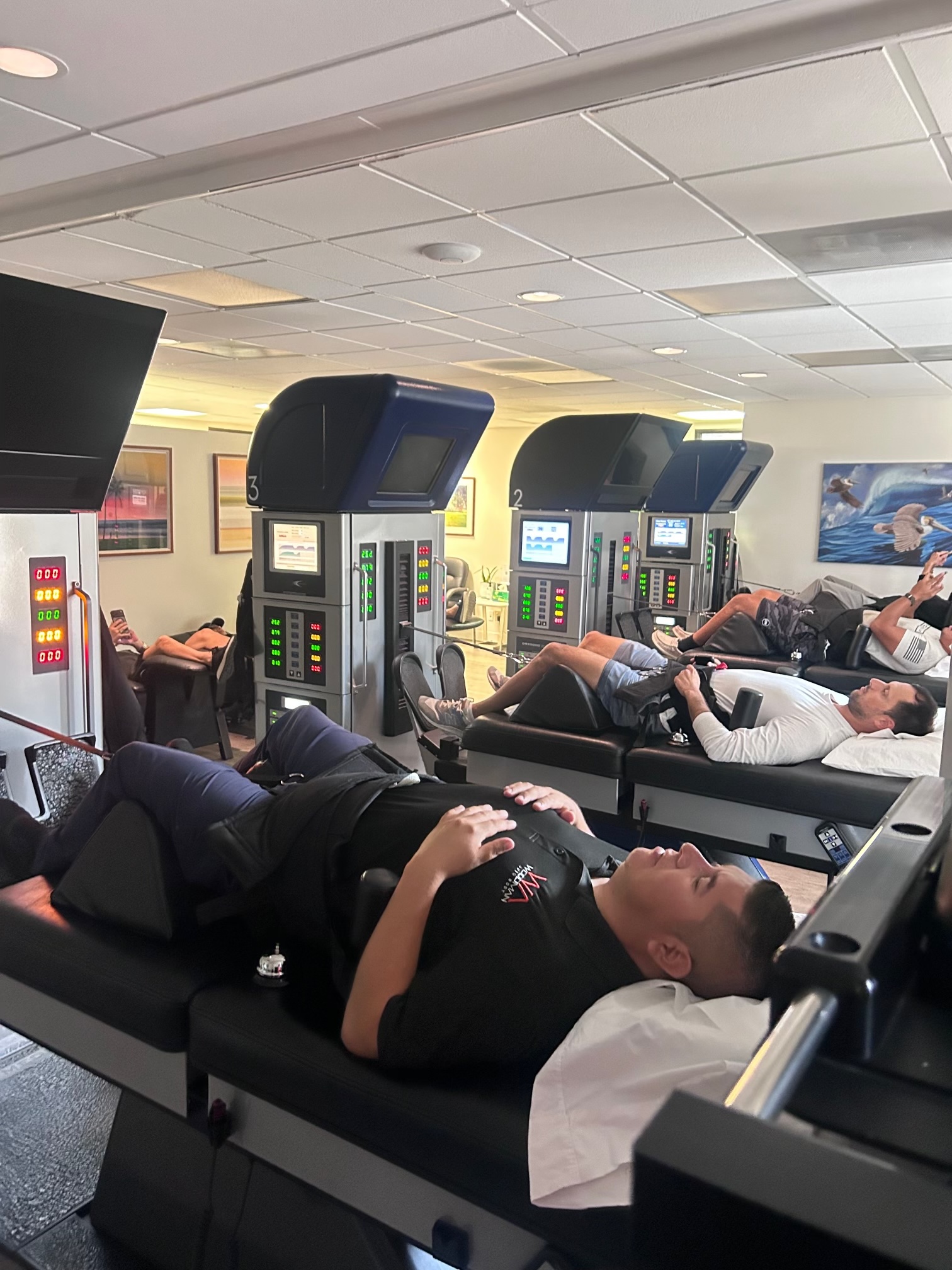
At The Spinal Decompression & Chiropractic Center of San Diego, Dr. Boelk uses the DRX9000 computerized spinal decompression system.
The DRX9000 applies controlled distraction forces to the spine through programmed pulling and relaxation cycles. During treatment, the patient lies on a specialized table while the system delivers forces according to individualized settings.
A typical lumbar treatment lasts approximately twenty to twenty-five minutes. The procedure is non-invasive and doesn't require incisions, anesthesia, or injections.
The intended purpose is to provide controlled mechanical unloading of spinal structures and potentially help manage symptoms in patients who respond favorably to traction-based care.
Dr. Boelk's Kearny Mesa practice has seven DRX9000 spinal decompression tables, including four lumbar and three cervical units.
It's important to recognize that research on computerized spinal decompression remains limited and mixed, and major sciatica guidelines do not recommend traction as routine treatment. Spinal decompression cannot be guaranteed to repair a herniated disc, eliminate nerve compression, or prevent surgery.
This is why appropriate patient selection, realistic expectations, and ongoing assessment are essential when considering whether treatment may be reasonable.
Three Practical Ways to Reduce Sciatica Aggravation During Your Day
One of the most useful things patients can do is begin recognizing patterns in their symptoms. Although these strategies aren't a substitute for individualized medical care, they can help people understand which activities may be contributing to repeated flare-ups.
1. Change positions before your symptoms become severe.
If sitting for thirty minutes consistently increases your leg pain, waiting until the pain becomes intense may make it more difficult to settle down afterward. Instead, consider standing or walking briefly before reaching that point, provided those movements are comfortable.
This can be especially useful for people who spend much of their day working at a computer or driving.
2. Be cautious with aggressive hamstring stretching.
Many patients describe feeling tightness in the buttock or back of the thigh and assume that stretching harder will solve the problem.
However, what feels like muscle tightness may sometimes be related to irritation of a spinal nerve root or increased sensitivity along the sciatic nerve.
Aggressive hamstring stretching, particularly when combined with forward bending through the lower back, can aggravate symptoms in some patients with disc-related sciatica.
This doesn't mean stretching is always harmful. It means that exercises should be appropriate for your condition and shouldn't repeatedly increase radiating pain, numbness, or tingling.
3. Track how far down your leg the symptoms travel.
One concept used in spinal rehabilitation is centralization, which occurs when symptoms retreat from the foot or calf toward the lower back during certain movements or activities.
For example, someone whose pain previously extended into the toes may notice that it gradually becomes limited to the thigh or buttock.
This can be a favorable clinical response, although it doesn't prove that a disc has physically moved or that nerve compression has resolved.
The opposite response, called peripheralization, occurs when symptoms travel farther down the leg during particular movements.
Exercises that repeatedly increase radiating pain, numbness, or weakness should be reconsidered rather than forced.
Understanding these patterns can help patients communicate more effectively with their healthcare providers and make better decisions about their daily activities.
Why Sciatica Recovery Requires More Than Temporary Pain Relief
Many patients understandably focus on finding something that reduces their pain as quickly as possible. While symptom relief is important, meaningful recovery often involves improving strength, endurance, movement tolerance, and confidence in everyday activities.
A patient may begin feeling better after reducing the activities that aggravate their nerve, but that doesn't necessarily mean they're ready to return immediately to heavy lifting, strenuous exercise, or long periods of sitting.
This is where progressive rehabilitation becomes important.
For example, someone who has avoided exercise for several weeks may need to rebuild core endurance and hip strength before returning to their usual workout routine. A patient whose job involves prolonged sitting may benefit from gradually increasing sitting tolerance while continuing appropriate movement throughout the day.
Recovery also isn't always a straight line. Some patients improve steadily, while others experience temporary flare-ups as they return to normal activities.
Tracking changes in walking tolerance, sleep quality, sitting endurance, and the location of leg symptoms can provide a more complete picture of progress than pain intensity alone.
Why Dr. Boelk Doesn't Recommend Spinal Decompression to Everyone
One of the most important parts of evaluating a patient with sciatica is determining whether a particular treatment is appropriate.
Not every patient who visits The Spinal Decompression & Chiropractic Center of San Diego is a candidate for spinal decompression.
Some patients have significant spinal instability, fractures, surgical hardware, or neurological findings that require another approach. Others may need additional imaging, medical evaluation, rehabilitation, or a surgical consultation before considering further conservative care.
One patient traveled from Tucson, Arizona, to meet with Dr. Boelk and appreciated receiving a straightforward recommendation, even though spinal decompression wasn't the appropriate option for his condition.
⭐⭐⭐⭐⭐
“I found this terrific practice on social media. I followed up and did my own research so I decided to pay them a visit. The place is clean, well organized and run by a very efficient receptionist. I met with the doctor and after a honest and forthright conversation, we both determined that surgery was my only option to correct my back issues. I will return as a customer when the time is right.”
— Jeff J., Tucson, AZ
Jeff's experience illustrates why an individualized evaluation matters. The purpose of an examination isn't simply to recommend a treatment program. It's to determine which options are appropriate for the patient's condition.
Sometimes that means considering conservative care. Other times, it means recognizing that another medical opinion or surgical evaluation may be the more appropriate next step.
When Should You Consider Surgery for Sciatica?
Although many patients improve without surgery, certain situations require prompt medical attention or surgical evaluation.
Persistent, disabling leg pain despite appropriate conservative treatment may warrant consultation with a spine surgeon, particularly when imaging confirms nerve compression that corresponds to the patient's symptoms.
Significant or progressive neurological weakness also requires prompt medical assessment.
Certain symptoms are medical emergencies. New loss of bladder or bowel control, numbness involving the groin or saddle region, or rapidly progressing weakness in one or both legs may indicate serious neurological compression and require immediate emergency evaluation.
For patients without these warning signs, the decision about surgery depends on symptom severity, neurological findings, imaging, previous treatments, and individual preferences.
Surgery may provide faster relief for appropriately selected patients, while continued conservative care may remain reasonable for others.
Why Patients From Mission Valley Choose Dr. Cassidy James Boelk, DC
When you're dealing with persistent sciatica, choosing a doctor with extensive experience evaluating spinal conditions is an important decision.
Dr. Cassidy James Boelk, DC, has devoted more than 22 years to helping patients explore non-surgical treatment options for herniated discs, bulging discs, sciatica, and other spinal conditions.
Dr. Boelk's Credentials, Experience & Professional Affiliations
-
Doctor of Chiropractic (DC)
-
Certified Spinal Decompression Doctor
-
Certified Pain-Free Performance Specialist
-
Member, International Disc Education Association
-
Founding Member, American Spinal Decompression Society
-
Founder, Spinal Decompression Training Academy
-
California X-Ray Supervisor and Operator License
-
22+ Years as a Spinal Decompression Specialist
-
100,000+ Spinal Decompression Treatments Performed
-
Seven DRX9000 Spinal Decompression Tables (4 Lumbar, 3 Cervical)
Personal Experience With Serious Back Injuries
Dr. Boelk's interest in spinal rehabilitation is also rooted in his own experiences with significant back injuries.
As a teenager, he sustained fractures involving his lower lumbar spine and developed spondylolisthesis. Later in life, he experienced lumbar disc herniations and sciatica, giving him firsthand insight into how debilitating spinal nerve pain can become.
Over the years, he has devoted thousands of hours to studying spinal rehabilitation, improving his own spinal health, and helping patients work toward returning to the activities they enjoy.
He also trains other doctors through the Spinal Decompression Training Academy, sharing his clinical experience with non-surgical spinal decompression protocols, patient selection, and treatment techniques.
What Happens During Your New Patient Examination?
For patients considering treatment, a comprehensive examination helps determine whether their symptoms correspond to the findings on imaging and whether spinal decompression or another approach may be appropriate.
At The Spinal Decompression & Chiropractic Center of San Diego, the evaluation may include a detailed medical history, assessment of spinal movement, neurological testing, and review of existing MRI images or reports.
Weight-bearing spinal X-rays, including flexion and extension views, may be recommended when clinically indicated to assess spinal alignment or stability.
Dr. Boelk also considers previous treatments, functional limitations, and the patient's personal goals when discussing possible next steps.
If additional medical evaluation or referral is necessary, that can be addressed during the process.
The comprehensive examination is separate from the complimentary consultation and has its own fees.
To schedule your new patient examination, call 619-298-0800.
Frequently Asked Questions About Sciatica Treatment in Mission Valley
What is the best treatment for sciatica without surgery?
There isn't one treatment that works best for everyone. The most appropriate approach depends on the underlying cause of the nerve irritation, symptom severity, neurological findings, and previous treatments. Exercise-based rehabilitation, activity modification, and other conservative options are commonly considered.
Why does my sciatica get worse when I drive?
Prolonged sitting can aggravate symptoms in some patients with disc-related sciatica. Changing positions, adjusting the seat, and taking breaks when possible may help reduce repeated symptom aggravation.
Can sciatica go away without surgery?
Yes. Many cases of sciatica improve over time, particularly when caused by lumbar disc herniations. However, persistent symptoms, significant weakness, or worsening neurological findings require appropriate medical evaluation.
Is walking good for sciatica?
Walking is often beneficial when tolerated. However, some patients, particularly those with certain forms of spinal stenosis, experience increased symptoms during prolonged standing or walking.
Can spinal decompression help with sciatica?
Some selected patients may experience symptom relief with traction-based treatment, but research remains limited and mixed. Spinal decompression isn't appropriate for everyone and cannot be guaranteed to resolve sciatica or prevent surgery.
Should I stretch my hamstrings if I have sciatica?
It depends on the cause of your symptoms and how you respond to stretching. Aggressive stretching can aggravate nerve-related leg pain in some patients. Exercises should be selected according to your condition and tolerance.
Where Can Mission Valley Residents Schedule a Sciatica Examination?
The Spinal Decompression & Chiropractic Center of San Diego is located nearby in Kearny Mesa at 5095 Murphy Canyon Road, Suite 300, San Diego, CA 92123.
The office welcomes patients from Mission Valley, Mission Hills, Linda Vista, Serra Mesa, and surrounding San Diego communities.
Call 619-298-0800 to schedule a new patient examination or request a complimentary consultation.
Looking for Non-Surgical Sciatica Treatment in Mission Valley, CA?
If sciatica has been interfering with your work, sleep, exercise, or everyday activities, you don't necessarily have to assume surgery is your only remaining option.
Many patients improve with appropriate conservative care, although the most effective approach depends on the underlying cause of their symptoms.
At The Spinal Decompression & Chiropractic Center of San Diego, Dr. Cassidy James Boelk, DC, has spent more than 22 years helping patients with sciatica and disc-related spinal conditions explore non-surgical treatment options.
Located nearby in Kearny Mesa, the practice offers comprehensive spinal evaluations and individualized treatment recommendations, including DRX9000 computerized spinal decompression for appropriately selected patients.
If you're ready to take the next step, schedule a comprehensive new patient examination. If you'd prefer to meet Dr. Boelk and ask questions before proceeding, you can begin with a Complimentary, No-Charge, No-Obligation Consultation.
Contact The Spinal Decompression & Chiropractic Center of San Diego
Dr. Cassidy James Boelk, DC
Certified Spinal Decompression Doctor
Certified Pain-Free Performance Specialist
Founder, Spinal Decompression Training Academy
The Spinal Decompression & Chiropractic Center of San Diego
5095 Murphy Canyon Road, Suite 300
San Diego, CA 92123
Phone: 619-298-0800
Email: frontdesk@sandiegobackcare.com
Website: www.SanDiegoBackCare.com
24/7 Answering Service | ¡Hablamos Español!
Call 619-298-0800 today to schedule your new patient examination or request your Complimentary, No-Charge, No-Obligation Consultation.
Understanding what's causing your sciatica is the first step toward making an informed decision about your treatment options.