What Is the Best Non-Surgical Treatment for Sciatica in La Jolla, CA?
Sciatica can be one of the most frustrating types of pain to experience, particularly when it begins interfering with activities that have always been part of your daily routine. What starts as discomfort in your lower back or buttock can develop into sharp, burning, or electric pain traveling down your leg. For some people, sitting becomes unbearable. Others struggle to stand comfortably, sleep through the night, or participate in activities they once enjoyed.
If you live in La Jolla, CA, and have been dealing with persistent sciatica, you may have already tried physical therapy, medications, chiropractic care, or epidural injections without achieving the improvement you hoped for. Perhaps your MRI shows a herniated disc at L4-L5 or L5-S1, and you've been told that surgery may eventually be necessary.
The encouraging news is that many people with sciatica improve without surgery. However, finding the most appropriate treatment requires understanding why the nerve is irritated in the first place. Sciatica can result from several different spinal conditions, and a treatment that helps one patient may not be appropriate for another.
At The Spinal Decompression & Chiropractic Center of San Diego, Dr. Cassidy James Boelk, DC, has spent more than 22 years helping patients explore non-surgical treatment options for sciatica, herniated discs, bulging discs, and other spinal conditions. His practice is located in Kearny Mesa and welcomes patients from La Jolla, University City, Pacific Beach, Del Mar, and throughout San Diego County.
When Sciatica Makes Everyday Life Difficult
One of the things Dr. Boelk frequently hears from patients is how much their condition has changed their lives. Some can no longer sit comfortably through a workday, while others have stopped exercising, traveling, or participating in recreational activities because they're afraid of another flare-up.
For active La Jolla residents who enjoy walking along the coast, surfing, golf, or staying physically fit, persistent sciatica can be especially discouraging. The problem isn't simply the pain itself; it's the uncertainty of not knowing which movements will aggravate the nerve or whether the condition will ever improve.
One patient described how severe sciatica had affected his ability to enjoy several of his favorite activities before seeking care with Dr. Boelk.
⭐⭐⭐⭐⭐
“There isn't enough room to fully explain the relief Dr. Boelk has brought to me and my family.
I found him after suffering from severe sciatica for more than a year. The pain shot from my hip all the way down to my left foot and became almost unbearable. I could no longer enjoy the activities I loved, including hockey, golf, and surfing.
Over the years, I had seen numerous chiropractors and experienced only temporary relief. Acupuncture helped somewhat, physical therapy was difficult to tolerate, and nothing seemed to provide lasting results. I couldn't sleep well, and my quality of life was steadily declining.
Then I met Dr. Boelk.
Through a structured treatment plan, adjustments, rehabilitation exercises, and lifestyle modifications, my life completely changed.
To this day, I tell people that Dr. Boelk saved my life.
Since my own recovery, I have referred my wife, daughter, mother, father, numerous friends, and many clients to his office. Every one of them has thanked me for the recommendation. Most recently, a firefighter friend of mine who was suffering from severe sciatica began treatment and is now making tremendous progress.
If you are considering surgery, I strongly encourage you to have Dr. Boelk evaluate your condition first.
What I respect most is his honesty. If he believes you are not a candidate or that another option would be better, he will tell you.
I trust him with my life and with my back.”
— Jayson Yavorsky, San Diego, CA
Jayson's experience illustrates how much persistent sciatica can affect a person's quality of life. Although individual results vary, his story also highlights the importance of combining appropriate treatment with rehabilitation and practical changes that support a return to normal activities.
Start With a Complimentary, No-Charge, No-Obligation Consultation
When you've been dealing with sciatica for months or even years, it's understandable to be cautious about trying another treatment. You may have already spent considerable time and money on approaches that provided only temporary improvement, and you want to understand your options before making another commitment.
That's why Dr. Boelk offers a Complimentary, No-Charge, No-Obligation Consultation.
This gives you an opportunity to meet with Dr. Boelk, discuss your condition, and learn more about the non-surgical treatment options available at his practice.
During your consultation, you can discuss:
-
Your symptoms: Where the pain begins, how far it travels down your leg, and which activities make it better or worse.
-
Your medical history: When the problem started, previous spinal injuries, and whether you've undergone back surgery.
-
Previous treatments: Physical therapy, medications, chiropractic care, injections, or other approaches you've tried.
-
Existing MRI or X-ray findings: If you have imaging available, you can discuss the findings and ask questions about what they may mean.
-
The DRX9000 spinal decompression system: How computerized spinal decompression works, what treatment involves, and its potential benefits and limitations.
-
Possible next steps: Whether a comprehensive new patient examination may be appropriate to determine the cause of your symptoms and whether you're a candidate for treatment.
You'll also have time to ask questions and discuss your concerns without feeling pressured to begin a treatment program.
The consultation is completely complimentary, with no charge and no obligation. It is a discussion rather than a comprehensive diagnostic examination and does not include a physical examination, new X-rays, or treatment. Those services are separate and have their own fees when appropriate.
If you're ready for a complete evaluation, you can schedule a new patient examination instead.
Call 619-298-0800 to schedule your new patient examination or request your complimentary consultation.
¡Hablamos Español! | 24/7 Answering Service
Why Sciatica Isn't the Same for Every Patient
Many people assume that sciatica is a specific diagnosis. In reality, it describes a collection of symptoms associated with irritation of nerve roots that contribute to the sciatic nerve.
The sciatic nerve is formed from nerve roots originating in the lower spine and travels through the buttock and down the leg. When one of these nerve roots becomes irritated, pain can be felt far from the actual location of the problem.
A lumbar disc herniation is one common cause. When disc material becomes displaced beyond its normal boundaries, it may irritate or compress a nearby spinal nerve root. Depending on which nerve is involved, symptoms can include burning leg pain, numbness, tingling, or weakness.
However, sciatica-like symptoms can also develop from degenerative changes in the spine, narrowing of the spaces through which nerves travel, or other conditions affecting the lower back and surrounding structures.
This distinction matters because a patient whose symptoms are caused by a herniated disc may require a different approach than someone whose symptoms are related to spinal stenosis or another condition.
For example, some patients with disc-related sciatica experience increased discomfort while sitting or bending forward. Others, particularly those with lumbar spinal stenosis, may feel worse while standing or walking and notice improvement when sitting or leaning forward.
These patterns aren't absolute, but they can provide valuable clues during an examination.
What Does Sciatica Feel Like When a Spinal Nerve Is Irritated?
Sciatica can produce a wide range of symptoms, and the intensity doesn't always correspond directly to the size of a disc herniation seen on MRI.
Some patients experience a dull ache in the buttock or thigh, while others describe sharp, electric, or burning pain traveling into the calf or foot. Numbness and tingling may occur along the same pathway, and certain patients develop weakness involving the foot or ankle.
Two of the most commonly affected lumbar levels are L4-L5 and L5-S1.
A typical posterolateral disc herniation at L4-L5 may irritate the L5 nerve root, potentially causing pain along the outer leg, numbness across the top of the foot, or difficulty lifting the foot or big toe. A herniation at L5-S1 may affect the S1 nerve root, sometimes producing pain down the back of the calf, altered sensation along the outside of the foot, or difficulty pushing off while walking.
However, these patterns aren't universal. Other spinal conditions, hip problems, and peripheral nerve disorders can produce similar symptoms.
This is why a comprehensive examination is important, particularly when symptoms have persisted despite previous treatment.
What Are the Best Non-Surgical Treatments for Sciatica?
The best treatment depends on the underlying cause of the nerve irritation, the severity of symptoms, neurological findings, and the patient's response to previous care.
For many patients, conservative treatment begins with education, appropriate activity modification, and exercise-based rehabilitation. Medications or injections may also be considered when appropriate, and selected patients may explore computerized spinal decompression as an additional treatment option.
Activity Modification and Rehabilitation
One of the first priorities is identifying movements and positions that consistently aggravate symptoms.
For example, a patient who experiences increased leg pain after sitting for twenty minutes may benefit from changing positions more frequently. Someone whose symptoms worsen after heavy lifting may need to temporarily modify their exercise routine.
However, prolonged bed rest is generally discouraged for uncomplicated sciatica. Remaining reasonably active within your tolerance is often preferable to avoiding movement altogether.
Rehabilitation may include exercises designed to improve spinal control, core endurance, hip strength, and movement tolerance. Depending on the patient's condition, modified McGill curl-ups, bird dogs, side planks, and progressive walking may be appropriate.
Dr. Boelk frequently discusses these approaches in his educational videos, emphasizing that exercise selection should reflect the patient's symptoms and physical capabilities.
Medications and Epidural Injections
Some patients benefit from medications recommended by their medical providers to help manage symptoms while the underlying condition improves. The appropriate medication depends on the patient's health history and the potential risks and benefits.
Epidural steroid injections may also be considered for certain patients with persistent or severe nerve-related leg pain. These injections may provide short-term relief for some individuals, although the benefits vary and they don't physically remove a herniated disc.
When symptoms continue despite appropriate treatment, reassessing the diagnosis and considering additional medical evaluation may be necessary.
Computerized Non-Surgical Spinal Decompression
For selected patients with disc-related sciatica, computerized spinal decompression may be considered as an additional conservative treatment option.
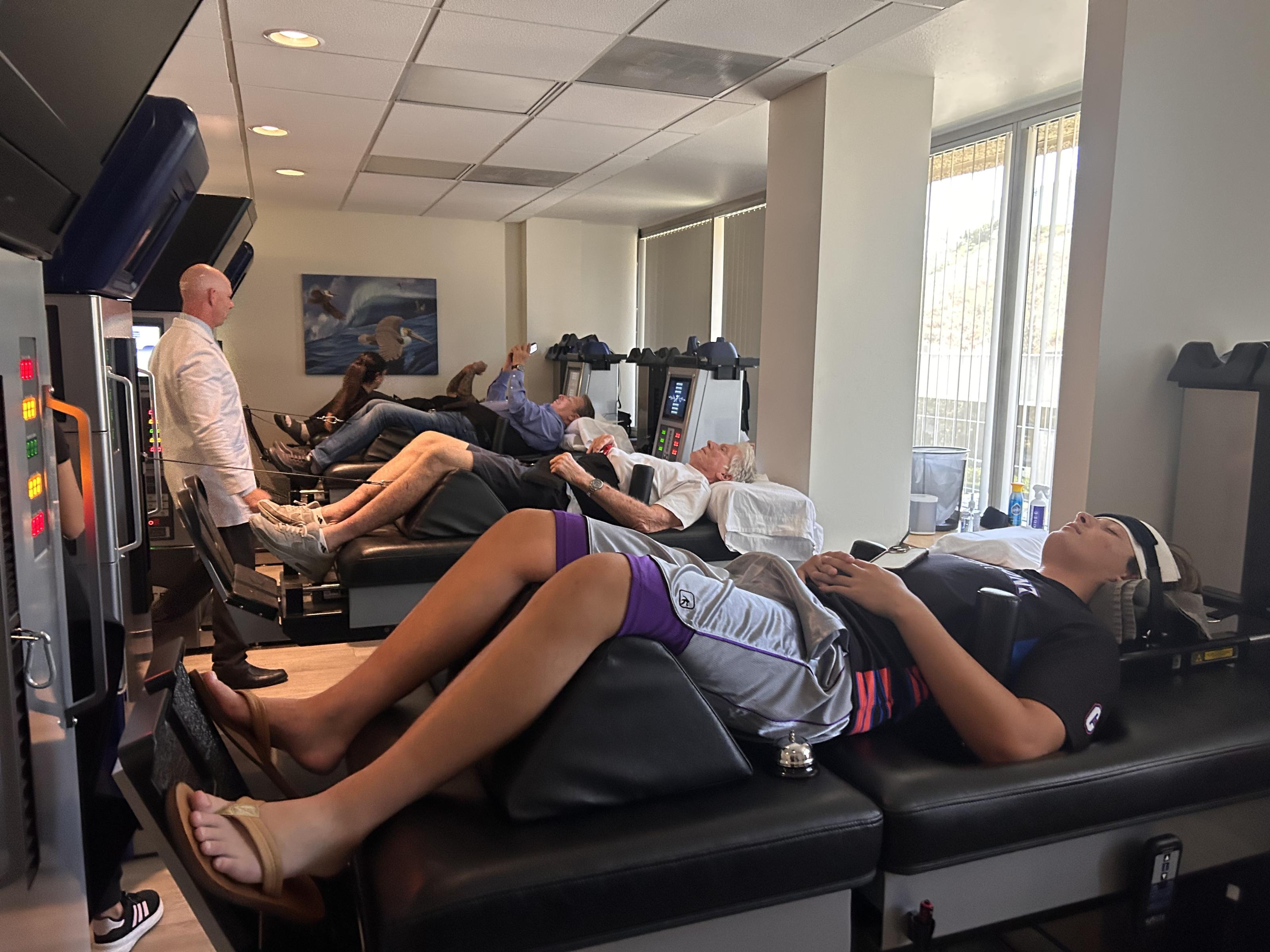
At The Spinal Decompression & Chiropractic Center of San Diego, Dr. Boelk uses the DRX9000 computerized spinal decompression system.
The DRX9000 applies controlled distraction forces to the spine through programmed pulling and relaxation cycles. During treatment, the patient lies on a specialized table while the system delivers forces according to individualized settings.
A typical lumbar treatment lasts approximately twenty to twenty-five minutes. The procedure is non-invasive and doesn't require incisions, anesthesia, or injections.
The intended purpose is to provide controlled mechanical unloading of spinal structures and potentially help manage symptoms in patients who respond favorably to traction-based care.
It's important to recognize that research on computerized spinal decompression remains limited and mixed, and major sciatica guidelines do not routinely recommend traction. Treatment cannot be guaranteed to repair a herniated disc, eliminate nerve compression, or prevent surgery.
For this reason, appropriate patient selection and ongoing evaluation are important parts of determining whether spinal decompression may be reasonable.
Why Does Sciatica Sometimes Last for Months or Even Years?
Many patients expect sciatica to resolve within a few days or weeks. Although some cases improve relatively quickly, others persist for several months or longer.
One reason is that an irritated spinal nerve can remain sensitive even after the initial aggravating event has passed. Depending on the underlying condition, inflammation, mechanical compression, or other factors may continue to contribute to symptoms.
Another common issue is repeated aggravation during everyday activities. Someone who spends long periods sitting, frequently bends or lifts, or returns to strenuous exercise too quickly may experience recurring flare-ups.
In other cases, the original diagnosis may need to be reconsidered. Not all leg pain comes from a herniated disc, and patients with persistent symptoms may benefit from additional examination or imaging.
The important point is that prolonged symptoms don't automatically mean surgery is necessary. However, they do indicate that a thoughtful reassessment may be appropriate, particularly when previous treatments haven't provided meaningful improvement.
Three Things Dr. Boelk Wants Patients With Sciatica to Understand
Over more than two decades of working with patients experiencing spinal pain, Dr. Boelk has emphasized the importance of understanding how symptoms respond to movement and activity.
Although every patient is different, several practical concepts can help people better recognize patterns in their sciatica.
First, pay attention to how far down your leg the pain travels. One concept frequently discussed in Dr. Boelk's educational videos is centralization, which occurs when symptoms retreat from the foot or calf toward the lower back during certain movements or activities.
For example, a patient who previously experienced pain extending into the toes may notice that the discomfort gradually becomes limited to the calf or thigh. This can be a favorable clinical response, although it doesn't prove that a disc has physically moved or that nerve compression has resolved.
Conversely, when a movement causes pain to travel farther down the leg, clinicians may describe this as peripheralization. Exercises that repeatedly increase leg pain, numbness, or weakness should be reconsidered rather than forced.
Second, don't judge recovery by pain intensity alone. A patient may report that pain has decreased from an eight to a five, which is encouraging, but other changes can be equally important. Can you sit longer without aggravating symptoms? Are you walking farther? Are you sleeping better? Are you able to perform everyday activities with greater confidence?
Tracking these functional improvements can provide a more complete picture of progress.
Third, be careful about returning to full activity too quickly. One of the most common frustrations patients experience is feeling better for several days, returning to their usual workout or recreational activities, and then experiencing another flare-up.
A gradual return to activity allows the body to rebuild strength and endurance while reducing the likelihood of repeatedly aggravating a sensitive nerve.
These strategies don't replace individualized medical advice, but they can help patients better understand their symptoms and participate more actively in their recovery.
Why Dr. Boelk Doesn't Recommend Spinal Decompression to Everyone
One of the most important parts of evaluating a patient with sciatica is determining whether the proposed treatment is appropriate.
Not everyone who visits The Spinal Decompression & Chiropractic Center of San Diego is a candidate for spinal decompression.
Some patients have significant spinal instability, fractures, surgical hardware, or neurological findings that require a different approach. Others may need additional imaging, medical evaluation, rehabilitation, or a surgical consultation before considering further conservative treatment.
One patient traveled from Tucson, Arizona, to consult with Dr. Boelk and appreciated receiving a straightforward recommendation, even though spinal decompression wasn't the appropriate treatment for his condition.
⭐⭐⭐⭐⭐
“I found this terrific practice on social media. I followed up and did my own research so I decided to pay them a visit. The place is clean, well organized and run by a very efficient receptionist. I met with the doctor and after a honest and forthright conversation, we both determined that surgery was my only option to correct my back issues. I will return as a customer when the time is right.”
— Jeff J., Tucson, AZ
Jeff's experience illustrates why an individualized evaluation matters. The purpose isn't simply to recommend a treatment program; it's to determine which options are appropriate for the patient's condition.
Sometimes that means considering spinal decompression as one possible conservative treatment. Other times, it means explaining why a different approach or medical referral may be more appropriate.
When Does Sciatica Require Surgery?
Although many patients improve without surgery, there are situations where surgical evaluation is appropriate.
Persistent, disabling leg pain despite adequate conservative treatment may warrant consultation with a spine surgeon, particularly when imaging confirms nerve compression that corresponds to the patient's symptoms. Significant or progressive neurological weakness also requires prompt medical attention.
Certain symptoms are medical emergencies. New loss of bladder or bowel control, numbness involving the groin or saddle region, or rapidly progressing weakness in one or both legs may indicate serious neurological compression and require immediate emergency evaluation.
For patients without these warning signs, the decision about surgery depends on symptom severity, neurological findings, imaging, treatment history, and individual preferences. Surgery may provide faster relief for appropriately selected patients, while continued conservative care may remain reasonable for others.
Why Patients Choose Dr. Cassidy James Boelk, DC, for Sciatica Treatment
When you're dealing with persistent sciatica, choosing a doctor with extensive experience in evaluating and managing spinal conditions is an important decision.
Dr. Cassidy James Boelk, DC, has devoted more than 22 years to helping patients explore non-surgical treatment options for herniated discs, bulging discs, sciatica, and other spinal conditions.
Credentials, Experience & Professional Affiliations
-
Doctor of Chiropractic (DC)
-
Certified Spinal Decompression Doctor
-
Certified Pain-Free Performance Specialist
-
Member, International Disc Education Association
-
Founding Member, American Spinal Decompression Society
-
Founder, Spinal Decompression Training Academy
-
California X-Ray Supervisor and Operator License
-
22+ Years as a Spinal Decompression Specialist
-
100,000+ Spinal Decompression Treatments Performed
-
Seven DRX9000 Spinal Decompression Tables (4 Lumbar, 3 Cervical)
A Doctor Who Understands Sciatica Personally
Dr. Boelk's interest in spinal rehabilitation is also rooted in his own experiences with serious back injuries.
As a teenager, he sustained a significant lower back injury involving spinal fractures and spondylolisthesis. Later in life, he experienced lumbar disc herniations and sciatica, giving him firsthand insight into how debilitating nerve-related spinal pain can become.
Over the years, he has devoted thousands of hours to studying spinal rehabilitation, improving his own spinal health, and helping patients work toward returning to the activities they enjoy.
Today, he also shares his clinical experience with other doctors through the Spinal Decompression Training Academy, helping them develop their knowledge of non-surgical spinal decompression protocols and patient care.
What Happens During Your New Patient Examination?
For patients considering treatment, a comprehensive examination helps determine whether the symptoms correspond to the findings on imaging and whether spinal decompression or another approach may be appropriate.
At The Spinal Decompression & Chiropractic Center of San Diego, the evaluation may include a detailed medical history, assessment of spinal movement, neurological testing, and review of existing MRI images or reports. Weight-bearing spinal X-rays, including flexion and extension views, may be recommended when clinically indicated to assess spinal alignment or stability.
Dr. Boelk also considers previous treatments, functional limitations, and the patient's personal goals when discussing possible next steps. If additional medical evaluation or referral is necessary, that can be addressed during the process.
The comprehensive examination is separate from the complimentary consultation and has its own fees.
To schedule your new patient examination, call 619-298-0800.
Frequently Asked Questions About Sciatica Treatment in La Jolla
What is the fastest way to relieve sciatica without surgery?
There isn't one treatment that provides the fastest relief for everyone. The appropriate approach depends on what's causing the nerve irritation. Some patients improve with activity modification and rehabilitation, while others may require medications, injections, or additional medical evaluation.
Can sciatica go away on its own?
Yes. Many cases of sciatica improve over time, particularly when caused by lumbar disc herniations. However, persistent symptoms, significant weakness, or worsening neurological findings require appropriate medical evaluation.
Is walking good for sciatica?
Walking is often beneficial when tolerated, although the response depends on the underlying condition. Some patients feel better while walking, while others—particularly those with certain forms of spinal stenosis—experience increased symptoms with prolonged standing or walking.
Can spinal decompression help with sciatica?
Some selected patients may experience symptom relief with traction-based treatment, but the research remains limited and mixed. Spinal decompression isn't appropriate for everyone and cannot be guaranteed to resolve sciatica or prevent surgery.
Can sciatica cause numbness in my foot?
Yes. Irritation of certain lumbar or sacral nerve roots can produce numbness, tingling, or altered sensation in the leg or foot. The location of symptoms may help identify which nerve is involved, but an examination is necessary to evaluate the cause.
How long does it take to recover from sciatica?
Recovery varies considerably. Some patients improve within several weeks, while others experience symptoms for several months or longer. The underlying cause, severity of nerve irritation, neurological findings, and response to treatment all influence recovery.
Where can La Jolla residents schedule a sciatica examination?
The Spinal Decompression & Chiropractic Center of San Diego is located at 5095 Murphy Canyon Road, Suite 300, in Kearny Mesa.
Call 619-298-0800 to schedule a new patient examination or request a complimentary consultation.
Looking for Non-Surgical Sciatica Treatment in La Jolla, CA?
Living with sciatica can affect nearly every part of your daily routine. Whether you're struggling to sit comfortably at work, sleep through the night, exercise, or enjoy time with your family, persistent nerve pain can become physically and emotionally exhausting.
If you've already tried several treatments without the improvement you hoped for, it may be time to take a closer look at what's causing your symptoms and whether additional conservative treatment is appropriate.
At The Spinal Decompression & Chiropractic Center of San Diego, Dr. Cassidy James Boelk, DC, has spent more than 22 years helping patients with sciatica and disc-related spinal conditions explore non-surgical treatment options.
If you're ready to take the next step, schedule a comprehensive new patient examination. If you'd prefer to meet Dr. Boelk and ask questions before proceeding, you can begin with a Complimentary, No-Charge, No-Obligation Consultation.
The consultation is complimentary and does not include a diagnostic examination, new X-rays, or treatment, which are separate services when appropriate.
Contact The Spinal Decompression & Chiropractic Center of San Diego
Dr. Cassidy James Boelk, DC
Certified Spinal Decompression Doctor
Certified Pain-Free Performance Specialist
Founder, Spinal Decompression Training Academy
The Spinal Decompression & Chiropractic Center of San Diego
5095 Murphy Canyon Road, Suite 300
San Diego, CA 92123
Phone: 619-298-0800
Email: frontdesk@sandiegobackcare.com
Website: www.SanDiegoBackCare.com
24/7 Answering Service | ¡Hablamos Español!
Call 619-298-0800 today to schedule your new patient examination or request your Complimentary, No-Charge, No-Obligation Consultation.