WHY DOES MY SCIATIC NERVE PAIN KEEP COMING BACK? – SAN DIEGO, CA
If Your Sciatica Keeps Coming Back, You're Probably Asking the Wrong Question
Sciatica has a way of giving people hope...
...only to take it away again.
One week you're feeling better.
The sharp pain down your leg starts to fade.
You're walking farther, sleeping better, and finally beginning to think your back is healing.
Then one morning you bend over to tie your shoes...
You drive to work...
You play a round of golf...
Or sometimes you simply wake up...
And suddenly the pain shoots down your leg all over again.
If this has happened to you, you're not alone.
One of the most common questions I hear from patients is:
"Why does my sciatica keep coming back?"
It's an understandable question because recurring pain can be incredibly discouraging.
Many people begin wondering if they're making the injury worse, whether they'll eventually need surgery, or if they'll simply have to live with sciatica forever.
The encouraging news is that recurring sciatica doesn't automatically mean your condition is getting worse.
However, it usually means the underlying cause of your symptoms hasn't been fully addressed.
Understanding why your sciatica keeps returning is often the first step toward finally breaking the cycle.
Looking for Answers?
If you're struggling with recurring sciatica, leg pain, numbness, tingling, or back pain, understanding why your symptoms continue returning is the first step.
Dr. Cassidy James Boelk, DC personally performs every consultation and examination. If you've already had an MRI, he'll review the images with you, explain what they mean, and discuss whether they actually match your symptoms.
Your Complimentary No-Charge Consultation Includes
✔ One-on-one consultation with Dr. Boelk
✔ Comprehensive examination
✔ MRI review (if available)
✔ Honest discussion of your treatment options
✔ Answers to all of your questions
Not everyone is a candidate for treatment. If Dr. Boelk believes another option would better serve you, he'll tell you.
📞 619-298-0800
Patient Story: "Nothing Seemed to Provide Lasting Results"
"There isn't enough room to fully explain the relief Dr. Boelk has brought to me and my family.
I found him after suffering from severe sciatica for more than a year. The pain shot from my hip all the way down to my left foot and became almost unbearable. I could no longer enjoy the activities I loved, including hockey, golf, and surfing.
Over the years, I had seen numerous chiropractors and experienced only temporary relief. Acupuncture helped somewhat, physical therapy was difficult to tolerate, and nothing seemed to provide lasting results. I couldn't sleep well, and my quality of life was steadily declining.
Then I met Dr. Boelk.
Through a structured treatment plan, adjustments, rehabilitation exercises, and lifestyle modifications, my life completely changed.
To this day, I tell people that Dr. Boelk saved my life.
If you are considering surgery, I strongly encourage you to have Dr. Boelk evaluate your condition first. What I respect most is his honesty. If he believes you are not a candidate or that another option would be better, he will tell you. I trust him with my life and with my back."
★★★★★ — Jayson Yavorsky, San Diego, CA
Sciatica Isn't Actually Your Diagnosis
This is one of the biggest misconceptions surrounding sciatica.
People often say,
"I have sciatica."
While that's true, sciatica describes a symptom—not the actual problem.
Sciatica simply means the sciatic nerve is irritated.
The real question is:
What's irritating it?
That irritation might come from:
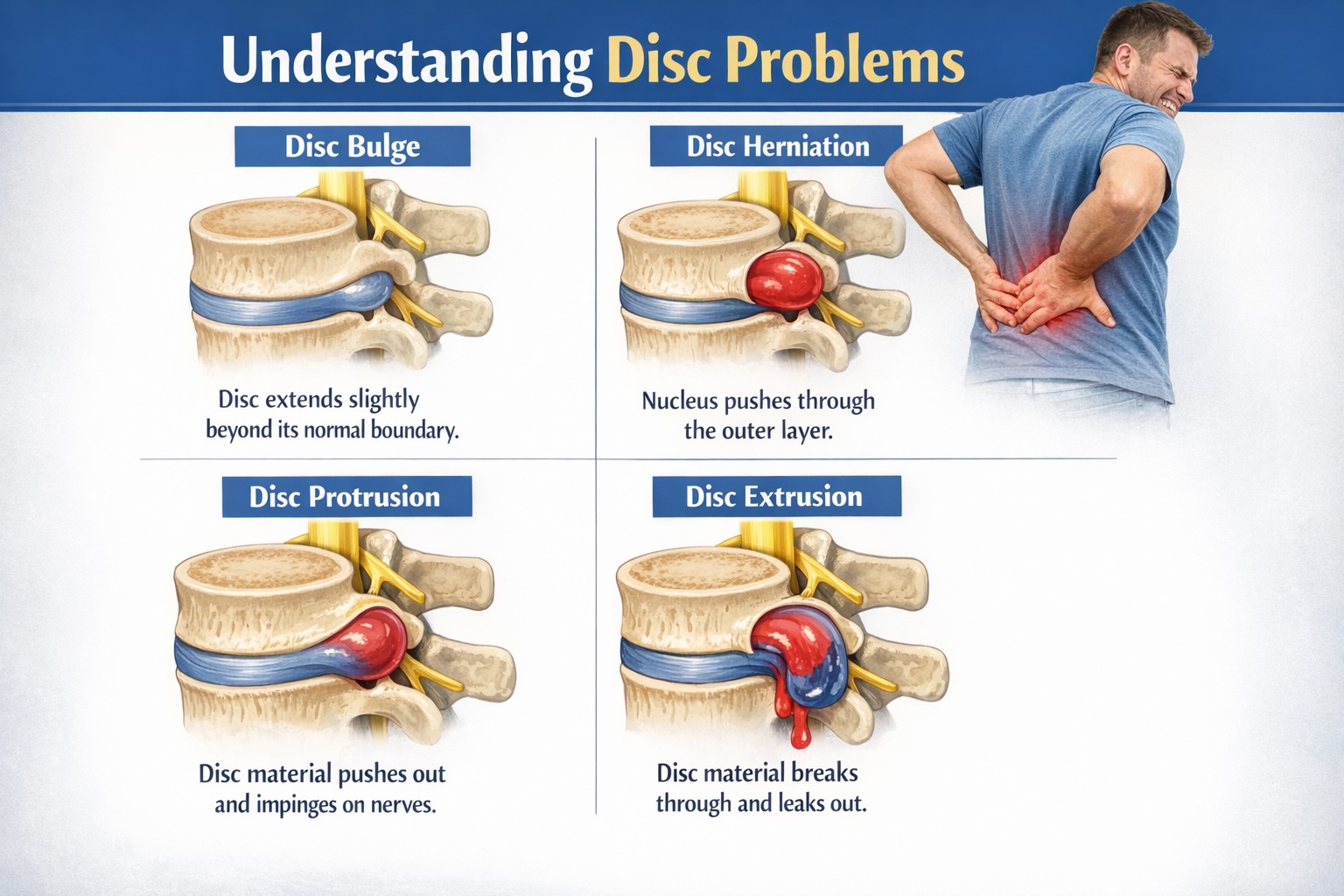
- A herniated disc
- A bulging disc
- Degenerative disc disease
- Foraminal stenosis
- Lumbar spinal stenosis
- Spondylolisthesis
- Or another condition affecting the lumbar spine
Until the underlying cause is identified, it's difficult to know why your symptoms continue returning.
That's why treating only the pain often leads to temporary relief rather than lasting improvement.
Why Does It Feel Better...Then Suddenly Flare Up Again?
Recovery from many spinal conditions isn't a straight line.
Think about spraining your ankle.
After a few weeks, it feels much better.
You decide to hike five miles.
The next morning it's sore again.
That doesn't necessarily mean you've re-injured it.
It may simply mean the tissue wasn't ready for that level of activity.
The same thing often happens with disc-related sciatica.
You begin feeling better.
The inflammation decreases.
The nerve becomes less irritated.
Then you spend six hours driving, help a friend move, sit through a long flight, or spend an entire weekend doing yard work.
Suddenly the symptoms return.
Many patients assume this means treatment failed.
More often, it means the irritated tissues were pushed beyond what they had fully recovered from.
One Thing Most Patients Never Hear
Here's something that surprises many people.
Spinal discs heal much differently than muscles or skin.
Muscles receive an excellent blood supply.
If you strain a muscle, your body can usually deliver oxygen and nutrients directly to the injured tissue.
Spinal discs are different.
They have a very limited direct blood supply and rely largely on the movement of nutrients through the disc rather than direct circulation.
That means disc injuries often heal much more slowly than people expect.
It's one reason patients may feel significantly better after several weeks, yet still experience occasional flare-ups if they return too quickly to prolonged sitting, repetitive bending, heavy lifting, or other activities that continue stressing the injured disc.
Improving symptoms are encouraging—but they don't always mean complete healing has occurred.
A Common Misconception
One of the biggest myths I hear is:
"If my sciatica came back, my treatment didn't work."
Not necessarily.
Healing isn't always linear.
Many orthopedic injuries improve gradually, with occasional setbacks along the way.
The more important question isn't:
"Did my pain come back?"
It's:
"Why did it come back?"
That's exactly what a thorough evaluation should help answer.
Why Does Sciatica Keep Returning Even After Physical Therapy, Chiropractic Care, or Injections?
This is one of the most frustrating situations patients describe.
They'll often tell me:
"I was doing really well...then a few weeks or months later, everything came back."
Sometimes they've already tried physical therapy.
Sometimes they've had chiropractic adjustments.
Others have undergone epidural steroid injections or taken medications that temporarily reduced the pain.
That doesn't necessarily mean those treatments were inappropriate or unsuccessful.
Each of those treatments has an important role for the right patient.
The challenge is that if the underlying reason the nerve continues to become irritated isn't fully addressed, symptoms may return once the temporary improvement fades.
For example, if a herniated disc is repeatedly placing mechanical stress on a spinal nerve, reducing inflammation may help relieve symptoms for a period of time. But if the mechanical irritation remains, the pain can eventually return.
That's why understanding what is causing your sciatica is far more important than simply asking what treatment should I try next?
The diagnosis should always come before the treatment plan.
Does Recurring Sciatica Mean You'll Eventually Need Surgery?
Fortunately, not necessarily.
This is one of the biggest fears patients have when they walk into our office.
They assume that because the pain keeps returning, surgery is inevitable.
In reality, there isn't a simple timeline that says:
- One flare-up = surgery.
- Three flare-ups = surgery.
- Six months of pain = surgery.
The decision to recommend surgery depends on many factors, including:
- The cause of your symptoms.
- The severity of nerve compression.
- Whether you're developing progressive weakness.
- How much your symptoms affect your quality of life.
- Whether appropriate conservative treatment has been attempted.
- Your overall health and personal goals.
Some patients truly do require surgery, and when that's the case, it's important to have an honest discussion about it.
However, many others improve without surgery through the right combination of conservative care.
The key is identifying which category you fall into rather than assuming surgery—or avoiding it at all costs.
Where Does Non-Surgical Spinal Decompression Fit?
For some patients whose recurring sciatica is caused by certain disc-related conditions, Non-Surgical Spinal Decompression may be one conservative treatment option to consider.
It's important to understand that spinal decompression is not appropriate for everyone.
Patients with certain medical conditions, significant spinal instability, fractures, infections, tumors, or other contraindications may require completely different treatment approaches.
That's one reason Dr. Cassidy James Boelk, DC performs a thorough consultation and examination before recommending care.
If imaging is available, he personally reviews the MRI with each patient to determine whether the findings actually match the symptoms and whether Non-Surgical Spinal Decompression is an appropriate option.
If another form of treatment—or even surgery—is more appropriate, he'll explain that honestly.
That philosophy has always been simple:
Recommend what's best for the patient, not what's best for the practice.
Why Patients Choose Dr. Cassidy James Boelk, DC
When people have been living with recurring sciatica, they're usually looking for more than temporary pain relief.
They want to understand why it keeps happening and what they can realistically do about it.
For more than 22 years, Dr. Cassidy James Boelk, DC has dedicated his practice to evaluating and treating patients with herniated discs, bulging discs, sciatica, spinal stenosis, degenerative disc disease, and other complex spinal conditions.
Patients choose Dr. Boelk because of his combination of experience, honesty, and specialization.
He is a:
- Board-Certified Doctor of Chiropractic
- Certified Spinal Decompression Doctor
- Certified Pain-Free Performance Specialist (PPSC)
- Founder of the Non-Surgical Spinal Decompression Training Academy
- Founding Member of the American Spinal Decompression Society
- California Licensed X-Ray Supervisor & Operator
Over the course of his career, Dr. Boelk has personally performed more than 100,000 spinal decompression treatments and exclusively utilizes seven DRX9000® spinal decompression systems, making his practice one of the largest providers of Non-Surgical Spinal Decompression in California.
He also personally reviews MRI studies whenever they're available and regularly trains other healthcare providers in the evaluation and treatment of disc-related spinal conditions.
Patients travel not only from throughout San Diego County, but from across the United States and internationally to seek his opinion.
Most importantly, they're looking for honest recommendations.
If Dr. Boelk believes you're a good candidate for treatment, he'll explain why.
If he believes another approach would better serve you, he'll tell you that too.
Honesty Matters
One of my favorite patient reviews isn't from someone we treated.
It's from someone we didn't.
"Very nice Dr. and honest! I would definitely recommend anyone who hasn't had metal put in their back from surgery to go to him and give his program a shot. I believe it would definitely help. Just not in my personal case, as I have a lot of hardware in my back. But I'm glad I took the time to meet with him. It was very informative all around."
★★★★★ — Toni W., Lake Elsinore, CA
I believe reviews like this say far more about a practice than any advertisement ever could.
A Personal Message From Dr. Cassidy James Boelk, DC
If you've been dealing with recurring sciatica, I know how discouraging it can be. I've met many patients who start to feel hopeful when the pain improves, only to become frustrated when it returns weeks or months later.
My advice is simple: don't judge your condition based on one good day or one bad day. Instead, focus on understanding why your symptoms continue returning. Once you have an accurate diagnosis, you can make informed decisions about the treatment options that are most appropriate for you.
Whether you choose our office or another provider, I encourage you to ask questions, understand your MRI if you've had one, and never feel pressured into treatment until you're comfortable with your diagnosis and your options.
If I believe I can help you, I'll explain why. If I don't, I'll tell you that too.
I wish you the very best on your road to recovery.
— Dr. Cassidy James Boelk, DC
You Don't Have to Figure This Out Alone
If your sciatica keeps returning and you're tired of wondering why, we'd be honored to help you better understand what's causing your symptoms.
Your Complimentary No-Charge Consultation includes:
✔ One-on-one consultation with Dr. Boelk
✔ Comprehensive examination
✔ MRI review (if available)
✔ Honest recommendations
✔ Answers to your questions
The Spinal Decompression & Chiropractic Center of San Diego
5095 Murphy Canyon Road, Suite 300
San Diego, CA 92123
📞 619-298-0800
✔ Complimentary No-Charge Consultation
✔ Live 24/7 Answering Service
✔ Hablamos Español