Spondylolisthesis Treatment Without Surgery | Clairemont, CA
Can Grade 1 or Grade 2 Spondylolisthesis Be Treated Without Surgery?
A diagnosis of spondylolisthesis can raise a lot of questions.
Why did the vertebra slip?
Is it going to get worse?
Is it causing the lower-back pain or sciatica?
Is exercise safe?
And one of the biggest concerns:
“Does having spondylolisthesis mean I'll eventually need back surgery?”
Not necessarily.
Some patients with spondylolisthesis may have conservative treatment options. But determining what treatment may be appropriate involves much more than simply looking at whether an MRI report says Grade 1 or Grade 2.
One of the most important questions Dr. Cassidy James Boelk, DC considers is:
Is the spondylolisthesis stable or unstable?
At The Spinal Decompression & Chiropractic Center of San Diego, Dr. Boelk evaluates patients from Clairemont, CA with spondylolisthesis to determine what may actually be causing their symptoms, whether the involved spinal segment appears stable, and whether Non-Surgical Spinal Decompression may be an appropriate conservative treatment option.
Not everyone is a candidate—and determining that comes before treatment.
Looking for Spondylolisthesis Treatment Without Surgery in Clairemont, CA?
If a patient has been diagnosed with spondylolisthesis and is looking for alternatives to surgery, the diagnosis alone doesn't determine the next step.
Dr. Boelk considers:
- The patient's symptoms
- Neurological findings
- Existing MRI findings
- The amount of vertebral slippage
- Whether the involved segment appears stable
- Disc problems that may also be contributing
- Foraminal or spinal stenosis
- Nerve compression
- Treatments already attempted
- Whether Non-Surgical Spinal Decompression may be appropriate
- Whether there's a reason the patient should not receive decompression
Find Out If You're a Candidate
Patients looking for another opinion are welcome to contact the office to determine whether an evaluation makes sense.
📞 619-298-0800
☎️ 24/7 Answering Service
🇪🇸 Hablamos Español
📍 The Spinal Decompression & Chiropractic Center of San Diego
5095 Murphy Canyon Road, Suite 300
Kearny Mesa, CA 92123
🌐 SanDiegoBackCare.com
⭐⭐⭐⭐⭐ Ten Years of Sciatica and Back Pain
Toni had been dealing with symptoms for years and had already tried several different approaches before finding the office.
She described her experience:
**“For the first time in 10 years, I am completely pain-free. My sciatca is gone, and I no longer have back pain.
Before finding Dr. Boelk, I tried chiropractic care, acupuncture, pain medications, and several other therapies that simply didn't work. I was one step away from back surgery when I discovered spinal decompression treatment at The Spinal Decompression & Chiropractic Center of San Diego.
The results have been incredible. Every visit was comfortable, relaxing, and completely pain-free. Dr. Boelk and Patty always took the time to explain everything and made me feel genuinely cared for throughout the process.
They are warm, welcoming, and truly dedicated to helping their patients.
Thank you, Dr. Boelk and Patty!”**
⭐⭐⭐⭐⭐
— Toni H., San Diego, CA
Toni's experience illustrates why some patients continue exploring conservative options before making a decision about surgery.
But her experience doesn't mean every person with spondylolisthesis, back pain, or sciatica is appropriate for spinal decompression.
Candidacy comes first.
What Is Spondylolisthesis?
Spondylolisthesis occurs when one vertebra shifts forward relative to the vertebra below it.
The amount of displacement is commonly classified by grade.
Grade 1 spondylolisthesis generally represents a smaller degree of forward displacement.
Grade 2 spondylolisthesis represents a greater degree of displacement.
But the grade doesn't tell the entire story.
Two patients with the same grade of spondylolisthesis can potentially have very different clinical situations.
One spinal segment may remain relatively stable.
Another may demonstrate abnormal movement when the patient changes position.
That difference can be extremely important when determining whether conservative treatment is appropriate.
Stable vs. Unstable Spondylolisthesis: Why Does It Matter?
A lumbar MRI can provide valuable information about:
- The vertebral slip
- Lumbar discs
- Nerves
- Spinal canal
- Foraminal spaces
- Disc bulges or herniations
- Degenerative changes
- Spinal stenosis
But an MRI is typically obtained while the patient is lying relatively still.
When stability is a concern, Dr. Boelk may also want to determine:
“What happens to the involved vertebra when the patient bends forward and backward?”
That's where weight-bearing flexion and extension X-rays may become particularly important.
Why Flexion and Extension X-Rays May Matter
When clinically indicated, Dr. Boelk may obtain weight-bearing X-rays in:
Neutral → Flexion → Extension
This allows the relationship between the involved vertebrae to be compared in different positions.
The objective is to evaluate whether there appears to be abnormal movement at the involved spinal segment.
Why is this so important?
Because an unstable spondylolisthesis may completely change the treatment recommendation.
If Dr. Boelk believes a patient's spondylolisthesis is unstable or that Non-Surgical Spinal Decompression would not be appropriate, he will not accept that patient for decompression treatment.
Depending on the findings, additional medical or surgical evaluation may be recommended instead.
Can Grade 1 Spondylolisthesis Be Treated Without Surgery?
In some cases, yes.
A diagnosis of Grade 1 spondylolisthesis does not automatically mean surgery is required.
But it also doesn't automatically mean someone is a candidate for Non-Surgical Spinal Decompression.
Dr. Boelk considers the entire clinical picture, including:
- Stability
- Symptoms
- Neurological findings
- MRI findings
- Disc condition
- Foraminal narrowing
- Spinal stenosis
- Previous treatment
- Overall clinical presentation
For an appropriately selected patient with a stable Grade 1 spondylolisthesis, conservative treatment may potentially be considered.
Can Grade 2 Spondylolisthesis Be Treated Without Surgery?
Possibly—but Grade 2 requires considerably more caution.
A Grade 2 slip doesn't automatically mean a patient needs surgery.
It also doesn't mean spinal decompression is automatically appropriate.
Dr. Boelk considers questions such as:
How much slippage is present?
Does the involved segment appear stable?
What does the MRI show?
Are there neurological findings?
Is a disc problem contributing to the symptoms?
Is foraminal or spinal stenosis present?
What happens on flexion and extension imaging when clinically indicated?
Some carefully selected patients with a stable Grade 2 spondylolisthesis may potentially be considered for conservative treatment.
Others may not be appropriate candidates.
The grade matters. But the grade isn't the entire decision.
What Symptoms Can Spondylolisthesis Cause?
Some people have spondylolisthesis with relatively few symptoms.
Others may experience:
- Chronic lower-back pain
- Pain with prolonged standing
- Pain with walking
- Buttock pain
- Sciatica
- Leg pain
- Numbness or tingling
- Tightness
- Symptoms aggravated by certain activities or positions
But there's another important consideration.
Spondylolisthesis may not be the only finding on the patient's MRI.
A patient may simultaneously have:
- Degenerative disc disease
- Disc bulging
- Disc herniation
- Foraminal narrowing
- Spinal stenosis
- Facet degeneration
- Nerve compression
That's why Dr. Boelk isn't simply asking:
“Does this patient have spondylolisthesis?”
He's trying to determine:
“What appears to be causing this patient's symptoms?”
⭐⭐⭐⭐⭐ Severe Back Pain and Sciatica That Interfered With Sleep
Abel came to the office following an accident with significant back pain and sciatica.
He described his experience:
**“I had really bad back problems to the point I couldn’t sleep, also had pain radiating along the sciatic nerve which ran down one leg from the lower back—caused by an accident.
I came in and talked to Dr. Cassidy about my back problems. He evaluated me and mentioned I was a good candidate for this treatment. After the first 2 decompression sessions my sciatic pain was gone and we were able to work on the root of the problem. I did a total of 24 sessions, after which I was able to start rehabilitation training to strengthen my core.
The office is super nice and the staff’s customer service is above and beyond.
Back and neck issues are horrible to live with—trust me, I know firsthand. I gained weight, took pain killers, went into depression, and had major anxiety. I’m over it now—feeling better, walking, sleeping well, and starting to have a better social life as well.
The experience for me has been nothing but excellent. Dr. Cassidy Boelk is hands down amazing—super glad I came here.”**
⭐⭐⭐⭐⭐
— Abel T., San Diego, CA
One part of Abel's experience is especially relevant to patients considering spinal decompression:
He was evaluated and determined to be a candidate before beginning treatment.
That's particularly important when spondylolisthesis is present.
Can Spondylolisthesis Cause Sciatica?
It can contribute to sciatica in some patients.
Spondylolisthesis may contribute to narrowing around a spinal nerve, potentially causing symptoms into the buttock or leg.
But sciatica may also be associated with:
- Lumbar disc herniation
- Disc protrusion or extrusion
- Foraminal stenosis
- Spinal stenosis
- Other causes of nerve irritation or compression
So if a patient has both spondylolisthesis and sciatica, the vertebral slip shouldn't automatically be assumed to explain everything.
Ideally:
Symptoms + examination + neurological findings + imaging
should correlate.
Can Spinal Decompression Be Used With Spondylolisthesis?
This is one of the most important questions patients with spondylolisthesis ask.
“If one vertebra has already slipped forward, could spinal decompression make it worse?”
There isn't a one-size-fits-all answer.
For an appropriately selected patient with a stable spine and certain associated disc or nerve-compression problems, Non-Surgical Spinal Decompression may potentially be considered as part of a conservative treatment approach.
However:
An unstable spondylolisthesis may not be appropriate for spinal decompression.
That's why Dr. Boelk doesn't simply see “spondylolisthesis” on an MRI report and begin treatment.
Stability and candidacy come first.
Non-Surgical Spinal Decompression for Clairemont, CA Patients
Patients from Clairemont, CA looking for nonsurgical options for spondylolisthesis, chronic lower-back pain, sciatica, and certain disc-related conditions can be evaluated at The Spinal Decompression & Chiropractic Center of San Diego.
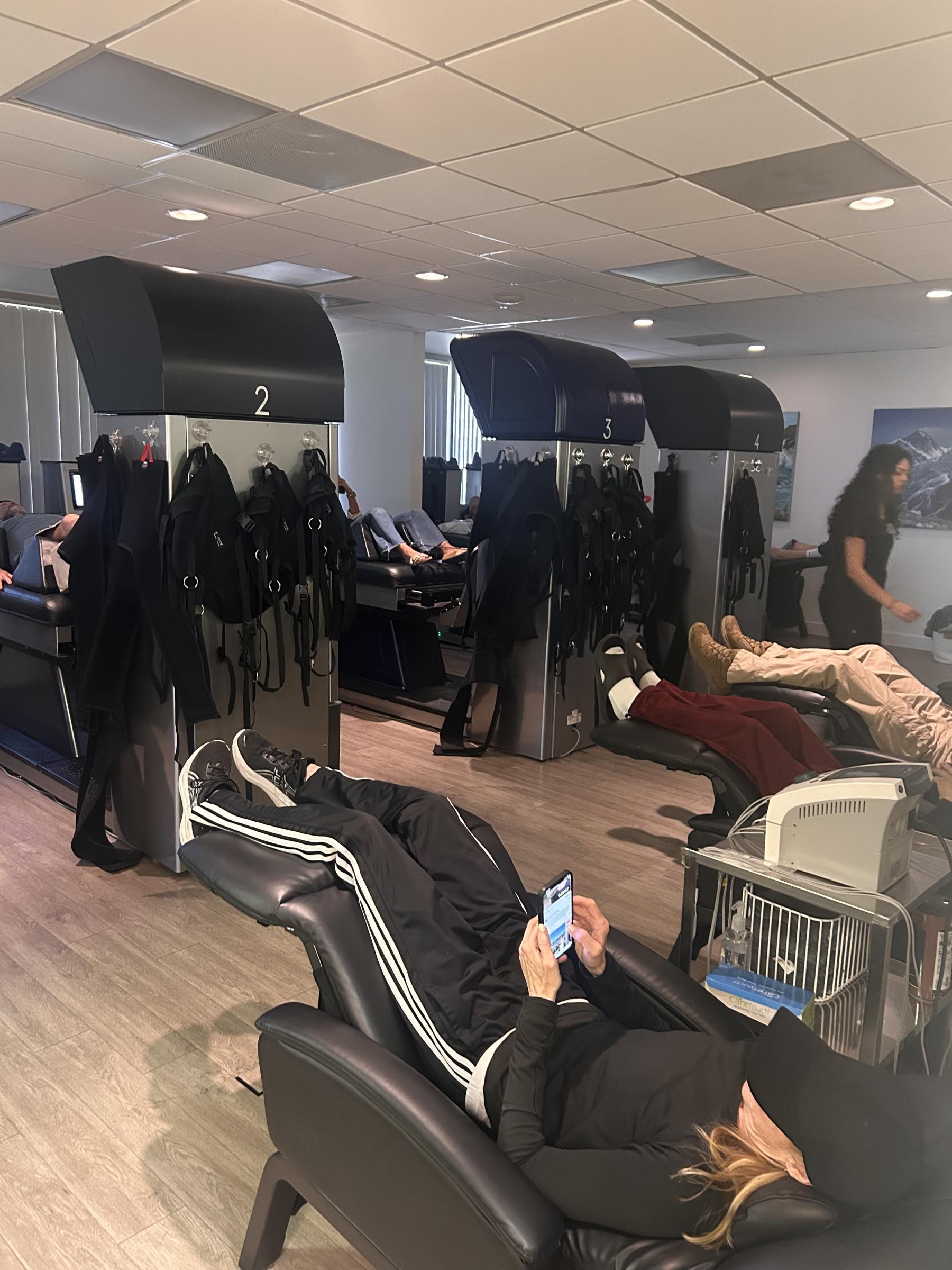
Dr. Boelk uses the DRX9000® Non-Surgical Spinal Decompression System.
The practice has 7 DRX9000 Spinal Decompression Systems and is one of the largest known dedicated Non-Surgical Spinal Decompression practices in California.
But the number of decompression systems isn't what determines whether a patient should receive treatment.
The evaluation does.
The goal is to determine whether Non-Surgical Spinal Decompression makes sense for that particular patient and that particular spine.
⭐⭐⭐⭐⭐ Sometimes the Right Answer Is NOT Spinal Decompression
For someone with spondylolisthesis, this may be one of the most important patient experiences on this page.
Jeff researched the practice and came to the office looking for answers about his back condition.
After an evaluation and an honest conversation with Dr. Boelk, they determined that spinal decompression wasn't the appropriate option for him.
Jeff still wrote:
“I found this terrific practice on social media. I followed up and did my own research so I decided to pay them a visit. The place is clean, well organized and run by a very efficient receptionist. I met with the doctor and after a honest and forthright conversation, we both determined that surgery was my only option to correct my back issues. I will return as a customer when the time is right.”
⭐⭐⭐⭐⭐
— Jeff J., Tucson, AZ
That experience illustrates an important part of Dr. Boelk's approach:
The purpose of an evaluation isn't to find a reason to put every patient on a DRX9000.
It's to determine what appears appropriate for that patient's condition.
If Dr. Boelk doesn't believe someone is a candidate for Non-Surgical Spinal Decompression, he'll tell them.
Why Patients Seek Out Dr. Cassidy James Boelk, DC
✔ Certified Spinal Decompression Doctor
✔ Certified Pain-Free Performance Specialist
✔ California X-Ray Radiology Licensed Doctor
✔ Founder, Non-Surgical Spinal Decompression Training Academy
✔ Founding Member, American Spinal Decompression Society
✔ More Than 22 Years Clinical Experience
✔ More Than 100,000 Spinal Decompression Treatments Performed
✔ 7 DRX9000® Spinal Decompression Systems
✔ One of the Largest Known Non-Surgical Spinal Decompression Practices in California
Dr. Boelk also trains other doctors in Non-Surgical Spinal Decompression protocols and techniques through the Non-Surgical Spinal Decompression Training Academy, based in his private practice.
What If Surgery Has Already Been Recommended?
A surgical recommendation shouldn't simply be ignored in favor of spinal decompression.
There are circumstances where surgery may be the appropriate treatment, particularly when significant instability or progressive neurological compromise is present.
But if a patient is uncertain about their options and wants to know whether the condition may still be appropriate for conservative treatment, another evaluation may help clarify those choices.
The goal isn't:
“Avoid surgery at all costs.”
It's:
“Determine the safest and most appropriate option for this particular condition.”
Sometimes conservative care may be appropriate.
Sometimes it may not.
What Does a Spondylolisthesis Evaluation Include?
Patients from Clairemont, CA who have been diagnosed with Grade 1 or Grade 2 spondylolisthesis can be evaluated by Dr. Boelk.
Depending on the individual patient, the evaluation may include:
✔ Review of symptoms and health history
✔ Review of treatments already attempted
✔ Focused orthopedic and neurological examination
✔ Review of an existing lumbar MRI when available
✔ Weight-bearing digital X-rays when clinically indicated
✔ Flexion and extension X-rays when spinal stability needs to be evaluated
✔ Evaluation of spondylolisthesis and associated disc or nerve findings
✔ Determination of whether Non-Surgical Spinal Decompression may be appropriate
✔ Recommended next steps if the patient is not a candidate
Looking for Spondylolisthesis Treatment Without Surgery in Clairemont, CA?
For someone dealing with spondylolisthesis, lower-back pain, sciatica, or leg symptoms, the most useful question isn't simply:
“Do I need surgery?”
And it isn't simply:
“Can spinal decompression treat spondylolisthesis?”
The better question is:
“What treatment options make sense for this particular spondylolisthesis?”
That's what the evaluation is designed to help determine.
Patients from Clairemont, CA looking for another opinion are welcome to contact the office. The team can help determine whether scheduling an evaluation with Dr. Cassidy James Boelk, DC makes sense.
The Spinal Decompression & Chiropractic Center of San Diego
Dr. Cassidy James Boelk, DC
Certified Spinal Decompression Doctor
Certified Pain-Free Performance Specialist
📍 5095 Murphy Canyon Road, Suite 300
Kearny Mesa, CA 92123
📞 619-298-0800
☎️ 24/7 Answering Service
🇪🇸 Hablamos Español
🌐 SanDiegoBackCare.com