Sciatica Treatment Without Surgery in Rancho Bernardo, CA: What to Do When Back and Leg Pain Keep Coming Back
You wake up feeling pretty good, get dressed, and start your day. But after walking around the neighborhood, standing in the kitchen, or spending a little too much time on your feet, that familiar pain starts creeping into your buttock or leg. Sometimes it's a dull ache. Other times, it's a sharp, burning sensation that travels all the way into your calf or foot.
If you've been living with sciatica, this probably sounds familiar. You may have started avoiding longer walks, limiting your workouts, or turning down invitations to play golf because you're worried about another painful flare-up. Even ordinary activities like grocery shopping or spending time with your grandchildren can become difficult.
For residents of Rancho Bernardo, where staying active is part of everyday life, recurring back and leg pain can be especially frustrating. Perhaps you've already tried stretching, physical therapy, chiropractic adjustments, medications, or injections. Some treatments may have helped temporarily, but the pain keeps returning.
Maybe you've even had an MRI showing an L4-L5 or L5-S1 disc herniation and have been told that surgery could be your next step.
The encouraging news is that many people with sciatica improve without surgery. The challenge is determining what's irritating the nerve, understanding why your symptoms keep returning, and finding an appropriate treatment approach for your particular condition.
At The Spinal Decompression & Chiropractic Center of San Diego, Dr. Cassidy James Boelk, DC, has spent more than 22 years helping patients with herniated discs, bulging discs, sciatica, and chronic spinal pain explore non-surgical treatment options.
Located in Kearny Mesa, the clinic welcomes patients from Rancho Bernardo, Poway, Carmel Mountain Ranch, Sabre Springs, and throughout San Diego County. Dr. Boelk is a Certified Spinal Decompression Doctor and Certified Pain-Free Performance Specialist who has performed more than 100,000 spinal decompression treatment sessions at his practice.
He also founded the Spinal Decompression Training Academy, where he trains other doctors in non-surgical spinal decompression protocols and techniques.
Could You Be a Candidate for Non-Surgical Spinal Decompression?
If you're struggling with sciatica and want to explore your options before considering surgery, the clinic offers a Complimentary, No-Charge, No-Obligation Consultation.
This is an opportunity to discuss your condition, ask questions, and learn whether further evaluation for spinal decompression may be appropriate.
During your consultation, you can:
-
Discuss your lower back pain, leg symptoms, and previous treatments.
-
Talk about your MRI findings if you've already had imaging.
-
Learn whether additional examination or diagnostic testing may be appropriate.
-
Find out whether non-surgical spinal decompression may be worth considering.
-
Ask questions without any obligation to begin treatment.
Call 619-298-0800 to request your complimentary consultation. The clinic has a 24/7 answering service and Spanish-speaking assistance available.
What Causes Sciatica, and Why Does It Travel Down Your Leg?
Sciatica describes symptoms associated with irritation or compression of nerve roots in the lower back that contribute to the sciatic nerve. These nerves travel through the pelvis and into the legs, providing sensation and helping control muscle movement.
One common cause is a lumbar disc herniation. The discs between your vertebrae act as cushions that help distribute mechanical forces throughout the spine. When part of a disc bulges or herniates, it may irritate a nearby nerve root, producing symptoms that travel away from the lower back and into the leg.
Common symptoms include:
-
Burning, shooting, or electric-like pain traveling from the buttock into the thigh, calf, or foot.
-
Numbness or tingling involving the leg, ankle, foot, or toes.
-
Pain that worsens with prolonged sitting, particularly while driving or working.
-
Increased discomfort when bending, lifting, coughing, or sneezing.
-
Difficulty standing or walking comfortably for extended periods.
-
Weakness involving certain muscles of the leg or foot.
-
Recurring flare-ups that interfere with sleep, work, exercise, and everyday activities.
Two commonly involved lumbar disc levels are L4-L5 and L5-S1. A herniation at L4-L5 may irritate the L5 nerve root, sometimes producing symptoms along the outside of the leg and into the top of the foot. An L5-S1 herniation may affect the S1 nerve root, causing symptoms down the back of the leg and toward the outside of the foot.
However, not everyone with pain traveling down the leg has a herniated disc. Other spinal conditions, hip disorders, and peripheral nerve problems can produce similar symptoms.
That's why Dr. Boelk emphasizes understanding the patient's medical history, examination findings, and available imaging rather than assuming everyone with leg pain has the same problem.
Why Does Sciatica Sometimes Get Worse When You Walk or Stand?
Many people associate sciatica with sitting, but some patients experience their worst symptoms while standing or walking.
You might feel comfortable sitting at home, only to develop burning pain or numbness after walking for ten or fifteen minutes. Sometimes the symptoms improve when you sit down or bend forward slightly.
This pattern can occur with lumbar spinal stenosis, a condition in which the spaces around the spinal nerves become narrowed. Certain positions, particularly standing upright or extending the lower back, may reduce the available space around sensitive nerve structures.
Other patients experience the opposite pattern. They feel better walking but develop increasing leg pain after sitting or bending forward. This is sometimes seen with disc-related nerve irritation.
These differences matter because not everyone with sciatica should be doing the same stretches or exercises.
For example, repeated backward bending may help some patients with disc-related symptoms but aggravate others who have certain forms of spinal stenosis. Similarly, prolonged forward bending may relieve symptoms in one patient while making another person's leg pain worse.
The goal is to identify which movements and positions improve your symptoms and which ones aggravate them.
A Patient's Experience With Severe Back Pain and Sciatica
When you've been dealing with persistent back and leg pain, hearing from someone who has experienced similar problems can be encouraging.
One patient came to Dr. Boelk after an accident left him struggling with significant back pain and symptoms traveling down one leg. His condition was affecting his sleep, mobility, and overall quality of life.
⭐⭐⭐⭐⭐
“I had really bad back problems to the point I couldn’t sleep, also had pain radiating along the sciatic nerve which ran down one leg from the lower back—caused by an accident.
I came in and talked to Dr. Cassidy about my back problems. He evaluated me and mentioned I was a good candidate for this treatment. After the first 2 decompression sessions my sciatic pain was gone and we were able to work on the root of the problem. I did a total of 24 sessions, after which I was able to start rehabilitation training to strengthen my core.
The office is super nice and the staff’s customer service is above and beyond.
Back and neck issues are horrible to live with—trust me, I know firsthand. I gained weight, took pain killers, went into depression, and had major anxiety. I’m over it now—feeling better, walking, sleeping well, and starting to have a better social life as well.
The experience for me has been nothing but excellent. Dr. Cassidy Boelk is hands down amazing—super glad I came here.”
— Abel T., San Diego, CA
Abel's experience also illustrates why rehabilitation is an important part of Dr. Boelk's approach. Once his symptoms improved, the next step was working on strength and stability to support his return to normal activities.
Three Things You Can Try at Home to Help Manage Sciatica
Dr. Boelk regularly shares educational videos explaining how everyday activities, posture, and specific movements may influence sciatica symptoms. While the appropriate exercises depend on the underlying cause, there are several practical strategies that may help you better manage your condition.
1. Find Your Walking Tolerance Before Your Leg Pain Gets Worse
Suppose you can walk comfortably for fifteen minutes, but after twenty-five minutes your calf begins burning and your symptoms gradually become more intense.
Instead of forcing yourself to finish a forty-five-minute walk, consider breaking your activity into shorter sessions.
For example, three fifteen-minute walks may be better tolerated than one forty-five-minute walk.
Pay attention to how your symptoms respond:
-
During the walk: Does your leg pain become stronger or travel farther down?
-
After the walk: Do your symptoms settle down relatively quickly?
-
Later that evening: Are you experiencing significantly more discomfort?
-
The following morning: Do you wake up with a noticeable flare-up?
If your symptoms consistently increase, consider reducing the duration or intensity until you find an activity level you can tolerate.
2. Pay Attention to Where Your Leg Pain Travels
One of the concepts Dr. Boelk discusses in his educational videos about sciatica and modified McKenzie exercises is how symptoms respond to different movements.
Some patients notice that bending forward causes pain to travel farther down the leg. Others find that certain gentle extension movements reduce symptoms in the calf or foot.
When pain retreats from the foot or calf toward the lower back, clinicians sometimes describe this as centralization. In certain patients, this can be an encouraging response.
However, not everyone responds favorably to extension exercises. The appropriate movement depends on the underlying condition and how the patient responds.
Pay attention to these questions:
-
Does a movement increase or decrease your leg pain?
-
Does the pain travel farther down your leg?
-
Does the discomfort retreat toward your lower back?
-
Do symptoms remain aggravated afterward?
Avoid repeatedly forcing exercises that increase pain, numbness, or weakness. Persistent symptoms should be evaluated professionally.
3. Avoid Staying in One Position Too Long
Some people with sciatica feel worse after prolonged sitting, while others develop symptoms when standing for extended periods. In either situation, remaining in the same position for too long may aggravate an already sensitive nerve.
If you know that sitting for thirty minutes consistently causes your symptoms to return, try getting up after twenty minutes instead.
If prolonged standing is your main problem, consider alternating standing activities with brief periods of sitting or walking, depending on which positions provide relief.
The goal isn't to avoid movement altogether. It's to recognize your individual tolerance and make adjustments before your symptoms become significantly worse.
New or progressive muscle weakness warrants prompt medical evaluation. New bowel or bladder dysfunction or saddle numbness requires emergency medical assessment.
Can Non-Surgical Spinal Decompression Help Sciatica Caused by a Herniated Disc?
For selected patients with disc-related symptoms, non-surgical spinal decompression may be considered as part of an individualized treatment plan.
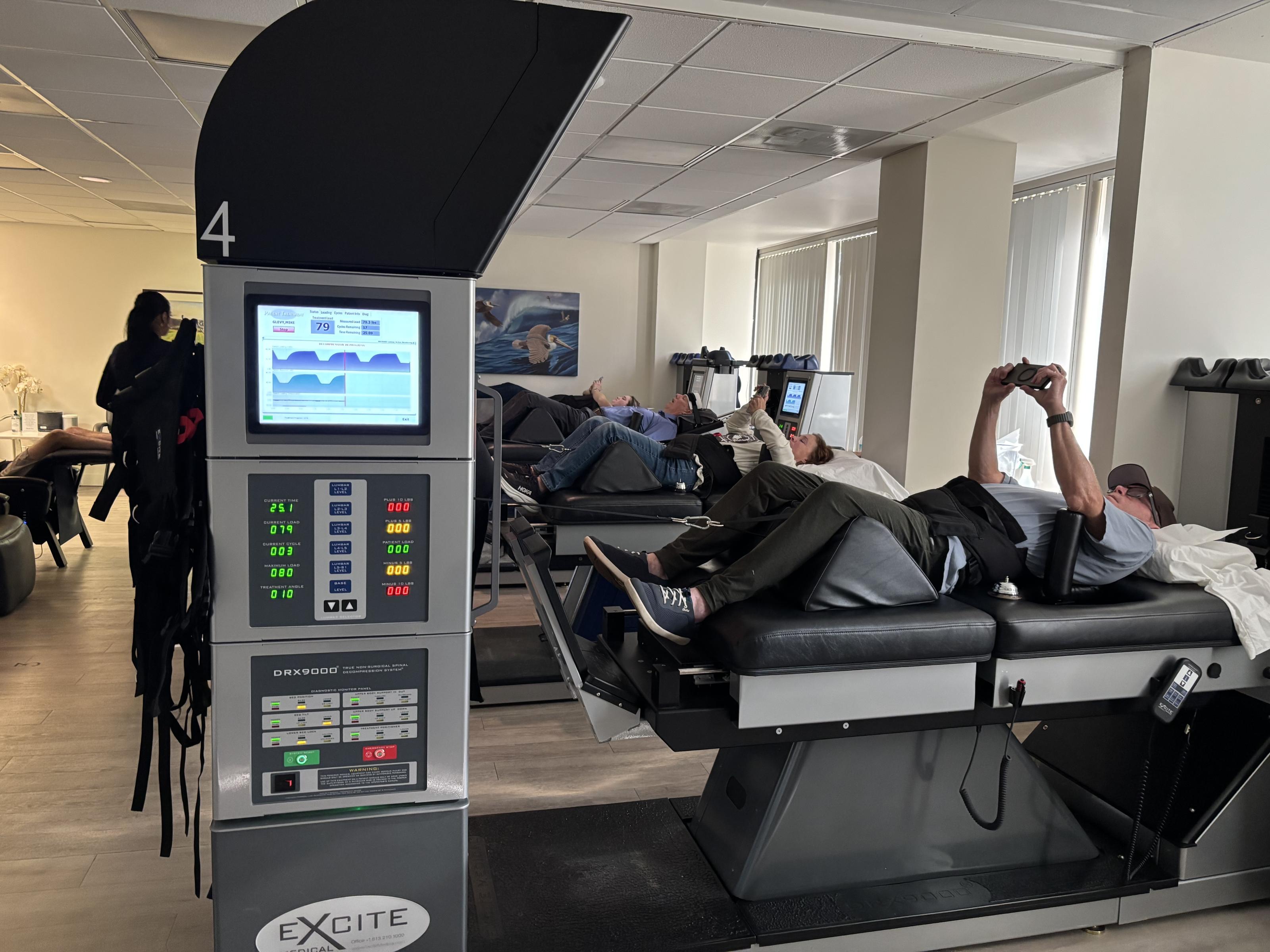
At The Spinal Decompression & Chiropractic Center of San Diego, Dr. Boelk uses the DRX9000 spinal decompression system, a computerized device designed to apply controlled distraction forces to the spine.
During treatment, the patient lies on a specialized table while the system delivers programmed pulling and relaxation cycles. Treatment settings can be adjusted based on the patient's condition, size, tolerance, and examination findings.
A typical lumbar decompression session lasts approximately twenty to twenty-five minutes. The treatment is non-invasive and doesn't involve incisions or anesthesia.
The intended goals include:
-
Applying controlled mechanical distraction to selected spinal structures.
-
Temporarily reducing mechanical loading on the lumbar spine.
-
Helping relieve symptoms in patients who respond favorably to traction-based treatment.
-
Supporting a broader plan that may include rehabilitation and activity modification.
The clinical evidence for computerized spinal decompression remains limited and mixed, and major guidelines do not routinely recommend traction for sciatica. That's why appropriate screening, realistic expectations, and monitoring each patient's response are important.
Spinal decompression isn't necessary or appropriate for everyone with a herniated disc. Some patients may be better served by exercise-based rehabilitation, other conservative care, or medical and surgical evaluation.
Who May Be a Candidate for Non-Surgical Spinal Decompression?
One of the most important parts of Dr. Boelk's approach is determining whether a patient is an appropriate candidate before recommending treatment.
Potential candidates may include certain patients with:
-
Lumbar disc herniations associated with persistent lower back or leg symptoms.
-
Bulging lumbar discs contributing to nerve irritation.
-
Disc-related sciatica involving pain, tingling, or numbness.
-
Recurring lower back pain with a suspected disc component.
-
Degenerative disc changes associated with mechanical symptoms.
-
Persistent symptoms despite previous conservative treatment.
However, having one of these conditions doesn't automatically mean spinal decompression is appropriate.
Dr. Boelk considers the patient's symptoms, medical history, neurological findings, previous treatments, and available imaging before making recommendations.
When clinically indicated, weight-bearing lumbar X-rays, including flexion and extension views, may be recommended to evaluate spinal alignment and possible instability. MRI findings may also be reviewed when relevant to the patient's symptoms.
Not sure whether your MRI findings or symptoms make you a potential candidate? Call 619-298-0800 to request a Complimentary, No-Charge, No-Obligation Consultation. The office has a 24/7 answering service and Spanish-speaking assistance available.
Why Dr. Boelk Doesn't Accept Every Patient for Spinal Decompression
One of the most important things to understand about spinal decompression is that not everyone is an appropriate candidate.
Certain conditions, including unstable fractures, significant spinal instability, and some post-surgical situations involving hardware, may make decompression inappropriate. Other patients may have conditions that are better managed through a different medical approach.
Sometimes the most helpful thing a doctor can do is explain why a particular treatment isn't appropriate.
One patient consulted with Dr. Boelk after sustaining a serious neck injury in a motocross accident. Although he was interested in avoiding surgery, his cervical fracture meant that spinal decompression wasn't appropriate at that time.
⭐⭐⭐⭐⭐
“I decided to see Dr. Boelk after a pretty gnarly motocoss neck injury. At the Hospital I was at, I felt I was getting pressured into a surgery which I refused. A friend of a friend referred him after Dr. Boelk successfully treated his broken back.
Dr. Boelk is a compassionate individual who truly cares about his patients. He looked at my MRI images, explained what he saw and potential routes for recovery. He could not treat me as I have to wait until the fracture in my neck heals, but the level of professionalism, compassion, caring and knowledge displayed by him was exceptional.
He also recommended to seek an additional opinion form another neurosurgeon. My experience was that he really cares and he's not someone who would take advantage of the situation someone's in (unlike some other doctors). I will definitely be back and already recommended him to others as well! Thank you Dr. Boelk!”
— Jan H., San Marcos, CA
Jan's experience illustrates why careful screening matters. Although Dr. Boelk couldn't recommend decompression at that time, the patient appreciated receiving an explanation of his condition and guidance about seeking another medical opinion.
Why Do Patients Travel From Outside San Diego to See Dr. Boelk?
Although the clinic is located in Kearny Mesa, Dr. Boelk has evaluated and treated patients from throughout California, other states, and countries including the United Kingdom.
Some patients travel because they've been struggling with spinal symptoms for years. Others have tried multiple treatment approaches and want to consult with a doctor who focuses extensively on non-surgical spinal decompression.
One patient travels from the United Kingdom for treatment at Dr. Boelk's practice.
⭐⭐⭐⭐⭐
“I travel from the UK to see Dr Boelk and his wonderful team . I have 3 bulging disc and one is touching the nerve. I have the spinal decompression treatment and it really helps keep me in my active life . I will not go to anyone else for back treatment, this place is number one and they genuinely care about their patients.”
— Lisa S., United Kingdom
Patients have also traveled from Alaska, Las Vegas, Arizona, and Imperial Valley to consult with Dr. Boelk.
For Rancho Bernardo residents, the clinic is located in Kearny Mesa, accessible via Interstate 15 and Highway 52.
Why Choose Dr. Cassidy James Boelk, DC, for Sciatica Treatment?
With more than 22 years of clinical experience and over 100,000 spinal decompression treatment sessions performed, Dr. Cassidy James Boelk, DC, has dedicated much of his career to helping patients with herniated discs, bulging discs, sciatica, and chronic neck and back pain explore non-surgical treatment options.
What makes Dr. Boelk's approach distinctive is that his experience goes beyond treating patients. Having personally dealt with significant spinal injuries, including lumbar fractures, spondylolisthesis, disc herniations, and sciatica, he understands firsthand how debilitating these conditions can be. He has spent thousands of hours studying spinal rehabilitation and helping both himself and his patients return to the activities they enjoy.
His professional credentials include:
-
Certified Spinal Decompression Doctor
-
Certified Pain-Free Performance Specialist
-
Founder of the Spinal Decompression Training Academy, where he trains other doctors in non-surgical spinal decompression protocols and techniques.
His Kearny Mesa clinic is equipped with seven DRX9000 spinal decompression tables, including four lumbar and three cervical systems, allowing the practice to focus extensively on patients with spinal disc conditions.
Whether someone wants to return to golf, surfing, working out, or simply walking comfortably through the neighborhood, Dr. Boelk's goal is to identify the underlying problem, determine whether the patient is an appropriate candidate for treatment, and develop a plan focused on improving their quality of life.
Why Rehabilitation Matters Even After Sciatica Improves
One of the biggest mistakes people make when their sciatica begins improving is returning immediately to their previous activity level.
For example, someone who hasn't exercised for two months may finally experience a good week and decide to return to heavy lifting, play eighteen holes of golf, or spend several hours working in the yard. The next morning, their symptoms flare up again.
This doesn't necessarily mean another disc injury has occurred. In some cases, the body simply hasn't rebuilt the strength, endurance, and movement tolerance needed for those activities.
That's why Dr. Boelk emphasizes rehabilitation and gradual activity progression.
Depending on the patient's condition, a rehabilitation program may include:
-
Core stabilization exercises.
-
Modified side planks and bird dogs.
-
Glute and hip strengthening.
-
Progressive walking and cardiovascular activity.
-
Movement modifications for lifting and bending.
-
Gradual return to golf, surfing, gym activities, and other recreational pursuits.
-
Education about recognizing and managing symptom flare-ups.
Not every patient needs the same exercises, and not every patient needs spinal decompression. The objective is to develop a reasonable approach based on the patient's symptoms, examination findings, and functional goals.
What If You've Already Been Told You Need Back Surgery?
Hearing that surgery might be necessary can be frightening, particularly when you're concerned about recovery time, potential complications, and whether you'll be able to return to your normal activities.
However, a herniated disc doesn't automatically mean surgery is required. Many people with sciatica improve with time, appropriate conservative care, activity modification, and exercise-based rehabilitation.
Surgery may be appropriate when symptoms remain disabling despite adequate conservative treatment, when neurological deficits progress, or when urgent medical conditions are present.
For people who have already tried several conservative treatments, the next step is understanding whether additional evaluation or another approach may be reasonable.
Dr. Boelk emphasizes reviewing the patient's condition and discussing the available options rather than assuming surgery should always be avoided or that decompression is appropriate for everyone.
What Happens During Your Complimentary Consultation?
If you're wondering whether spinal decompression might be appropriate for your condition, you don't need to commit to a treatment program just to begin the conversation.
The Spinal Decompression & Chiropractic Center of San Diego offers a Complimentary, No-Charge, No-Obligation Consultation for prospective patients interested in discussing non-surgical treatment options.
During your consultation, you can discuss:
-
Your symptoms and how long you've been experiencing them.
-
Whether your pain travels into the buttock, thigh, calf, or foot.
-
Previous treatments you've tried and how you responded.
-
Relevant MRI findings or other imaging.
-
How your condition affects work, sleep, exercise, and daily activities.
-
Whether a comprehensive examination may be appropriate.
-
Whether non-surgical spinal decompression is worth considering.
The consultation itself is complimentary. If a comprehensive examination, X-rays, or other services are recommended, those are separate services, and the office can explain any associated fees before proceeding.
Not everyone will qualify for spinal decompression, and there is no obligation to begin treatment.
Call 619-298-0800 to request your Complimentary, No-Charge, No-Obligation Consultation. The clinic has a 24/7 answering service and Spanish-speaking assistance available.
Sciatica Treatment Without Surgery for Rancho Bernardo Residents
Living with sciatica can gradually change your entire routine. You start planning how long you can sit, how far you can walk, and whether certain activities are worth the possibility of another painful flare-up.
Maybe you've stopped playing golf, working out, taking longer walks, or participating in activities with your family. Perhaps you're having difficulty sleeping or concentrating at work because your leg pain keeps returning.
Whatever your situation, understanding what's causing your symptoms is an important first step toward choosing an appropriate treatment approach.
For more than two decades, Dr. Cassidy James Boelk, DC, has focused much of his clinical practice on helping patients with disc-related spinal conditions explore non-surgical options. His combination of specialized decompression training, rehabilitation experience, and personal history with spinal injuries provides a foundation for evaluating patients with persistent back and leg symptoms.
For Rancho Bernardo residents, the clinic is located in Kearny Mesa on Murphy Canyon Road, with access from Interstate 15 and Highway 52.
Schedule Your Complimentary Sciatica Consultation Today
If you're searching for sciatica treatment without surgery in Rancho Bernardo, CA, The Spinal Decompression & Chiropractic Center of San Diego invites you to request a complimentary consultation.
Why Schedule a Consultation?
-
Complimentary: No charge for the initial consultation.
-
No obligation: You're not required to begin treatment.
-
Specialized experience: More than 22 years focusing on spinal conditions and non-surgical treatment options.
-
Individualized screening: Find out whether further evaluation for spinal decompression may be appropriate.
-
Convenient location: Kearny Mesa, accessible from Rancho Bernardo and surrounding communities.
-
24/7 answering service: Call to request an appointment outside regular office hours.
-
Spanish-speaking assistance available.
Contact The Spinal Decompression & Chiropractic Center of San Diego
Dr. Cassidy James Boelk, DC
-
Certified Spinal Decompression Doctor
-
Certified Pain-Free Performance Specialist
-
Founder, Spinal Decompression Training Academy
Office Address:
5095 Murphy Canyon Road, Suite 300
San Diego, CA 92123
Phone: 619-298-0800
Email: frontdesk@sandiegobackcare.com
Website: www.SanDiegoBackCare.com
24/7 answering service | Spanish-speaking assistance available
Call 619-298-0800 today to request your Complimentary, No-Charge, No-Obligation Consultation.
You don't have to commit to treatment to find out whether you're a candidate. Start by learning more about your condition and the options available to you.