Sciatica Treatment Without Surgery in Carmel Mountain Ranch, CA: Finding Relief From Back and Leg Pain
If you've been dealing with sciatica, you know how quickly it can change your daily routine. Something as simple as getting out of bed, driving to work, or bending down to put on your shoes can become uncomfortable. And when the pain starts traveling from your lower back into your buttock, calf, or foot, it's difficult to ignore.
For people living in Carmel Mountain Ranch, sciatica can make an otherwise active lifestyle frustrating. Maybe you enjoy playing golf, working out, walking around the neighborhood, or spending weekends outdoors with your family. But lately, you've been avoiding those activities because you're worried about aggravating your back.
Perhaps you've already tried chiropractic adjustments, physical therapy, stretching, medications, or injections. Some treatments may have helped temporarily, but the symptoms keep returning. You might even have an MRI showing a herniated disc at L4-L5 or L5-S1 and have been told that surgery could eventually be necessary.
The encouraging news is that many people with sciatica improve without surgery. However, choosing the right treatment starts with understanding what's irritating the nerve, identifying which activities make your symptoms worse, and determining whether additional conservative treatment is appropriate.
At The Spinal Decompression & Chiropractic Center of San Diego, Dr. Cassidy James Boelk, DC, has spent more than 22 years helping patients with herniated discs, bulging discs, sciatica, and chronic spinal pain explore non-surgical treatment options.
Located in Kearny Mesa, the clinic welcomes patients from Carmel Mountain Ranch, Rancho Bernardo, Sabre Springs, Poway, and throughout North County San Diego.
Dr. Boelk is a Certified Spinal Decompression Doctor and Certified Pain-Free Performance Specialist who has performed more than 100,000 spinal decompression treatment sessions at his practice. He also founded the Spinal Decompression Training Academy, where he trains other doctors in non-surgical spinal decompression protocols and techniques.
Could You Be a Candidate for Non-Surgical Spinal Decompression?
If you've been struggling with sciatica and want to explore your options before considering surgery, the clinic offers a Complimentary, No-Charge, No-Obligation Consultation.
This is an opportunity to discuss your symptoms, ask questions, and learn whether further evaluation for spinal decompression may be appropriate.
During your consultation, you can:
-
Discuss your lower back pain, leg symptoms, and previous treatments.
-
Talk about your MRI findings if you've already had imaging.
-
Learn whether a comprehensive examination may be appropriate.
-
Find out whether non-surgical spinal decompression may be worth considering.
-
Ask questions without any obligation to begin treatment.
Call 619-298-0800 to request your complimentary consultation. The clinic has a 24/7 answering service and Spanish-speaking assistance available.
What Causes Sciatica, and Why Does the Pain Travel Down Your Leg?
Sciatica is a term used to describe symptoms associated with irritation or compression of nerve roots in the lower back that contribute to the sciatic nerve. These nerves travel through the pelvis and into the legs, providing sensation and helping control muscle movement.
One common cause is a lumbar disc herniation. The discs between your vertebrae help cushion the spine and distribute mechanical forces during everyday activities. When part of a disc bulges or herniates, it may irritate a nearby nerve root, producing symptoms that travel away from the lower back and into the leg.
Common symptoms include:
-
Burning, shooting, or electric-like pain traveling from the buttock into the thigh, calf, or foot.
-
Numbness or tingling involving the leg, ankle, foot, or toes.
-
Pain that worsens with prolonged sitting, especially while driving or working.
-
Increased discomfort when bending, lifting, coughing, or sneezing.
-
Difficulty standing upright after sitting for an extended period.
-
Weakness involving certain muscles of the leg or foot.
-
Recurring flare-ups that interfere with sleep, work, exercise, and daily activities.
Two of the most commonly involved lumbar disc levels are L4-L5 and L5-S1. A herniation at L4-L5 may irritate the L5 nerve root, sometimes producing symptoms along the outside of the leg and into the top of the foot. An L5-S1 herniation may affect the S1 nerve root, causing symptoms down the back of the leg and toward the outside of the foot.
However, not everyone with pain traveling down the leg has a herniated disc. Other spinal conditions, hip disorders, and peripheral nerve problems can produce similar symptoms. That's why Dr. Boelk emphasizes identifying the underlying problem rather than assuming every patient needs the same treatment.
Why Does Sciatica Often Get Worse When You're Driving?
One of the most common complaints among patients with disc-related sciatica is that sitting makes their symptoms worse. They may feel reasonably comfortable standing or walking, but after twenty or thirty minutes behind the wheel, the familiar burning sensation begins traveling into the buttock or leg.
For Carmel Mountain Ranch residents who commute along Interstate 15 or Highway 56, prolonged driving can be particularly frustrating. You may leave home feeling relatively comfortable but arrive at work with increased leg pain or difficulty standing upright.
Depending on the condition of the lumbar discs and the patient's posture, prolonged sitting and forward bending can increase mechanical stress on sensitive spinal structures. If a nerve root is already irritated, certain positions may aggravate the symptoms.
Interestingly, some patients experience the opposite pattern. They feel better sitting or bending forward but develop leg symptoms when standing or walking. This can occur with conditions such as lumbar spinal stenosis, which may require a different treatment approach.
The important point is that the same exercise, stretch, or treatment that helps one person with sciatica may aggravate another person's symptoms. Understanding your individual symptom pattern can help guide appropriate treatment and activity modifications.
What Do Patients Say About Their Experience With Sciatica Treatment?
When you've been struggling with sciatica for months or years, hearing from someone who has experienced similar symptoms can be encouraging.
One patient came to Dr. Boelk after experiencing severe back pain and sciatica following a previous lumbar disc surgery. When his symptoms returned, he was concerned about the possibility of needing another operation.
⭐⭐⭐⭐⭐
“I have been dealing with back pain for several years. It got so bad that I had surgery 5 years ago for a bulging disc. About 5 months ago the disc bulged again hitting my sciatic nerve creating pain in my legs that made me want to cry it hurt so bad. After trying so many other options I was fortunate enough to find the spinal decompression and chiropractic center of San Diego. After just a few sessions I noticed a difference. Now after being there for the past few months I'm able to go about my normal life again.
What a blessing it was to find a Dr that genuinely cares and knows how to help people in my situation. Thank you Dr Boelk!”
— Anthony K., San Diego, CA
Anthony's experience highlights how important it can be for patients with recurring disc-related symptoms to understand their options. A history of previous disc surgery doesn't automatically determine which treatment is appropriate, and patients with prior procedures require careful evaluation before considering additional spinal treatment.
Three Things You Can Try at Home to Help Manage Sciatica
Dr. Boelk regularly shares educational videos explaining how everyday activities, posture, and certain exercises may influence sciatica symptoms. Although no single exercise is appropriate for everyone, there are several practical strategies that may help you better understand and manage your condition.
1. Change Positions Before Your Sciatica Gets Worse
If your sciatica consistently begins after thirty minutes of sitting, consider standing up and moving around after twenty minutes instead.
The goal is to interrupt the position that aggravates your symptoms before the pain becomes more intense. This can be particularly useful for people who spend long hours working at a computer or commuting between Carmel Mountain Ranch and other parts of San Diego.
A few simple adjustments may help:
-
Stand and move periodically throughout the workday.
-
Avoid prolonged slouched sitting if it aggravates your symptoms.
-
Experiment with lumbar support if it improves your comfort.
-
Take brief breaks during longer drives when practical.
-
Pay attention to whether your leg pain improves after changing positions.
Sometimes small changes in how long you remain in one position can make a meaningful difference.
2. Pay Attention to Where Your Leg Pain Travels
One of the concepts Dr. Boelk discusses in his educational videos about sciatica and modified McKenzie exercises is how symptoms respond to different movements.
Some patients notice that bending forward causes pain to travel farther down the leg. Others find that certain gentle extension movements reduce symptoms in the calf or foot.
When pain retreats from the foot or calf toward the lower back, clinicians sometimes describe this as centralization. In certain patients, this can be an encouraging response.
However, not everyone responds favorably to extension exercises. The appropriate movement depends on the underlying condition and how the patient responds.
Pay attention to the following:
-
Does a movement increase or decrease your leg pain?
-
Does the pain travel farther down your leg?
-
Does the discomfort retreat toward your lower back?
-
Do symptoms remain aggravated afterward?
Avoid repeatedly forcing exercises that increase pain, numbness, or weakness. Persistent symptoms should be evaluated professionally.
3. Try Shorter Walks Instead of Pushing Through Pain
Walking is often beneficial for people with lower back pain, but longer walks aren't necessarily better when you're dealing with sciatica.
Suppose you can comfortably walk for fifteen minutes, but after twenty-five minutes your calf begins burning and your symptoms gradually become more intense. Instead of forcing yourself to complete a forty-five-minute walk, consider breaking it into several shorter sessions.
For example, three fifteen-minute walks may be better tolerated than one forty-five-minute walk.
Monitor how you feel during the walk, later that evening, and the following morning. If your symptoms consistently increase, consider reducing the duration or intensity until you find an activity level you can tolerate.
New or progressive muscle weakness warrants prompt medical evaluation. New bowel or bladder dysfunction or saddle numbness requires emergency medical assessment.
Can Non-Surgical Spinal Decompression Help Sciatica Caused by a Herniated Disc?
For selected patients with disc-related symptoms, non-surgical spinal decompression may be considered as part of an individualized treatment plan.
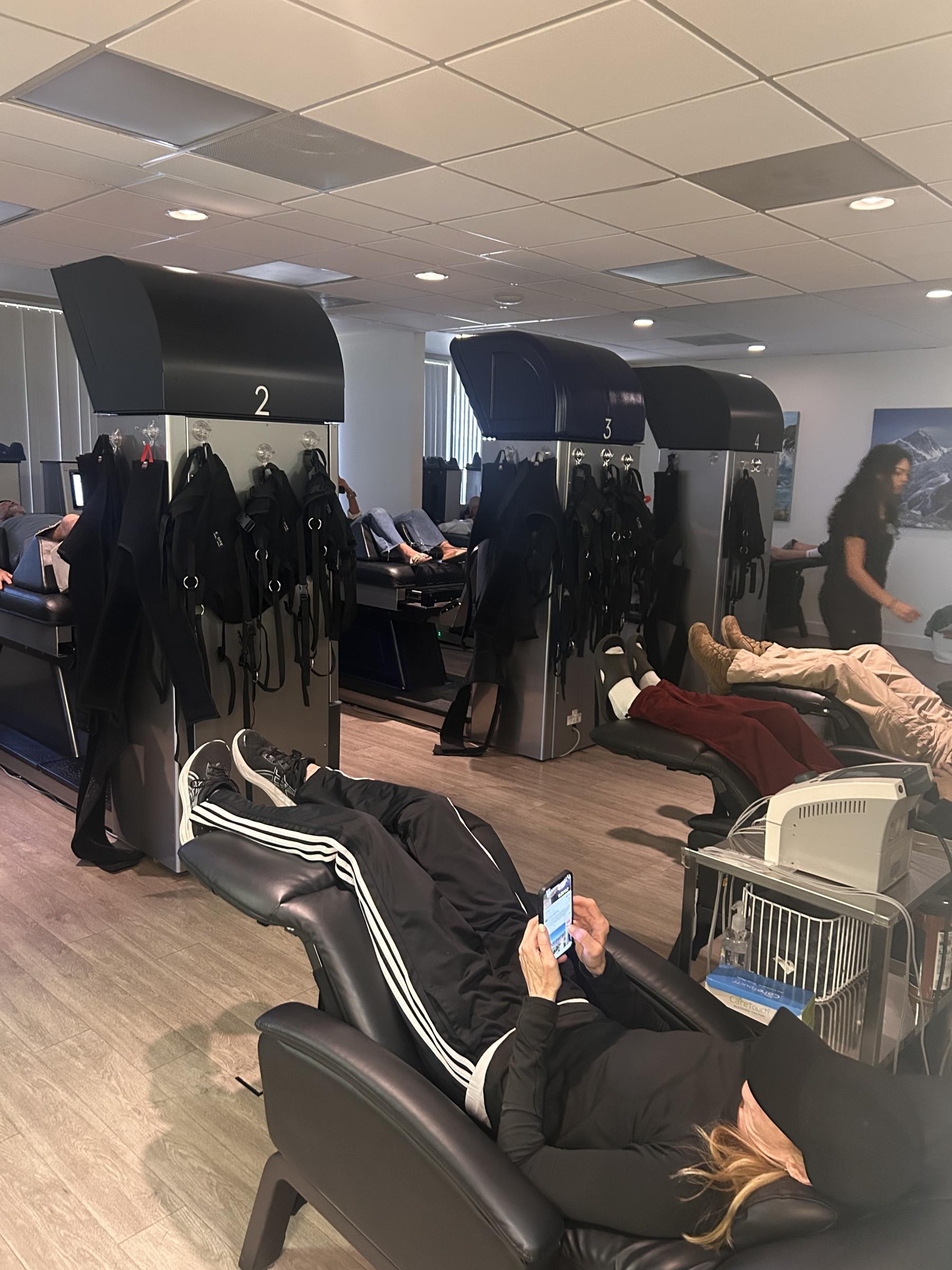
At The Spinal Decompression & Chiropractic Center of San Diego, Dr. Boelk uses the DRX9000 spinal decompression system, a computerized device designed to apply controlled distraction forces to the spine.
During treatment, the patient lies on a specialized table while the system delivers programmed pulling and relaxation cycles. Treatment settings can be adjusted based on the patient's condition, size, tolerance, and examination findings.
A typical lumbar decompression session lasts approximately twenty to twenty-five minutes. The treatment is non-invasive and doesn't involve incisions or anesthesia.
The intended goals include:
-
Applying controlled mechanical distraction to selected spinal structures.
-
Temporarily reducing mechanical loading on the lumbar spine.
-
Helping relieve symptoms in patients who respond favorably to traction-based treatment.
-
Supporting a broader plan that may include rehabilitation and activity modification.
The clinical evidence for computerized spinal decompression remains limited and mixed, and major guidelines do not routinely recommend traction for sciatica. That's why appropriate screening, realistic expectations, and monitoring each patient's response are important.
Spinal decompression isn't necessary or appropriate for everyone with a herniated disc. Some patients may be better served by exercise-based rehabilitation, other conservative care, or medical and surgical evaluation.
Who May Be a Candidate for Non-Surgical Spinal Decompression?
One of the most important parts of Dr. Boelk's approach is determining whether a patient is an appropriate candidate before recommending treatment.
Potential candidates may include certain patients with:
-
Lumbar disc herniations associated with persistent lower back or leg symptoms.
-
Bulging lumbar discs contributing to nerve irritation.
-
Disc-related sciatica involving pain, tingling, or numbness.
-
Recurring lower back pain with a suspected disc component.
-
Degenerative disc changes associated with mechanical symptoms.
-
Persistent symptoms despite previous conservative treatment.
However, having one of these conditions doesn't automatically mean spinal decompression is appropriate. Dr. Boelk considers the patient's symptoms, medical history, neurological findings, previous treatments, and available imaging before making recommendations.
When clinically indicated, weight-bearing lumbar X-rays, including flexion and extension views, may be recommended to evaluate spinal alignment and possible instability. MRI findings may also be reviewed when relevant to the patient's symptoms.
Not sure whether your MRI findings or symptoms make you a potential candidate? Call 619-298-0800 to request a Complimentary, No-Charge, No-Obligation Consultation. The office has a 24/7 answering service and Spanish-speaking assistance available.
Why Dr. Boelk Doesn't Accept Every Patient for Spinal Decompression
One of the most important things to understand about spinal decompression is that not everyone is an appropriate candidate.
Certain conditions, including unstable fractures, significant spinal instability, and some post-surgical situations involving hardware, may make decompression inappropriate. Other patients may have conditions that are better managed through a different medical approach.
Sometimes the most helpful thing a doctor can do is explain why a particular treatment isn't appropriate.
One patient traveled from Lake Elsinore to consult with Dr. Boelk after undergoing previous spinal surgery. Although her spinal hardware made his decompression program inappropriate for her particular situation, she appreciated the honesty and information she received.
⭐⭐⭐⭐⭐
“Very nice Dr. and Honest ! I would definitely recommend anyone who hasn't had metal put in there back in a surgery to go to him and give his program a shot. I believe it would definitely help. Just not in my personal case. As I have a lot of hardware in my back. But I'm glad I took the time to meet with him. It was very informative all around.”
— Toni W., Lake Elsinore, CA
Toni's experience illustrates why proper screening matters. The goal isn't simply to recommend decompression to everyone who walks through the door. It's to determine whether the treatment is appropriate and whether another medical approach may be more beneficial.
Why Do Patients Travel From Outside San Diego to See Dr. Boelk?
Although the clinic is located in Kearny Mesa, Dr. Boelk has evaluated and treated patients from throughout California, other states, and countries including the United Kingdom.
Some patients travel because they've been dealing with spinal symptoms for years and want to explore another treatment option. Others have tried multiple approaches and are looking for a doctor who focuses extensively on non-surgical spinal decompression.
One patient traveled from Las Vegas after experiencing persistent lower back problems and sciatica that hadn't responded to his usual treatments.
⭐⭐⭐⭐⭐
“My name is Ira Smith. I live in Las Vegas and found out about Dr. Boelk’s program here in San Diego and decided to start treatments with him. I’ve had lower back problems since I was very young. I had aggravated my lower back pretty bad again and usually I could do exercises, chiropractic treatment, rest and this time those things would no longer relieve my pain. I would get the sciatic pain shooting down into my leg and foot and would be pretty bad.
I found out thru my MRI’s that Dr. Boelk went over with me that I had 5 protruding discs. I did not want to get surgery as I have heard and seen that they don’t always work very well at all. I am 2/3 of the way done with Dr. Boelk’s program and I have zero pain. I pretty much go thru my activities with no pain. As I follow the program it has been absolutely fantastic! I have been thru physical therapy, chiropractic programs, I went to the hospital and they told me I have 1 bad disc, but I found out I had 4 more bad discs as well. The treatment has relieved the pain and is not painful at all. This can be the starting point for anyone with back pain to get their life back.
This is the place to start. If your skeptical, what’s your health worth? The cost of this has been way less than the cost of all my other therapies that I have gone thru. This is less money than all those things, less pain and gives you a great quality of life. This is new and modern and it fixes the problem. Use Dr. Boelk’s program to change your life and it will change your life! This is the place to start. -Thank You”
— Ira Smith, Age 49, Las Vegas, Nevada
For Carmel Mountain Ranch residents, the clinic is located in Kearny Mesa, accessible by Interstate 15 and Highway 52.
Why Choose Dr. Cassidy James Boelk, DC, for Sciatica Treatment?
With more than 22 years of clinical experience and over 100,000 spinal decompression treatment sessions performed, Dr. Cassidy James Boelk, DC, has dedicated much of his career to helping patients with herniated discs, bulging discs, sciatica, and chronic neck and back pain explore non-surgical treatment options.
What makes Dr. Boelk's approach distinctive is that his experience goes beyond treating patients. Having personally dealt with significant spinal injuries, including lumbar fractures, spondylolisthesis, disc herniations, and sciatica, he understands firsthand how debilitating these conditions can be. He has spent thousands of hours studying spinal rehabilitation and helping both himself and his patients return to the activities they enjoy.
His professional credentials include:
-
Certified Spinal Decompression Doctor
-
Certified Pain-Free Performance Specialist
-
Founder of the Spinal Decompression Training Academy, where he trains other doctors in non-surgical spinal decompression protocols and techniques.
His Kearny Mesa clinic is also equipped with seven DRX9000 spinal decompression tables, including four lumbar and three cervical systems, allowing the practice to focus extensively on patients with spinal disc conditions.
Whether someone wants to return to golf, surfing, working out, or simply sitting comfortably through the workday, Dr. Boelk's goal is to identify the underlying problem, determine whether the patient is an appropriate candidate for treatment, and develop a plan focused on improving their quality of life.
Why Rehabilitation Matters Even After Sciatica Improves
One of the biggest mistakes people make when their sciatica begins improving is returning immediately to their previous activity level.
For example, someone who hasn't exercised for two months may finally experience a good week and decide to return to heavy lifting, play eighteen holes of golf, or spend several hours working in the yard. The next morning, their symptoms flare up again.
This doesn't necessarily mean another disc injury has occurred. In some cases, the body simply hasn't rebuilt the strength, endurance, and movement tolerance needed for those activities.
That's why Dr. Boelk emphasizes rehabilitation and gradual activity progression.
Depending on the patient's condition, a rehabilitation program may include:
-
Core stabilization exercises.
-
Modified side planks and bird dogs.
-
Glute and hip strengthening.
-
Progressive walking and cardiovascular activity.
-
Movement modifications for lifting and bending.
-
Gradual return to golf, surfing, gym activities, and other recreational pursuits.
-
Education about recognizing and managing symptom flare-ups.
Not every patient needs the same exercises, and not every patient needs spinal decompression. The objective is to develop a reasonable approach based on the patient's symptoms, examination findings, and functional goals.
What If You've Already Been Told You Need Back Surgery?
Hearing that surgery might be necessary can be frightening, particularly when you're concerned about recovery time, potential complications, and whether you'll be able to return to your normal activities.
However, a herniated disc doesn't automatically mean surgery is required. Many people with sciatica improve with time, appropriate conservative care, activity modification, and exercise-based rehabilitation.
Surgery may be appropriate when symptoms remain disabling despite adequate conservative treatment, when neurological deficits progress, or when urgent medical conditions are present.
For people who have already tried several conservative treatments, the next step is understanding whether additional evaluation or another approach may be reasonable.
Dr. Boelk emphasizes reviewing the patient's condition and discussing the available options rather than assuming surgery should always be avoided or that decompression is appropriate for everyone.
What Happens During Your Complimentary Consultation?
If you're wondering whether spinal decompression might be appropriate for your condition, you don't need to commit to a treatment program just to begin the conversation.
The Spinal Decompression & Chiropractic Center of San Diego offers a Complimentary, No-Charge, No-Obligation Consultation for prospective patients interested in discussing non-surgical treatment options.
During your consultation, you can discuss:
-
Your symptoms and how long you've been experiencing them.
-
Whether your pain travels into the buttock, thigh, calf, or foot.
-
Previous treatments you've tried and how you responded.
-
Relevant MRI findings or other imaging.
-
How your condition affects work, sleep, exercise, and daily activities.
-
Whether a comprehensive examination may be appropriate.
-
Whether non-surgical spinal decompression is worth considering.
The consultation itself is complimentary. If a comprehensive examination, X-rays, or other services are recommended, those are separate services, and the office can explain any associated fees before proceeding.
Not everyone will qualify for spinal decompression, and there is no obligation to begin treatment.
Call 619-298-0800 to request your Complimentary, No-Charge, No-Obligation Consultation. The clinic has a 24/7 answering service and Spanish-speaking assistance available.
Sciatica Treatment Without Surgery for Carmel Mountain Ranch Residents
Living with sciatica can gradually change your entire routine. You start planning how long you can sit, how far you can drive, and whether certain activities are worth the possibility of another painful flare-up.
Maybe you've stopped working out, playing golf, taking longer walks, or participating in activities with your family. Perhaps you're having difficulty sleeping or concentrating at work because your leg pain keeps returning.
Whatever your situation, understanding what's causing your symptoms is an important first step toward choosing an appropriate treatment approach.
For more than two decades, Dr. Cassidy James Boelk, DC, has focused much of his clinical practice on helping patients with disc-related spinal conditions explore non-surgical options. His combination of specialized decompression training, rehabilitation experience, and personal history with spinal injuries provides a foundation for evaluating patients with persistent back and leg symptoms.
For Carmel Mountain Ranch residents, the clinic is located in Kearny Mesa on Murphy Canyon Road, with access from Interstate 15 and Highway 52.
Schedule Your Complimentary Sciatica Consultation Today
If you're searching for sciatica treatment without surgery in Carmel Mountain Ranch, CA, The Spinal Decompression & Chiropractic Center of San Diego invites you to request a complimentary consultation.
Why Schedule a Consultation?
-
Complimentary: No charge for the initial consultation.
-
No obligation: You're not required to begin treatment.
-
Specialized experience: More than 22 years focusing on spinal conditions and non-surgical treatment options.
-
Individualized screening: Find out whether further evaluation for spinal decompression may be appropriate.
-
Convenient location: Kearny Mesa, accessible from Carmel Mountain Ranch and surrounding communities.
-
24/7 answering service: Call to request an appointment outside regular office hours.
-
Spanish-speaking assistance available.
Contact The Spinal Decompression & Chiropractic Center of San Diego
Dr. Cassidy James Boelk, DC
-
Certified Spinal Decompression Doctor
-
Certified Pain-Free Performance Specialist
-
Founder, Spinal Decompression Training Academy
Office Address:
5095 Murphy Canyon Road, Suite 300
San Diego, CA 92123
Phone: 619-298-0800
Email: frontdesk@sandiegobackcare.com
Website: www.SanDiegoBackCare.com
24/7 answering service | Spanish-speaking assistance available
Call 619-298-0800 today to request your Complimentary, No-Charge, No-Obligation Consultation.
You don't have to commit to treatment to find out whether you're a candidate. Start by learning more about your condition and the options available to you.