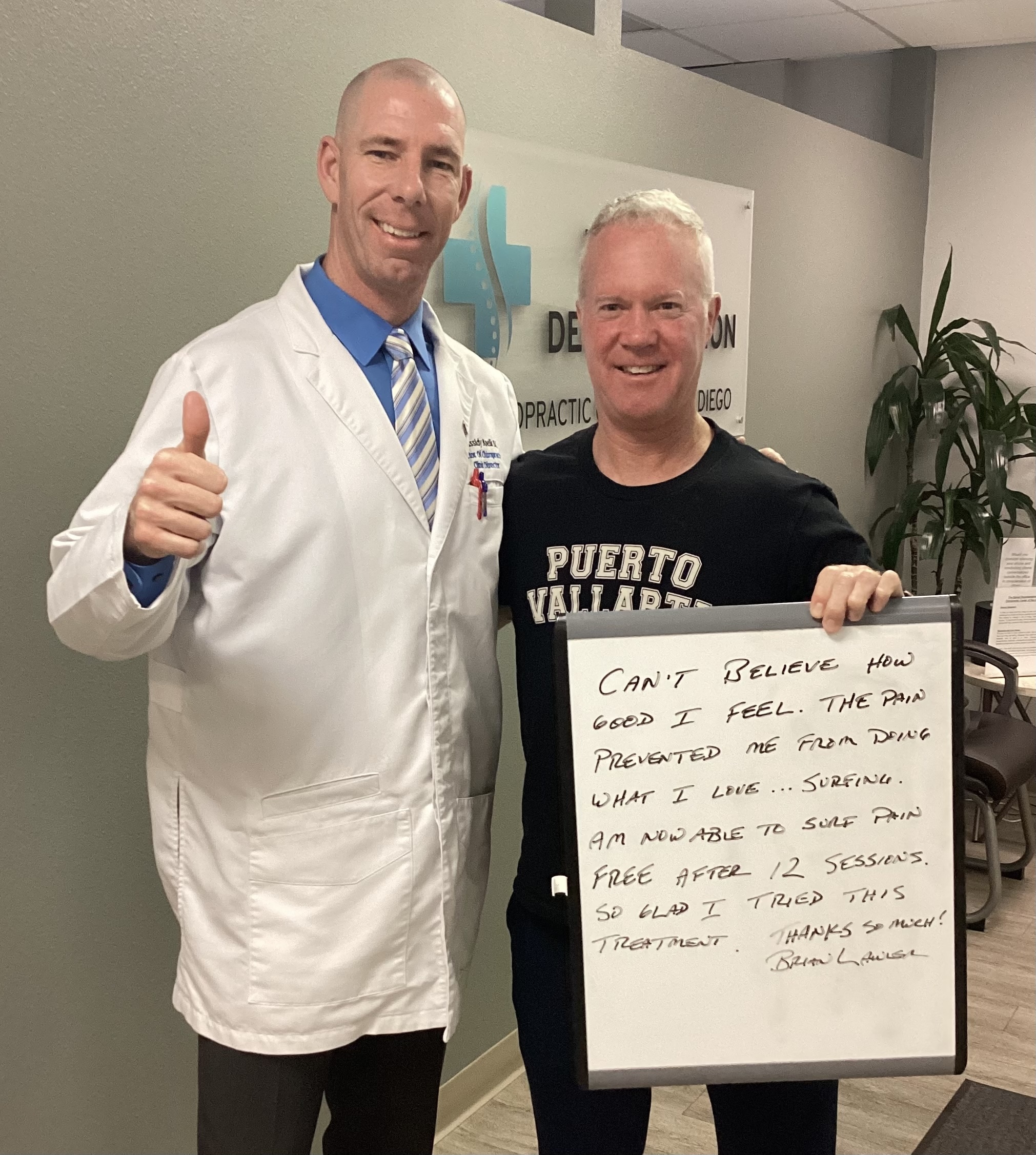
MY SURGEON SAYS I NEED BACK SURGERY. SHOULD I GET A SECOND OPINION? – SAN DIEGO, CA
Why Taking the Time to Understand Your Options Could Be One of the Most Important Healthcare Decisions You Ever Make
You finally had your MRI.
A few days later, you're sitting in a surgeon's office reviewing the results.
He points to the screen and says...
"You have a herniated disc."
Or maybe...
"You have spinal stenosis."
Then comes the sentence you were hoping you wouldn't hear.
"I think you need back surgery."
You leave the appointment carrying a copy of your MRI.
Your mind is racing.
Should I schedule the surgery?
Should I get another opinion?
Am I wasting valuable time if I wait?
What if another doctor tells me something completely different?
If you've found yourself asking those questions, you're certainly not alone.
In fact, one of the most common conversations Dr. Cassidy James Boelk, DC has with new patients at The Spinal Decompression & Chiropractic Center of San Diego isn't about spinal decompression.
It's about helping people understand their diagnosis before making one of the biggest healthcare decisions of their lives.
Should You Get a Second Opinion?
In many cases...
Yes.
Not because your surgeon is necessarily wrong.
And not because every patient should avoid surgery.
The reason is much simpler.
Back surgery is often permanent.
Taking the time to understand all of your treatment options before moving forward is simply a wise decision.
Sometimes a second opinion confirms exactly what the first surgeon recommended.
That can provide tremendous peace of mind because you know multiple providers reached the same conclusion.
Other times, patients learn there are still conservative treatment options worth considering before surgery.
Either way, you'll likely feel much more confident because you understand why you're making that decision.
Getting a Second Opinion Doesn't Mean You Distrust Your Surgeon
Some patients feel uncomfortable seeking another opinion.
They're worried it may offend the surgeon or appear as though they don't trust them.
Fortunately, that's usually not the case.
Most surgeons understand that patients facing a major operation want to feel confident they're making the right decision.
In fact, many physicians encourage patients to ask questions, learn about their condition, and seek another opinion if it helps them feel more comfortable moving forward.
After all, an informed patient usually makes better decisions.
★★★★★
"Last year, I spent three months constantly going back and forth between doctor's appointments and urgent care. The pain was unbearable—I was taking medication regularly just to get through the day. Getting out of bed was excruciating, and walking or standing felt like torture. Every step filled me with dread.
In December, my doctor finally ordered an MRI. That's when I learned I had an extruded disc pressing on my L5 nerve, which affects the leg and foot. My doctor scheduled two follow-up appointments: one for pain management (spinal injections), and another to evaluate me for surgery.
Then I discovered spinal decompression therapy. I was thrilled to find a non-invasive alternative.
I never ended up needing either of those appointments.
Now, I'm walking regularly, standing up straight—something I couldn't do before. When I first sought help, I was so hunched over that I had to use a cane just to move forward. Because of the pain, I hadn't exercised in months. But now, I'm doing a program called 75 Hard, which requires not one but two 45-minute workouts every day, and I've even gotten back to lifting weights.
I'm so thankful I found this place. Dr. Boelk and the staff are incredibly friendly, and it's always a pleasure to come in."
★★★★★ — Amanda, San Diego, CA
What Should a Second Opinion Include?
A second opinion should involve much more than someone looking at your MRI for a few minutes.
A thorough evaluation should answer questions like:
-
What is actually causing your pain?
-
Do your symptoms match your MRI findings?
-
Are there signs that surgery is clearly necessary?
-
Are there conservative treatment options that haven't been explored?
-
What are the risks and benefits of waiting?
-
What are the risks and benefits of surgery?
Those answers are often far more valuable than simply hearing someone say, "Yes, I agree," or "No, I don't."
The goal isn't to collect different opinions.
The goal is to understand your condition well enough to make the best decision for your health.
Does Every Surgeon Recommend the Same Treatment?
Not always.
Medicine isn't always black and white.
Two experienced doctors can look at the same MRI and agree on the diagnosis but have different opinions about the best place to begin treatment.
One may recommend surgery sooner.
Another may recommend additional conservative care first.
That doesn't automatically mean either doctor is wrong.
It simply reflects the fact that treatment decisions involve more than imaging studies alone.
Your symptoms...
Your examination...
Your neurological findings...
Your activity level...
Your overall health...
All play an important role in determining the most appropriate treatment plan.
What If the Second Opinion Is Different?
This happens more often than people realize.
One doctor may recommend surgery.
Another may recommend additional conservative treatment.
So who do you believe?
The answer isn't simply choosing the opinion you like better.
The goal is understanding why each doctor is making that recommendation.
Ask questions.
What is the diagnosis?
What findings on the MRI support surgery?
Do your examination findings match the MRI?
What are the risks of waiting?
What are the risks of surgery?
Could conservative treatment still be appropriate?
The more you understand, the more confident you'll feel in your decision.
Does Getting a Second Opinion Delay Treatment?
This is another common concern.
Many patients worry that if they don't schedule surgery immediately, they're making their condition worse.
Sometimes that can be true.
Fortunately, it often isn't.
Most disc injuries, spinal stenosis, and degenerative spinal conditions develop over time.
In many cases, there is enough time to gather information, ask questions, and make a thoughtful decision rather than feeling rushed.
Of course, there are exceptions.
If you're experiencing rapidly worsening weakness, loss of bowel or bladder control, numbness in the saddle area, foot drop, or other serious neurological symptoms, immediate medical evaluation is essential.
Fortunately, those situations are relatively uncommon.
For everyone else, taking the time to fully understand your diagnosis is often time well spent.
What If You Already Tried Physical Therapy, Chiropractic, or Injections?
Many patients seek a second opinion because they feel like they've run out of options.
They've already tried physical therapy.
They've already had injections.
They've already taken medication.
Some have even seen several different specialists.
That doesn't automatically mean surgery is your only remaining choice.
It also doesn't mean another conservative treatment will definitely solve the problem.
Every patient's condition is different.
The important question isn't simply what treatments you've already tried.
The important question is whether those treatments addressed the underlying cause of your symptoms.
That's one reason a careful evaluation is so important.
Where Does Non-Surgical Spinal Decompression Fit?
For some patients with certain disc-related conditions, Non-Surgical Spinal Decompression may be an appropriate conservative treatment option.
For others, it isn't.
That's why every patient at The Spinal Decompression & Chiropractic Center of San Diego begins with a comprehensive consultation and examination before treatment recommendations are made.
If Dr. Cassidy James Boelk, DC believes another approach would be more appropriate—whether that's physical therapy, pain management, another specialist, or surgery—he'll explain why.
Not every patient is accepted for treatment.
That has always been an important part of our philosophy.
Recommendations should never be based on what a provider hopes to offer.
They should be based on what's in the patient's best interest.
Why Patients Choose Dr. Cassidy James Boelk, DC
Choosing the right provider for a second opinion involves much more than finding someone who treats herniated discs.
Patients deserve someone who takes the time to listen, review their imaging, perform a thorough examination, and explain their options in a way that makes sense.
For more than 22 years, Dr. Cassidy James Boelk, DC has focused on evaluating and treating patients with disc-related spinal conditions.
His qualifications include:
-
Board-Certified Doctor of Chiropractic
-
Certified Spinal Decompression Doctor
-
Certified Pain-Free Performance Specialist (PPSC)
-
Founder of the Non-Surgical Spinal Decompression Training Academy
-
Founding Member of the American Spinal Decompression Society
-
California Licensed X-Ray Supervisor & Operator
-
Personally reviews MRI studies with every patient when available
-
More than 100,000 spinal decompression treatments performed
-
Seven DRX9000® Spinal Decompression Systems
-
Patients regularly travel from throughout California, across the United States, and internationally for evaluation and treatment
More importantly, patients often mention something else.
Honesty.
If Dr. Boelk believes you're likely to benefit from treatment, he'll explain why.
If he believes surgery is your best option, he'll tell you that too.
"Very nice doctor and honest! I would definitely recommend anyone who hasn't had metal put in their back from surgery to go see him and give his program a shot. I believe it would definitely help—just not in my personal case because I have a lot of hardware in my back. But I'm glad I took the time to meet with him. It was very informative all around."
★★★★★ — Toni W., Lake Elsinore, CA
A Personal Message From Dr. Cassidy James Boelk, DC
If you've read this far, chances are you're looking for answers—not just another treatment recommendation.
I understand how overwhelming it can be to hear that back surgery may be your next step.
I've experienced significant neck and back injuries myself, and I know how quickly pain can affect your sleep, your work, your family, and the activities you enjoy.
My advice is simple.
Don't let fear make the decision for you.
Take the time to understand your diagnosis.
Ask questions.
Learn about your treatment options.
If I believe you're a good candidate for treatment, I'll explain why.
If I don't, I'll tell you that as well.
My goal has always been to help patients make informed decisions based on honest answers—not pressure.
I hope this article has helped you better understand why getting a second opinion is often one of the smartest steps you can take before deciding on back surgery.
I wish you the very best on your road to recovery.
— Dr. Cassidy James Boelk, DC
Schedule a Complimentary No-Charge Consultation
If you've been told you may need back surgery and would like a second opinion, we'd be happy to help you better understand your condition and discuss your treatment options.
Your visit includes:
-
A comprehensive consultation
-
A thorough examination
-
MRI review (if available)
-
Honest recommendations
-
Answers to your questions
Whether you're a candidate for treatment at our office or not, our goal is to help you understand your condition and make the best decision for your health.
The Spinal Decompression & Chiropractic Center of San Diego
5095 Murphy Canyon Road, Suite 300
San Diego, CA 92123
📞 619-298-0800
✔ Complimentary No-Charge Consultation
✔ Live 24/7 Answering Service
✔ Hablamos Español