L5 Sciatica Symptoms | Poway, CA
Pain running down the outside of the leg, numbness across the top of the foot, tingling into the big toe, or weakness when lifting the foot can all be associated with irritation of the L5 nerve in the lower back.
What often makes L5 sciatica confusing is that the lower back may not be the patient's main complaint. Some people have considerable back pain when the problem begins and then find that the back improves while the leg symptoms remain. Others have very little back pain and are primarily concerned about persistent leg pain, numbness or a foot that simply does not feel as strong as it used to.
Dr. Cassidy James Boelk, DC has worked with lumbar disc injuries, sciatica and Non-Surgical Spinal Decompression for more than 22 years and has performed more than 100,000 spinal decompression treatments. When evaluating a patient with possible L5 nerve involvement, he looks beyond the MRI report. Where the symptoms travel, what makes them better or worse, whether there is numbness or weakness, and whether the imaging findings correspond with the patient's symptoms all matter.
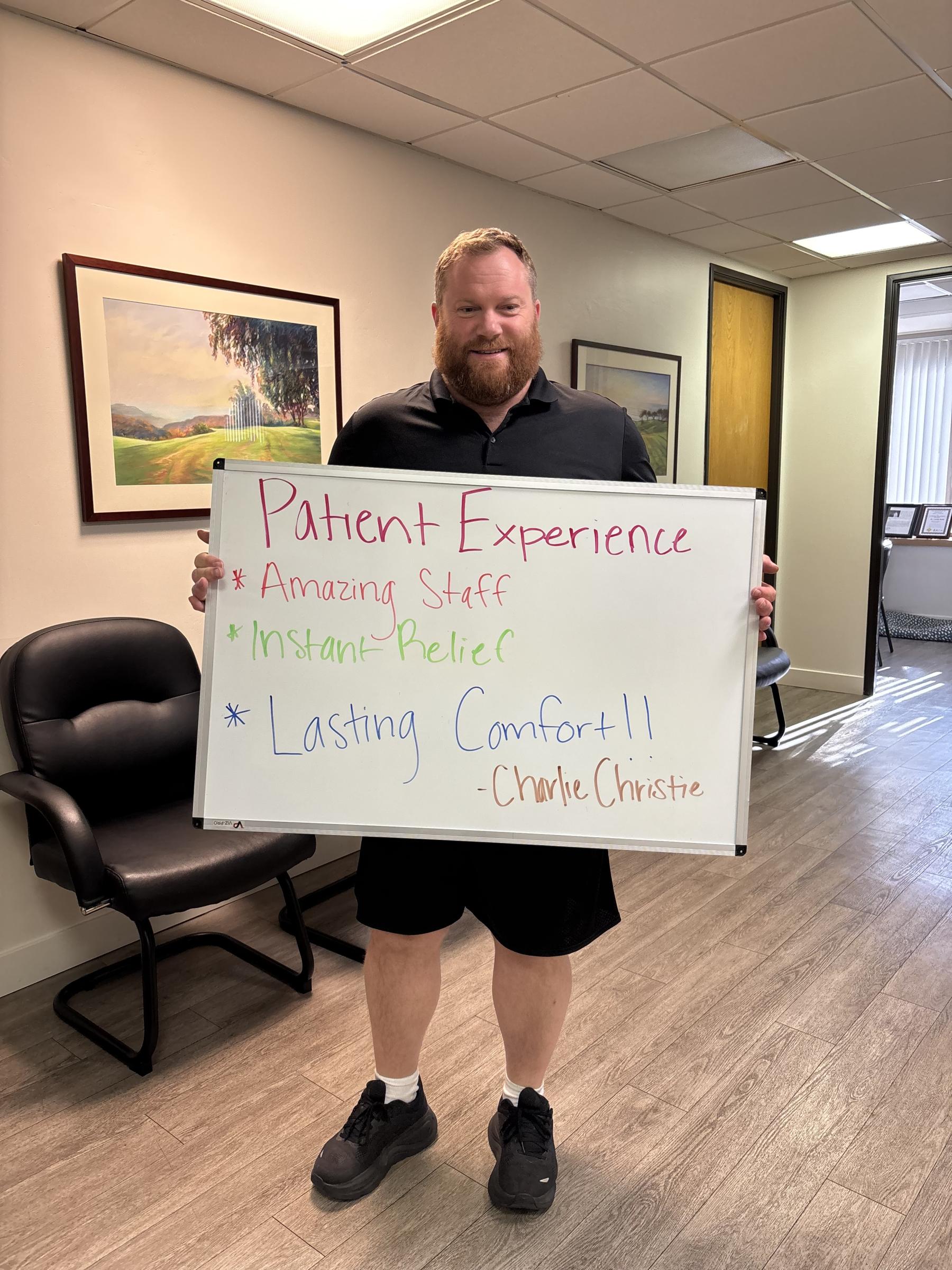
A Patient's Experience With Severe Sciatica
Toni H. had been dealing with her condition for 10 years and had already tried a number of different treatments before coming to The Spinal Decompression & Chiropractic Center of San Diego.
⭐⭐⭐⭐⭐
“For the first time in 10 years, I am completely pain-free. My sciatca is gone, and I no longer have back pain.
Before finding Dr. Boelk, I tried chiropractic care, acupuncture, pain medications, and several other therapies that simply didn't work. I was one step away from back surgery when I discovered spinal decompression treatment at The Spinal Decompression & Chiropractic Center of San Diego.
The results have been incredible. Every visit was comfortable, relaxing, and completely pain-free. Dr. Boelk and Patty always took the time to explain everything and made me feel genuinely cared for throughout the process.
They are warm, welcoming, and truly dedicated to helping their patients.
Thank you, Dr. Boelk and Patty!”
— Toni H., San Diego, CA
Individual results vary. Toni's experience does not mean every patient with sciatica or an L5 nerve problem will respond in the same way.
Start With a No-Charge Consultation
For patients dealing with persistent sciatica, leg pain, numbness, tingling or weakness, the first step does not have to be committing to another treatment program.
The Spinal Decompression & Chiropractic Center of San Diego offers a No-Charge, No-Obligation Consultation with Dr. Cassidy James Boelk, DC.
The purpose of the consultation is to understand what has been happening, review the information already available and determine whether the office appears to be an appropriate place to help.
During the consultation, Dr. Boelk may:
-
Review when and how the symptoms began
-
Discuss exactly where the pain travels
-
Identify areas of numbness, tingling or burning
-
Discuss any weakness or changes in walking
-
Review what makes the symptoms better or worse
-
Discuss how sitting, standing, walking, bending, sleeping and exercise affect the condition
-
Review treatments that have already been tried and how the patient responded
-
Review existing MRI images, X-rays and radiology reports when available
-
Compare the imaging findings with the patient's actual symptoms
-
Discuss whether additional examination or imaging may be appropriate
-
Discuss whether Non-Surgical Spinal Decompression may be an option
-
Answer questions about the condition and available treatment options
-
Discuss what Dr. Boelk believes would be an appropriate next step
Patients who already have a lumbar MRI should bring the actual images as well as the written report. Looking at the images often provides information that cannot be obtained by reading the report alone.
An MRI is not required to schedule the initial consultation. Patients who do not have one can still meet with Dr. Boelk and discuss whether additional imaging appears appropriate.
There is no obligation to begin treatment following the consultation.
Dr. Boelk personally conducts these consultations and reviews the patient's available imaging. Because of the time involved, the office reserves a limited number of No-Charge Consultation appointments within the weekly clinic schedule.
To ask about the next available consultation, call 619-298-0800.
What L5 Sciatica Can Feel Like
The L5 nerve contributes to sensation and muscle function extending from the lower back into portions of the leg and foot. When that nerve becomes irritated or compressed, patients may experience:
-
Pain along the outside of the thigh or lower leg
-
Burning or aching into the leg
-
Tingling or numbness across the top of the foot
-
Symptoms extending toward the big toe
-
Weakness lifting the foot upward
-
Weakness extending the big toe
-
A difference in coordination between the two feet
-
Difficulty walking on the heel when weakness becomes more pronounced
Not every patient follows exactly the same pattern. There can be overlap between nerve roots, and the location of a disc herniation or other form of narrowing can influence the symptoms.
This is why Dr. Boelk does not determine the source of someone's sciatica based on a symptom chart alone.
The history matters.
A patient who develops leg pain every time they sit for 20 or 30 minutes presents differently from someone who feels comfortable sitting but develops numbness after walking. A patient whose back pain has disappeared while the foot remains numb also provides a different clinical picture.
These details can help determine what should be evaluated.
Why an L4-L5 Disc Herniation Can Affect the L5 Nerve
Patients frequently ask why an MRI describes a problem at L4-L5 when their symptoms are being associated with the L5 nerve.
The disc level and the affected nerve root do not always carry the same number.
A disc herniation at L4-L5 can irritate or compress the L5 nerve depending on the location of the disc material.
This is also one reason reviewing the actual MRI images can be valuable.
A written MRI report may describe several findings at once. A patient may have disc degeneration at one level, a bulging disc at another and a herniation somewhere else. There may also be facet changes or narrowing around one or more nerves.
Those findings are important, but an abnormal MRI does not automatically identify which finding is responsible for the patient's symptoms.
Dr. Boelk compares the imaging with the history and clinical presentation. If the location of a disc problem corresponds with the patient's leg symptoms, numbness and weakness, that finding becomes more meaningful.
If the imaging and symptoms do not correspond, that is important as well.
Why Weakness Matters
Most people seek help because of pain. When a nerve is involved, however, strength and neurological function also need to be considered.
L5 nerve involvement can affect muscles responsible for lifting the foot and extending the big toe.
A patient may first notice that one foot fatigues more quickly or feels less coordinated. The difference may be subtle enough that it is noticed only while walking, climbing stairs or exercising.
More significant involvement can make it difficult to lift the front of the foot normally. Patients may begin catching their toes or notice the foot slapping the ground.
Progressive weakness should be evaluated rather than simply watched while continuing the same exercises or stretches.
Rapidly progressing weakness, new bowel or bladder dysfunction, difficulty urinating, or numbness involving the groin or saddle region requires prompt medical attention and should not wait for a routine spinal decompression consultation.
Why the Leg Can Hurt When the Back Doesn't
This is one of the more common sources of confusion with sciatica.
Patients understandably assume the problem should be located where they feel the pain. If the calf hurts, they look for a calf problem. If the foot is numb, they may assume something is wrong with the foot.
Sometimes that is correct.
Other times the source is farther up the nerve in the lumbar spine.
Some patients remember having lower back pain when the condition started. As the back pain improves, symptoms begin to travel farther into the buttock or leg. Eventually the lower back may feel relatively comfortable while the leg continues to hurt.
Other patients never experience substantial lower back pain at all.
For this reason, the absence of severe back pain does not by itself rule out a lumbar disc or nerve problem.
Pay Attention to What Happens During Normal Activities
Before an evaluation, one of the most useful things a patient can do is pay attention to how the symptoms behave during everyday activities.
How long can you sit before the leg starts hurting?
Can you walk comfortably, or does the foot become progressively numb?
Does standing bother you more than sitting?
Does bending forward change the symptoms?
Are you sleeping comfortably?
Has one foot begun feeling different from the other?
If numbness is present, try to identify where it occurs rather than simply describing the entire foot as numb.
These observations can provide useful information without repeatedly provoking the symptoms to “test” the nerve.
Patients should also be cautious about aggressively stretching a leg that constantly feels tight. Nerve irritation can sometimes create a sensation similar to muscle tightness. If stretching repeatedly causes pain, burning, tingling or numbness to travel farther down the leg, forcing the stretch harder may not be helpful.
When Non-Surgical Spinal Decompression May Be Considered
For an appropriate patient, Non-Surgical Spinal Decompression may be considered when an L5 nerve problem is associated with a lumbar disc or degenerative condition.
The Spinal Decompression & Chiropractic Center of San Diego uses the DRX9000 exclusively and currently has four lumbar and three cervical systems.
Treatment is individualized rather than based on a standard “sciatica setting.”
Dr. Boelk considers the level and location of the disc problem, the patient's symptoms, positioning, treatment angle, starting force, body size, tolerance and response to care.
Before any of that occurs, however, the patient needs to be an appropriate candidate.
An unhealed fracture, significant osteoporosis, unstable spondylolisthesis, abdominal aortic aneurysm, pregnancy for lumbar decompression, certain malignancies and other conditions can make decompression inappropriate. Previous spinal surgery also needs to be carefully evaluated, particularly when fusion or metal hardware is present at the level that would need treatment.
There are patients who come to the office expecting to begin spinal decompression and are told that Dr. Boelk does not recommend it.
That is part of proper patient selection.
Another conservative approach may be more appropriate. Additional imaging may be necessary. In some cases, a surgical consultation is the correct recommendation.
Experience With Disc Injuries and Sciatica
Dr. Cassidy James Boelk, DC has more than 22 years of experience with Non-Surgical Spinal Decompression and has performed more than 100,000 spinal decompression treatments.
His professional background includes:
-
Doctor of Chiropractic (DC)
-
Certified Spinal Decompression Doctor
-
Certified Pain-Free Performance Specialist (PPSC)
-
Founder, Non-Surgical Spinal Decompression Training Academy
-
Trains other doctors in spinal decompression protocols and techniques
-
Founding Member, American Spinal Decompression Society
-
Member, International Disc Education Association
-
California X-Ray Radiation Supervisor & Operator
His experience with spinal injuries is also personal. Dr. Boelk suffered an L5 compression fracture at age 16 and later dealt with disc injuries and sciatica himself. Those experiences have influenced his approach to patients who want to recover while remaining active.
L5 Sciatica Consultation for Poway Patients
If you are experiencing pain along the outside of the leg, numbness or tingling across the top of the foot, symptoms extending toward the big toe, or a change in foot strength, the first priority is determining where those symptoms are coming from.
Patients from Poway can begin with a No-Charge, No-Obligation Consultation with Dr. Cassidy James Boelk, DC.
Bring your MRI images and report if you already have them. If you do not have imaging, you can still begin with the consultation.
There is no requirement to start treatment, and if Dr. Boelk does not believe Non-Surgical Spinal Decompression is appropriate for your condition, he will tell you.
Because Dr. Boelk personally performs these consultations, only a limited number are available during the weekly clinic schedule.
Call 619-298-0800 to ask about the next available No-Charge Consultation.
The Spinal Decompression & Chiropractic Center of San Diego
5095 Murphy Canyon Road, Suite 300
San Diego, CA 92123
619-298-0800
Live 24/7 Answering Service • Hablamos Español
Related Articles
L4-L5 Herniated Disc: Symptoms & Treatment Options – Poway, CA
Who Is a Good Candidate for Non-Surgical Spinal Decompression? Poway, CA