L5-S1 Disc Herniation Treatment Without Surgery – Serra Mesa, CA
An L5-S1 disc herniation can be surprisingly unpredictable. One day the lower back is the main problem. The next day the back feels a little better, but pain is shooting through the buttock and into the leg. Sitting may hurt more than walking. The calf may feel tight or cramp at night. There can be numbness or tingling in the foot that seems completely disconnected from the lower back.
Dr. Cassidy James Boelk, DC has spent more than 22 years working with patients who have herniated discs, bulging discs, sciatica and other difficult spinal conditions. His office, The Spinal Decompression & Chiropractic Center of San Diego, is located at 5095 Murphy Canyon Road in Kearny Mesa, immediately adjacent to the Serra Mesa area.
One of the biggest concerns patients have after seeing an L5-S1 herniation on an MRI is whether they are eventually going to need surgery.
An L5-S1 disc herniation does not automatically mean surgery.
Many patients can be managed conservatively. The more important question is whether the patient's particular disc problem is safe and reasonable to treat without surgery.
That requires looking beyond the MRI report.
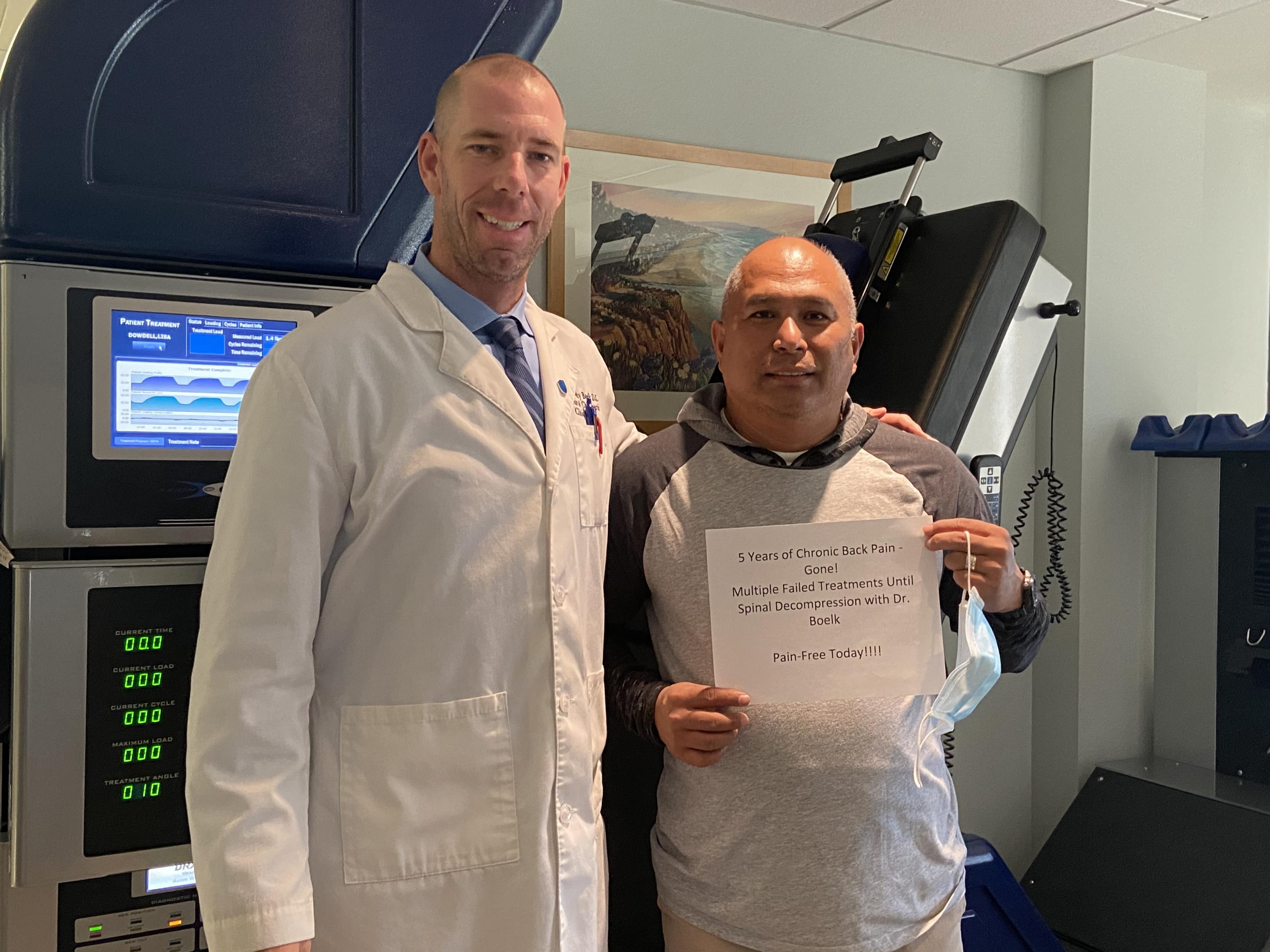
Ming's Back Pain Became So Severe He Had Trouble Getting Out of Bed
Ming T. had dealt with back problems before, but this episode was different. His pain lasted throughout the month, getting out of bed became difficult, and there were times when his back would lock up while he was walking.
⭐⭐⭐⭐⭐ Ming T. — San Diego, CA
"I came in with extreme back pain, resulting in days were it was difficult to get out of bed. There were moments where I would be walking and then my back would lock up. I thought it was something I have dealt with in the past but this last the entire month of July. I finally dedicated myself to finding the long term solution.
I came to Dr. Boelk unsure about the process, but after he identified exactly what my ailment was, I felt confident that this was the long term solution I was looking for.
I instantly felt better and Dr. Boelk kept encouraging me to trust the process and understand it will take time to feel 100%. I am now pain free and honestly feel stronger, even a little taller. I highly recommend you visit Dr. Boelk."
— Ming T., San Diego, CA
Ming's experience was his own, and another patient may respond very differently. What stands out is how much a lower-back problem can interfere with ordinary life before someone finally decides that simply waiting for it to go away is no longer working.
Patients From Serra Mesa Can Start With a No-Charge Consultation
Patients dealing with an L5-S1 herniation, sciatica, or another lumbar disc problem can schedule a No-Charge, No-Obligation Consultation with Dr. Cassidy James Boelk, DC.
If an MRI has already been performed, bring the actual images along with the written report whenever possible. Dr. Boelk personally reviews available imaging and compares what he sees with the patient's symptoms.
During the consultation, he will want to understand:
-
Where the pain starts and where it travels
-
Whether symptoms extend into the buttock, thigh, calf, ankle, or foot
-
Whether there is numbness, tingling, or burning
-
Whether the leg or foot feels weak
-
How long the patient can comfortably sit
-
Whether driving increases the symptoms
-
How walking and standing affect the pain
-
Whether the problem interferes with sleep
-
How and when the symptoms started
-
What treatments have already been tried
-
Whether there has been previous spinal surgery
-
Whether symptoms are improving, staying the same, or getting worse
Patients do not need to already have an MRI to schedule the consultation. If additional examination or imaging appears appropriate, Dr. Boelk can discuss that with the patient.
There is no obligation to start treatment. If Dr. Boelk does not believe Non-Surgical Spinal Decompression is appropriate, he will say so.
Call 619-298-0800 to schedule a No-Charge, No-Obligation Consultation.
The Spinal Decompression & Chiropractic Center of San Diego
5095 Murphy Canyon Road, Suite 300
San Diego, CA 92123
Phone: 619-298-0800
www.SanDiegoBackCare.com
Live 24/7 Answering Service • Hablamos Español
What Exactly Is an L5-S1 Disc Herniation?
L5-S1 is the disc at the bottom of the lumbar spine, between the fifth lumbar vertebra and the sacrum.
It is an area that handles a tremendous amount of mechanical load. Sitting, bending, lifting, twisting, exercise, sports, repetitive work, previous injuries and normal degenerative changes can all place stress on the disc.
A healthy disc has a tougher outer portion surrounding softer material inside. If the outer fibers weaken or tear, disc material can begin pushing outward.
An MRI may describe that as a disc bulge, protrusion, herniation or extrusion, depending on the appearance of the disc.
Patients often focus on the size.
Dr. Boelk is also interested in the location.
A large herniation that is not significantly irritating a nerve may behave very differently from a smaller herniation sitting in exactly the wrong place.
That is one reason an MRI that “looks terrible” does not always produce terrible symptoms, while a less dramatic MRI can sometimes accompany severe sciatica.
What Are the Symptoms of an L5-S1 Herniation?
There is no single symptom pattern.
Some patients have primarily lower-back pain. Others have relatively little back pain but severe symptoms farther down the leg.
Possible symptoms include:
-
Lower-back pain and stiffness
-
Pain on one side of the lower back
-
Glute or buttock pain
-
Sciatica traveling down the leg
-
Burning or shooting pain
-
Numbness or tingling
-
Calf discomfort or cramping
-
Symptoms extending toward the ankle or foot
-
Altered sensation in the foot
-
Weakness in the leg or foot
-
Difficulty sitting for extended periods
-
Increased pain while driving
-
Difficulty sleeping comfortably
The symptoms still need to be evaluated properly. Not every calf cramp, numb foot, or painful buttock is caused by an L5-S1 disc.
The MRI Should Match the Patient
An MRI is extremely useful, but Dr. Boelk does not treat an MRI picture by itself.
Imagine two patients who both have an L5-S1 herniation.
The first has some morning stiffness but can work, exercise, sit, sleep and walk without much difficulty. The second has pain running from the buttock into the calf, numbness in the foot and can barely tolerate a 20-minute drive.
Those patients have the same basic MRI diagnosis but very different clinical problems.
Dr. Boelk wants to know whether the location of the disc injury makes sense with the patient's symptoms and neurological findings. If it does not, he wants to know why before starting treatment.
Why Can Sitting Make L5-S1 Sciatica Worse?
Patients are sometimes confused because walking feels better than sitting.
That can happen with certain lumbar disc problems.
Sitting changes the position of the pelvis and lower back, and prolonged sitting can aggravate an already sensitive disc or spinal nerve. Driving may be particularly irritating because the patient remains seated while being exposed to continuous vibration.
The position of the seat can contribute as well.
If the seat is very low and the knees are significantly higher than the hips, the lower back may remain in a more rounded position. For someone who spends a lot of time behind the wheel, that position can be repeated for hours every week.
There is no single perfect sitting position for every disc patient. But if sitting or driving consistently brings on the sciatica, it is worth paying attention to how long the patient sits, how the seat is positioned, and whether the sitting can be broken up periodically.
A “Tight” Hamstring Can Sometimes Be an Irritated Nerve
Another pattern Dr. Boelk sees is a patient who keeps stretching the painful leg because the hamstring feels incredibly tight.
That feeling may not be coming entirely from the hamstring.
An irritated sciatic nerve can create pulling, tightness, burning, or discomfort through the back of the thigh and calf. Aggressively stretching the leg may sometimes increase that irritation.
If a stretch sends pain farther down the leg, causes more tingling or numbness, or repeatedly leaves the patient worse afterward, that is information Dr. Boelk wants to know.
The answer is not automatically to stretch harder.
What Are the Nonsurgical Options?
Treatment depends on the severity of the problem, neurological findings, how long it has been present, and whether the patient is getting better or worse.
Conservative options can include activity modification, medication, physical therapy and rehabilitation, epidural steroid injections, and for selected patients, Non-Surgical Spinal Decompression.
A patient who injured a disc recently and is already improving may need a very different approach from someone who has had sciatica for eight months and has already gone through multiple treatments.
There is no reason to make every L5-S1 patient follow the same path.
How Dr. Boelk Uses the DRX9000
The Spinal Decompression & Chiropractic Center of San Diego exclusively uses the DRX9000 for lumbar Non-Surgical Spinal Decompression.
The DRX9000 uses controlled decompression and relaxation cycles directed toward the lumbar spine. Dr. Boelk individualizes the treatment rather than using identical settings for everyone diagnosed with an L5-S1 herniation.
Treatment variables may include:
-
Disc level
-
MRI findings
-
Location of symptoms
-
Patient positioning
-
Treatment angle
-
Body size
-
Starting force
-
Treatment cycles
-
Patient tolerance
-
Response to previous treatments
These settings can change as treatment progresses.
The office has four lumbar DRX9000 systems and three cervical DRX9000C systems, but having the equipment is only part of providing decompression care.
The doctor still has to decide whether the patient should be treated, how treatment should begin, whether the patient is responding appropriately, and when the plan needs to change.
Why Patients Seek Out Dr. Cassidy James Boelk, DC
Dr. Boelk has devoted a significant part of his career to difficult disc conditions and Non-Surgical Spinal Decompression.
His background includes:
-
Doctor of Chiropractic
-
Certified Spinal Decompression Doctor
-
Certified Pain-Free Performance Specialist
-
More than 22 years of clinical experience
-
More than 100,000 spinal decompression treatments performed
-
Founder of the Non-Surgical Spinal Decompression Training Academy
-
Trains other doctors in spinal decompression protocols and techniques
-
Founding Member of the American Spinal Decompression Society
-
Member of the International Disc Education Association
-
California X-Ray Radiation Supervisor & Operator
-
Seven DRX9000 spinal decompression systems
-
Exclusively uses DRX9000 technology for Non-Surgical Spinal Decompression
Dr. Boelk also has personal experience with significant spinal injury. He suffered an L5 compression fracture at age 16 and later dealt with additional disc injuries and sciatica.
That history has influenced his interest not only in reducing pain, but in rehabilitation and helping patients return to normal activity.
Decompression Is Not the Finish Line
A patient in severe pain understandably wants the pain to stop first.
After that, the conversation changes.
Can the patient sit normally again? Can they make the drive to work? Can they bend over without fear? Can they get back to exercising? Is the spine strong enough to handle the activities the patient wants to return to?
As the condition allows, rehabilitation can be used to restore strength, improve movement and gradually increase what the patient can tolerate.
For some patients, the target is simply being able to sleep and work normally again. Others want to return to running, weight training, golf, surfing, hiking, hockey, or another sport.
Getting the patient back to function matters.
Not Everyone Is a Candidate for Non-Surgical Spinal Decompression
There are also situations where an L5-S1 herniation should not be treated with decompression.
Dr. Boelk screens patients for conditions that may include:
-
Unstable spondylolisthesis
-
An unhealed spinal fracture
-
Significant osteoporosis
-
Abdominal aortic aneurysm
-
Pregnancy for lumbar treatment
-
Certain malignancies
-
Certain surgical hardware at the treatment level
-
Progressive neurological weakness
-
Cauda equina syndrome
-
Other conditions that could make treatment unsafe
Previous spinal surgery needs to be considered individually as well. The type of surgery, level involved, presence of hardware, spinal stability, current imaging and current symptoms all matter.
Sometimes the best recommendation is more imaging. Sometimes it is pain management, another specialist, or a surgical consultation.
Not treating someone who should not undergo decompression is part of practicing spinal decompression responsibly.
When Sciatica Is More Than Routine Sciatica
Most patients with an L5-S1 herniation do not have a medical emergency, even when the pain is severe.
There are neurological changes that should not be ignored.
Seek prompt medical attention for:
-
New bowel or bladder dysfunction
-
New difficulty beginning urination
-
Numbness around the groin or saddle region
-
Rapidly progressing weakness
-
Sudden loss of control of a leg or foot
-
Other significant, rapidly worsening neurological symptoms
Those symptoms should be evaluated promptly rather than waiting for a routine spinal decompression appointment.
Can an L5-S1 Herniation Improve Without Surgery?
Many can.
Some patients improve with time, sensible activity changes and rehabilitation. Medication or an injection may be helpful for others. Selected patients may be candidates for Non-Surgical Spinal Decompression.
There are also patients who need a surgical opinion.
The decision depends on much more than whether the MRI contains the word “herniation.” Dr. Boelk considers the actual imaging when available, symptoms, neurological findings, spinal stability, previous treatment, previous injuries or surgery, and how the condition is progressing.
The first job is figuring out what is actually causing the patient's symptoms and whether conservative care is still appropriate.
Schedule a No-Charge, No-Obligation Consultation Near Serra Mesa
Patients from Serra Mesa dealing with an L5-S1 disc herniation, bulging disc, disc protrusion, extrusion, sciatica, or another lower lumbar disc problem can schedule a No-Charge, No-Obligation Consultation with Dr. Cassidy James Boelk, DC.
Bring MRI images, X-rays, and reports if available. Patients without imaging can still schedule.
The Spinal Decompression & Chiropractic Center of San Diego
5095 Murphy Canyon Road, Suite 300
San Diego, CA 92123
Phone: 619-298-0800
www.SanDiegoBackCare.com
Live 24/7 Answering Service • Hablamos Español
Call 619-298-0800 to schedule a No-Charge, No-Obligation Consultation with Dr. Cassidy James Boelk, DC.