L5-S1 Disc Herniation Treatment Without Surgery – Scripps Ranch, CA
An L5-S1 disc herniation does not always feel like a back problem. For some patients, the back pain is actually the easy part. It is the sciatica running into the buttock, calf, ankle, or foot that eventually takes over their day.
Sitting becomes uncomfortable. Driving across San Diego becomes a problem. Sleep gets interrupted. The leg may feel tight no matter how much it is stretched, or part of the foot may start tingling or feeling numb. Someone who is normally active may suddenly stop working out, golfing, surfing, running, or even taking longer walks because every activity seems to set the leg off again.
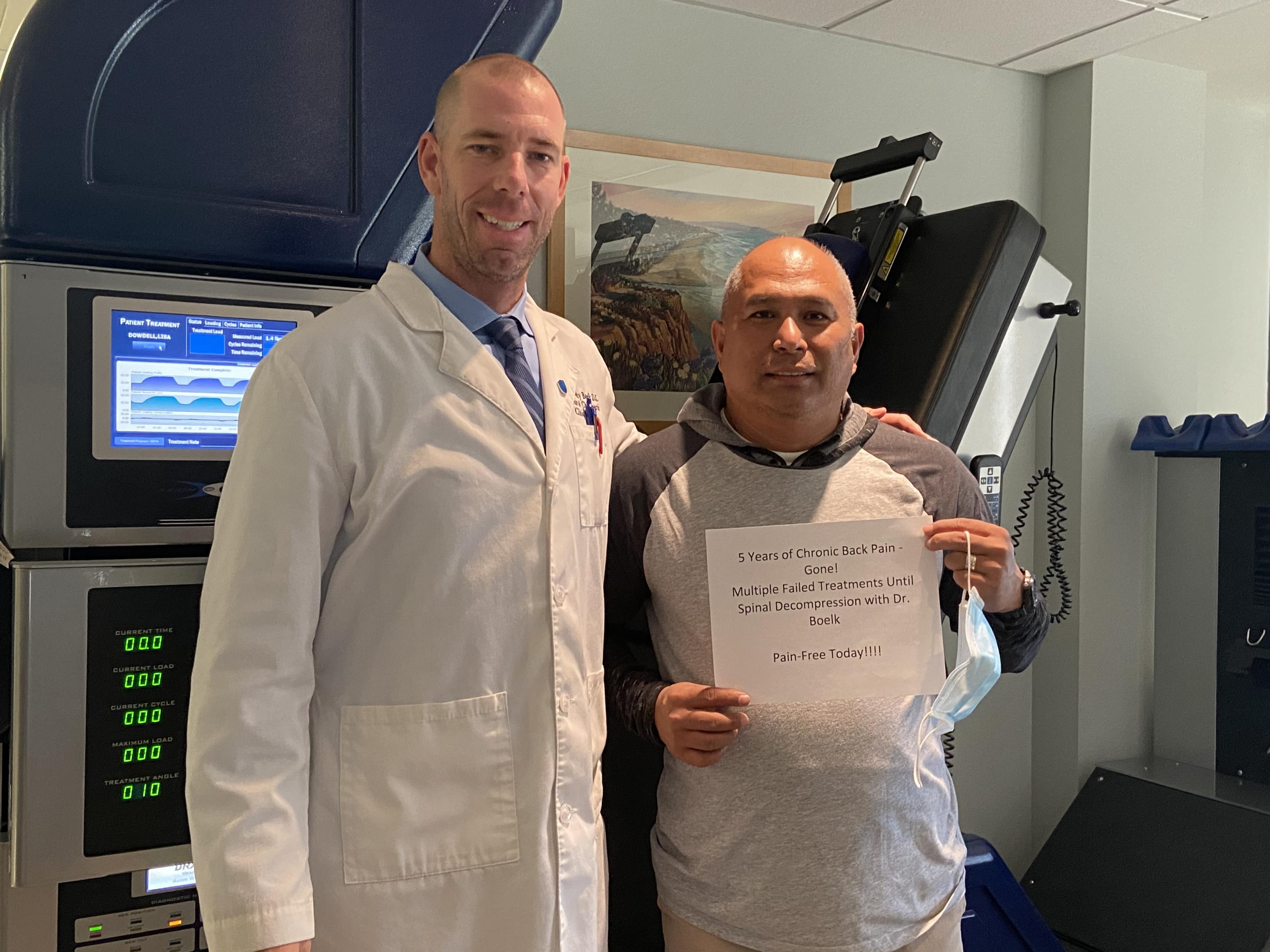
Dr. Cassidy James Boelk, DC sees this type of problem regularly at The Spinal Decompression & Chiropractic Center of San Diego, located in Kearny Mesa near Scripps Ranch.
Many patients already have an MRI by the time they arrive. They have read terms such as L5-S1 disc herniation, protrusion, extrusion, nerve impingement, foraminal narrowing, or degenerative disc disease and want to know what comes next.
One of the most common questions is: Does an L5-S1 disc herniation mean surgery?
Not necessarily.
Many disc herniations can be managed without surgery. The more important question is whether conservative treatment is still appropriate for that particular patient. That takes more than reading one line from an MRI report.
Jayson Had Sciatica From His Hip All the Way to His Foot
Jayson Yavorsky had dealt with sciatica for more than a year. By the time he found Dr. Boelk, the pain was affecting his sleep and had taken him away from hockey, golf, and surfing.
⭐⭐⭐⭐⭐ Jayson Yavorsky — San Diego, CA
“There isn't enough room to fully explain the relief Dr. Boelk has brought to me and my family.
I found him after suffering from severe sciatica for more than a year. The pain shot from my hip all the way down to my left foot and became almost unbearable. I could no longer enjoy the activities I loved, including hockey, golf, and surfing.
Over the years, I had seen numerous chiropractors and experienced only temporary relief. Acupuncture helped somewhat, physical therapy was difficult to tolerate, and nothing seemed to provide lasting results. I couldn't sleep well, and my quality of life was steadily declining.
Then I met Dr. Boelk.
Through a structured treatment plan, adjustments, rehabilitation exercises, and lifestyle modifications, my life completely changed.
To this day, I tell people that Dr. Boelk saved my life.
Since my own recovery, I have referred my wife, daughter, mother, father, numerous friends, and many clients to his office. Every one of them has thanked me for the recommendation. Most recently, a firefighter friend of mine who was suffering from severe sciatica began treatment and is now making tremendous progress.
If you are considering surgery, I strongly encourage you to have Dr. Boelk evaluate your condition first.
What I respect most is his honesty. If he believes you are not a candidate or that another option would be better, he will tell you.
I trust him with my life and with my back.”
— Jayson Yavorsky, San Diego, CA
Jayson's experience also brings up an important point about treating disc-related sciatica: getting someone out of pain is important, but eventually the patient wants his or her life back. That means being able to sit, sleep, work, exercise, travel, and return to the activities that disappeared when the problem became severe.
Start by Figuring Out Whether the L5-S1 Disc Is Really Causing the Symptoms
Patients from Scripps Ranch can schedule a No-Charge, No-Obligation Consultation with Dr. Cassidy James Boelk, DC.
If an MRI has already been performed, bring the actual images if possible, along with the written report. Dr. Boelk personally reviews available imaging rather than relying only on the radiologist's summary.
He will also want to know what is happening outside the MRI machine:
-
Where does the pain start?
-
Does it travel into the buttock or leg?
-
How far down the leg does it go?
-
Is there numbness, tingling, or burning?
-
Does the calf cramp or constantly feel tight?
-
Has the leg or foot become weaker?
-
How long can the patient sit?
-
Does driving make the sciatica worse?
-
What happens with standing or walking?
-
Is the pain interfering with sleep?
-
What treatments have already been tried?
-
Has there been previous spinal surgery?
-
Is the condition improving, staying the same, or getting worse?
Patients without an MRI can still schedule a consultation. If additional examination or imaging is needed, Dr. Boelk can discuss that with the patient.
There is no obligation to begin treatment.
Call 619-298-0800 to schedule a No-Charge, No-Obligation Consultation.
The Spinal Decompression & Chiropractic Center of San Diego
5095 Murphy Canyon Road, Suite 300
San Diego, CA 92123
Phone: 619-298-0800
www.SanDiegoBackCare.com
Live 24/7 Answering Service • Hablamos Español
What Is Actually Happening at L5-S1?
L5-S1 is the lowest disc in the lumbar spine. It sits where the fifth lumbar vertebra meets the sacrum and handles considerable stress during sitting, bending, lifting, twisting, sports, and normal daily movement.
When the outer fibers of the disc weaken or tear, disc material can begin pushing outward. Depending on what the MRI looks like, this may be described as a bulge, protrusion, herniation, or extrusion.
What Dr. Boelk pays close attention to is where that disc material is going.
A relatively small herniation positioned near a nerve can sometimes produce severe symptoms. A larger-looking disc abnormality may be present in another patient without causing the same degree of pain.
That is why the MRI should make sense with the clinical picture.
If a patient has an L5-S1 abnormality on MRI but the symptoms are pointing somewhere else, simply treating L5-S1 because it looks bad on the scan may miss the actual problem.
Why Can the Pain Go All the Way Into the Foot?
A herniated lumbar disc can irritate or compress one of the nerves that eventually contributes to the larger sciatic nerve.
Once that happens, the patient may feel symptoms along the nerve pathway rather than just at the injured disc.
That can include:
-
Lower-back pain
-
Buttock pain
-
Pain traveling down one leg
-
Burning or electrical pain
-
Numbness and tingling
-
Calf pain or cramping
-
Symptoms around the ankle
-
Numbness or altered sensation in parts of the foot
-
Weakness in the leg or foot
The exact pattern depends on which nerve is involved.
This is also why someone can have a significant lumbar disc problem while saying, “My back actually doesn't hurt that much.”
The leg may be telling most of the story.
Why Is Sitting Often So Difficult?
One of the questions Dr. Boelk asks disc patients is what happens when they sit.
Someone may be able to walk around comfortably but develop sciatica after 20 minutes in a chair. Another patient can stand at work but struggles with the drive home.
Long periods of sitting can be irritating for certain lower lumbar disc injuries. Driving adds continuous vibration and keeps the patient in essentially the same position.
How someone sits matters too.
When the seat is extremely low and the knees sit well above the hips, the pelvis and lower back may stay in a rounded position for a long time. If that position consistently makes symptoms worse, adjusting the seat and breaking up prolonged sitting may help reduce some of the repeated irritation.
For longer drives, getting out periodically and walking for a few minutes can be helpful for some patients.
Stretching the Leg Harder Isn't Always the Answer
A patient with sciatica often feels like the hamstring or calf desperately needs to be stretched.
Sometimes the muscle really is tight.
But an irritated sciatic nerve can also create a strong sensation of pulling or tightness through the back of the leg. In that situation, repeatedly forcing a deep hamstring stretch can irritate the nerve rather than solve the problem.
A simple clue is what happens afterward.
If stretching consistently sends the pain farther down the leg, increases numbness or tingling, or produces a significant flare-up, Dr. Boelk would want to know about it.
More stretching is not automatically better.
What Can Be Tried Before L5-S1 Surgery?
There are several conservative approaches, and the right combination depends on the patient.
Some recent disc injuries improve with time, sensible activity modification, and gradual rehabilitation. Medication can be useful for controlling pain or inflammation during an acute flare-up. Physical therapy may help restore movement, strength, and spinal stability.
Epidural steroid injections are sometimes used when inflammation around a spinal nerve is contributing to significant pain. Some patients get substantial relief from an injection, while others experience temporary or minimal improvement.
Non-Surgical Spinal Decompression is another option Dr. Boelk considers for selected disc conditions.
A patient does not necessarily need to fail every other treatment before discussing decompression, nor does everyone with a herniated disc need it. The decision should make sense based on what is actually happening.
Non-Surgical Spinal Decompression With the DRX9000
The Spinal Decompression & Chiropractic Center of San Diego exclusively uses the DRX9000 for lumbar Non-Surgical Spinal Decompression.
The system uses controlled decompression and relaxation cycles directed toward the lumbar spine.
Dr. Boelk individualizes treatment based on factors that can include:
-
Disc level
-
MRI findings
-
Direction of symptoms
-
Patient positioning
-
Treatment angle
-
Body size
-
Starting force
-
Treatment cycles
-
Patient tolerance
-
Response to previous treatment
The settings can be changed as the patient progresses.
The machine matters, but the protocol matters too. So does deciding who should never be placed on the machine in the first place.
Mercedes Traveled From El Centro for Treatment
Mercedes Bautista initially came across Dr. Boelk's office while looking for help for a friend. After having her own MRI performed, she learned that she had a bulging disc and degenerative changes and ultimately began traveling from El Centro for treatment.
⭐⭐⭐⭐⭐ Mercedes Bautista — El Centro, CA
“Hi my name is Mercedes Bautista. I found out about this treatment on the internet and I came because I was searching for a doctor for my friend. I have always had low back problems, so Dr. Boelk suggested that I have an MRI done. I decided to go ahead and do it and what I found out was astonishing. Dr. Boelk told me I had a bulging disc and that my discs were dehydrated. I went home very surprised and even scared.
That night with my husband I cried. My husband and I both talked about it and decided that the finances were worth getting my back fixed. The next thing we had to figure out was how I was going to get here, because I live in El Centro.
So we decided we were going to rent a car and I travel here 4 times a week. The girls here are wonderful and very awesome. They make you feel like family, it’s an extremely relaxing environment. I feel better and I have recommended this treatment to my family and friends. Thank You!”
— Mercedes Bautista, Age 42, El Centro, CA
Why Patients Seek Out Dr. Cassidy James Boelk, DC
Dr. Boelk has spent more than two decades working with difficult disc conditions, sciatica, and Non-Surgical Spinal Decompression.
His background includes:
-
Doctor of Chiropractic
-
Certified Spinal Decompression Doctor
-
Certified Pain-Free Performance Specialist
-
More than 22 years of clinical experience
-
More than 100,000 spinal decompression treatments performed
-
Founder of the Non-Surgical Spinal Decompression Training Academy
-
Trains other doctors in spinal decompression protocols and techniques
-
Founding Member of the American Spinal Decompression Society
-
Member of the International Disc Education Association
-
California X-Ray Radiation Supervisor & Operator
-
Seven DRX9000 spinal decompression systems
-
Exclusively uses DRX9000 technology for Non-Surgical Spinal Decompression
The office has four lumbar DRX9000 systems and three cervical DRX9000C systems.
Dr. Boelk also understands spinal injury from the other side of the examination room. He suffered an L5 compression fracture at age 16 and later experienced additional disc injuries and sciatica. His own recovery has involved thousands of hours spent on rehabilitation, exercise, spinal mechanics, and getting back to an active lifestyle.
That experience has helped shape the way he approaches patients who do not simply want their pain score reduced. They want to get back to living normally again.
What If the Patient Is Not a Candidate?
This part is important.
An MRI showing a herniated disc does not automatically make someone a candidate for Non-Surgical Spinal Decompression.
Dr. Boelk screens for problems that could make treatment inappropriate, including certain cases involving:
-
Unstable spondylolisthesis
-
An unhealed spinal fracture
-
Significant osteoporosis
-
Abdominal aortic aneurysm
-
Pregnancy for lumbar decompression
-
Certain malignancies
-
Certain surgical hardware at the treatment level
-
Progressive neurological weakness
-
Cauda equina syndrome
-
Other conditions that could make decompression unsafe
Sometimes the answer is to wait. Sometimes more imaging is needed. Sometimes another specialist needs to be involved.
And sometimes the right answer is surgery.
The point of the consultation is not to convince every patient to undergo decompression. It is to determine whether decompression makes sense in the first place.
Don't Ignore Progressive Weakness or Bowel and Bladder Changes
Pain can be severe without being an emergency. Certain neurological changes are different.
A patient with a known or suspected lumbar disc herniation should seek prompt medical attention for symptoms such as:
-
New loss of bowel or bladder control
-
New difficulty urinating
-
Numbness in the groin or saddle region
-
Rapidly increasing weakness
-
Sudden loss of control of a leg or foot
-
Other significant, rapidly worsening neurological symptoms
These symptoms should not wait for a routine decompression consultation.
Can an L5-S1 Herniation Heal Without Surgery?
Many L5-S1 disc herniations can improve without surgery, but there is no responsible way to promise that for every patient.
Dr. Boelk looks at the entire situation: MRI findings when available, symptom pattern, neurological findings, spinal stability, previous treatment, previous surgery, overall health, and whether the patient appears to be getting better or worse.
For some patients, continued conservative care and rehabilitation may be enough. For others, Non-Surgical Spinal Decompression may be worth considering. Another group may need a pain-management or surgical opinion.
Finding out which group a patient falls into is far more useful than assuming an L5-S1 diagnosis automatically determines the treatment.
Schedule a No-Charge, No-Obligation Consultation Near Scripps Ranch
Patients from Scripps Ranch dealing with an L5-S1 disc herniation, bulging disc, disc protrusion, disc extrusion, sciatica, or another lower lumbar disc problem can schedule a No-Charge, No-Obligation Consultation with Dr. Cassidy James Boelk, DC.
Bring existing MRI images, X-rays, and reports if available. Patients without imaging can still schedule.
The Spinal Decompression & Chiropractic Center of San Diego
5095 Murphy Canyon Road, Suite 300
San Diego, CA 92123
Phone: 619-298-0800
www.SanDiegoBackCare.com
Live 24/7 Answering Service • Hablamos Español
Call 619-298-0800 to schedule a No-Charge, No-Obligation Consultation with Dr. Cassidy James Boelk, DC.