L4 Sciatica Symptoms | San Diego, CA
If you've been told you have an L4 nerve problem, the symptoms may not look like what most people picture when they hear the word sciatica.
A lot of people think sciatica always means pain starting in the buttock and shooting all the way down the back of the leg. That certainly happens, but L4 nerve irritation can feel different.
With L4 involvement, pain or altered sensation may be felt through the front of the thigh, around the knee and toward the inside of the lower leg. Some patients notice numbness or tingling. Others notice weakness, particularly through the quadriceps or when trying to straighten the knee.
And sometimes the complaint that brings someone into the office isn't even “sciatica.”
It's:
“My knee hurts, but they can't figure out why.”
Or:
“The inside of my lower leg feels numb.”
Or:
“My leg doesn't feel as strong going up and down stairs.”
Dr. Cassidy James Boelk, DC has spent more than 22 years evaluating and treating patients with disc-related spinal problems and has performed more than 100,000 Non-Surgical Spinal Decompression treatments.
When someone comes into his San Diego office with possible L4 nerve symptoms, he doesn't diagnose the problem from a pain diagram alone.
He wants to know what the patient is feeling, where they're feeling it, whether there is weakness, what the examination shows and whether those findings make sense with the MRI.
⭐⭐⭐⭐⭐ Michael Langsdale — San Diego, CA
“I have had an outstanding experience with Dr. Boelk and his staff at The Spinal Decompression & Chiropractic Center of San Diego.
They follow a very structured treatment protocol and utilize the best spinal decompression equipment available. I've been treated elsewhere using lower-quality decompression systems and never experienced meaningful improvement.
Dr. Boelk is attentive, professional, and genuinely cares about every patient. You can see it in the way he interacts with everyone who walks through the door.
After about 12 treatments, my sciatica was gone and I was nearly back to normal. Honestly, I wasn't sure I would ever heal. What surprised me most was that after my very first treatment, I experienced significant relief and was able to sleep mostly pain-free for the first time in months.
The improvement has allowed me to get back to hiking, traveling, and enjoying life again.
This treatment was one of the best investments I've ever made.
Thank you, Dr. Boelk and your entire team.”
— Michael Langsdale, San Diego, CA
Have an MRI? Bring the Images With You
If your MRI mentions L3-L4, L4-L5, a disc bulge, disc herniation, foraminal narrowing or spinal stenosis, bring the actual images and report.
Dr. Boelk can review them with you and compare what's visible on the MRI with what you're actually experiencing.
No MRI yet? That's okay.
Dr. Boelk offers a No-Charge, No-Obligation Consultation to discuss your symptoms and determine whether further evaluation or Non-Surgical Spinal Decompression may be appropriate.
The Spinal Decompression & Chiropractic Center of San Diego
5095 Murphy Canyon Road, Suite 300
San Diego, CA 92123
Phone: 619-298-0800
www.SanDiegoBackCare.com
Live 24/7 Answering Service • Hablamos Español
Where Are L4 Sciatica Symptoms Usually Felt?
L4 symptoms can involve the front of the thigh, knee and inside portion of the lower leg.
Depending on the patient and the location of the nerve irritation, symptoms may include:
-
Pain through the front of the thigh
-
Pain around the knee
-
Pain extending down the inside of the lower leg
-
Numbness or tingling along the medial lower leg
-
Changes in sensation toward the inside of the ankle or foot
-
Weakness in the quadriceps
-
Difficulty extending or straightening the knee
-
A diminished knee-jerk reflex
But real patients don't always follow a textbook diagram perfectly.
There can be overlap between L3, L4 and even other nerve-root patterns.
That is why Dr. Boelk doesn't look at a symptom chart and say, “That's definitely L4.”
The location of the symptoms is a clue.
It's not the entire diagnosis.
Can L4 Cause Knee Pain?
Yes, an L4 nerve problem can produce symptoms around the knee.
And that can be confusing.
A patient may naturally assume that pain around the knee means something is wrong with the knee itself.
Sometimes that's exactly what it is.
There may be arthritis, a meniscus problem, a ligament injury or another condition involving the knee.
But if the knee evaluation doesn't seem to explain everything, Dr. Boelk starts asking more questions.
Does the pain also extend into the thigh?
Is the inside of the lower leg numb or tingling?
Does the leg feel weaker?
Does the knee occasionally feel like it's going to buckle?
Do you also have lower-back pain?
Did the leg symptoms begin at the same time as the back problem?
Those details can point the evaluation in a very different direction.
Weakness Can Be More Important Than Pain
This is something patients can overlook.
Pain gets your attention because it hurts.
Weakness may be more subtle.
With L4 nerve involvement, the quadriceps can be affected. You may notice that one leg doesn't feel as strong when climbing stairs, getting up from a chair or stepping down.
Maybe the knee feels less stable.
Maybe you can still do everything, but one side clearly doesn't have the same strength as the other.
Tell Dr. Boelk.
Don't just describe the pain and forget to mention that your leg feels weaker.
Changes in strength provide different information than pain alone.
What Does the Knee-Jerk Reflex Have to Do With Your Back?
You've probably had a doctor tap just below your kneecap with a small reflex hammer.
Your lower leg kicks forward.
That's the patellar reflex.
L3 and L4 contribute to that reflex, so a change in the knee-jerk response can provide another clue when L4 nerve involvement is suspected.
Again, Dr. Boelk isn't diagnosing someone from one reflex.
He's putting pieces together.
Where is the pain?
Where is the numbness?
What muscles are weak?
What do the reflexes look like?
What does the MRI show?
Does all of it tell a reasonably consistent story?
That's much more useful than looking at one abnormality on an MRI and assuming you've found the problem.
Don't Assume L4-L5 Means the L4 Nerve
This is one of the easiest things to misunderstand when reading your own MRI report.
You see:
L4-L5 disc herniation
So it seems logical to assume:
L4 nerve.
It isn't always that simple.
The nerve root affected by a disc problem depends partly on where the disc material is located.
A disc problem at L4-L5 can affect different neural structures depending on its location.
This is one reason Dr. Boelk prefers looking at the actual MRI rather than relying only on the written impression.
If you have an MRI, bring the images.
Don't worry about trying to interpret it yourself before you come in.
What if Your MRI Has Several Bad Levels?
That's common.
Someone may have degeneration at L3-L4, a disc herniation at L4-L5 and another abnormality at L5-S1.
The report may sound terrible.
That doesn't mean every abnormal level is producing symptoms.
Dr. Boelk wants to identify which findings actually make sense with what the patient is experiencing.
Suppose the MRI shows abnormalities at three levels, but the patient's pain, sensory changes, weakness and examination findings consistently point toward one particular nerve.
That's very different from simply treating every abnormal-looking disc on the scan.
Can Non-Surgical Spinal Decompression Help L4 Nerve Pain?
For certain patients, it may be an option.
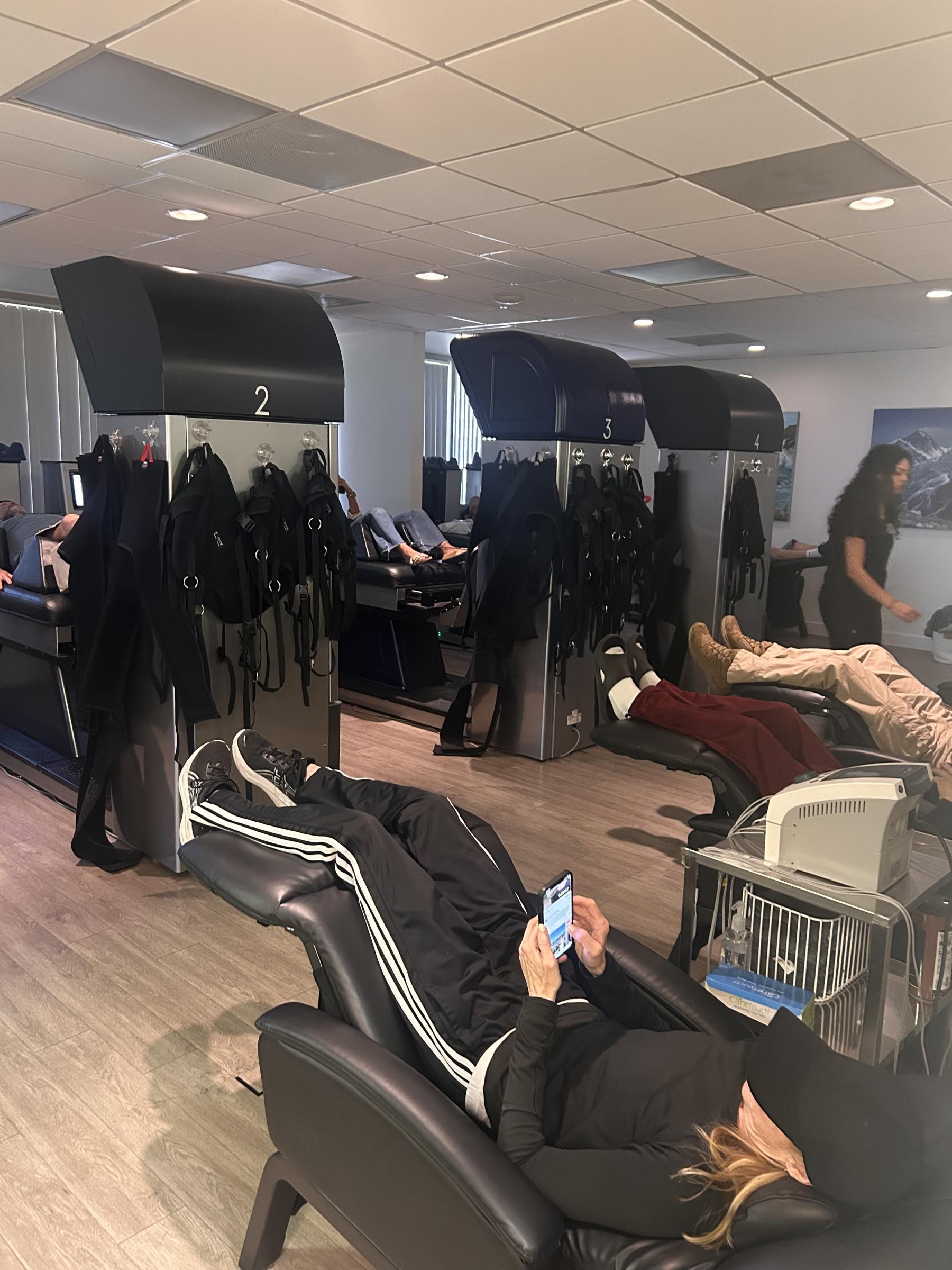
If Dr. Boelk believes the nerve irritation is associated with a disc or degenerative spinal problem that is appropriate for decompression, he may recommend Non-Surgical Spinal Decompression using the DRX9000.
The office uses the DRX9000 exclusively and has seven systems—four lumbar and three cervical.
But there isn't an “L4 setting” that gets used on every patient.
Dr. Boelk considers the location of the disc problem, level being treated, treatment angle, positioning, starting force, body size, symptoms, tolerance and how the patient responds.
The treatment is individualized.
Pay Attention to What Your Leg Is Actually Doing
Before your appointment, spend a few days noticing the pattern.
Don't obsess over it. Just pay attention.
Where does the pain start?
Where does it stop?
Does it go across the front of the thigh?
Does your knee hurt?
Is the inside of your lower leg numb?
Does the leg feel weaker on stairs?
What happens when you sit?
What happens when you walk?
Does coughing or sneezing reproduce the leg pain?
Does the pain change when you change positions?
If you have numbness, use your finger and show Dr. Boelk exactly where you feel it.
Specific information is much more useful than simply saying, “My whole leg bothers me.”
What Can You Do at Home?
You don't need to spend hours searching for an “L4 stretch.”
In fact, be cautious about blindly following exercises based solely on a nerve-root diagram you found online.
If walking feels comfortable, short walks may be reasonable.
If sitting for long periods clearly aggravates the symptoms, break up your sitting when possible.
If an exercise or stretch repeatedly creates burning, electrical pain, numbness or tingling farther into the leg, don't keep forcing it.
For sleep, some patients are more comfortable on their side with a pillow between the knees. Others prefer lying on their back with support under the knees.
And pay attention to strength.
If the leg is becoming progressively weaker rather than simply painful, get it evaluated.
⭐⭐⭐⭐⭐ Lynn C. — Alaska
“My name is Lynn. I am from Alaska, and I just want to say it was totally worth taking a trip to go to the Spinal Decompression & Chiropractic Center of San Diego. I was having pain radiating down my legs, I couldn’t sleep, I could barely walk.
After treatment I am back to shoveling snow, teaching school, taking walks. So, I just want to thank Dr. Boelk and the clinic, you guys are wonderful, and you have created such a wonderful, friendly, kind and truly caring atmosphere. I highly encourage anybody that might be considering spinal decompression therapy, it really makes a difference.”
— Lynn C., Alaska
Not Every L4 Nerve Problem Should Be Treated With Decompression
This is important.
Dr. Boelk doesn't recommend decompression simply because an MRI shows a disc problem.
There are situations where decompression may not be appropriate, including an unhealed fracture, significant osteoporosis, unstable spondylolisthesis, abdominal aortic aneurysm, pregnancy for lumbar treatment, certain malignancies and other conditions that can make treatment unsafe.
Previous spinal surgery also needs to be evaluated carefully, particularly when there is fusion or metal hardware at the level that would need treatment.
Sometimes another specialist needs to be involved.
Sometimes surgery really is the appropriate option.
And sometimes the patient needs more information before anyone should be talking about treatment.
⭐⭐⭐⭐⭐ Jeff J. — Tucson, AZ
“I found this terrific practice on social media. I followed up and did my own research so I decided to pay them a visit. The place is clean, well organized and run by a very efficient receptionist. I met with the doctor and after a honest and forthright conversation, we both determined that surgery was my only option to correct my back issues. I will return as a customer when the time is right.”
— Jeff J., Tucson, AZ
That's why Dr. Boelk evaluates candidacy before beginning decompression.
When L4 Symptoms Need More Immediate Attention
Pain, tingling and numbness deserve evaluation, but progressive weakness deserves particular attention.
If your quadriceps is becoming noticeably weaker, the knee is repeatedly giving way, or you're losing function in the leg, don't simply keep stretching it and hoping it goes away.
Get evaluated.
And if you develop new bowel or bladder dysfunction, difficulty urinating, numbness around the groin or saddle area, or rapidly progressing neurological weakness, seek prompt medical attention rather than waiting for a routine decompression consultation.
More Than 22 Years Working With Disc and Nerve Problems
Dr. Boelk suffered an L5 compression fracture at age 16 and later experienced disc injuries and sciatica himself. Those experiences and thousands of hours spent working on his own rehabilitation helped shape the direction of his practice.
Today, Dr. Boelk is a Certified Spinal Decompression Doctor and Certified Pain-Free Performance Specialist.
He is the Founder of the Non-Surgical Spinal Decompression Training Academy, where he trains other doctors in decompression protocols and techniques.
He is also a Founding Member of the American Spinal Decompression Society, a member of the International Disc Education Association, and holds California X-ray radiography credentials.
After more than 22 years and more than 100,000 decompression treatments, his approach still begins with figuring out what's actually causing the patient's symptoms.
L4 Sciatica Symptoms? Find Out What's Causing Them
If you're experiencing pain through the front of your thigh or around the knee, numbness or tingling along the inside of the lower leg, or unexplained weakness in the leg, don't assume you know which nerve is involved based on an online diagram.
If you already have a lumbar MRI, bring the actual images and report.
Dr. Boelk can review your symptoms, examination findings and imaging and discuss whether a disc or degenerative spinal problem may be contributing—and whether Non-Surgical Spinal Decompression may be an appropriate option.
No MRI? That's okay. You can still schedule a consultation.
Not every patient is a candidate. If Dr. Boelk doesn't believe decompression is appropriate for your condition, he'll tell you.
No-Charge, No-Obligation Consultation
The Spinal Decompression & Chiropractic Center of San Diego
5095 Murphy Canyon Road, Suite 300
San Diego, CA 92123
Phone: 619-298-0800
www.SanDiegoBackCare.com
Live 24/7 Answering Service • Hablamos Español
Call 619-298-0800 to schedule your No-Charge, No-Obligation Consultation.