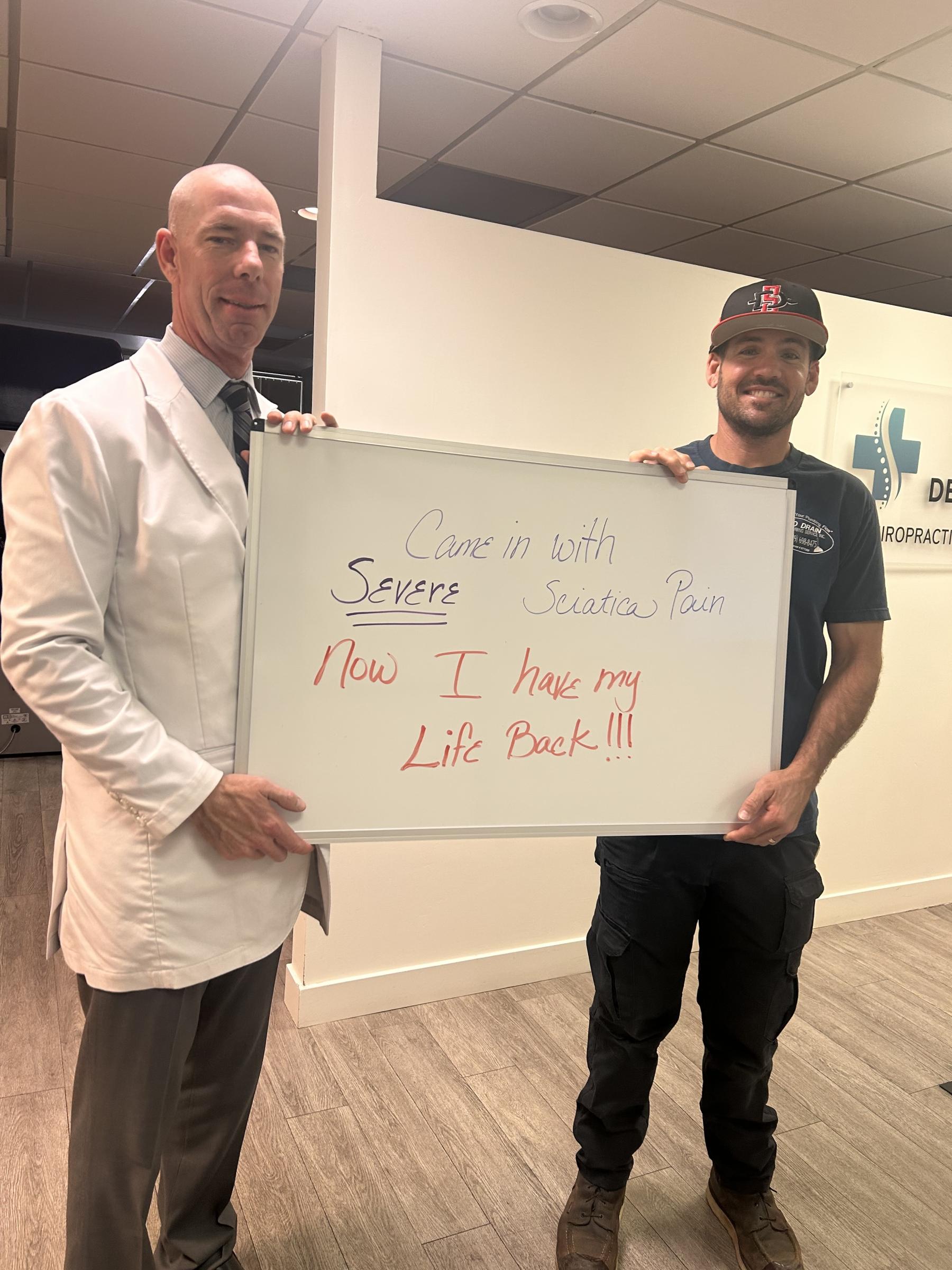
L4 Sciatica Symptoms | La Jolla, CA
If you're having pain around the front of your thigh or knee, numbness or tingling down the inside of your lower leg, or one leg feels weaker when you're climbing stairs, the problem may not be your knee or leg at all. Those symptoms can sometimes occur when the L4 nerve root in the lower back is irritated or compressed.
This can be confusing because L4 symptoms don't always look like what people normally think of as sciatica. There may be very little lower-back pain, and the pain doesn't necessarily shoot all the way down the back of the leg. For some people, the knee or front of the thigh is actually where they notice the problem the most.
Dr. Cassidy James Boelk, DC has been evaluating and treating patients with disc injuries, sciatica and other spinal conditions for more than 22 years and has performed more than 100,000 Non-Surgical Spinal Decompression treatments. One of the things he has learned during that time is that where a patient feels pain is important, but it doesn't always tell you where the problem originates.
That's why an evaluation for possible L4 nerve irritation involves more than looking at an MRI report. Dr. Boelk wants to know where the symptoms travel, whether there is numbness or tingling, whether strength has changed, what makes the symptoms better or worse, and whether the physical findings actually correspond with what is visible on the MRI.
⭐⭐⭐⭐⭐ Toni H. — San Diego, CA
“For the first time in 10 years, I am totally pain free. My sciatica is gone and I have no more back pain! I've tried other chiropractic procedures, acupuncture, pain killing drugs, and other type therapies that just did not work. I was one step before back surgery, until I discovered Dr. Boelk's therapy and his procedure, and it's a miracle! My office visits were always so relaxing and comfortable, there was never any pain involved with the therapy. Dr. Boelk and Patty are so welcoming and warm and ready to explain everything that's going on. They both take such good care of you! Thank you Dr. Boelk and Patty!”
— Toni H., San Diego, CA
What Does L4 Sciatica Usually Feel Like?
Although everyone's symptoms can be a little different, irritation of the L4 nerve root may cause:
-
Pain through the front or inner portion of the thigh
-
Pain around the knee
-
Burning, tingling or numbness along the inside of the lower leg
-
Altered sensation toward the inside of the ankle
-
Weakness through the quadriceps
-
Difficulty straightening the knee with normal strength
-
A feeling that the knee or leg is less stable than it used to be
-
Changes in the patellar, or knee-jerk, reflex
A patient doesn't need to have every symptom on that list, and the symptoms don't always follow a perfect line down the leg. There is overlap between neighboring nerve roots, particularly L3 and L4, so Dr. Boelk uses the location of the symptoms as one part of the evaluation rather than treating a nerve diagram as a diagnosis.
One of the most useful things you can do is pay attention to exactly where your symptoms are occurring. If part of the leg is numb, show exactly where. If the leg feels weak, think about when you notice it most—is it climbing stairs, getting out of a chair, stepping off a curb or simply standing on that leg?
Those details can be surprisingly helpful when trying to determine whether the symptoms may be coming from the lumbar spine.
Why an L4 Problem Can Be Mistaken for a Knee Problem
Pain around the knee naturally makes people think something is wrong with the knee. And sometimes there is. Arthritis, meniscus problems, ligament injuries and other knee conditions can certainly cause pain in that area.
The situation becomes more interesting when the knee doesn't explain everything. Someone may have knee pain along with numbness down the inside of the lower leg. Another patient may notice discomfort through the front of the thigh and feel as though the leg is weaker going up stairs. Someone else may have already had the knee evaluated but still doesn't have a good explanation for why the symptoms continue.
In those situations, Dr. Boelk considers whether the lumbar spine and L4 nerve root could be involved.
Weakness is particularly important. Patients sometimes spend most of their appointment describing their pain and only later mention that the leg has also become weaker. With L4 nerve involvement, the quadriceps can be affected, which may make knee extension, climbing stairs or getting up from a seated position feel different.
Pain can fluctuate considerably from day to day. A meaningful or progressive change in strength deserves attention.
What if Your MRI Shows L3-L4 or L4-L5?
MRI reports can be intimidating because they often list several abnormalities at once. You might see terms such as L3-L4 disc bulge, L4-L5 disc herniation, foraminal narrowing, degenerative disc disease or spinal stenosis.
The mistake is assuming that every abnormality on the report must be causing pain. That's not necessarily true.
Dr. Boelk prefers to review the actual MRI images whenever they're available. He can look at the location of a disc problem or narrowing, how much room appears to be available around the nerve, and whether those findings reasonably correspond with the patient's symptoms and examination.
It's also important to understand that seeing L4-L5 on an MRI report doesn't automatically mean the L4 nerve is the nerve causing your symptoms. The nerve affected depends in part on the location of the disc abnormality or narrowing.
This is why a good evaluation shouldn't start and end with reading the written MRI report. A patient may have several abnormal-looking discs but only one finding that makes sense with the pain, numbness or weakness they're experiencing. In another patient, the MRI may not adequately explain the symptoms at all. Both situations affect what should happen next.
What Can You Do While You're Trying to Figure This Out?
There isn't one exercise or stretch that is appropriate for every person with L4 symptoms, but there are a few practical things worth paying attention to.
If short walks feel comfortable, walking may be helpful for staying mobile. If prolonged sitting clearly increases the leg symptoms, try breaking up longer periods of sitting when possible. Some people sleep more comfortably on their side with a pillow between the knees, while others prefer lying on their back with support underneath the knees.
Be careful with aggressive stretching, particularly if the leg already feels tight, numb or irritated. A comfortable muscle stretch is one thing. A stretch that repeatedly sends burning, tingling, electrical pain or increased numbness farther into the leg is something different. Don't keep forcing a movement simply because you've been told it's a “sciatica stretch.”
It can also help to notice whether sitting, standing, walking, bending, coughing or sneezing changes the symptoms. You don't need to repeatedly provoke the pain to test yourself. Just pay attention to what happens during your normal day and share those observations during your evaluation.
Can Non-Surgical Spinal Decompression Help L4 Sciatica?
If the L4 nerve irritation is associated with an appropriate disc or degenerative spinal problem, Non-Surgical Spinal Decompression may be an option.
Dr. Boelk's office uses the DRX9000 exclusively, with four lumbar and three cervical systems. Treatment isn't based on simply putting every patient with sciatica onto the same machine setting. The level and location of the disc problem, symptoms, positioning, treatment angle, starting force, body size, tolerance and response all need to be considered.
Just as importantly, not every person with a disc problem or sciatica should receive decompression.
Dr. Cassidy James Boelk, DC evaluates every patient for candidacy before recommending treatment. An unhealed fracture, significant osteoporosis, unstable spondylolisthesis, abdominal aortic aneurysm, pregnancy for lumbar decompression, certain malignancies and other conditions can make treatment inappropriate. Previous spinal surgery also needs to be evaluated carefully, particularly when fusion or metal hardware is present at the level that would need treatment.
Sometimes another type of conservative care makes more sense. Sometimes additional imaging or another specialist is appropriate. And there are situations where surgery really is the appropriate recommendation.
⭐⭐⭐⭐⭐ Jan H. — San Marcos, CA
“I decided to see Dr. Boelk after a pretty gnarly motocoss neck injury. At the Hospital I was at, I felt I was getting pressured into a surgery which I refused. A friend of a friend referred him after Dr. Boelk successfully treated his broken back.
Dr. Boelk is a compassionate individual who truly cares about his patients. He looked at my MRI images, explained what he saw and potential routes for recovery. He could not treat me as I have to wait until the fracture in my neck heals, but the level of professionalism, compassion, caring and knowledge displayed by him was exceptional.
He also recommended to seek an additional opinion form another neurosurgeon. My experience was that he really cares and he's not someone who would take advantage of the situation someone's in (unlike some other doctors). I will definitely be back and already recommended him to others as well! Thank you Dr. Boelk!”
— Jan H., San Marcos, CA
That is an important part of the consultation process. Scheduling a consultation doesn't mean you've committed to treatment. If Dr. Boelk doesn't believe you're an appropriate candidate for Non-Surgical Spinal Decompression, he'll tell you.
What Happens During the No-Charge Consultation?
If you've been dealing with leg pain, numbness, tingling or weakness and aren't sure what to do next, the No-Charge, No-Obligation Consultation gives you an opportunity to sit down with Dr. Cassidy James Boelk, DC and discuss what's actually happening.
The consultation may include:
-
Discussing when your symptoms started and how they have changed
-
Identifying exactly where the pain, numbness or tingling travels
-
Discussing weakness or changes in function you've noticed
-
Reviewing what makes your symptoms better or worse
-
Discussing previous treatments and how you responded
-
Reviewing your existing MRI, X-rays and reports when available
-
Looking at whether the imaging findings appear to match your symptoms
-
Discussing whether additional examination or imaging may be appropriate
-
Determining whether Non-Surgical Spinal Decompression may be an option
-
Answering your questions and discussing a reasonable next step
Already have an MRI? Bring the images and the report.
If you don't have an MRI, that's okay. You can still start with the consultation.
There is no obligation to begin treatment, and if Dr. Boelk doesn't believe decompression is appropriate for your condition, he'll tell you.
Why Experience Matters With Disc and Nerve Problems
Dr. Cassidy James Boelk, DC has focused much of his professional career on Non-Surgical Spinal Decompression and patients dealing with disc-related spinal conditions.
His background includes:
-
Doctor of Chiropractic (DC)
-
More than 22 years of Non-Surgical Spinal Decompression experience
-
More than 100,000 spinal decompression treatments performed
-
Certified Spinal Decompression Doctor
-
Certified Pain-Free Performance Specialist (PPSC)
-
Founder, Non-Surgical Spinal Decompression Training Academy
-
Trains other doctors in spinal decompression protocols and techniques
-
Founding Member, American Spinal Decompression Society
-
Member, International Disc Education Association
-
California X-Ray Radiation Supervisor & Operator
His interest in spinal injuries is also personal. Dr. Boelk suffered an L5 compression fracture at age 16 and later dealt with disc injuries and sciatica himself. Those experiences, along with thousands of hours spent on his own rehabilitation, helped shape the direction of his practice and his interest in helping patients find non-surgical options when appropriate.
When L4 Symptoms Need More Immediate Attention
Most patients researching L4 symptoms aren't dealing with an emergency, but there are neurological changes that shouldn't be ignored.
If the leg is becoming progressively weaker, the knee is repeatedly giving way or you're noticing a meaningful loss of strength, have it evaluated rather than continuing to wait.
New bowel or bladder dysfunction, difficulty urinating, numbness around the groin or saddle area, or rapidly progressing neurological weakness require prompt medical attention and should not wait for a routine decompression consultation.
Dealing With L4 Sciatica Symptoms in La Jolla?
If you're having pain around the front of your thigh or knee, numbness or tingling along the inside of the lower leg, or weakness that doesn't seem to have a good explanation, the next step is to determine where those symptoms are actually coming from.
If you already have a lumbar MRI, bring the images and report. Dr. Cassidy James Boelk, DC can review them with you, compare the imaging with what you're actually experiencing, and discuss whether Non-Surgical Spinal Decompression may be an appropriate option.
If you don't have imaging yet, that's okay too.
You don't have to commit to treatment just to get some answers. Start with a No-Charge, No-Obligation Consultation and find out whether your symptoms and imaging suggest that you're a candidate for care.
The Spinal Decompression & Chiropractic Center of San Diego
5095 Murphy Canyon Road, Suite 300
San Diego, CA 92123
Call 619-298-0800
Live 24/7 Answering Service • Hablamos Español