L4 Sciatica Symptoms | Kearny Mesa, CA
A patient comes in because his knee hurts.
He has already tried resting it. Maybe he has iced it, stretched his quadriceps, changed his workouts or even had the knee examined.
But something doesn't quite add up.
The pain isn't always just in the knee. Sometimes he feels it higher in the thigh. Other times there's an odd numb or tingling feeling running down the inside of the lower leg. Going up or down stairs doesn't feel right because that leg seems weaker than the other one.
That's when Dr. Cassidy James Boelk, DC starts wondering whether the knee is really the whole problem.
L4 nerve irritation can cause symptoms that are easy to mistake for a problem in the knee or leg.
L4 radiculopathy may produce pain or altered sensation through the front of the thigh and knee and into the medial—or inside—portion of the lower leg. It can also affect quadriceps strength and the patellar reflex. There is overlap with neighboring nerve roots, though, so the location of the pain alone doesn't make the diagnosis.
Dr. Boelk has spent more than 22 years working with disc injuries, sciatica and difficult spinal conditions and has performed more than 100,000 Non-Surgical Spinal Decompression treatments.
He has also seen plenty of patients who walked in convinced they knew what their MRI meant.
Sometimes they were right.
Sometimes they weren't.
The better approach is to put the MRI, examination and patient's symptoms together and see whether they tell the same story.
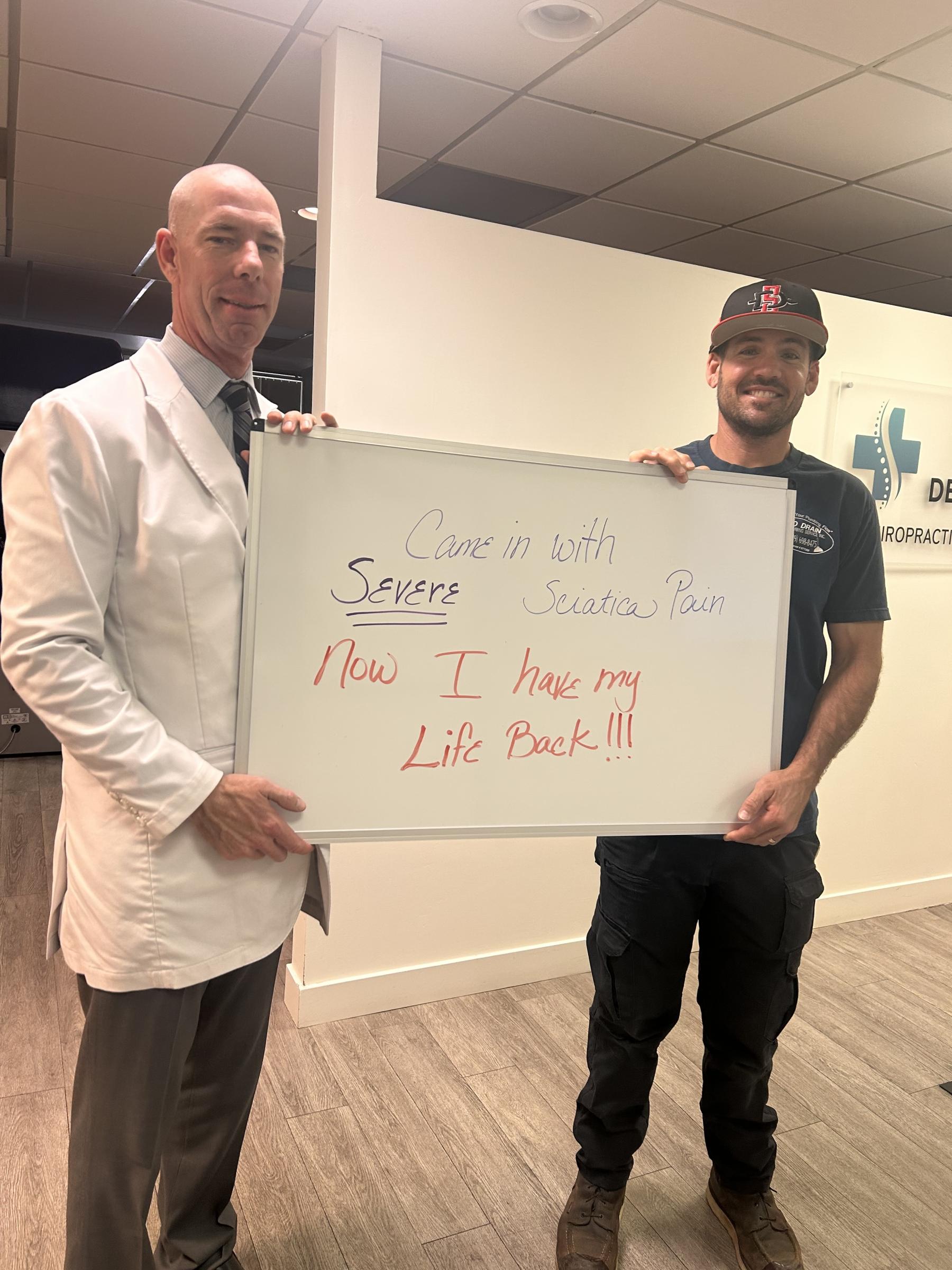
⭐⭐⭐⭐⭐ Joshua T. — San Diego, CA
“Dr. Boelk has been a lifesaver.
I suffered from constant low back pain and sciatica for more than eight months. Pain medications didn't help, and I was headed toward multiple injections in hopes of finding relief.
After beginning treatment with Dr. Boelk, everything changed.
Today, my pain is completely gone.
As a firefighter who depends on his body every day to help others, being pain-free has made a tremendous difference in both my career and quality of life.
The results I experienced were absolutely worth it, and I highly recommend looking into what Dr. Boelk and his team can do for you.”
— Joshua T., San Diego, CA
If You Already Have an MRI, Bring It
If you live or work in Kearny Mesa and your MRI mentions L3-L4, L4-L5, a disc protrusion, herniation, foraminal narrowing or spinal stenosis, bring the actual images and report.
Dr. Boelk will want to see them.
And if you don't have an MRI, that's okay.
A No-Charge, No-Obligation Consultation gives you an opportunity to sit down with Dr. Boelk, explain what's happening and determine whether your symptoms need further evaluation and whether Non-Surgical Spinal Decompression may be appropriate.
The Spinal Decompression & Chiropractic Center of San Diego
5095 Murphy Canyon Road, Suite 300
San Diego, CA 92123
Phone: 619-298-0800
www.SanDiegoBackCare.com
Live 24/7 Answering Service • Hablamos Español
What Do L4 Sciatica Symptoms Actually Feel Like?
Don't worry too much about memorizing a dermatome chart.
Think about your own leg.
L4 symptoms may be felt through the front of the thigh, around the knee and down the inside of the lower leg toward the medial ankle. Depending on the degree and location of nerve irritation, someone may experience pain, burning, tingling, numbness or weakness.
The quadriceps can also be affected. A diminished patellar—or knee-jerk—reflex is another finding associated with L4 nerve-root involvement.
What Dr. Boelk wants from the patient is specificity.
Instead of:
“My leg hurts.”
Show him.
Does it hurt here?
Does it stop at the knee?
Does it continue below it?
Is the inside of the shin numb?
Does the leg hurt, or does it simply feel different?
Does one leg feel weaker when you're climbing stairs?
Those details are useful.
L4 Pain Can Fool You Into Thinking It's Your Knee
This is one reason this particular nerve root is interesting.
If someone has pain around the knee, looking at the knee makes perfect sense.
There are plenty of things that can go wrong with a knee.
But sometimes the symptoms don't behave like a straightforward knee problem.
Maybe there's pain in the front of the thigh too.
Maybe the medial lower leg is numb.
Maybe the knee feels like it's going to give way even though there wasn't a knee injury.
Maybe the knee was examined and nothing significant was found.
L3 and L4 radiculopathy can produce symptoms around the anterior thigh and knee, and other musculoskeletal problems can mimic radiculopathy as well. That is why the examination needs to consider both possibilities rather than assuming every knee-region symptom is coming from the spine.
Dr. Boelk isn't trying to turn every knee problem into a back problem.
He's trying not to miss a back problem because the patient happens to feel it around the knee.
One Thing Patients Sometimes Forget to Mention: Weakness
A patient can describe the pain in incredible detail and then, almost as an afterthought, say:
“Oh yeah, that leg also feels weaker.”
That gets Dr. Boelk's attention.
L4 nerve-root involvement can affect knee extension and the quadriceps.
In real life, you may notice that when you're going up stairs.
Or getting out of a chair.
Or stepping down from a curb.
Maybe the knee feels as though it could buckle.
Maybe one side simply doesn't have the same power.
Pain can fluctuate considerably. A change in motor function is something Dr. Boelk wants to know about.
What Does Your MRI Really Mean?
This is where things can get confusing fast.
A patient opens the MRI report and sees:
L3-L4 disc bulge.
L4-L5 disc protrusion.
Foraminal stenosis.
Degenerative disc disease.
Then Google gets involved, and 45 minutes later the patient is convinced three nerves are damaged and surgery is inevitable.
Slow down.
An MRI is incredibly useful, but the written report isn't the entire diagnosis.
Dr. Boelk prefers to review the actual images whenever possible.
He wants to see where the abnormality is located, how much room there is around the nerve and whether that finding makes sense with what the patient is feeling.
And there's another source of confusion:
An L4-L5 disc problem does not automatically mean the L4 nerve root is the problem.
The L4 nerve exits through the L4-L5 foramen, but which nerve is affected by a disc herniation depends on where the disc material is located.
This is exactly why trying to diagnose yourself from the level printed on an MRI report can send you in the wrong direction.
There Is No Requirement That Your Symptoms Match a Picture Perfectly
Dermatome diagrams are useful teaching tools.
Human beings are messier.
There is overlap between neighboring nerve roots, and research and clinical references recognize considerable overlap among the L2-L4 distributions.
So a patient doesn't have to point to one perfect stripe down the leg for Dr. Boelk to take the possibility of nerve irritation seriously.
He's looking at the overall pattern.
Pain.
Sensation.
Strength.
Reflexes.
Imaging.
History.
Put enough of those pieces together and the picture becomes much clearer.
A Few Things Worth Noticing Before Your Appointment
You don't need special equipment.
Just pay attention to what happens during your normal day.
Can you climb stairs normally?
Does the knee feel stable?
Is one thigh noticeably weaker?
Where exactly is the numbness?
Does sitting change it?
Does walking change it?
Do coughing or sneezing reproduce the leg pain? Radicular symptoms from a disc problem can sometimes worsen with coughing or sneezing.
If something makes the symptoms travel farther down your leg, remember that too.
And don't spend the entire day testing it.
Patients sometimes repeatedly bend, stretch or straighten the leg just to see whether the symptom is still there.
If you've already figured out that a particular movement aggravates the nerve, you don't need to prove it to yourself another 20 times.
What About Stretching?
Be careful with the idea that every tight-feeling leg needs to be stretched harder.
If the front or back of the thigh feels tight, a gentle stretch may feel perfectly fine.
But if an exercise creates burning, tingling, electrical pain or increased numbness farther into the leg, that's different.
Don't force a neurological symptom because an exercise video told you the stretch was “good for sciatica.”
If walking feels comfortable, walk.
If sitting for a long time clearly aggravates the problem, get up periodically.
For sleep, experiment with a pillow between the knees while side-lying or support under the knees while lying on your back.
None of those things diagnoses or fixes an L4 nerve problem.
They're simply reasonable ways to stop unnecessarily aggravating symptoms while you're figuring out what's actually wrong.
⭐⭐⭐⭐⭐ Lynn C. — Alaska
“My name is Lynn. I am from Alaska, and I just want to say it was totally worth taking a trip to go to the Spinal Decompression & Chiropractic Center of San Diego. I was having pain radiating down my legs, I couldn’t sleep, I could barely walk.
After treatment I am back to shoveling snow, teaching school, taking walks. So, I just want to thank Dr. Boelk and the clinic, you guys are wonderful, and you have created such a wonderful, friendly, kind and truly caring atmosphere. I highly encourage anybody that might be considering spinal decompression therapy, it really makes a difference.”
— Lynn C., Alaska
Where Non-Surgical Spinal Decompression May Fit In
If Dr. Boelk determines that the nerve irritation is associated with a disc or degenerative spinal problem and the patient is an appropriate candidate, Non-Surgical Spinal Decompression may be considered.
The office uses the DRX9000 exclusively and has seven systems—four lumbar and three cervical.
But this is where Dr. Boelk's experience becomes more important than the name printed on the machine.
There isn't a button labeled “L4.”
He considers the level and location of the disc problem, the patient's symptoms, positioning, treatment angle, starting force, body size, tolerance and response.
That protocol can change as the patient changes.
After more than 100,000 decompression treatments, Dr. Boelk has also learned something equally important:
Knowing who not to treat matters just as much as knowing how to treat.
Sometimes the Right Answer Is No
A decompression office shouldn't mean that everybody who walks through the door gets decompression.
Dr. Boelk doesn't accept every patient.
An unhealed fracture, significant osteoporosis, unstable spondylolisthesis, abdominal aortic aneurysm, pregnancy for lumbar decompression, certain malignancies and other conditions may make treatment inappropriate.
Previous spinal surgery also needs to be evaluated carefully, particularly when there is fusion or metal hardware at the level that would need treatment.
Sometimes another specialist is the better next step.
Sometimes surgery needs to be considered.
Sometimes more information is needed before making any decision.
⭐⭐⭐⭐⭐ Jan H. — San Marcos, CA
“I decided to see Dr. Boelk after a pretty gnarly motocoss neck injury. At the Hospital I was at, I felt I was getting pressured into a surgery which I refused. A friend of a friend referred him after Dr. Boelk successfully treated his broken back.
Dr. Boelk is a compassionate individual who truly cares about his patients. He looked at my MRI images, explained what he saw and potential routes for recovery. He could not treat me as I have to wait until the fracture in my neck heals, but the level of professionalism, compassion, caring and knowledge displayed by him was exceptional.
He also recommended to seek an additional opinion form another neurosurgeon. My experience was that he really cares and he's not someone who would take advantage of the situation someone's in (unlike some other doctors). I will definitely be back and already recommended him to others as well! Thank you Dr. Boelk!”
— Jan H., San Marcos, CA
That kind of consultation is still useful.
You may leave knowing decompression is appropriate.
You may leave knowing it isn't.
Either way, you know more than you did when you walked in.
Don't Sit on Increasing Weakness
If the pain is annoying but stable, that's one conversation.
If the leg is becoming progressively weaker, that's another.
If you're increasingly struggling to straighten the knee, the leg repeatedly gives way, or you've noticed a meaningful loss of strength, get evaluated.
New bowel or bladder dysfunction, difficulty urinating, numbness around the groin or saddle area, or rapidly progressing neurological weakness require prompt medical attention rather than waiting for a routine decompression consultation.
Why Dr. Boelk Has Spent More Than 22 Years Doing This
Dr. Boelk's interest in spinal injuries didn't begin with a decompression machine.
He fractured L5 when he was 16 years old and later dealt with disc injuries and sciatica himself. Thousands of hours spent working on his own rehabilitation eventually influenced the direction of his practice.
Today he is a Certified Spinal Decompression Doctor and Certified Pain-Free Performance Specialist.
He founded the Non-Surgical Spinal Decompression Training Academy, where he trains other doctors in decompression protocols and techniques. He is a Founding Member of the American Spinal Decompression Society, a member of the International Disc Education Association, and holds California X-ray radiography credentials.
He's performed more than 100,000 Non-Surgical Spinal Decompression treatments.
That experience is useful when deciding how to treat a patient.
It's just as useful when deciding not to.
L4 Sciatica Symptoms? Find Out What's Actually Causing Them
If you live or work in Kearny Mesa and you're experiencing pain around the front of the thigh or knee, numbness or tingling down the inside of the lower leg, or unexplained weakness, don't try to diagnose yourself from a picture on the internet.
And don't assume the pain is coming from your knee simply because that's where you feel it.
If you have an MRI, bring the actual images and report.
Dr. Boelk can review what you're experiencing, look at the imaging and discuss whether a lumbar disc or degenerative spinal problem may be contributing.
If you don't have an MRI, that's okay too.
Not every patient is a candidate. If Dr. Boelk doesn't believe Non-Surgical Spinal Decompression is appropriate for you, he'll tell you.
No-Charge, No-Obligation Consultation
The Spinal Decompression & Chiropractic Center of San Diego
5095 Murphy Canyon Road, Suite 300
San Diego, CA 92123
Phone: 619-298-0800
www.SanDiegoBackCare.com
Live 24/7 Answering Service • Hablamos Español
Call 619-298-0800 to schedule your No-Charge, No-Obligation Consultation.