L4 Sciatica Symptoms | Chula Vista, CA
Pain around the front of your thigh or knee can be confusing, especially when there's no obvious knee injury. Add numbness or tingling along the inside of the lower leg, or a leg that feels weaker when you're climbing stairs or getting out of a chair, and the source of the problem may actually be in your lower back.
These are some of the symptoms that can occur when the L4 nerve root becomes irritated or compressed.
L4 nerve irritation doesn't always look like the classic picture people have in mind when they hear the word sciatica. The pain may not shoot down the back of the leg into the foot, and some people have surprisingly little lower-back pain. Instead, the most noticeable problem may be pain around the knee, discomfort through the front of the thigh, numbness along the inner lower leg or weakness through the quadriceps.
Dr. Cassidy James Boelk, DC has worked with patients suffering from disc injuries, sciatica and other spinal conditions for more than 22 years and has performed more than 100,000 Non-Surgical Spinal Decompression treatments. One thing he's learned during that time is that the location of the pain is only part of the story.
How the symptoms started, exactly where they travel, whether there's numbness or weakness, what makes them better or worse, and whether those findings match the patient's imaging can tell you much more than simply knowing that an MRI shows a “bad disc.”
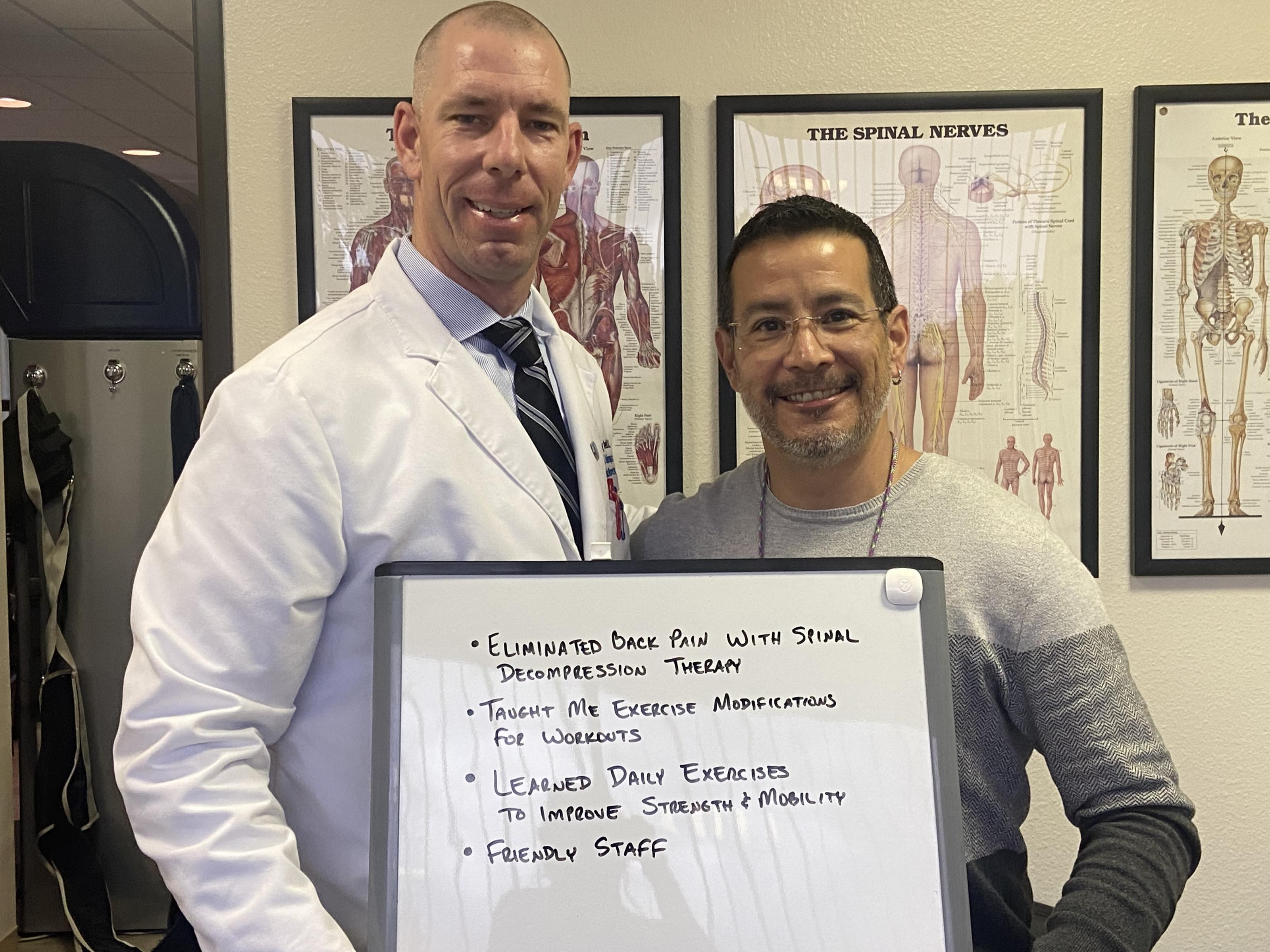
⭐⭐⭐⭐⭐ Jayson Yavorsky
“I was diagnosed with a herniated disc at L5-S1, which left me with severe sciatic pain down my right leg. I could barely stand up straight or walk without intense pain.
Before finding Dr. Boelk, I tried several other treatments, including chiropractic care, physical therapy, and epidural injections. Nothing gave me lasting relief.
After starting spinal decompression treatment with Dr. Boelk, I began noticing improvement. Over time, my pain continued to decrease and my mobility improved significantly.
Today, I'm back to living my life without the constant sciatic pain that had been controlling everything I did.
Dr. Boelk and his staff were professional, knowledgeable, and genuinely cared about helping me recover. I'm extremely grateful for the treatment I received and would highly recommend Dr. Boelk to anyone dealing with a herniated disc or sciatica.”
— Jayson Yavorsky
What Are the Symptoms of L4 Sciatica?
There isn't one exact symptom pattern that every person with L4 nerve irritation will experience. However, there are certain complaints that tend to make Dr. Boelk look more closely at the L4 nerve root:
-
Pain through the front or inner portion of the thigh
-
Pain around the knee
-
Burning, tingling or numbness along the inside of the lower leg
-
Changes in sensation toward the inside of the ankle
-
Weakness through the quadriceps
-
Difficulty straightening the knee with normal strength
-
Trouble climbing stairs or rising from a seated position
-
A feeling that the knee or leg isn't as stable as it used to be
-
A change in the patellar, or knee-jerk, reflex
The pattern isn't always textbook. L3 and L4 symptoms can overlap, and pain doesn't necessarily follow a perfectly defined path down the leg. That's why Dr. Boelk doesn't diagnose the source of someone's symptoms by looking at a dermatome chart alone.
If you're experiencing these symptoms, one of the most helpful things you can do is simply pay attention to what your leg is doing during normal activities. Does one leg feel different when you climb stairs? Is there an area of numbness you can clearly point to? Does sitting aggravate the symptoms? Does walking make them better or worse?
Those details can provide useful clues when combined with an examination and imaging.
Could Knee Pain Actually Be Coming From Your Lower Back?
This is one of the more confusing aspects of L4 nerve irritation.
If your knee hurts, it makes perfect sense to assume the knee itself is the problem. Sometimes it is. Arthritis, meniscus injuries, ligament problems and other knee conditions can cause pain in the same general area.
But knee pain becomes more suspicious for a possible spinal component when other symptoms are present.
For example, someone may have pain around the knee but also notice tingling or numbness extending down the inside of the lower leg. Another person may have discomfort through the front of the thigh and notice that one leg doesn't feel as strong on stairs. Someone else may have had the knee examined or treated but continues to have symptoms that don't seem to fit a straightforward knee problem.
In situations like these, evaluating the lumbar spine may help explain what has been missed.
Weakness is particularly important. The L4 nerve contributes to the muscles that help straighten the knee. If that nerve isn't functioning normally, the quadriceps may feel weaker. A patient might first notice it while getting out of a low chair, stepping down from a curb or climbing stairs.
That doesn't automatically mean you have an L4 nerve problem, but it's worth mentioning during an evaluation rather than focusing only on the pain.
What if Your MRI Shows More Than One Bad Disc?
This happens all the time.
A lumbar MRI may show a disc bulge at one level, a herniation somewhere else, degenerative changes at several levels and some degree of narrowing around one or more nerves. Patients understandably read the report and wonder which finding is actually responsible for what they're feeling.
Sometimes the answer is fairly clear. Other times it isn't.
Dr. Cassidy James Boelk, DC prefers to review the actual MRI images whenever they're available. The written report is useful, but looking at the images allows him to see where a disc abnormality or narrowing is located and compare that with the patient's symptoms.
For example, seeing L4-L5 disc herniation written on your report doesn't automatically tell you which nerve is being affected. The position of the disc problem and the area where the nerve is being compressed or irritated matter.
This is also why an abnormal MRI doesn't automatically mean that every abnormality needs to be treated. Some findings may have been present long before the current pain started. Others may correspond much more closely with the symptoms you're experiencing now.
The MRI should help answer the clinical question. It shouldn't replace the clinical evaluation.
A Few Things You Can Pay Attention to Right Now
While you're trying to figure out what's causing the problem, resist the temptation to constantly test the painful leg or try every sciatica exercise you find online.
Instead, pay attention to your normal day.
If sitting for a long time makes the leg progressively worse, try breaking up longer periods of sitting when you can. If short walks feel comfortable, staying gently mobile may be preferable to spending the entire day resting. For sleep, some people are more comfortable on their side with a pillow between their knees, while others prefer lying on their back with support under the knees.
Be cautious with aggressive stretching as well.
Patients with irritated nerves often describe the leg as feeling “tight,” so the natural reaction is to stretch harder. But nerve irritation and muscle tightness aren't the same thing. If a stretch causes burning, electrical pain, tingling or increasing numbness farther down the leg, forcing that stretch harder may not be a good idea.
You can also pay attention to whether coughing, sneezing, bending, prolonged driving, standing or walking changes the symptoms. You don't need to intentionally aggravate yourself to gather this information. Just notice what happens during your regular activities.
Could Non-Surgical Spinal Decompression Be an Option?
When L4 nerve irritation is associated with an appropriate disc or degenerative spinal condition, Non-Surgical Spinal Decompression may be considered.
Dr. Boelk's office uses the DRX9000 exclusively and has four lumbar and three cervical systems. The treatment isn't approached as a generic “sciatica setting.” The location of the disc problem, treatment angle, positioning, starting force, body size, symptoms, tolerance and response all need to be considered when developing a treatment protocol.
Equally important is deciding who shouldn't be treated.
An unhealed fracture, significant osteoporosis, unstable spondylolisthesis, abdominal aortic aneurysm, pregnancy for lumbar decompression, certain malignancies and other conditions may make decompression inappropriate. Previous spinal surgery also needs to be carefully evaluated, particularly when fusion or metal hardware is present at the level that would need treatment.
There are patients Dr. Boelk evaluates and ultimately does not accept for decompression care. In some cases another form of conservative treatment makes more sense. In others, additional imaging or another specialist is appropriate. There are also circumstances where surgery may be the right recommendation.
Being evaluated doesn't obligate you to become a patient.
What Happens During the No-Charge Consultation?
If you're dealing with symptoms that could be coming from the L4 nerve and aren't sure what to do next, you can start with a No-Charge, No-Obligation Consultation with Dr. Cassidy James Boelk, DC.
The consultation may include:
-
Discussing when and how your symptoms began
-
Identifying exactly where the pain travels
-
Discussing numbness, tingling, burning or weakness
-
Reviewing what makes your symptoms better or worse
-
Discussing treatments you've already tried and how you responded
-
Reviewing existing MRI images, X-rays and reports when available
-
Comparing your imaging findings with the symptoms you're experiencing
-
Discussing whether additional examination or imaging may be appropriate
-
Determining whether Non-Surgical Spinal Decompression may be an option
-
Answering your questions and discussing a reasonable next step
If you already have a lumbar MRI, bring the actual images along with the report. Looking at both is much more useful than simply knowing that someone told you that you have a bulging or herniated disc.
If you don't have an MRI, that's okay. You can still start with the consultation.
There is no obligation to begin treatment. If Dr. Boelk doesn't believe you're an appropriate candidate for decompression, he'll tell you.
Experience With Disc Injuries and Sciatica
Dr. Cassidy James Boelk, DC has spent more than two decades working with patients suffering from disc injuries, sciatica and other spinal conditions.
His professional background includes:
-
Doctor of Chiropractic (DC)
-
More than 22 years of Non-Surgical Spinal Decompression experience
-
More than 100,000 spinal decompression treatments performed
-
Certified Spinal Decompression Doctor
-
Certified Pain-Free Performance Specialist (PPSC)
-
Founder, Non-Surgical Spinal Decompression Training Academy
-
Trains other doctors in spinal decompression protocols and techniques
-
Founding Member, American Spinal Decompression Society
-
Member, International Disc Education Association
-
California X-Ray Radiation Supervisor & Operator
His interest in spinal injuries is personal as well as professional. Dr. Boelk suffered an L5 compression fracture at age 16 and later dealt with disc injuries and sciatica himself. His own experience with spinal injuries, combined with thousands of hours spent on rehabilitation, helped shape the direction of his professional career.
When You Shouldn't Wait
If your symptoms are primarily pain, numbness or tingling and they're stable, you have time to be properly evaluated and determine what is causing them.
Increasing weakness is different.
If one leg is becoming progressively weaker, your knee is repeatedly giving way or you're noticing a meaningful loss of strength, don't simply keep waiting to see whether it eventually disappears.
New bowel or bladder dysfunction, difficulty urinating, numbness around the groin or saddle area, or rapidly progressing neurological weakness require prompt medical attention and should not wait for a routine decompression consultation.
Dealing With L4 Sciatica Symptoms in Chula Vista?
If you've been dealing with pain around the front of your thigh or knee, numbness or tingling along the inside of your lower leg, or unexplained weakness in one leg, the next step isn't to guess which disc or nerve is responsible. It's to determine whether the symptoms are actually coming from your lumbar spine and what, if anything, should be done about it.
If you already have an MRI, bring the images and report. Dr. Cassidy James Boelk, DC can review them with you, compare the findings with what you're experiencing and discuss whether Non-Surgical Spinal Decompression may be an appropriate option.
If you don't have imaging yet, that's okay too.
Start with a No-Charge, No-Obligation Consultation. There is no commitment to begin treatment, and not every patient who comes in for a consultation is accepted for decompression care.
The Spinal Decompression & Chiropractic Center of San Diego
5095 Murphy Canyon Road, Suite 300
San Diego, CA 92123
Call 619-298-0800
Live 24/7 Answering Service • Hablamos Español
Related Articles
L4-L5 Herniated Disc: Symptoms & Treatment Options – Chula Vista, CA
Who Is a Good Candidate for Non-Surgical Spinal Decompression? Chula Vista, CA