How to Fix Sciatica Fast – San Diego, CA
One of the most common questions people ask when dealing with severe leg pain is:
“How do I fix sciatica fast?”
And honestly, that makes sense.
Sciatica can be incredibly frustrating because it often affects:
- walking
- sitting
- sleeping
- driving
- exercising
- work
- travel
- daily movement
Some people describe:
- burning pain into the leg
- numbness in the foot
- sharp pain in the glute
- tingling down the calf
- pain sitting in the car
- difficulty standing upright
- weakness in the leg
In many cases, the pain can become severe enough that patients begin considering injections or surgery simply because they want relief as quickly as possible.
At The Spinal Decompression & Chiropractic Center of San Diego, Dr. Cassidy Boelk DC focuses on helping patients understand what may actually be causing their sciatica and whether they may be a candidate for conservative, non-surgical treatment options.
What Actually Causes Sciatica?
Sciatica is not technically a diagnosis itself.
Instead, it is a term used to describe irritation or compression involving the sciatic nerve.
In many cases, sciatica symptoms are related to:
- bulging discs
- disc herniations
- disc degeneration
- inflammation around nerve roots
- spinal compression
- movement dysfunction
- muscular imbalance
This is important because the cause of the sciatica often determines what type of treatment may help.
For example, some people worsen their symptoms by aggressively stretching forward or repeatedly bending into painful positions.
Others may temporarily feel relief but continue aggravating the irritated disc or nerve throughout the day without realizing it.
Why Does Sciatica Often Keep Returning?
One major reason is that many people only treat the inflammation temporarily while the underlying mechanical irritation continues.
For example:
- prolonged sitting
- repetitive bending
- poor lifting mechanics
- weak core muscles
- hip immobility
- poor posture
- repetitive twisting
can continue irritating the injured area.
This is why many patients experience:
- temporary relief
- recurring flare-ups
- worsening episodes over time
- pain that keeps returning every few months
The goal is not simply masking pain temporarily.
The goal is reducing the repeated stress causing the irritation in the first place.
What Can You Try at Home for Sciatica?
In some cases, mild sciatica symptoms may gradually improve with proper activity modification and movement awareness.
Some helpful strategies may include:
- limiting prolonged sitting
- avoiding repetitive bending forward
- taking short walks throughout the day
- avoiding aggressive twisting or heavy lifting during flare-ups
- improving posture while sitting and driving
- carefully improving hip mobility
- gradually improving glute and core stability
Some patients also feel relief with gentle extension-based positioning exercises, especially if prolonged flexion and sitting worsen symptoms.
However, one important point:
exercises that help one person may aggravate another.
This is why proper evaluation matters.
A good sign is when symptoms:
- centralize
- gradually improve week-to-week
- become less intense
- move out of the leg
- allow better tolerance to sitting and walking
However, if symptoms:
- worsen
- continue traveling down the leg
- plateau for weeks
- cause weakness
- create numbness
- interfere with sleep or work
then it may be important to seek professional evaluation.
Can Sciatica Heal Without Surgery?
In many cases, yes.
Many patients improve without surgery when the underlying cause is appropriately addressed.
However, not all cases are the same.
Some patients improve relatively quickly.
Others require more involved treatment and rehabilitation depending on:
- severity of disc injury
- duration of symptoms
- nerve involvement
- movement dysfunction
- daily activity demands
- overall conditioning
This is one reason why individualized treatment plans matter so much.
How Does Non-Surgical Spinal Decompression Work?
Non-Surgical Spinal Decompression (NSSD) is designed to help reduce pressure on injured spinal discs and irritated nerve roots.
At our San Diego office, Dr. Boelk exclusively uses FDA-cleared DRX9000 spinal decompression systems.
Unlike generalized traction, proper spinal decompression is highly customized based on:
- disc level involved
- symptom presentation
- body positioning
- angle of pull
- decompression force
- patient tolerance
- nerve irritation patterns
The goal is helping reduce pressure on sensitive spinal structures while improving the environment around injured discs.
Over the past 20 years, Dr. Cassidy Boelk DC has performed over 100,000 spinal decompression sessions and has worked extensively with patients dealing with:
- severe sciatica
- disc injuries
- chronic low back pain
- recurring nerve pain
He is also:
- A Certified Spinal Decompression Doctor
- Certified Pain-Free Performance Specialist
- Founder of the Spinal Decompression Training Academy
- A doctor who trains other healthcare providers on decompression protocols and clinical decision-making
Why Active Rehabilitation Is Important
One major mistake is relying only on passive treatments.
While passive therapies may help reduce irritation, long-term improvement often requires improving:
- movement quality
- posture
- hip mobility
- spinal stability
- glute function
- core control
This is why active rehabilitation is frequently combined alongside decompression treatment.
The goal is helping patients move better while reducing repeated aggravation of the injured area.
Real Patient Experience
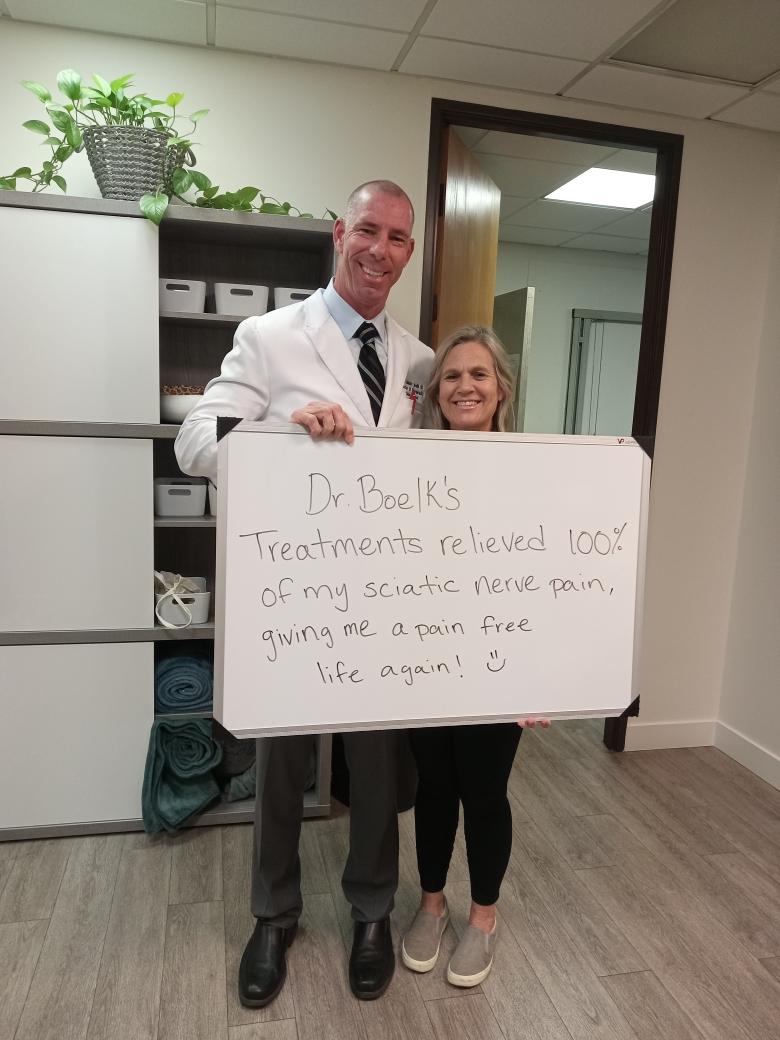
“After dealing with severe sciatica for months, I could barely sit or drive without pain going down my leg. I had tried other treatments without much improvement. Dr. Boelk took the time to explain what was actually happening with my disc and nerve. The decompression combined with the rehab exercises helped me get back to functioning normally again.”
— Calder Pearce
Calder’s experience highlights how identifying the underlying mechanical cause of sciatica — rather than simply masking symptoms — can often lead to more lasting improvement.
When Should You Seek Professional Help?
If you are experiencing:
- worsening sciatica
- severe leg pain
- numbness
- tingling
- weakness
- pain with sitting
- recurring flare-ups
- failed injections or therapy
- chronic low back pain
it may be important to have the condition properly evaluated.
Not all sciatica is the same.
Not every patient requires surgery.
And not all spinal decompression treatments are the same.
Proper diagnosis, clinical decision-making, and individualized treatment planning matter tremendously.
Looking for Sciatica Treatment in San Diego?
Dr. Cassidy Boelk DC has spent nearly 20 years focusing on disc injuries, sciatica, and Non-Surgical Spinal Decompression.
Many patients travel from throughout:
- San Diego
- Arizona
- Nevada
- Utah
- Oregon
- Alaska
- Mexico
- the United Kingdom
- Spain
to seek his customized non-surgical treatment approach.
To Learn More or Schedule a No-Charge Consultation:
The Spinal Decompression & Chiropractic Center of San Diego
- 5095 Murphy Canyon Road, Suite 300
San Diego, CA 92123 - Office: (619) 298-0800
- Call or Text: (619) 884-8298
- Website: www.SanDiegoBackCare.com
Credentials & Experience
- Certified Spinal Decompression Doctor
- Certified Pain-Free Performance Specialist
- Founder of the Spinal Decompression Training Academy
- Over 100,000 spinal decompression sessions performed
- DRX9000 exclusive office
- Patients seen from across the U.S. and internationally
- Hablamos español
All patients are evaluated on a case-by-case basis. Not every patient is a candidate for Non-Surgical Spinal Decompression treatment.