How Long Does It Take for a Herniated Disc to Heal Without Surgery? – San Diego, CA
Many people with a herniated disc begin experiencing improvement within 6 to 12 weeks without surgery. However, recovery varies significantly, especially when a disc herniation is irritating or compressing a spinal nerve.
Some people recover within several weeks. Others continue experiencing lower back pain, sciatica, numbness, or tingling for months.
If you've been diagnosed with an L4-L5 or L5-S1 disc herniation, you may be wondering whether the disc can heal naturally, how long you should wait, and what treatment options are available before considering surgery.
At The Spinal Decompression & Chiropractic Center of San Diego, Dr. Cassidy James Boelk, DC, has more than 22 years of experience evaluating and treating patients with herniated discs, bulging discs, degenerative disc disease, and sciatica.
His approach focuses on identifying the source of the symptoms, reviewing spinal imaging, and determining whether non-surgical treatment may be appropriate.
A San Diego Patient Shares His Experience With a Herniated Disc
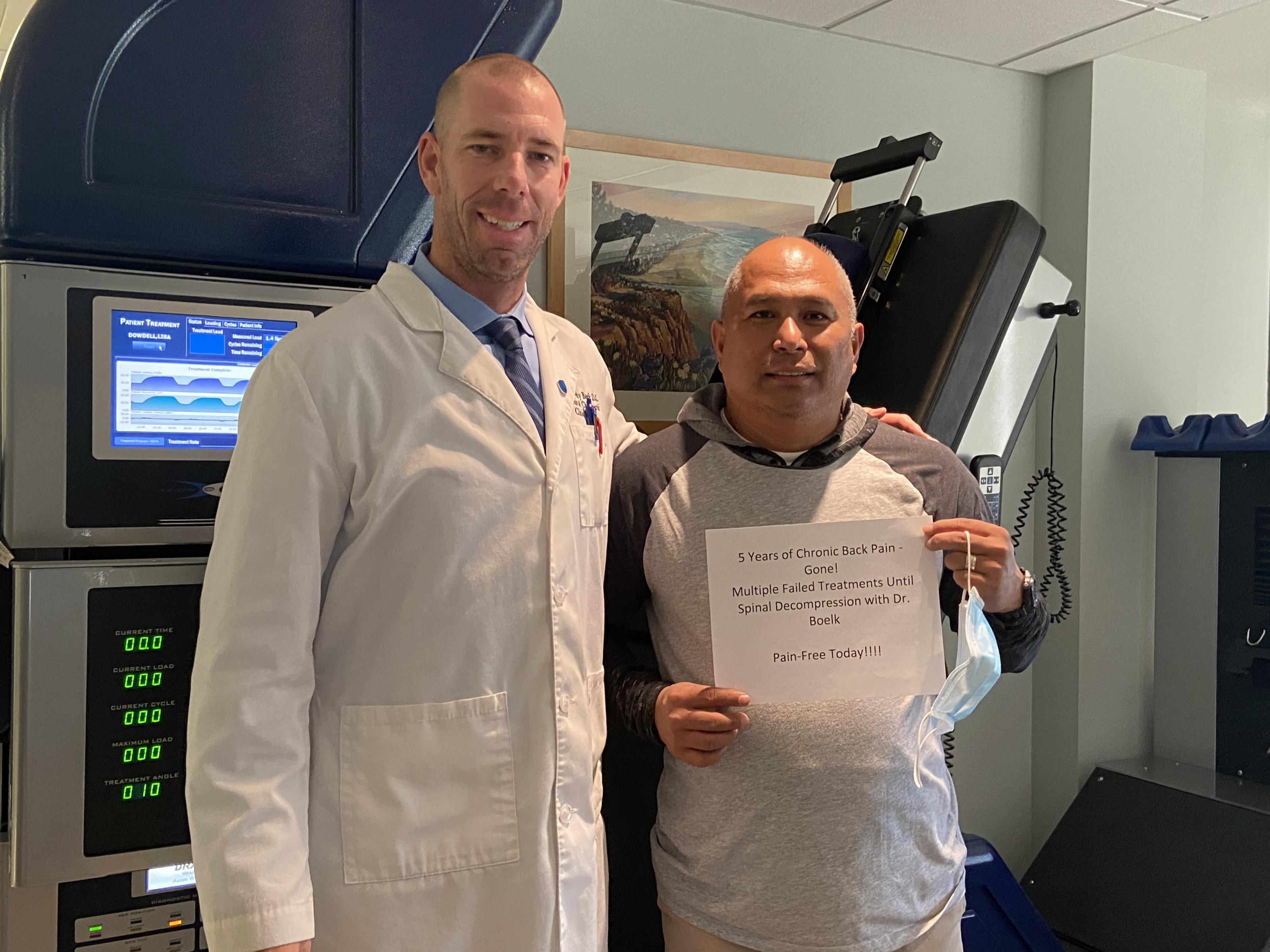
Patient Experience – Paul C.
"I have been seeing Dr. Boelk since November for my back pain due to disc herniation. I lost mobility and had difficulty even putting shoes on. The pain was interfering with my everyday lifestyle. After reviewing the X-ray results, we agreed upon a treatment plan. Agreeing to this treatment plan was the best choice I've made for my back pain. The spinal decompression has relieved all the pain I felt in my lower back. I can walk, run and exercise without any pain and I'm able to get back in the gym and continue my daily routines. The office staff are very friendly and caring as well. I highly recommend Dr. Boelk's office to anyone seeking exceptional care."
— Paul C.
Looking for Help With a Herniated Disc in San Diego?
The office offers a limited number of No-Charge Consultations each week for people interested in learning more about non-surgical spinal decompression.
During the consultation, patients can discuss their symptoms, previous treatments, and available imaging. If a comprehensive examination or additional imaging is necessary, the office will explain the next steps.
Call 619-298-0800 to schedule a No-Charge Consultation.
24/7 answering service. Hablamos Español.
How Long Does a Herniated Disc Usually Take to Heal?
There is no single recovery timeline that applies to everyone.
Some patients experience noticeable improvement within the first few weeks. Others need several months before their symptoms significantly decrease.
A general recovery timeline may look like this:
First 2 Weeks
During the early stages, inflammation and nerve irritation may be significant.
Patients may experience sharp lower back pain, muscle spasms, difficulty bending, or pain traveling into the buttock or leg.
Some people have trouble sitting, standing, or sleeping comfortably.
Weeks 2–6
Many patients begin noticing gradual improvement.
Pain may become less intense, walking may become easier, and symptoms traveling into the leg may begin to decrease.
However, recovery is not always consistent. Some patients experience temporary flare-ups as they resume normal activities.
Weeks 6–12
A substantial number of patients with acute lumbar disc herniations experience meaningful improvement during the first three months.
For some, the leg pain improves before the lower back pain. Others notice improvements in mobility and daily function before their pain completely resolves.
Three Months and Beyond
Some patients continue improving gradually over several months.
Others experience persistent symptoms because of ongoing nerve irritation, mechanical sensitivity, or additional spinal conditions.
The important distinction is that symptom improvement and structural disc healing are not necessarily the same thing.
A patient may feel significantly better even when an MRI continues to show a disc herniation.
Can a Herniated Disc Actually Heal on Its Own?
Yes. Some herniated discs can naturally decrease in size through a process called spontaneous resorption.
When disc material extends outside its normal boundaries, the body's immune system may gradually help break down and absorb portions of the displaced material.
Certain disc herniations, particularly extrusions and sequestrations, appear more likely to decrease in size naturally than broad-based disc bulges.
However, this process doesn't occur in every patient, and there is no guarantee that a herniation will completely disappear.
Another important point is that the size of a disc herniation does not always determine how much pain a patient experiences.
Some people have relatively large herniations with surprisingly few symptoms. Others have smaller herniations that significantly irritate nearby spinal nerves.
This is why Dr. Boelk evaluates the patient rather than relying solely on MRI findings.
Why Do Some Herniated Discs Take Longer to Improve?
Several factors can influence recovery.
1. The Location of the Herniated Disc
The L4-L5 and L5-S1 levels are among the most common locations for lumbar disc herniations.
A herniation at these levels may irritate a spinal nerve and contribute to sciatica, numbness, tingling, or weakness.
In the neck, cervical disc herniations at C5-C6 or C6-C7 may contribute to symptoms traveling into the shoulder, arm, or hand.
The relationship between the disc and surrounding nerves is often more important than the disc's appearance alone.
2. The Degree of Nerve Irritation
Patients experiencing primarily localized lower back pain may have a different recovery pattern than those with significant nerve-related symptoms.
Burning pain, numbness, tingling, and weakness can indicate nerve involvement.
Persistent or progressive neurological symptoms require careful evaluation.
3. Additional Spinal Conditions
Some patients have more than one contributing problem.
Degenerative disc disease, facet joint changes, foraminal narrowing, and spinal instability may complicate recovery.
For this reason, Dr. Boelk considers the patient's symptoms, physical examination findings, and imaging together.
4. Daily Activities and Mechanical Stress
Prolonged sitting, repetitive bending, heavy lifting, and certain exercises may aggravate symptoms in some patients.
That doesn't mean patients should avoid all movement.
Appropriate activity, strengthening, and rehabilitation are often important parts of recovery.
The goal is to identify which movements are helpful, which activities are aggravating, and how to gradually restore normal function.
What if My Herniated Disc Hasn't Improved After 6 to 12 Weeks?
If symptoms are not improving, the next step is to reassess the condition rather than simply continuing the same treatment indefinitely.
Dr. Boelk reviews the patient's history, symptoms, examination findings, and available imaging to better understand what may be preventing recovery.
For some patients, additional imaging or consultation with another healthcare professional may be appropriate.
For others, a carefully selected conservative treatment program may still be reasonable.
The important question isn't simply how long the patient has had a herniated disc.
It's whether the condition is improving, remaining unchanged, or progressively worsening.
A Patient's Experience With an Extruded Disc
Patient Experience – Amanda, San Diego, CA
"Last year, I spent three months constantly going back and forth between doctor’s appointments and urgent care. The pain was unbearable—I was taking medication regularly just to get through the day. Getting out of bed was excruciating, and walking or standing felt like torture. Every step filled me with dread.
In December, my doctor finally ordered an MRI. That’s when I learned I had an extruded disc pressing on my L5 nerve, which affects the leg and foot. My doctor scheduled two follow-up appointments: one for pain management (spinal injections), and another to evaluate me for surgery.
Then I discovered spinal decompression therapy. I was thrilled to find a non-invasive alternative. I never ended up needing either of those appointments.
Now, I’m walking regularly, standing up straight—something I couldn’t do before. When I first sought help, I was so hunched over that I had to use a cane just to move forward. Because of the pain, I hadn’t exercised in months. But now, I’m doing a program called 75 hard which requires not one but 2 45-minute workouts per day, and I've even gotten back to lifting weights!
I’m so thankful I found this place. It’s conveniently located near my work, which makes it easy to fit sessions into my lunch break. Dr. Boelk and the staff are incredibly friendly and polite—it’s always a pleasure to come in.
The environment is so relaxing that I look forward to each visit. I truly thank God for leading me to this alternative. It’s made such a difference in my life."
— Amanda, San Diego, CA
Can Non-Surgical Spinal Decompression Help a Herniated Disc?
Non-surgical spinal decompression is one conservative treatment option that may be considered for selected patients with disc-related neck or lower back pain.
At The Spinal Decompression & Chiropractic Center of San Diego, Dr. Boelk uses the DRX9000 spinal decompression system.
This technology applies controlled spinal traction using treatment settings selected according to the patient's condition and response.
The goal is to reduce mechanical loading and potentially improve symptoms.
However, spinal decompression is not appropriate for everyone. Research on traction-based treatment has produced mixed results, and it has not been established that decompression reliably retracts herniated discs or permanently restores disc height.
Dr. Boelk emphasizes three important considerations.
Proper Patient Selection: Not every disc herniation is responsible for a patient's symptoms, and certain spinal conditions make decompression inappropriate.
Individualized Treatment: Treatment parameters should be based on the patient's condition, spinal stability, symptoms, and response.
Rehabilitation and Long-Term Management: Strengthening, movement, and appropriate activity modification can play important roles in recovery.
Patients can learn more about non-surgical spinal decompression at SanDiegoBackCare.com.
Not Everyone Is a Candidate for Spinal Decompression
One of the most important parts of Dr. Boelk's approach is determining whether a patient is an appropriate candidate before recommending treatment.
Some patients have spinal conditions that require a different approach, including certain fractures, unstable spinal conditions, surgical hardware at the intended treatment level, or neurological findings that require additional medical evaluation.
In these situations, Dr. Boelk may recommend further testing, a surgical consultation, or another treatment option.
A Patient Who Was Not a Candidate Shares His Experience
Patient Experience – Jeff J., Tucson, AZ
"I found this terrific practice on social media. I followed up and did my own research so I decided to pay them a visit. The place is clean, well organized and run by a very efficient receptionist. I met with the doctor and after a honest and forthright conversation, we both determined that surgery was my only option to correct my back issues. I will return as a customer when the time is right."
— Jeff J., Tucson, AZ
Dr. Boelk believes that an honest evaluation is just as important as the treatment itself.
The goal is not to recommend decompression to everyone. It is to help each patient understand which options are appropriate for their particular condition.
When Should You Be Concerned About a Herniated Disc?
Although many disc herniations improve without surgery, certain symptoms require prompt medical evaluation.
These include:
-
New or progressively worsening arm or leg weakness.
-
Significant difficulty walking or loss of coordination.
-
Persistent or worsening neurological symptoms.
-
Severe pain that is not responding to appropriate care.
New loss of bladder or bowel control, numbness in the saddle region, or rapidly progressive neurological weakness requires emergency medical attention.
The goal should never be to avoid surgery at all costs. The goal is to identify the safest and most appropriate treatment for each patient's condition.
Patients Travel to San Diego for Spinal Decompression Treatment
Although the office is located in San Diego, Dr. Boelk has evaluated and treated patients who have traveled from other parts of California, across the United States, and internationally.
Some patients travel because they are looking for a doctor with extensive experience using the DRX9000 system. Others have already tried multiple conservative treatments and want another opinion before making decisions about surgery.
The office can help prospective out-of-town patients understand the evaluation process and discuss potential scheduling arrangements.
An Out-of-Town Patient Shares Her Experience
Patient Experience – Lynn C., Alaska
"My name is Lynn. I am from Alaska, and I just want to say it was totally worth taking a trip to go to the Spinal Decompression & Chiropractic Center of San Diego. I was having pain radiating down my legs, I couldn’t sleep, I could barely walk.
After treatment I am back to shoveling snow, teaching school, taking walks. So, I just want to thank Dr. Boelk and the clinic, you guys are wonderful, and you have created such a wonderful, friendly, kind and truly caring atmosphere. I highly encourage anybody that might be considering spinal decompression therapy, it really makes a difference."
— Lynn C., Alaska
Patients traveling from outside the San Diego area are encouraged to contact the office before making travel arrangements. Not everyone will qualify for treatment, and an appropriate evaluation is necessary before any treatment plan can be recommended.
Why Patients Choose Dr. Cassidy James Boelk, DC
Dr. Boelk has spent more than two decades working with patients experiencing disc-related spinal conditions.
His professional background includes:
-
Doctor of Chiropractic.
-
Certified Spinal Decompression Doctor.
-
Certified Pain-Free Performance Specialist (PPSC).
-
Founder of the Non-Surgical Spinal Decompression Training Academy.
-
Founding Member of the American Spinal Decompression Society.
-
Member of the International Disc Education Association.
-
California X-ray Radiology Licensed Doctor.
-
More than 22 years of experience with non-surgical spinal decompression.
-
Experience overseeing more than 100,000 spinal decompression treatment sessions.
Dr. Boelk also understands spinal injuries from personal experience. After breaking his back when he was younger and later experiencing disc-related injuries and sciatica, he developed a strong interest in helping patients explore appropriate non-surgical treatment options.
His San Diego office has seven DRX9000 spinal decompression units and regularly evaluates patients who have already tried physical therapy, medication, injections, or other conservative treatments.
Can You Recover From a Herniated Disc Without Surgery?
For many patients, the answer is yes.
A herniated disc does not automatically mean surgery is necessary. Some herniations naturally decrease in size, while others become less symptomatic even when the disc remains abnormal on MRI.
However, recovery depends on the individual's condition, neurological findings, and response to treatment.
Patients who have been dealing with symptoms for several months should not assume they simply need to wait longer.
A comprehensive evaluation can help determine whether continued conservative care is reasonable or whether another treatment approach is needed.
Another Patient Shares His Herniated Disc Experience
Patient Experience – Brian Perrotta, San Diego, CA
"I highly recommend Dr. Cassidy Boelk, DC and the team at The Spinal Decompression and Chiropractic Center. I came in with severe sciatica and a herniated disc, and his treatments have made a world of difference. He and his staff are both professional and genuinely caring, creating a welcoming and supportive environment. The treatments were not only highly effective but also tailored to my specific needs. I’m grateful for the care I received and the significant improvement in my quality of life."
— Brian Perrotta, San Diego, CA
Schedule a No-Charge Consultation in San Diego
If you're experiencing persistent lower back pain, neck pain, sciatica, or symptoms associated with a herniated disc, Dr. Cassidy James Boelk, DC, and his team can help you better understand the available options.
The Spinal Decompression & Chiropractic Center of San Diego offers a limited number of No-Charge Consultations each week.
Not everyone is a candidate for non-surgical spinal decompression. The office evaluates each patient's condition before making treatment recommendations.
The Spinal Decompression & Chiropractic Center of San Diego
5095 Murphy Canyon Road, Suite 300
San Diego, CA 92123
Phone: 619-298-0800
Website: www.SanDiegoBackCare.com
24/7 Answering Service
Hablamos Español
Patients traveling from outside San Diego, other states, or internationally may contact the office to discuss scheduling and coordination before making travel arrangements.
A herniated disc does not automatically mean surgery. Understanding the condition and receiving an appropriate evaluation are important first steps toward recovery.