How Long Does It Take for a Herniated Disc to Heal Without Surgery? – La Jolla, CA
A herniated disc can often improve without surgery. Many people notice significant relief within 6 to 12 weeks, while others continue dealing with lower back pain, sciatica, or nerve symptoms for several months.
The recovery timeline depends on several factors, including the location of the herniation, whether a spinal nerve is involved, and how the patient responds to conservative treatment.
For someone living in La Jolla who enjoys walking, swimming, surfing, golfing, or simply staying active, even a few weeks of persistent back or leg pain can be frustrating.
At The Spinal Decompression & Chiropractic Center of San Diego, Dr. Cassidy James Boelk, DC, has spent more than 22 years helping patients with disc-related spinal conditions explore appropriate non-surgical treatment options.
His office, located a short drive from La Jolla in the Murphy Canyon area of San Diego, specializes in evaluating patients with herniated discs, bulging discs, degenerative disc disease, and sciatica.
A Patient's Experience With a Herniated Disc
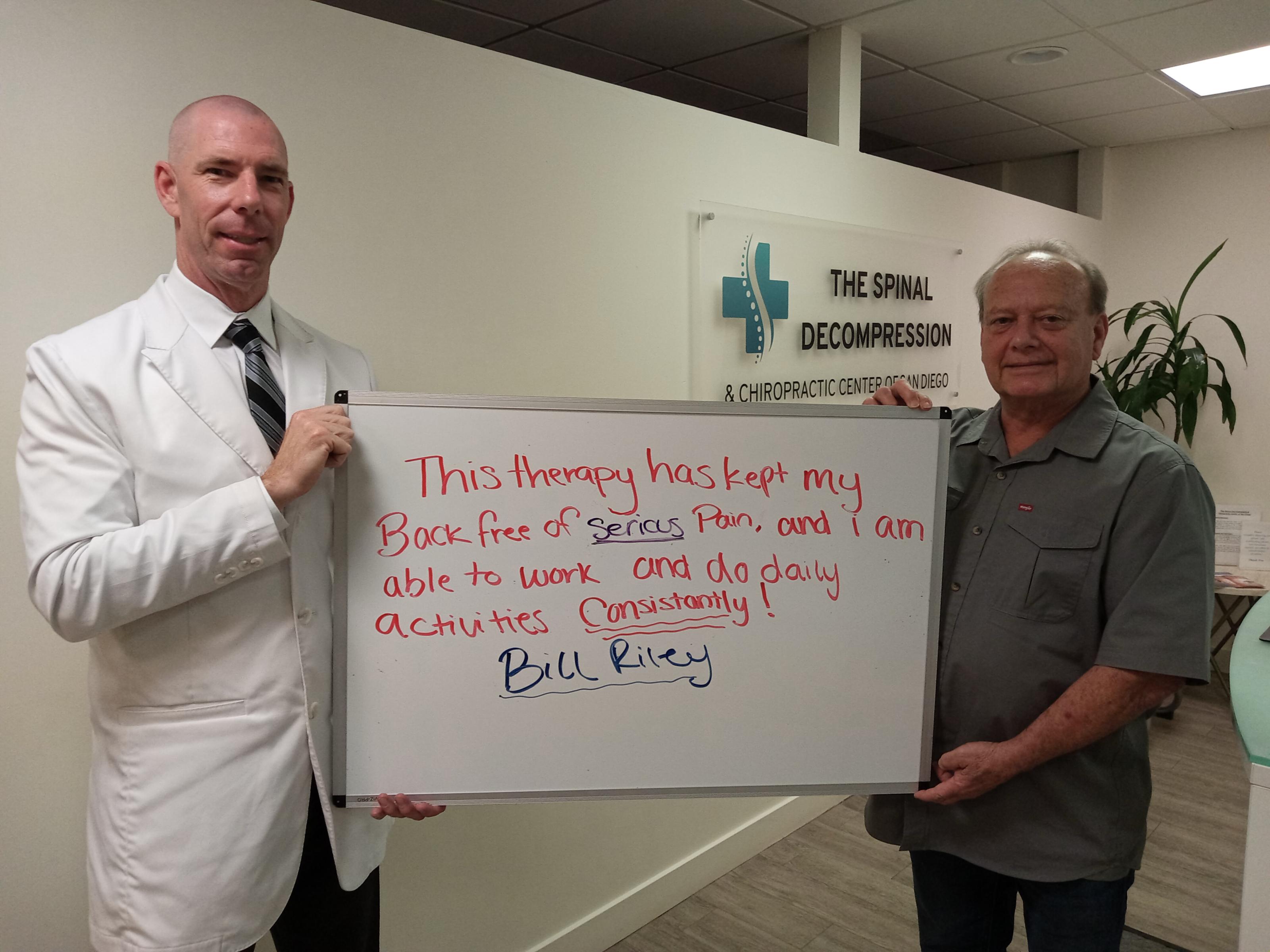
Patient Testimonial – Paul C.
"I have been seeing Dr. Boelk since November for my back pain due to disc herniation. I lost mobility and had difficulty even putting shoes on. The pain was interfering with my everyday lifestyle. After reviewing the X-ray results, we agreed upon a treatment plan. Agreeing to this treatment plan was the best choice I've made for my back pain. The spinal decompression has relieved all the pain I felt in my lower back. I can walk, run and exercise without any pain and I'm able to get back in the gym and continue my daily routines. The office staff are very friendly and caring as well. I highly recommend Dr. Boelk's office to anyone seeking exceptional care."
— Paul C.
No-Charge Consultations for La Jolla Residents
If you've been diagnosed with a herniated disc and aren't sure what to do next, Dr. Boelk's office offers a limited number of No-Charge Consultations each week.
This is an opportunity to discuss your symptoms, previous treatment, and whether non-surgical spinal decompression may be worth considering.
Not everyone is a candidate. A comprehensive examination and imaging review may be needed before determining whether treatment is appropriate.
Call 619-298-0800 to schedule a consultation.
The office has a 24/7 answering service. Hablamos Español.
How Long Does a Herniated Disc Take to Heal Naturally?
Most people want a specific answer. Two weeks? Six weeks? Three months?
Unfortunately, herniated discs don't follow an exact schedule.
Some patients feel noticeably better within a few weeks. Others experience symptoms that come and go for months.
During the first several weeks, inflammation and nerve irritation may contribute to significant pain. Sitting, bending, getting out of bed, or driving can be particularly uncomfortable.
Between weeks four and six, many patients begin noticing that certain activities are easier. They may be able to walk longer, sleep more comfortably, or sit without the same intensity of pain.
By 6 to 12 weeks, a substantial number of people with acute lumbar disc herniations have experienced meaningful improvement.
However, patients with persistent nerve irritation may take considerably longer to recover.
One important point is that feeling better doesn't necessarily mean the disc has returned to its original shape.
Can a Herniated Disc Actually Shrink Without Surgery?
Yes. In some cases, the body can gradually break down and absorb herniated disc material.
This natural process is called spontaneous resorption.
Interestingly, certain larger herniations, particularly disc extrusions and sequestrations, may be more likely to shrink naturally than smaller, contained disc bulges.
The body recognizes some of the displaced disc material and initiates an inflammatory response that can help remove it over time.
This process can take months and doesn't happen in every case.
It's also possible for a patient to feel much better even though the herniation is still visible on MRI.
Dr. Boelk frequently emphasizes that imaging findings need to be considered alongside the patient's symptoms and examination. A disc abnormality on MRI doesn't automatically mean it's responsible for the pain.
Why Do Some Herniated Discs Take Months to Improve?
There are several reasons recovery may be slower than expected.
Nerve Compression or Irritation
A herniated disc that irritates a spinal nerve can cause symptoms well beyond the lower back.
Patients may experience burning pain, tingling, numbness, or weakness extending into the buttock, thigh, calf, or foot.
Even when the initial inflammation decreases, nerve-related symptoms may take additional time to settle.
The Location of the Herniation
L4-L5 and L5-S1 are two common levels for lumbar disc herniations.
An L4-L5 herniation may affect the L5 nerve root, while an L5-S1 herniation may affect the S1 nerve root.
These conditions can produce different patterns of pain, numbness, or muscle weakness.
Other Spinal Problems
Some patients have degenerative disc disease, facet joint changes, foraminal narrowing, or spinal instability in addition to a herniated disc.
When multiple conditions are present, treatment decisions can become more complicated.
Repeatedly Aggravating the Area
Certain activities may repeatedly aggravate symptoms, especially prolonged sitting, repetitive bending, or lifting in positions the patient doesn't currently tolerate well.
This doesn't mean patients should stop exercising or avoid movement altogether. The goal is to modify aggravating activities while gradually rebuilding strength and movement tolerance.
What if My Herniated Disc Hasn't Improved After Three Months?
If you've been dealing with symptoms for several months, it may be time for another evaluation.
That doesn't automatically mean surgery is necessary.
It does mean that someone should take a closer look at why the symptoms are continuing.
Dr. Boelk considers the patient's medical history, neurological findings, physical examination, and available MRI or X-ray imaging.
He also looks at which treatments have already been attempted and whether those treatments produced any meaningful improvement.
For some patients, continued rehabilitation is appropriate. Others may benefit from a different conservative approach, further diagnostic testing, or consultation with a spine specialist.
A Patient Who Returned to an Active Lifestyle
Patient Testimonial – Yuri Fresia
“When I first came here I was suffering from sciatica pain for several months non stop. I tried many different non invasive treatments, pain killers but relief was just temporary. I heard about Dr. Boelk on social media and after reading other people testimonials about him I decided to try. It felt better since my first session. After 12 I felt I was improving a lot but still had room to get better so we decided trying 12 more. After 36 sessions I felt I was back to normal. I could get back to surf, jiu jitsu and work after 6 months away. Doctor helped me through the whole process, leaving me free to decide the next step and being honest about expectations. I totally recommend for all my friends that suffer from sciatica pain. It’s worth 100%.”
— Yuri Fresia
Can Non-Surgical Spinal Decompression Help?
For certain patients with disc-related pain, non-surgical spinal decompression may be considered as part of a conservative treatment plan.
Dr. Boelk uses the DRX9000 spinal decompression system at his San Diego office. The equipment applies controlled traction to the spine, with settings adjusted according to the patient's condition and tolerance.
The intention is to reduce mechanical loading and potentially improve symptoms.
However, research on traction-based spinal decompression has produced mixed results. It has not been established that the treatment reliably pulls a herniated disc back into place or permanently restores lost disc height.
Dr. Boelk believes the evaluation is just as important as the equipment.
Before recommending treatment, he considers whether the disc is likely responsible for the symptoms, whether the spine is stable, and whether there are any reasons decompression should be avoided.
Rehabilitation, strengthening, and appropriate activity modification may also be incorporated into the patient's overall care.
Not Every Patient Is a Candidate for Spinal Decompression
This is an important distinction.
Some patients come to the office hoping to avoid surgery, but their examination or imaging reveals a condition that makes spinal decompression inappropriate.
Certain spinal fractures, unstable spondylolisthesis, surgical hardware at the intended treatment level, and serious neurological findings may rule out treatment or require further medical evaluation.
Dr. Boelk does not believe every patient should receive spinal decompression simply because they have a disc problem.
A Patient Who Was Not a Candidate
Patient Testimonial – Jan H., San Marcos, CA
“I decided to see Dr. Boelk after a pretty gnarly motocoss neck injury. At the Hospital I was at, I felt I was getting pressured into a surgery which I refused. A friend of a friend referred him after Dr. Boelk successfully treated his broken back.
Dr. Boelk is a compassionate individual who truly cares about his patients. He looked at my MRI images, explained what he saw and potential routes for recovery. He could not treat me as I have to wait until the fracture in my neck heals, but the level of professionalism, compassion, caring and knowledge displayed by him was exceptional.
He also recommended to seek an additional opinion form another neurosurgeon. My experience was that he really cares and he's not someone who would take advantage of the situation someone's in (unlike some other doctors). I will definitely be back and already recommended him to others as well! Thank you Dr. Boelk!”
— Jan H., San Marcos, CA
Sometimes the most important outcome of an evaluation is identifying that a different treatment or specialist is needed.
When Does a Herniated Disc Require Surgery?
Most herniated discs do not require surgery, but there are situations where surgical evaluation becomes important.
Progressive muscle weakness, significant neurological deficits, or persistent disabling symptoms despite appropriate conservative treatment may warrant consultation with a spine surgeon.
New loss of bladder or bowel control, numbness in the saddle region, or rapidly progressing neurological weakness requires emergency medical attention.
Dr. Boelk's goal is not to keep every patient out of surgery regardless of their condition. It is to help determine when conservative treatment is reasonable and when another approach is necessary.
Why Patients From La Jolla Choose Dr. Cassidy James Boelk, DC
Dr. Boelk has devoted more than two decades of his professional career to non-surgical spinal decompression and disc-related spinal conditions.
His credentials and professional experience include:
-
Doctor of Chiropractic (DC)
-
Certified Spinal Decompression Doctor
-
Certified Pain-Free Performance Specialist (PPSC)
-
Founder, Non-Surgical Spinal Decompression Training Academy
-
Founding Member, American Spinal Decompression Society
-
Member, International Disc Education Association
-
California X-ray Radiology Licensed Doctor
-
More than 22 years of non-surgical spinal decompression experience
-
More than 100,000 spinal decompression treatment sessions overseen
-
Experience training other doctors in spinal decompression
-
Clinical experience evaluating cervical and lumbar disc conditions
Dr. Boelk's interest in spinal injuries is also personal. He broke his back when he was younger and later experienced disc injuries and sciatica himself.
Today, his clinic operates seven DRX9000 spinal decompression units and evaluates patients who have often tried multiple treatments before seeking another opinion.
Patients Travel to San Diego From Across the Country and Overseas
While the office regularly sees patients from La Jolla, Del Mar, Pacific Beach, University City, and other nearby communities, some patients travel considerably farther.
Patients have visited from other parts of California, neighboring states, and internationally.
For those traveling long distances, the office can discuss scheduling arrangements and the evaluation process before a trip is planned.
A Patient Who Travels From the United Kingdom
Patient Testimonial – Lisa S., United Kingdom
“I travel from the UK to see Dr Boelk and his wonderful team . I have 3 bulging disc and one is touching the nerve. I have the spinal decompression treatment and it really helps keep me in my active life . I will not go to anyone else for back treatment, this place is number one and they genuinely care about their patients.”
— Lisa S., United Kingdom
Patients traveling from outside the area should contact the office in advance. Treatment eligibility cannot be guaranteed without an appropriate evaluation.
Can You Still Recover if You've Had a Herniated Disc for Six Months or Longer?
Yes. Some patients continue improving well beyond the first three months.
However, persistent symptoms should not automatically be blamed on a disc that hasn't healed.
The original herniation may still be irritating a nerve, but there could also be another contributing condition.
If you've been dealing with the same pain for six months or longer, a fresh evaluation may help clarify why recovery has stalled.
The important question isn't just how long the disc has been herniated. It's what is causing the symptoms now and whether the current treatment approach is helping.
Another Patient Shares His Experience
Patient Testimonial – Brian Perrotta, San Diego, CA
“I highly recommend Dr. Cassidy Boelk, DC and the team at The Spinal Decompression and Chiropractic Center. I came in with severe sciatica and a herniated disc, and his treatments have made a world of difference. He and his staff are both professional and genuinely caring, creating a welcoming and supportive environment. The treatments were not only highly effective but also tailored to my specific needs. I’m grateful for the care I received and the significant improvement in my quality of life.”
— Brian Perrotta, San Diego, CA
Schedule a No-Charge Consultation Near La Jolla
If you've been diagnosed with a herniated disc and are still experiencing lower back pain, sciatica, neck pain, numbness, or tingling, Dr. Cassidy James Boelk, DC, and his team can help you explore the available options.
The Spinal Decompression & Chiropractic Center of San Diego offers a limited number of No-Charge Consultations each week.
Not everyone is a candidate for spinal decompression, and treatment recommendations are made following an appropriate evaluation.
The Spinal Decompression & Chiropractic Center of San Diego
5095 Murphy Canyon Road, Suite 300
San Diego, CA 92123
Phone: 619-298-0800
Website: www.SanDiegoBackCare.com
24/7 Answering Service
Hablamos Español
Serving La Jolla, University City, Del Mar, Pacific Beach, and the greater San Diego area.
A herniated disc doesn't automatically mean surgery. For many patients, recovery is possible with time and appropriate conservative care. The first step is understanding what's causing the symptoms and determining which treatment options make sense.