How Long Does It Take for a Herniated Disc to Heal Without Surgery? – El Cajon, CA
Many herniated discs begin improving within 6 to 12 weeks without surgery, although some patients recover much faster while others experience symptoms for several months or longer. The recovery timeline depends on the location and severity of the herniation, the degree of nerve irritation, the patient's overall spinal health, and the treatment approach.
For people in El Cajon, California, dealing with a herniated disc, sciatica, or persistent lower back pain, one of the biggest concerns is whether the condition will eventually improve—or whether surgery is inevitable.
Fortunately, most lumbar disc herniations do not require surgery.
At The Spinal Decompression & Chiropractic Center of San Diego, Dr. Cassidy James Boelk, DC, has spent more than two decades helping patients explore conservative treatment options for disc-related spinal conditions.
As a Certified Spinal Decompression Doctor and Certified Pain-Free Performance Specialist, Dr. Boelk specializes in evaluating patients with herniated discs, degenerative disc disease, sciatica, and other conditions affecting the spinal discs and nerves.
Limited No-Charge Spinal Decompression Consultations Available
-
Speak with an experienced spinal decompression doctor about your symptoms.
-
Discuss your previous MRI findings, treatment history, and current limitations.
-
Learn whether non-surgical spinal decompression may be appropriate for your condition.
-
Understand the next steps before committing to a treatment program.
Call 619-298-0800 or visit www.SanDiegoBackCare.com.
A Patient's Experience Avoiding Back Surgery
For many patients, the frustration isn't simply the pain. It's the inability to walk comfortably, bend over, exercise, sleep, or enjoy everyday activities.
Calder Pearce shared his experience after struggling with lower back problems for more than five years.
Patient Testimonial – Calder Pearce, San Diego, CA
“Dr. Boelk and his team are the best in the business! I have had lower back problems for over 5 years and been to 6 other doctors seeking options other than surgery. I came in early January not able to bend and walking with a limp. By February I was able to bend again with minimal pain and by March I am now able to bend without any pain and am able to walk normally.
I am EXTREMELY happy I did not have surgery and found Dr. Boelk. Trust him and the process and he will get you feeling better. He also said from the beginning that if at any stage in the process he felt like progress wasn't happening he would let me know which was not the case with other specialist I have seen in the past so I appreciate that.”
Every patient's condition is different, but experiences like this illustrate why many individuals want to explore conservative treatment before considering surgery.
Can a Herniated Disc Heal Naturally?
Yes. The body can sometimes reduce the size of a herniated disc through a natural process called spontaneous resorption.
A spinal disc contains a softer inner material surrounded by a tougher outer layer. When the outer layer becomes damaged, some of the inner material may protrude or escape into the spinal canal.
Depending on its location, this material can irritate nearby nerves and cause symptoms such as:
-
Lower back pain
-
Sciatica extending into the buttock, thigh, calf, or foot
-
Numbness or tingling in the leg
-
Burning or shooting nerve pain
-
Difficulty sitting or standing for extended periods
-
Weakness involving certain leg or foot muscles
Over time, the body's immune system may help break down and absorb some of the displaced disc material.
Interestingly, larger extruded or sequestered disc herniations may be more likely to shrink naturally than smaller, contained disc bulges.
However, improvement in symptoms does not necessarily mean the disc has completely returned to its original structure.
Many patients experience significant relief even when follow-up imaging continues to show a herniation.
How Long Does It Take for a Herniated Disc to Stop Hurting?
The recovery process varies, but several general stages are common.
First 2 to 4 Weeks
During the early stages, inflammation and nerve irritation may begin decreasing.
Some patients notice that their leg pain becomes less intense or that they can walk and move more comfortably.
Others continue experiencing significant discomfort, particularly with prolonged sitting, bending, or lifting.
Weeks 4 to 8
Many patients begin noticing more consistent improvement during this period.
Walking may become easier, pain episodes may become less frequent, and everyday activities may become more manageable.
However, improvement is not always linear. Patients may experience occasional flare-ups, especially when returning too quickly to activities that aggravate their symptoms.
Weeks 8 to 12
By this stage, many patients with uncomplicated lumbar disc herniations have experienced meaningful symptom improvement.
Those who continue experiencing significant pain, numbness, or limitations may benefit from additional evaluation.
Three to Six Months
Some patients require several months to experience substantial improvement, particularly when nerve irritation has been present for an extended period.
Numbness and tingling may persist after pain begins improving.
Six Months or Longer
Disc material can continue changing structurally for many months.
However, patients experiencing ongoing disabling symptoms should not simply assume they need to wait indefinitely.
A comprehensive evaluation can help determine whether additional conservative treatment, specialist care, or surgical consultation is appropriate.
Why Do Some Herniated Discs Take Longer to Heal?
Several factors influence recovery.
1. Location of the disc herniation
L4-L5 and L5-S1 are two of the most common levels involved in lumbar disc herniations. Depending on the location of the herniation, these injuries may irritate nerves that travel into the buttocks, legs, and feet.
2. Degree of nerve compression
A disc herniation that significantly compresses a spinal nerve may produce more persistent symptoms than one causing relatively mild irritation.
3. Duration of the problem
Patients who have experienced symptoms for months or years may have additional factors contributing to their pain, including reduced strength, altered movement patterns, or other spinal conditions.
4. Daily activities
Repeated forward bending, prolonged sitting, heavy lifting, and certain twisting movements may aggravate symptoms in some patients.
5. Additional spinal conditions
Degenerative disc disease, spinal stenosis, facet joint changes, and spinal instability may complicate the clinical picture.
6. Rehabilitation and treatment
Appropriate activity modification, progressive exercise, and individualized conservative care can help patients regain strength and function.
Can Non-Surgical Spinal Decompression Help a Herniated Disc?
For certain patients, non-surgical spinal decompression may be considered as part of a conservative treatment program.
The DRX9000 spinal decompression system applies controlled mechanical traction to the spine. The objective is to reduce mechanical loading on certain spinal structures and potentially relieve symptoms associated with disc-related conditions.
At The Spinal Decompression & Chiropractic Center of San Diego, Dr. Boelk utilizes seven DRX9000 spinal decompression units, including four lumbar and three cervical systems.
His clinical approach combines careful patient selection, spinal decompression when appropriate, activity modification, and individualized rehabilitation.
Research on mechanical traction and non-surgical spinal decompression has produced mixed results. Some studies suggest short-term improvement in pain or disability for selected patients, but there is insufficient evidence to conclude that spinal decompression reliably heals herniated discs or prevents surgery.
For that reason, Dr. Boelk emphasizes determining whether a patient is an appropriate candidate before recommending treatment.
Patient Experience: Sciatica and Lower Back Pain
Sciatica can be particularly frustrating because the symptoms often extend beyond the lower back.
Pain may travel into the buttock, down the leg, and sometimes all the way into the foot.
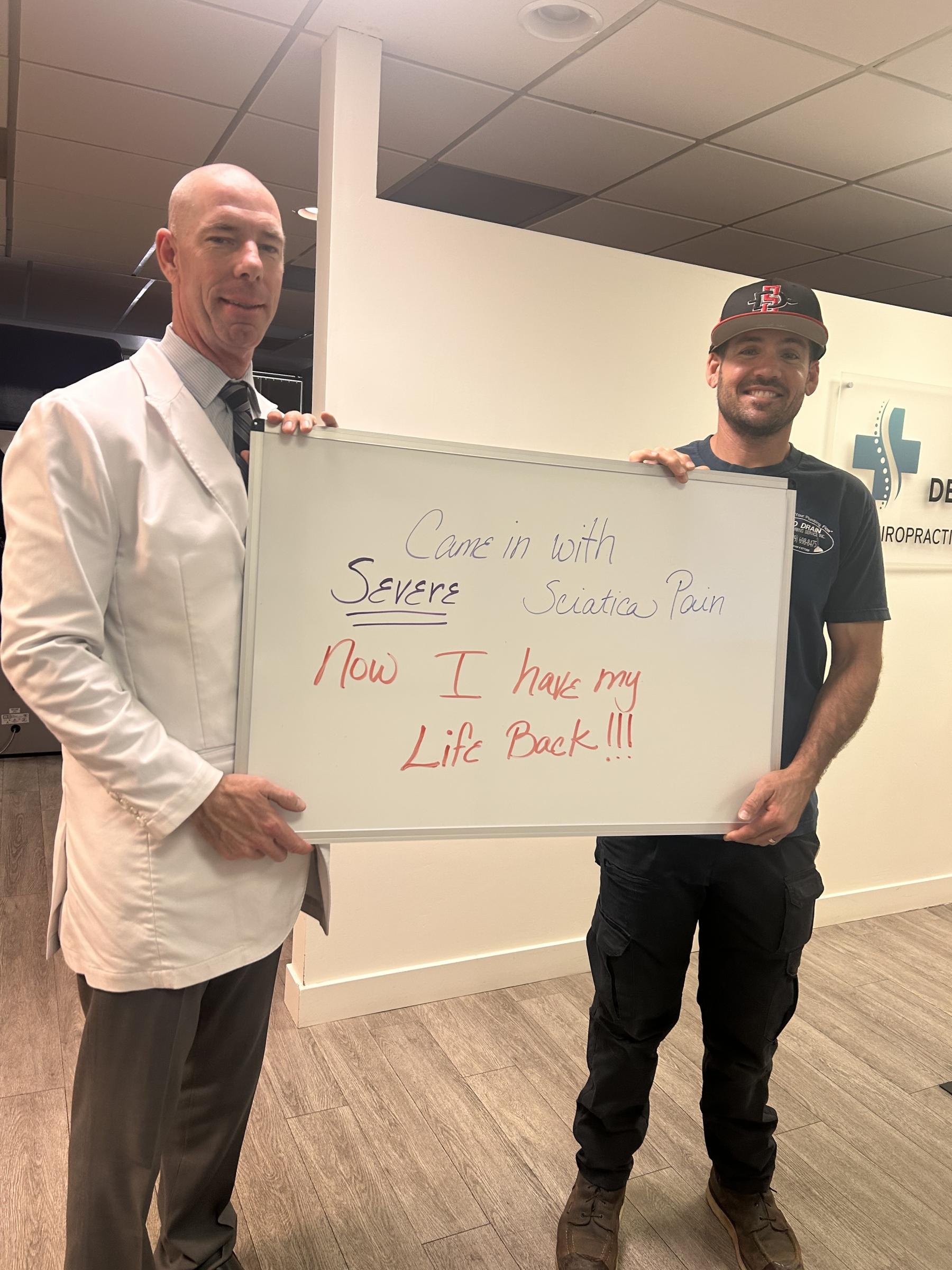
One patient, Abel T., shared his experience after developing severe back pain and radiating sciatic symptoms following an accident.
Patient Testimonial – Abel T., San Diego, CA
“I had really bad back problems to the point I couldn’t sleep, also had pain radiating along the sciatic nerve which ran down one leg from the lower back—caused by an accident.
I came in and talked to Dr. Cassidy about my back problems. He evaluated me and mentioned I was a good candidate for this treatment. After the first 2 decompression sessions my sciatic pain was gone and we were able to work on the root of the problem. I did a total of 24 sessions, after which I was able to start rehabilitation training to strengthen my core.
The office is super nice and the staff’s customer service is above and beyond.
Back and neck issues are horrible to live with—trust me, I know firsthand. I gained weight, took pain killers, went into depression, and had major anxiety. I’m over it now—feeling better, walking, sleeping well, and starting to have a better social life as well.
The experience for me has been nothing but excellent. Dr. Cassidy Boelk is hands down amazing—super glad I came here.”
What Exercises Can Help a Herniated Disc Recover?
Movement and exercise are important parts of recovery, but not every exercise is appropriate for every disc injury.
Depending on the patient's symptoms and examination findings, rehabilitation may include:
-
Gentle walking within a comfortable tolerance
-
Appropriate lumbar stabilization exercises
-
Modified bird dogs
-
Glute bridges when tolerated
-
Side planks or modified side planks
-
Hip strengthening exercises
-
Gentle mobility exercises that do not reproduce or worsen radiating symptoms
-
Gradual strengthening and return-to-activity programs
Some patients feel better with certain extension-based movements, while others experience increased pain with extension.
Similarly, forward bending may aggravate some disc herniations but may be tolerated or helpful in other conditions.
Exercise selection should be based on the individual patient's symptoms rather than assuming one movement is appropriate for everyone.
Why Patients From El Cajon Seek Out Dr. Cassidy James Boelk, DC
Dr. Boelk's interest in spinal injuries began long before he opened his practice.
As a teenager, he fractured his lower back and later experienced additional disc injuries and sciatica.
Those experiences helped shape his professional interest in spinal rehabilitation and conservative treatment options.
For more than two decades, he has worked with patients experiencing chronic back pain, neck pain, herniated discs, and nerve-related symptoms.
His professional qualifications and experience include:
-
Board-Certified Doctor of Chiropractic
-
Certified Spinal Decompression Doctor
-
Certified Pain-Free Performance Specialist
-
Founder of the Spinal Decompression Training Academy
-
Founding Member of the American Spinal Decompression Society
-
Member of the International Disc Education Association
-
California X-ray Radiology Licensed Doctor
-
More than 22 years of clinical experience
-
Experience overseeing more than 100,000 spinal decompression treatment sessions
-
Advanced experience with DRX9000 lumbar and cervical spinal decompression systems
-
Instructor for healthcare professionals learning non-surgical spinal decompression protocols and techniques
-
Extensive experience in spinal rehabilitation, mobility, and stabilization programs
Dr. Boelk has also spent thousands of hours working through his own spinal injuries while helping patients manage similar conditions.
His practice is located in Kearny Mesa, serving patients throughout San Diego County, including El Cajon, La Mesa, Santee, Lakeside, Spring Valley, and surrounding communities.
Not Everyone Is a Candidate for Non-Surgical Spinal Decompression
One of the most important parts of successful patient care is recognizing when a treatment is not appropriate.
Certain conditions, including spinal instability, acute fractures, significant neurological deficits, some postoperative conditions involving spinal hardware, and other medical issues, may make decompression inappropriate.
Dr. Boelk evaluates patients individually and may recommend additional imaging or referral to another specialist when necessary.
Patient Testimonial – Jeff J., Tucson, AZ
“I found this terrific practice on social media. I followed up and did my own research so I decided to pay them a visit. The place is clean, well organized and run by a very efficient receptionist. I met with the doctor and after a honest and forthright conversation, we both determined that surgery was my only option to correct my back issues. I will return as a customer when the time is right.”
For patients considering spinal decompression, an honest evaluation is an essential first step.
When Does a Herniated Disc Require Surgery?
Although many disc herniations improve without surgery, some patients require surgical evaluation.
Situations that may warrant surgical consideration include:
-
Progressive muscle weakness
-
Persistent, disabling leg pain despite appropriate conservative treatment
-
Significant nerve compression associated with ongoing neurological problems
-
Severe functional limitations that do not improve
-
Certain spinal conditions that are unlikely to respond adequately to conservative care
New bowel or bladder dysfunction, saddle anesthesia, or rapidly progressive neurological weakness requires emergency medical evaluation.
For patients without urgent surgical indications, conservative treatment is often considered before surgery.
Do You Need an MRI Before Starting Treatment?
An MRI is not necessary for every patient with lower back pain or a suspected herniated disc.
However, MRI imaging may be recommended when neurological findings, persistent symptoms, or the patient's medical history suggest a need for additional diagnostic information.
Dr. Boelk reviews available MRI studies and may recommend additional imaging when clinically indicated.
Standing spinal X-rays, including flexion and extension views when appropriate, can also help assess spinal alignment and possible instability.
The goal is to understand the patient's condition before making treatment recommendations.
Patients Travel From Outside San Diego for Spinal Decompression
Although many patients visit the center from El Cajon and other East County communities, Dr. Boelk also evaluates individuals who travel from other states and countries.
Patients have sought his expertise from locations including Mexico, Canada, Spain, and the United Kingdom.
For out-of-town patients, the office can discuss the consultation process, available imaging, and scheduling considerations before travel.
Treatment recommendations are made only after determining whether the patient is an appropriate candidate.
How Can You Tell Whether Your Herniated Disc Is Improving?
Several changes may suggest that recovery is progressing.
-
Leg pain becomes less intense or less frequent.
-
Pain no longer travels as far down the leg.
-
Walking and standing tolerance improves.
-
Sitting becomes more comfortable.
-
Sleep is less frequently interrupted by pain.
-
Daily activities become easier.
-
Strength and mobility gradually improve.
Improvement does not always happen at the same pace for every symptom.
For example, radiating pain may decrease while some numbness remains.
However, new or worsening weakness should be evaluated promptly.
Schedule a No-Charge Spinal Decompression Consultation Near El Cajon, CA
Living with a herniated disc can affect almost every part of daily life.
For some patients, the biggest challenge is sitting through a workday. For others, it's walking, exercising, sleeping comfortably, or participating in activities they previously enjoyed.
If you have been dealing with persistent lower back pain, sciatica, or symptoms associated with a herniated disc, it may be worth learning whether additional conservative treatment options are available.
Dr. Cassidy James Boelk, DC, offers limited no-charge spinal decompression consultations at The Spinal Decompression & Chiropractic Center of San Diego.
During the consultation, prospective patients can:
-
Discuss their current symptoms and limitations.
-
Review their treatment history and available imaging.
-
Learn about non-surgical spinal decompression.
-
Ask questions about the DRX9000 treatment system.
-
Understand whether a comprehensive examination or further evaluation may be appropriate.
-
Discuss potential next steps without committing to treatment.
The consultation is provided at no charge and carries no obligation to begin care. Any additional examination, imaging, or treatment is discussed separately.
The Spinal Decompression & Chiropractic Center of San Diego
Dr. Cassidy James Boelk, DC
Certified Spinal Decompression Doctor
Certified Pain-Free Performance Specialist
Office Address:
5095 Murphy Canyon Road, Suite 300
San Diego, CA 92123
Phone: 619-298-0800
Website: www.SanDiegoBackCare.com
Email: frontdesk@sandiegobackcare.com
24/7 telephone answering service available. Hablamos Español.
Serving El Cajon, La Mesa, Santee, Lakeside, Spring Valley, Rancho San Diego, and communities throughout San Diego County.
If you're wondering how long your herniated disc will take to improve—and whether surgery can be avoided—contact the office to learn more about your options.