How Long Does It Take for a Herniated Disc to Heal Without Surgery? – Chula Vista, CA
Many herniated discs begin improving within 6 to 12 weeks without surgery. However, recovery depends on several factors, including the severity of the disc injury, whether a spinal nerve is compressed, how long symptoms have been present, and the treatment approach.
Some patients experience significant relief within a few weeks. Others continue struggling with lower back pain, sciatica, numbness, tingling, or weakness for several months.
The encouraging news is that a herniated disc does not automatically mean surgery is necessary. Many patients improve with conservative treatment, and some herniated discs naturally shrink over time.
For people living in Chula Vista, California, who are looking for alternatives to back surgery, Dr. Cassidy James Boelk, DC, at The Spinal Decompression & Chiropractic Center of San Diego specializes in evaluating patients with herniated discs, sciatica, degenerative disc disease, and other disc-related spinal conditions.
Limited no-charge spinal decompression consultations are available.
Call 619-298-0800 or visit www.SanDiegoBackCare.com to learn more.
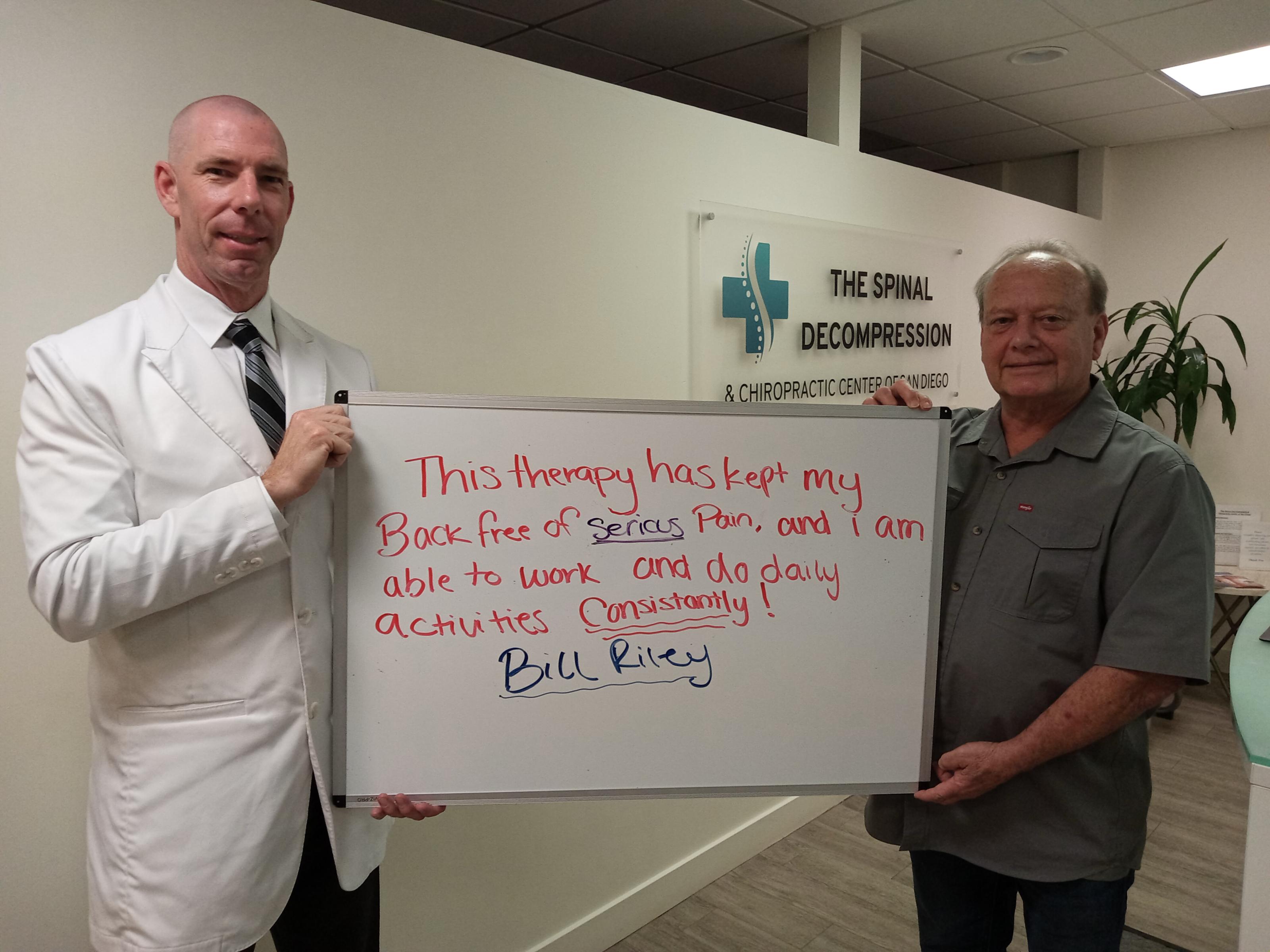
Patient Experience: Finding Relief Without Back Surgery
One of the most common concerns patients have is whether their back pain will ever improve without surgery.
Calder Pearce shared his experience after years of lower back problems and consultations with multiple doctors.
Patient Testimonial – Calder Pearce, San Diego, CA
“Dr. Boelk and his team are the best in the business! I have had lower back problems for over 5 years and been to 6 other doctors seeking options other than surgery. I came in early January not able to bend and walking with a limp. By February I was able to bend again with minimal pain and by March I am now able to bend without any pain and am able to walk normally.
I am EXTREMELY happy I did not have surgery and found Dr. Boelk. Trust him and the process and he will get you feeling better. He also said from the beginning that if at any stage in the process he felt like progress wasn't happening he would let me know which was not the case with other specialist I have seen in the past so I appreciate that.”
Can a Herniated Disc Actually Heal on Its Own?
Yes. In many cases, the body has a natural ability to respond to a herniated disc.
A spinal disc consists of a tougher outer layer called the annulus fibrosus and a softer, gel-like center called the nucleus pulposus. When the outer portion of the disc becomes damaged, some of the inner material may push outward or escape through the damaged area.
This can irritate or compress nearby spinal nerves.
Over time, the body's inflammatory and immune processes may help break down and absorb some of the displaced disc material. This process is known as spontaneous disc resorption.
Interestingly, larger extruded or sequestered disc herniations sometimes have a greater likelihood of naturally shrinking than smaller, contained disc bulges.
However, there is an important distinction between a disc healing structurally and a patient feeling better.
A patient may experience substantial pain relief even when an MRI continues to show a disc herniation. Conversely, some patients continue experiencing symptoms despite improvements in the appearance of their disc.
The goal of treatment should focus on improving symptoms, restoring function, and helping patients return to their normal activities—not simply changing what appears on an MRI.
How Long Does Recovery Usually Take?
Although every patient is different, the following timeline provides a general idea of what recovery may look like.
First 2 to 6 Weeks
During the early stages, inflammation and nerve irritation may begin settling down.
Some patients notice improvements in their lower back pain, leg pain, or ability to walk and sit comfortably.
However, activities such as prolonged sitting, repeated bending, heavy lifting, or twisting may continue aggravating symptoms.
6 to 12 Weeks
Many patients experience meaningful improvement during this period.
Pain may become less frequent, walking tolerance may improve, and activities that previously caused discomfort may become easier.
For patients who are not improving as expected, this is an important time to reconsider the diagnosis and whether additional evaluation or treatment is appropriate.
3 to 6 Months
Some patients require several months for their symptoms to improve significantly, particularly when a spinal nerve has been irritated for an extended period.
Numbness, tingling, and certain sensory symptoms may take longer to improve than pain.
Persistent or progressive muscle weakness requires medical reassessment rather than simply waiting for the disc to heal.
6 Months and Beyond
Some disc herniations continue changing structurally for many months.
However, ongoing significant pain or functional limitations should not automatically be considered a normal part of healing.
Patients who have not responded to appropriate conservative care may benefit from further diagnostic evaluation and discussion of additional treatment options.
Why Do Some Herniated Discs Take Longer to Heal?
Several factors can influence recovery.
-
Location of the herniation: L4-L5 and L5-S1 disc herniations commonly affect nerves traveling into the legs.
-
Severity of nerve compression: Significant nerve compression can contribute to persistent pain, numbness, or weakness.
-
Duration of symptoms: Long-standing symptoms may require a different treatment approach than a recent injury.
-
Daily activities: Repeated aggravating movements can make symptom management more difficult.
-
Overall spinal condition: Degenerative disc disease, spinal stenosis, and other structural conditions may complicate recovery.
-
Smoking and general health: Smoking and certain metabolic health conditions can negatively affect spinal health and recovery.
-
Treatment and rehabilitation: Appropriate activity modification, progressive exercise, and individualized care may improve function and help patients manage symptoms.
Importantly, the size of a herniated disc on MRI does not always correspond directly with the severity of a patient's symptoms.
Can Non-Surgical Spinal Decompression Help a Herniated Disc?
For selected patients, non-surgical spinal decompression may be considered as part of a conservative treatment plan.
Non-surgical spinal decompression uses controlled mechanical traction to apply a carefully regulated pulling force to the spine.
The objective is to reduce mechanical loading on certain spinal structures and potentially relieve some symptoms associated with disc-related conditions.
At The Spinal Decompression & Chiropractic Center of San Diego, Dr. Boelk utilizes the DRX9000 spinal decompression system.
The clinic has seven DRX9000 decompression units, including equipment designed for both lumbar and cervical treatment.
Dr. Boelk has spent more than two decades working with patients suffering from spinal disc injuries and has extensive experience evaluating patients who are hoping to avoid surgery.
Spinal decompression is not appropriate for every patient, and research has not established that it reliably heals herniated discs or eliminates the need for surgery. Evidence for traction-based treatments is mixed, with some studies reporting short-term symptom improvement.
For this reason, the first step is determining whether a patient's condition is appropriate for this type of treatment.
What Can You Do to Help a Herniated Disc Recover?
While there is no single exercise or treatment that works for everyone, several strategies may help patients manage their symptoms and regain function.
Stay appropriately active. Complete bed rest is generally not recommended for uncomplicated disc herniations. Gentle walking and comfortable movement can help patients remain active without unnecessarily aggravating their symptoms.
Avoid repeatedly aggravating movements. Some patients experience increased symptoms with prolonged sitting, repeated forward bending, heavy lifting, or twisting. Others have different movement sensitivities. Activities should be modified according to the individual's symptoms.
Begin appropriate rehabilitation. Exercises that improve trunk stability, hip strength, mobility, and movement control can help patients gradually return to their normal activities.
Address persistent nerve symptoms. Radiating leg pain, numbness, tingling, or weakness may indicate irritation or compression of a spinal nerve. Persistent symptoms deserve a thorough evaluation.
Recognize serious neurological symptoms. New bladder or bowel dysfunction, numbness around the groin or saddle region, or rapidly progressive leg weakness can indicate a serious condition requiring emergency medical evaluation.
Patient Experience: Returning to Normal Activities
Another patient, Ming T., described how severe lower back pain had affected daily life before seeking care.
Patient Testimonial – Ming T., San Diego, CA
“I came in with extreme back pain, resulting in days were it was difficult to get out of bed. There were moments where I would be walking and then my back would lock up. I thought it was something I have dealt with in the past but this last the entire month of July. I finally dedicated myself to finding the long term solution.
I came to Dr. Boelk unsure about the process, but after he identified exactly what my ailment was, I felt confident that this was the long term solution I was looking for.
I instantly felt better and Dr. Boelk kept encouraging me to trust the process and understand it will take time to feel 100%. I am now pain free and honestly feel stronger, even a little taller. I highly recommend you visit Dr. Boelk.”
Why Patients From Chula Vista Choose Dr. Cassidy James Boelk, DC
Dr. Boelk has dedicated much of his chiropractic career to helping patients with herniated discs, sciatica, spinal stenosis, degenerative disc disease, and chronic spinal pain.
His interest in spinal rehabilitation is also personal.
After fracturing his back as a teenager, Dr. Boelk experienced significant spinal challenges of his own. He later dealt with lumbar disc herniations and sciatica, giving him firsthand experience with the physical limitations and frustration that accompany these conditions.
Today, he combines that personal experience with more than two decades of clinical practice.
His professional background includes:
-
Board-Certified Doctor of Chiropractic
-
Certified Spinal Decompression Doctor
-
Certified Pain-Free Performance Specialist
-
Founder of the Spinal Decompression Training Academy
-
Founding Member of the American Spinal Decompression Society
-
Member of the International Disc Education Association
-
California X-ray Radiology Licensed Doctor
-
More than 22 years of clinical experience
-
Experience overseeing more than 100,000 spinal decompression treatment sessions
-
Advanced experience with DRX9000 lumbar and cervical spinal decompression systems
-
Instructor and trainer for other healthcare professionals learning non-surgical spinal decompression protocols
-
Extensive experience developing individualized rehabilitation and spinal stabilization programs
The Spinal Decompression & Chiropractic Center of San Diego maintains seven DRX9000 spinal decompression units, allowing the clinic to provide treatment for appropriate cervical and lumbar spine conditions.
Not Everyone Is a Candidate for Spinal Decompression
An important part of Dr. Boelk's approach is identifying patients who may not be appropriate candidates for non-surgical spinal decompression.
Certain spinal fractures, instability, severe neurological deficits, surgical hardware, and other medical conditions may make treatment inappropriate.
When necessary, Dr. Boelk recommends additional imaging, specialist evaluation, or surgical consultation rather than proceeding with treatment.
Patient Testimonial – Toni W., Lake Elsinore, CA
“Very nice Dr. and Honest ! I would definitely recommend anyone who hasn't had metal put in there back in a surgery to go to him and give his program a shot. I believe it would definitely help. Just not in my personal case. As I have a lot of hardware in my back. But I'm glad I took the time to meet with him. It was very informative all around.”
This reflects an important principle of the clinic: patients should understand their condition and available treatment options before committing to a program of care.
Do You Need an MRI Before Starting Spinal Decompression?
Not every patient requires an MRI before beginning conservative treatment.
However, MRI imaging may be appropriate when symptoms suggest significant nerve compression, neurological deficits are present, symptoms persist despite treatment, or additional diagnostic information is necessary.
Dr. Boelk reviews each patient's history, examination findings, and available imaging to determine whether additional studies are warranted.
Standing spinal X-rays, including flexion and extension views when indicated, may also be used to assess spinal alignment and potential instability.
Patients Travel From Outside San Diego for Spinal Decompression
Although the clinic regularly treats patients from Chula Vista, Bonita, Eastlake, Otay Ranch, National City, and surrounding San Diego communities, some patients travel considerably farther.
Over the years, Dr. Boelk has evaluated patients from other parts of California, neighboring states, and international locations including Mexico, Canada, Spain, and the United Kingdom.
For individuals traveling from outside San Diego, the clinic can help coordinate an initial consultation and discuss the evaluation process before any treatment recommendations are made.
How Do You Know Whether Your Herniated Disc Needs Surgery?
Most patients with a lumbar disc herniation do not require surgery.
However, surgical evaluation may become appropriate when a patient experiences progressive neurological weakness, significant functional impairment, or persistent disabling pain despite an appropriate course of conservative treatment.
Surgery may also be necessary urgently for certain neurological emergencies.
The decision should consider the patient's symptoms, neurological examination, imaging findings, functional limitations, and personal goals.
For patients without urgent surgical indications, a carefully selected conservative treatment plan may be a reasonable first step.
Schedule a No-Charge Spinal Decompression Consultation Near Chula Vista, CA
If you have been dealing with a herniated disc for weeks, months, or even years, it may be time to explore your options.
At The Spinal Decompression & Chiropractic Center of San Diego, Dr. Cassidy James Boelk, DC, offers limited no-charge consultations to help prospective patients learn more about non-surgical spinal decompression and whether a further evaluation may be appropriate.
During the initial consultation, patients can:
-
Discuss their symptoms and how long they have been experiencing them.
-
Learn more about common causes of disc-related pain and sciatica.
-
Discuss previous treatments and available imaging.
-
Learn how the DRX9000 spinal decompression system works.
-
Determine whether a comprehensive examination or additional imaging may be appropriate.
-
Ask questions about non-surgical treatment options.
The consultation is provided at no charge and does not obligate patients to begin treatment. Any recommended examination, imaging, or treatment is discussed separately.
The Spinal Decompression & Chiropractic Center of San Diego
Dr. Cassidy James Boelk, DC
Certified Spinal Decompression Doctor
Certified Pain-Free Performance Specialist
5095 Murphy Canyon Road, Suite 300
San Diego, CA 92123
Office: 619-298-0800
Website: www.SanDiegoBackCare.com
Email: frontdesk@sandiegobackcare.com
24/7 telephone answering service available. Hablamos Español.
For patients in Chula Vista who want to understand their options before considering back surgery, a consultation with Dr. Boelk may be a helpful place to begin.