How Do You Fix a Herniated Disc Without Surgery in San Diego, CA?
You've been dealing with lower back pain for weeks, maybe even months. At first, you thought you had pulled a muscle. But now the pain is traveling into your buttock, down your leg, and possibly all the way into your calf or foot. Sitting in the car is uncomfortable, getting out of bed is difficult, and you're starting to avoid activities you used to enjoy.
Eventually, you have an MRI, and the report says something like L4-L5 disc herniation, L5-S1 disc protrusion, or herniated lumbar disc with nerve root compression.
Now you're searching Google, trying to answer one important question:
How do you fix a herniated disc without surgery?
The good news is that many people with herniated discs improve without undergoing an operation. In some cases, the body can even gradually shrink or reabsorb herniated disc material. But the most important goal isn't necessarily making your MRI look normal again. It's reducing the irritation affecting your nerves, improving your ability to move, and helping you return to the activities you enjoy.
For people searching for herniated disc treatment without surgery in San Diego, Dr. Cassidy James Boelk, DC, offers an opportunity to explore whether non-surgical treatment may be appropriate.
At The Spinal Decompression & Chiropractic Center of San Diego, located in Kearny Mesa, Dr. Boelk has spent more than 22 years helping patients with herniated discs, bulging discs, sciatica, and chronic spinal pain. As a Certified Spinal Decompression Doctor and Certified Pain-Free Performance Specialist, he has performed more than 100,000 spinal decompression treatment sessions at his practice.
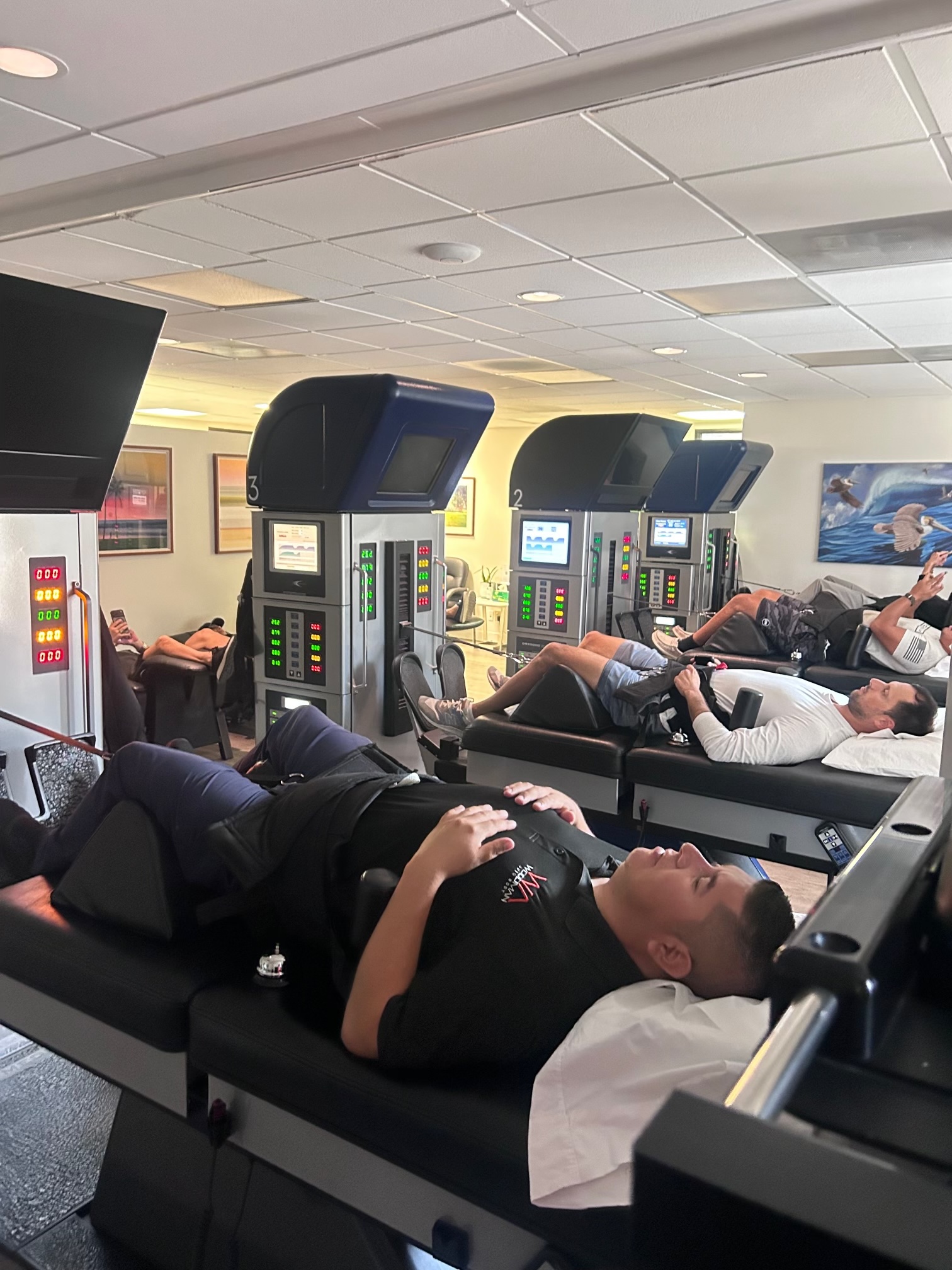
His clinic is equipped with seven DRX9000 spinal decompression tables, and he also trains other doctors in non-surgical spinal decompression techniques through the Spinal Decompression Training Academy.
If you've already tried other treatments or have been told that surgery may be necessary, call 619-298-0800 to schedule a new patient examination or request a Complimentary, No-Charge, No-Obligation Consultation.
Can a Herniated Disc Actually Heal Without Surgery?
Yes. Many herniated discs improve with time and appropriate conservative care, and some undergo measurable changes on follow-up MRI studies.
To understand how this happens, it helps to know a little about the anatomy of your spine.
Between each vertebra is an intervertebral disc. These discs act as cushions that help absorb and distribute forces as you sit, stand, bend, lift, and move throughout the day.
Each disc has two primary components: a tough outer layer called the annulus fibrosus and a softer, gel-like center called the nucleus pulposus.
A disc herniation occurs when disc material pushes through or becomes displaced beyond part of its normal boundaries. Depending on the location, that material may irritate or compress a nearby spinal nerve root.
When this happens in the lower back, symptoms can include:
-
Sharp or aching lower back pain.
-
Burning or shooting pain traveling down one leg.
-
Tingling or numbness in the calf, foot, or toes.
-
Pain that becomes worse when sitting or driving.
-
Difficulty bending forward or putting on shoes.
-
Pain with coughing, sneezing, or lifting.
-
Weakness in certain muscles of the leg or foot.
One interesting thing about herniated discs is that the body sometimes recognizes displaced disc material and gradually breaks it down through natural inflammatory and immune processes. This is called spontaneous resorption.
However, not every disc herniation shrinks, and not every patient's symptoms improve at the same rate.
Some people feel significantly better even though their MRI still shows a herniation. Others continue experiencing symptoms despite changes in the disc's appearance.
That's why Dr. Boelk emphasizes evaluating the patient's symptoms, neurological findings, physical limitations, and imaging together rather than treating the MRI report alone.
What Is the Best Way to Treat a Herniated Disc Without Surgery?
There isn't one treatment that works for everyone. A patient with a small L5-S1 herniation and mild leg pain may require a different approach from someone with a large L4-L5 extrusion, significant sciatica, and muscle weakness.
In many cases, treatment begins with conservative measures such as activity modification, appropriate exercise, rehabilitation, and symptom management.
For selected patients, additional non-surgical treatments may also be considered.
1. Identify What Keeps Aggravating Your Herniated Disc
One of the first things Dr. Boelk discusses with patients is how their symptoms respond to everyday activities.
For example, someone with an L5-S1 disc herniation may feel reasonably comfortable standing but experience burning pain down the leg after sitting for twenty minutes.
Another patient may notice that bending forward to tie their shoes causes their symptoms to travel farther into the calf or foot.
These patterns provide valuable information.
Rather than telling everyone with a herniated disc to stretch more, Dr. Boelk encourages patients to understand which movements aggravate their condition and which positions provide relief.
Simple modifications may include:
-
Taking frequent breaks from prolonged sitting.
-
Avoiding repetitive bending or heavy lifting during painful flare-ups.
-
Changing how you get into and out of bed.
-
Temporarily modifying exercises that aggravate leg pain.
-
Finding comfortable positions that help symptoms settle.
-
Gradually increasing activity instead of immediately returning to strenuous exercise.
The goal isn't to avoid movement indefinitely. It's to reduce repeated irritation while gradually rebuilding your tolerance for everyday activities.
2. Begin an Appropriate Rehabilitation Program
Rehabilitation is an important part of recovery for many patients with herniated discs.
However, the exercises need to match the patient's condition.
For example, some patients respond favorably to extension-based movements, while others experience increased symptoms with those same exercises.
A rehabilitation program may include core stabilization, glute strengthening, walking, and progressive movement training.
Dr. Boelk frequently incorporates or discusses exercises such as modified McGill curl-ups, bird dogs, side planks, and hip-strengthening movements when appropriate.
The purpose isn't to force the disc back into place. Instead, rehabilitation helps improve spinal control, strength, endurance, and the ability to tolerate everyday activities.
For someone who wants to return to golf, surfing, hockey, weight training, or simply playing with their children, rehabilitation can be an important part of the process.
3. Consider Medications or Injections When Appropriate
Some patients benefit from medications that help manage pain while the condition improves. A medical provider can determine which medications are appropriate based on the patient's symptoms, medical history, and individual risks.
Epidural steroid injections are another option sometimes considered for persistent nerve-related leg pain. They may provide temporary relief for selected patients, although the benefits vary and the injection doesn't physically remove the herniated disc.
For patients who have already tried medications, injections, or physical therapy without the improvement they hoped for, it may be worth discussing whether additional evaluation or other treatment options are appropriate.
4. Find Out Whether Non-Surgical Spinal Decompression Is Appropriate
At The Spinal Decompression & Chiropractic Center of San Diego, Dr. Boelk focuses extensively on evaluating patients for non-surgical spinal decompression.
The clinic uses the DRX9000 spinal decompression system, a computerized table designed to apply controlled distraction forces to the spine.
During treatment, the patient lies on a specialized table while the system delivers programmed pulling and relaxation cycles. Treatment settings can be adjusted according to the patient's condition, examination findings, size, and tolerance.
A typical lumbar treatment lasts approximately twenty to twenty-five minutes.
The procedure is non-invasive and doesn't involve incisions, anesthesia, or injections.
The intended goals include temporarily reducing mechanical loading on spinal structures and helping manage symptoms in patients who respond favorably to traction-based treatment.
It's important to understand that research on computerized spinal decompression remains limited and mixed, and traction is not routinely recommended in major sciatica guidelines. It cannot be guaranteed to repair a disc or prevent surgery.
This is one reason Dr. Boelk emphasizes determining whether a patient is an appropriate candidate before recommending treatment.
What If You've Already Tried Physical Therapy, Chiropractic Care, or Injections?
This is a situation Dr. Boelk encounters regularly.
Someone has been dealing with a herniated disc for six months or longer. They've tried several different approaches, perhaps experienced temporary relief, but the pain keeps returning.
Maybe their symptoms are affecting their ability to work, exercise, sleep, or spend time with their family.
One patient came to Dr. Boelk's office after experiencing months of persistent sciatica and trying multiple non-invasive treatments.
⭐⭐⭐⭐⭐
“When I first came here I was suffering from sciatica pain for several months non stop. I tried many different non invasive treatments, pain killers but relief was just temporary. I heard about Dr. Boelk on social media and after reading other people testimonials about him I decided to try. It felt better since my first session. After 12 I felt I was improving a lot but still had room to get better so we decided trying 12 more. After 36 sessions I felt I was back to normal. I could get back to surf, jiu jitsu and work after 6 months away. Doctor helped me through the whole process, leaving me free to decide the next step and being honest about expectations. I totally recommend for all my friends that suffer from sciatica pain. It’s worth 100%.”
— Yuri Fresia
For patients who have already tried several treatments, a comprehensive examination can help clarify whether their symptoms correspond to the MRI findings, whether further testing is needed, and which treatment options may be reasonable.
L4-L5 vs. L5-S1 Herniated Disc: Does the Location Matter?
Absolutely. The location of a herniated disc can influence which nerve is irritated and where the patient experiences symptoms.
Two of the most commonly affected levels are L4-L5 and L5-S1.
L4-L5 Herniated Disc Symptoms
A typical posterolateral L4-L5 disc herniation may irritate the L5 nerve root.
Patients may experience:
-
Pain traveling through the buttock and outside of the leg.
-
Tingling or numbness extending toward the top of the foot.
-
Difficulty lifting the big toe or foot upward.
-
Increased discomfort with sitting, bending, or lifting.
L5-S1 Herniated Disc Symptoms
A typical posterolateral L5-S1 disc herniation may irritate the S1 nerve root.
Patients may experience:
-
Pain traveling through the buttock and down the back of the thigh.
-
Burning or tingling in the calf or outside of the foot.
-
Difficulty pushing off with the foot.
-
Weakness during repeated heel raises.
-
Increased symptoms with certain movements or prolonged positions.
However, symptoms don't always follow textbook patterns. The exact location of the herniation, the degree of nerve irritation, and other spinal findings can influence the patient's experience.
That's why a comprehensive examination is so important.
Three Things You Can Try at Home for a Herniated Disc
Dr. Boelk regularly creates educational videos explaining how patients can modify everyday activities, recognize symptom patterns, and manage sciatica flare-ups.
Here are three practical strategies that may help.
1. Try the Log-Roll Technique When Getting Out of Bed
Many patients with irritated lumbar discs find that getting out of bed is particularly uncomfortable, especially first thing in the morning.
Instead of sitting straight up and bending forward, try rolling onto your side while keeping your shoulders and hips moving together.
Then allow your legs to move over the edge of the bed while using your arms to push yourself into a seated position.
This technique can help limit repeated twisting and bending during a movement that many people perform several times a day.
Move slowly and stop or modify the technique if it aggravates your symptoms.
2. Pay Attention to Whether Your Leg Pain Moves Up or Down
One concept Dr. Boelk frequently explains in his videos about modified McKenzie exercises is the difference between symptoms moving farther down the leg and symptoms retreating toward the lower back.
For example, suppose you begin an exercise with pain in your buttock, but afterward the pain travels into your calf or foot.
That may be a sign the movement is aggravating your nerve symptoms.
On the other hand, some patients notice that certain movements reduce the pain in their foot or calf, even if they temporarily experience more discomfort closer to the lower back.
Clinicians sometimes describe this response as centralization.
Not every patient responds favorably to extension exercises, and no single movement is appropriate for everyone. Avoid forcing movements that increase pain, numbness, or weakness.
3. Don't Return to Full Activity Just Because You Have a Good Day
This is especially important for active San Diego residents.
Maybe you've been dealing with a herniated disc for several weeks. Suddenly, you have two or three days when your symptoms are substantially better.
You decide to play eighteen holes of golf, return to the gym, go surfing, or spend several hours working in the yard.
The next morning, your sciatica is back.
Feeling better doesn't necessarily mean your back has regained the strength and tolerance needed for every activity.
Instead, gradually increase the duration and intensity of your activities while monitoring how your symptoms respond during the activity, later that evening, and the following morning.
How Long Does It Take a Herniated Disc to Heal Without Surgery?
Recovery varies considerably from person to person.
Some patients experience meaningful improvement within several weeks. Others require several months, particularly when nerve-related symptoms have been present for a long time.
Several factors can influence recovery:
-
The size and location of the herniation.
-
The degree of nerve irritation or compression.
-
Whether muscle weakness is present.
-
How long the symptoms have been occurring.
-
The patient's overall health and activity level.
-
Whether daily activities continue aggravating the condition.
It's also important to understand that pain improvement and neurological recovery aren't always the same thing.
Numbness or weakness may take longer to improve than pain, and some neurological deficits can persist.
Patients with progressive weakness should receive prompt medical evaluation rather than simply waiting for the disc to heal.
Can You Avoid Another Back Surgery After a Previous Discectomy?
Some patients experience recurring disc symptoms after undergoing lumbar disc surgery.
This can be particularly frustrating because they've already gone through surgery and rehabilitation, only to find themselves dealing with another episode of back or leg pain.
Whether additional conservative treatment is appropriate depends on the patient's previous procedure, current symptoms, neurological findings, and updated imaging.
One patient shared his experience after undergoing lumbar disc surgery and later reinjuring his back.
⭐⭐⭐⭐⭐
“I love The Spinal Decompression & Chiropractic Center of San Diego because of the incredible care they provide. I have to admit, I had my doubts at first because of the cost. After having a lumbar discectomy in 2019, I re-injured my lower back in 2022 and was convinced I was going to need surgery again. Thankfully, because of the care I received from Dr. Cassidy Boelk and his amazing staff, my pain improved significantly. I'm back at work, feeling much better, and—best of all—I was able to avoid another back surgery. After trying numerous alternative therapies along with traditional medical treatments, I can honestly say I now know this is the treatment for me. Looking back, the investment was absolutely worth it.”
— Ricky Mims
A previous spinal surgery doesn't automatically rule out every conservative treatment. However, some procedures and certain types of spinal hardware may make decompression inappropriate.
A thorough examination and review of the patient's surgical history are essential before making treatment recommendations.
When Does a Herniated Disc Require Surgery?
Although many herniated discs improve without surgery, there are situations where surgical evaluation is appropriate.
Surgery may be considered when severe leg pain remains disabling despite adequate conservative treatment, when neurological deficits are significant or progressing, or when imaging confirms nerve compression that corresponds to the patient's symptoms.
Certain warning signs require immediate medical attention:
-
New loss of bladder or bowel control.
-
New numbness in the groin or saddle region.
-
Rapidly progressing weakness in one or both legs.
-
Symptoms suggesting cauda equina syndrome.
These symptoms require emergency medical evaluation rather than a routine chiropractic appointment.
For other patients, deciding whether surgery is appropriate involves discussing the expected benefits, risks, alternatives, and likely recovery with a qualified spine specialist.
Why Dr. Boelk Doesn't Recommend Spinal Decompression to Everyone
One of the most important aspects of Dr. Boelk's approach is determining whether a patient is an appropriate candidate before recommending treatment.
Not every herniated disc requires spinal decompression, and not every patient with back pain has a disc problem.
Some patients have significant spinal instability, fractures, certain post-surgical conditions, or other findings that make a different treatment approach more appropriate.
One patient traveled from Tucson, Arizona, after researching Dr. Boelk's practice online.
⭐⭐⭐⭐⭐
“I found this terrific practice on social media. I followed up and did my own research so I decided to pay them a visit. The place is clean, well organized and run by a very efficient receptionist. I met with the doctor and after a honest and forthright conversation, we both determined that surgery was my only option to correct my back issues. I will return as a customer when the time is right.”
— Jeff J., Tucson, AZ
This experience illustrates why appropriate screening matters. Sometimes the best recommendation is conservative care. Other times, it may be additional imaging, rehabilitation, a medical referral, or a surgical consultation.
The goal is to help patients understand their condition and choose an appropriate next step.
Why Choose Dr. Cassidy James Boelk, DC, for Herniated Disc Treatment in San Diego?
With more than 22 years of clinical experience and over 100,000 spinal decompression treatment sessions performed, Dr. Cassidy James Boelk, DC, has dedicated much of his career to helping patients with herniated discs, bulging discs, sciatica, and chronic neck and back pain explore non-surgical treatment options.
His interest in spinal rehabilitation is also personal. As a teenager, Dr. Boelk sustained a significant lumbar spinal injury involving fractures and spondylolisthesis. Later in life, he experienced disc herniations and sciatica himself.
Those experiences helped shape his interest in understanding spinal injuries, rehabilitation, and non-surgical approaches to managing persistent back and leg symptoms. He has spent thousands of hours studying rehabilitation techniques and helping both himself and his patients return to the activities they enjoy.
His professional credentials include:
-
Certified Spinal Decompression Doctor
-
Certified Pain-Free Performance Specialist
-
Founder of the Spinal Decompression Training Academy, where he trains other doctors in non-surgical spinal decompression protocols and techniques.
His Kearny Mesa clinic is equipped with seven DRX9000 spinal decompression tables, including four lumbar and three cervical systems.
Patients visit the practice from throughout San Diego County, and some travel from other states and countries to consult with Dr. Boelk.
Whether someone wants to return to surfing, golf, exercise, work, or simply sitting comfortably through dinner, his goal is to understand the patient's condition and determine which treatment options are appropriate.
Why a New Patient Examination Is So Important
One of the biggest mistakes people make when dealing with a herniated disc is assuming the MRI tells the entire story.
An MRI can show disc herniations, nerve compression, and other structural abnormalities, but it doesn't always establish which finding is responsible for the patient's symptoms.
A comprehensive examination helps connect the imaging findings with what the patient is actually experiencing.
At The Spinal Decompression & Chiropractic Center of San Diego, a new patient evaluation may include:
-
A detailed discussion of symptoms and medical history.
-
Review of previous treatments and relevant medical records.
-
Assessment of spinal movement and functional limitations.
-
Neurological testing, including strength, sensation, and reflexes when indicated.
-
Review of existing MRI images and reports.
-
Weight-bearing spinal X-rays, including flexion and extension views, when clinically appropriate.
-
Discussion of treatment options and whether spinal decompression may be appropriate.
The examination also provides an opportunity to identify situations where additional medical evaluation or referral may be necessary.
If you've been dealing with persistent back pain or sciatica, call 619-298-0800 to schedule a new patient examination at our San Diego office.
You can also begin with a Complimentary, No-Charge, No-Obligation Consultation if you'd like to discuss your situation before scheduling a comprehensive examination.
The consultation is complimentary. Examinations, X-rays, and other services are separate when recommended.
Frequently Asked Questions About Herniated Discs
Can a herniated disc go back into place without surgery?
Herniated disc material doesn't necessarily slide back into its original position. However, some herniations shrink or undergo natural resorption over time. Symptoms can also improve without the disc returning to its original appearance.
Can an L5-S1 herniated disc heal without surgery?
Many patients with L5-S1 herniations improve with conservative care. Appropriate options may include activity modification, rehabilitation, medications, and other treatments selected according to the patient's condition.
Is walking good for a herniated disc?
Walking is often beneficial when tolerated. However, patients should monitor whether walking increases leg pain, numbness, or weakness. Shorter, more frequent walks may be better tolerated than one prolonged walk.
Should you stretch a herniated disc?
It depends on the movement and the patient's symptoms. Some stretches may provide relief, while others can aggravate an irritated nerve. Avoid repeatedly forcing movements that cause pain to travel farther down the leg.
Can spinal decompression help you avoid back surgery?
Some patients report improvement with spinal decompression and do not proceed to surgery. However, there isn't sufficient high-quality evidence to guarantee that computerized spinal decompression prevents surgery. Appropriate patient selection and ongoing assessment are important.
Where can I get a herniated disc examination in San Diego?
The Spinal Decompression & Chiropractic Center of San Diego is located at 5095 Murphy Canyon Road, Suite 300, in Kearny Mesa. Patients can call 619-298-0800 to schedule a new patient examination or request a complimentary consultation.
Still Struggling With a Herniated Disc in San Diego? Find Out What Your Options Are.
If you've been dealing with a herniated disc for weeks, months, or even years, you may be wondering whether you're ever going to get your normal life back.
Maybe you're tired of taking medications, avoiding activities, or constantly worrying about another painful flare-up.
Perhaps you've already tried physical therapy, chiropractic adjustments, injections, or other treatments without the improvement you hoped for.
Or maybe you've recently been told that surgery is your next option, and you want to understand whether additional conservative treatment is reasonable.
Whatever your situation, the first step is determining what's actually causing your symptoms and whether you're an appropriate candidate for treatment.
At The Spinal Decompression & Chiropractic Center of San Diego, Dr. Cassidy James Boelk, DC, has spent more than 22 years helping patients with herniated discs, bulging discs, and sciatica explore non-surgical treatment options.
A new patient examination can help identify your symptoms, evaluate relevant imaging, and determine which next steps may be appropriate.
Schedule Your New Patient Examination in San Diego
If you're ready to get answers about your herniated disc, contact the office today.
-
New Patient Examination: A comprehensive evaluation to better understand your condition and treatment options.
-
Complimentary, No-Charge, No-Obligation Consultation: An opportunity to discuss your situation before deciding whether to schedule an examination.
-
Specialized Experience: More than 22 years of clinical experience and over 100,000 spinal decompression treatment sessions performed.
-
Individualized Screening: Not everyone is a candidate for spinal decompression, and recommendations are based on your specific findings.
-
24/7 Answering Service: Call anytime to request an appointment.
-
Spanish-Speaking Assistance Available.
Contact The Spinal Decompression & Chiropractic Center of San Diego
Dr. Cassidy James Boelk, DC
Certified Spinal Decompression Doctor
Certified Pain-Free Performance Specialist
Founder, Spinal Decompression Training Academy
Office:
The Spinal Decompression & Chiropractic Center of San Diego
5095 Murphy Canyon Road, Suite 300
San Diego, CA 92123
Phone: 619-298-0800
Email: frontdesk@sandiegobackcare.com
Website: www.SanDiegoBackCare.com
24/7 answering service | Spanish-speaking assistance available
Call 619-298-0800 today to schedule your new patient examination or request a Complimentary, No-Charge, No-Obligation Consultation.
You may have more options than you realize. The first step is finding out what's causing your pain and whether non-surgical treatment is appropriate for you.