How Do You Fix a Herniated Disc Without Surgery in Mission Valley, CA?
If you've been diagnosed with a herniated disc in your lower back, there's a good chance you've already spent considerable time searching for answers. Maybe your MRI shows an L4-L5 disc herniation, an L5-S1 disc protrusion, or a disc extrusion pressing against a spinal nerve. Perhaps your doctor has recommended physical therapy, medications, injections, or even surgery.
But what if you want to explore your options before undergoing an operation?
Can you actually fix a herniated disc without surgery? And if so, which treatments give you the best chance of getting back to your normal activities?
These are questions Dr. Cassidy James Boelk, DC, regularly hears from patients at The Spinal Decompression & Chiropractic Center of San Diego.
For residents of Mission Valley, CA, dealing with herniated discs, bulging discs, sciatica, and persistent lower back pain, the encouraging news is that many people improve without undergoing spinal surgery.
Some herniated discs gradually shrink through the body's natural healing processes. Others remain visible on an MRI even after the patient's pain has substantially improved.
However, not every herniated disc is the same, and not every patient is an appropriate candidate for every treatment.
That's why identifying the source of your symptoms and understanding which spinal structures are involved is so important.
Located in nearby Kearny Mesa, The Spinal Decompression & Chiropractic Center of San Diego specializes in evaluating patients who want to explore non-surgical options for disc-related spinal conditions.
Dr. Boelk is a Certified Spinal Decompression Doctor and Certified Pain-Free Performance Specialist with more than 22 years of clinical experience. He has performed over 100,000 spinal decompression treatment sessions at his practice and trains other doctors in non-surgical spinal decompression techniques.
If you're dealing with a herniated disc and want to know whether non-surgical treatment may be appropriate, call 619-298-0800 to schedule your new patient examination.
What Actually Happens When You Herniate a Disc?
Your spine contains a series of intervertebral discs that sit between the vertebrae. These discs help absorb and distribute forces as you move throughout the day.
Each disc contains a tough outer layer called the annulus fibrosus and a softer, gel-like center called the nucleus pulposus.
When disc material becomes displaced beyond its normal boundaries, it can form a bulge, protrusion, extrusion, or other type of herniation.
Depending on the location, this displaced material may irritate or compress a nearby spinal nerve root.
That's when symptoms can become particularly uncomfortable.
You might experience pain in your lower back, but you could also develop burning, tingling, numbness, or shooting pain traveling down one leg.
This is commonly described as sciatica.
One important distinction is that a herniated disc doesn't always cause pain simply because it's present. Some people have disc herniations visible on MRI without experiencing significant symptoms.
The problem often becomes more complicated when the herniation is associated with inflammation, mechanical nerve compression, or other changes affecting the surrounding spinal structures.
This is why a thorough examination should involve more than simply reading the MRI report.
Can a Herniated Disc Heal Naturally Without Surgery?
Yes. Many herniated discs improve over time, and some undergo a process known as spontaneous resorption.
During this process, the body gradually breaks down and absorbs portions of the displaced disc material.
Interestingly, certain larger extrusions and sequestrations may be more likely to undergo resorption than smaller contained protrusions.
However, that doesn't mean every large herniation will heal on its own, or that every patient should simply wait for the disc to shrink.
The degree of nerve irritation, neurological findings, severity of symptoms, and impact on daily activities all matter.
Another important point is that pain relief doesn't always require the disc to return to its original shape.
A patient may feel substantially better even though a follow-up MRI still shows a disc abnormality.
The objective of treatment is to reduce symptoms, improve function, address neurological concerns, and help the patient safely return to normal activities.
Why Does an L4-L5 or L5-S1 Herniated Disc Cause Leg Pain?
Two of the most frequently affected lumbar discs are L4-L5 and L5-S1.
These are located in the lower portion of the lumbar spine, where considerable mechanical forces occur during sitting, bending, lifting, and other activities.
L4-L5 Herniated Disc Symptoms
A typical posterolateral L4-L5 disc herniation may irritate the L5 nerve root.
Patients may experience pain traveling from the lower back into the buttock, along the outside of the leg, and toward the top of the foot.
Some also experience tingling or numbness involving the big toe or weakness when attempting to lift the foot upward.
For certain patients, walking on their heels becomes more difficult.
L5-S1 Herniated Disc Symptoms
A typical posterolateral L5-S1 disc herniation may irritate the S1 nerve root.
Symptoms may include pain traveling through the buttock, down the back of the thigh, and into the calf or outside of the foot.
Some patients notice weakness when pushing off with the affected foot or performing repeated heel raises.
However, these are general patterns. Not every patient experiences symptoms in exactly the same location.
The precise position of the herniation, which nerve is affected, and other spinal conditions can influence the symptoms.
Why Is My Herniated Disc Worse When Sitting or Driving?
This is a particularly common complaint among patients who work at desks or spend considerable time commuting.
Someone living in Mission Valley may feel reasonably comfortable while standing or walking but develop significant sciatica after sitting in traffic or working at a computer.
Why does this happen?
Sitting changes the position of the pelvis and lumbar spine. Depending on posture and the individual's condition, certain seated positions can increase mechanical stress on spinal structures or aggravate an already irritated nerve.
Many people also tend to slump forward when sitting for long periods.
For someone with a disc-sensitive condition, that sustained flexed position may provoke symptoms.
But not everyone with a herniated disc is worse while sitting. Some patients are more uncomfortable standing or walking, particularly when other conditions such as spinal stenosis are present.
The key is identifying your particular symptom pattern.
If sitting for twenty minutes consistently produces burning pain down your leg, that information is useful during your examination.
It also gives you a practical starting point for modifying your activities.
Instead of waiting until the pain becomes severe, consider standing up and changing positions before reaching that twenty-minute threshold.
What Are the Best Non-Surgical Treatments for a Herniated Disc?
The appropriate treatment depends on your symptoms, neurological findings, medical history, imaging, and response to previous care.
There is no single treatment that works for everyone.
Activity Modification and Staying Active
One of the first steps is identifying activities that repeatedly aggravate your symptoms.
For example, prolonged sitting, repeated bending, heavy lifting, or certain gym exercises may increase nerve-related pain.
Temporarily modifying those activities can help reduce repeated irritation.
However, prolonged bed rest generally isn't recommended for uncomplicated herniated discs.
For many patients, remaining reasonably active within their tolerance is preferable to becoming completely inactive.
Physical Therapy and Rehabilitation
A structured rehabilitation program may help improve strength, mobility, endurance, and the ability to tolerate everyday activities.
Depending on the patient's symptoms, exercises may include core stabilization, hip strengthening, walking, and progressive movement training.
Dr. Boelk frequently discusses exercises such as modified McGill curl-ups, bird dogs, and side planks when appropriate.
However, the exercises should match the patient's condition.
Some patients respond favorably to extension-based movements, while others find that those same movements aggravate their symptoms.
Rehabilitation isn't about forcing a disc back into place. It's about improving the body's ability to tolerate movement and physical demands.
Medications and Epidural Steroid Injections
Medications may be appropriate for some patients, depending on their medical history and the severity of their symptoms.
Epidural steroid injections may also be considered for persistent nerve-related leg pain.
These injections may provide temporary relief for selected patients, but they don't physically remove the herniated disc.
Non-Surgical Spinal Decompression
For selected patients, computerized spinal decompression may be considered as an additional conservative treatment option.
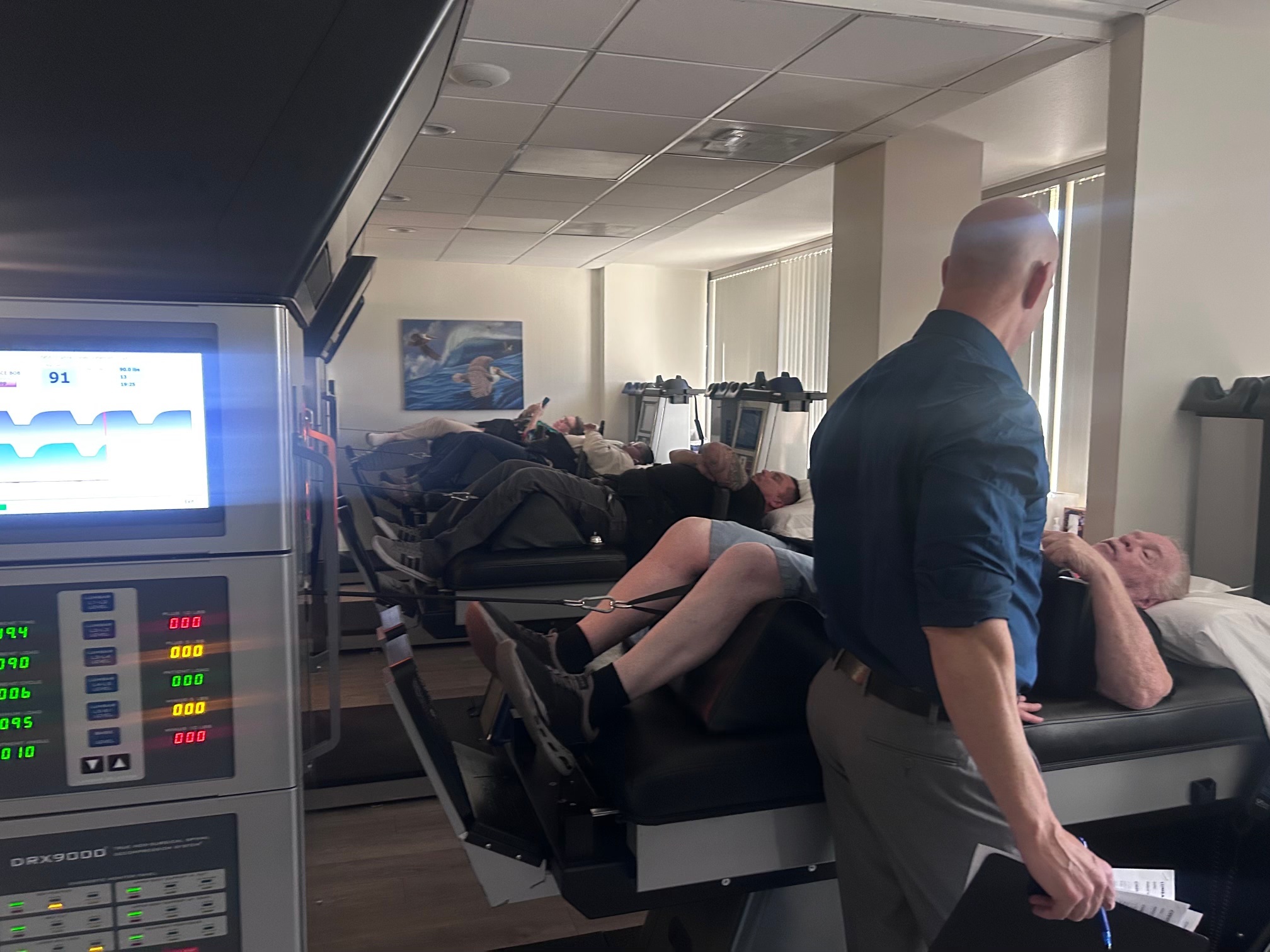
At The Spinal Decompression & Chiropractic Center of San Diego, Dr. Boelk uses the DRX9000 spinal decompression system.
The DRX9000 is a computerized table designed to deliver controlled distraction forces to the spine through programmed pulling and relaxation cycles.
During treatment, the patient lies on a specialized table while the system applies individualized settings based on examination findings, body size, tolerance, and treatment goals.
A typical lumbar session lasts approximately twenty to twenty-five minutes.
The procedure is non-invasive and doesn't require incisions, anesthesia, or injections.
The intended purpose is to temporarily reduce mechanical loading on spinal structures and potentially help manage symptoms in patients who respond favorably to traction-based treatment.
It's important to understand that research on computerized spinal decompression remains limited and mixed. Major sciatica guidelines do not routinely recommend traction, and spinal decompression cannot be guaranteed to repair a disc or prevent surgery.
That's why determining whether someone is an appropriate candidate is an essential part of Dr. Boelk's evaluation.
What If Your Herniated Disc Is Pressing on a Nerve?
When a herniated disc irritates or compresses a spinal nerve root, symptoms can become particularly disruptive.
Some patients experience severe burning pain down the leg. Others have numbness, tingling, or muscle weakness.
The degree of pain doesn't always correspond directly to the size of the herniation.
A relatively small disc protrusion in an unfortunate location may cause substantial symptoms, while a larger herniation may cause relatively little discomfort.
One patient who came to Dr. Boelk's office described experiencing severe symptoms from an extruded disc affecting the L5 nerve.
⭐⭐⭐⭐⭐
“Last year, I spent three months constantly going back and forth between doctor’s appointments and urgent care. The pain was unbearable—I was taking medication regularly just to get through the day. Getting out of bed was excruciating, and walking or standing felt like torture. Every step filled me with dread.
In December, my doctor finally ordered an MRI. That’s when I learned I had an extruded disc pressing on my L5 nerve, which affects the leg and foot. My doctor scheduled two follow-up appointments: one for pain management (spinal injections), and another to evaluate me for surgery.
Then I discovered spinal decompression therapy. I was thrilled to find a non-invasive alternative. I never ended up needing either of those appointments.
Now, I’m walking regularly, standing up straight—something I couldn’t do before. When I first sought help, I was so hunched over that I had to use a cane just to move forward. Because of the pain, I hadn’t exercised in months. But now, I’m doing a program called 75 hard which requires not one but 2 45-minute workouts per day, and I've even gotten back to lifting weights!
I’m so thankful I found this place. It’s conveniently located near my work, which makes it easy to fit sessions into my lunch break. Dr. Boelk and the staff are incredibly friendly and polite—it’s always a pleasure to come in.
The environment is so relaxing that I look forward to each visit. I truly thank God for leading me to this alternative. It’s made such a difference in my life.”
— Amanda, San Diego, CA
Amanda's experience illustrates how significantly disc-related symptoms can interfere with everyday activities.
However, symptoms such as progressive muscle weakness or significant neurological changes require prompt medical assessment rather than simply continuing conservative treatment.
Three Things You Can Try at Home When You Have a Herniated Disc
Dr. Boelk regularly creates educational videos explaining how patients can recognize symptom patterns, modify daily activities, and gradually return to exercise.
Here are three practical strategies that may be useful.
1. Change How You Get Out of Bed
Many patients with lumbar disc problems notice that getting out of bed first thing in the morning is particularly uncomfortable.
Instead of sitting straight up and bending forward, try rolling onto your side while keeping your shoulders and hips moving together.
Allow your legs to move over the edge of the bed while using your arms to push yourself into a seated position.
This is commonly called the log-roll technique.
It can help reduce repeated bending and twisting during a movement that many patients find uncomfortable.
2. Watch Where Your Sciatica Travels
One concept Dr. Boelk discusses in his educational videos is whether a movement causes symptoms to travel farther down the leg or retreat toward the lower back.
For example, imagine you begin an exercise with pain in your buttock, but afterward the pain travels farther down into your calf or foot.
That may be a sign that the movement is aggravating your nerve symptoms.
Some patients experience the opposite response, with symptoms retreating from the calf or foot toward the lower back. Clinicians sometimes describe this as centralization.
Not everyone responds favorably to the same movements, and exercises that increase pain, numbness, or weakness should not be forced.
3. Stop Pushing Through Increasing Leg Pain
Suppose you start walking with mild discomfort in your lower back.
After fifteen minutes, the pain begins traveling into your buttock. Ten minutes later, it's moving down your thigh and into your calf.
That's useful information.
Rather than pushing through the worsening symptoms, consider shortening your walks and gradually increasing your activity as tolerated.
Pay attention to how you feel during the activity, later that evening, and the following morning.
The goal is to build tolerance without repeatedly provoking significant flare-ups.
How Long Does It Take a Herniated Disc to Heal Without Surgery?
Recovery varies considerably.
Some patients experience meaningful improvement within several weeks. Others require several months, especially when nerve-related symptoms have been present for a long time.
Factors that may influence recovery include the size and location of the herniation, the degree of nerve irritation, the presence of muscle weakness, and the patient's overall health.
It's also important to understand that pain improvement and neurological recovery don't always happen at the same rate.
Someone may notice that their leg pain has substantially improved while some numbness remains.
For patients returning to sports, weight training, or physically demanding work, rebuilding strength and activity tolerance may take additional time.
What If You've Already Had Surgery for a Herniated Disc?
Some patients develop recurrent disc-related symptoms after a previous lumbar procedure.
For example, someone who underwent a discectomy several years ago may experience another episode of back pain or sciatica.
Whether additional conservative treatment is appropriate depends on the previous procedure, current symptoms, neurological findings, and updated imaging.
One patient described developing a recurrent disc problem after previously undergoing surgery.
⭐⭐⭐⭐⭐
“I have been dealing with back pain for several years. It got so bad that I had surgery 5 years ago for a bulging disc. About 5 months ago the disc bulged again hitting my sciatic nerve creating pain in my legs that made me want to cry it hurt so bad. After trying so many other options I was fortunate enough to find the spinal decompression and chiropractic center of San Diego. After just a few sessions I noticed a difference. Now after being there for the past few months I'm able to go about my normal life again.
What a blessing it was to find a Dr that genuinely cares and knows how to help people in my situation. Thank you Dr Boelk!”
— Anthony K., San Diego, CA
Previous spinal surgery doesn't automatically rule out every conservative treatment. However, certain procedures, significant instability, and some types of spinal hardware may make decompression inappropriate.
A careful review of the patient's medical and surgical history is essential.
When Should You Consider Surgery for a Herniated Disc?
Although many patients improve without surgery, there are situations where surgical evaluation is appropriate.
Surgery may be considered when severe leg pain remains disabling despite adequate conservative care, when significant neurological deficits are present, or when imaging confirms nerve compression that corresponds to the patient's symptoms.
Certain warning signs require emergency medical attention, including:
-
New loss of bladder or bowel control.
-
New numbness involving the groin or saddle region.
-
Rapidly progressing weakness in one or both legs.
-
Symptoms suggesting cauda equina syndrome.
These symptoms require immediate medical assessment rather than a routine chiropractic appointment.
For other patients, the decision about surgery involves discussing the expected benefits, risks, alternatives, and recovery with an appropriate spine specialist.
Why Not Everyone Is a Candidate for Spinal Decompression
One of the most important parts of Dr. Boelk's approach is determining whether spinal decompression is appropriate before recommending treatment.
Some patients have fractures, significant spinal instability, previous surgical hardware, or neurological findings that require a different approach.
One patient who had undergone previous spinal surgery traveled to consult with Dr. Boelk and appreciated receiving an honest explanation of her options.
⭐⭐⭐⭐⭐
“Very nice Dr. and Honest ! I would definitely recommend anyone who hasn't had metal put in there back in a surgery to go to him and give his program a shot. I believe it would definitely help. Just not in my personal case. As I have a lot of hardware in my back. But I'm glad I took the time to meet with him. It was very informative all around.”
— Toni W., Lake Elsinore, CA
This is why a new patient examination matters.
Sometimes the appropriate recommendation is spinal decompression. Other times, it may be rehabilitation, additional imaging, medical evaluation, or a surgical consultation.
The goal is to help patients understand their condition and make an informed decision.
Why Choose Dr. Cassidy James Boelk, DC, for Herniated Disc Treatment in Mission Valley?
For more than 22 years, Dr. Cassidy James Boelk, DC, has focused much of his clinical practice on helping patients with herniated discs, bulging discs, sciatica, and chronic spinal pain explore non-surgical treatment options.
His interest in spinal rehabilitation is also personal.
As a teenager, Dr. Boelk sustained a significant lumbar spinal injury involving fractures and spondylolisthesis. Later in life, he experienced disc herniations and sciatica himself.
Those experiences helped shape his interest in understanding spinal injuries, rehabilitation, and non-surgical approaches to managing persistent back and leg symptoms.
He has spent thousands of hours studying rehabilitation techniques and helping both himself and his patients work toward returning to the activities they enjoy.
His professional credentials include:
-
Certified Spinal Decompression Doctor
-
Certified Pain-Free Performance Specialist
-
Founder of the Spinal Decompression Training Academy, where he trains other doctors in non-surgical spinal decompression protocols and techniques.
His Kearny Mesa clinic is equipped with seven DRX9000 spinal decompression tables, including four lumbar and three cervical systems.
Patients visit the practice from throughout San Diego County, including Mission Valley, Mission Hills, Hillcrest, Serra Mesa, and surrounding communities.
For Mission Valley residents, the clinic is located at 5095 Murphy Canyon Road, Suite 300, in Kearny Mesa.
Why a New Patient Examination Is Important Before Beginning Treatment
One of the biggest mistakes people make when dealing with a herniated disc is assuming that the MRI tells the entire story.
An MRI can identify disc herniations, nerve compression, and other structural abnormalities, but it doesn't always establish which finding is responsible for the patient's symptoms.
A comprehensive examination helps connect the imaging findings with what the patient is actually experiencing.
At The Spinal Decompression & Chiropractic Center of San Diego, a new patient evaluation may include:
-
A detailed discussion of symptoms and medical history.
-
Review of previous treatments and relevant medical records.
-
Assessment of spinal movement and functional limitations.
-
Neurological testing, including strength, sensation, and reflexes when indicated.
-
Review of existing MRI images and reports.
-
Weight-bearing spinal X-rays, including flexion and extension views, when clinically appropriate.
-
Discussion of treatment options and whether spinal decompression may be appropriate.
The examination also provides an opportunity to identify situations where additional medical evaluation or referral may be necessary.
If you've been struggling with a herniated disc in Mission Valley and want to know whether you're a candidate for non-surgical treatment, call 619-298-0800 to schedule your new patient examination.
You can also begin with a Complimentary, No-Charge, No-Obligation Consultation if you'd like to discuss your situation before scheduling a comprehensive examination.
The consultation is complimentary. Examinations, X-rays, and other services are separate when recommended.
Frequently Asked Questions About Herniated Discs in Mission Valley, CA
Can an L5-S1 herniated disc heal without surgery?
Many patients with L5-S1 herniations improve with conservative care. Some herniations shrink naturally over time, while others remain visible on imaging even after symptoms improve.
Can you exercise with a herniated disc?
Often, yes. However, exercise selection and intensity should match the patient's condition. Activities that repeatedly worsen leg pain, numbness, or weakness may need to be modified.
Is walking better than sitting for a herniated disc?
Some patients tolerate walking better than sitting, particularly when prolonged sitting aggravates their symptoms. However, the response varies, and some patients experience increased discomfort while walking.
Does a herniated disc always require surgery?
No. Many lumbar disc herniations improve without surgery. Surgical evaluation becomes more important when severe symptoms persist despite appropriate conservative care or when significant neurological problems develop.
Can spinal decompression help a herniated disc?
Computerized spinal decompression may provide symptom relief for some selected patients, but the clinical evidence remains limited and mixed. It cannot be guaranteed to repair a disc or prevent surgery.
Where can Mission Valley residents schedule a herniated disc examination?
The Spinal Decompression & Chiropractic Center of San Diego is located at 5095 Murphy Canyon Road, Suite 300, in Kearny Mesa. Call 619-298-0800 to schedule a new patient examination or request a complimentary consultation.
Still Struggling With a Herniated Disc in Mission Valley? Find Out What Your Options Are.
Living with a herniated disc can gradually change your entire routine.
Maybe you've stopped exercising, reduced your workouts, avoided longer walks, or started planning your day around how long you can sit before your leg pain returns.
Perhaps you've already tried physical therapy, medications, injections, or other treatments without the improvement you hoped for.
Or maybe you've recently been told that surgery is your next option, and you want to understand whether additional conservative treatment is reasonable.
Whatever your situation, the first step is determining what's actually causing your symptoms and whether you're an appropriate candidate for treatment.
At The Spinal Decompression & Chiropractic Center of San Diego, Dr. Cassidy James Boelk, DC, has spent more than 22 years helping patients with herniated discs, bulging discs, and sciatica explore non-surgical treatment options.
A new patient examination can help identify your symptoms, evaluate relevant imaging, and determine which next steps may be appropriate.
Schedule Your New Patient Examination
If you're ready to get answers about your herniated disc, contact the office today.
-
New Patient Examination: A comprehensive evaluation to better understand your condition and treatment options.
-
Complimentary, No-Charge, No-Obligation Consultation: An opportunity to discuss your situation before deciding whether to schedule an examination.
-
Specialized Experience: More than 22 years of clinical experience and over 100,000 spinal decompression treatment sessions performed.
-
Individualized Screening: Not everyone is a candidate for spinal decompression, and recommendations are based on your specific findings.
-
24/7 Answering Service: Call anytime to request an appointment.
-
Spanish-Speaking Assistance Available.
Contact The Spinal Decompression & Chiropractic Center of San Diego
Dr. Cassidy James Boelk, DC
Certified Spinal Decompression Doctor
Certified Pain-Free Performance Specialist
Founder, Spinal Decompression Training Academy
Office:
The Spinal Decompression & Chiropractic Center of San Diego
5095 Murphy Canyon Road, Suite 300
San Diego, CA 92123
Phone: 619-298-0800
Email: frontdesk@sandiegobackcare.com
Website: www.SanDiegoBackCare.com
24/7 answering service | Spanish-speaking assistance available
Call 619-298-0800 today to schedule your new patient examination or request a Complimentary, No-Charge, No-Obligation Consultation.
You may have more options than you realize. The first step is finding out what's causing your pain and whether non-surgical treatment is appropriate for you.