Epidural Didn’t Help My Sciatica — What Should I Do Next? | Kearny Mesa, CA
The epidural helped.
For a few days, a few weeks, maybe even a couple of months, the sciatica finally settled down. You could sit longer, walk farther or sleep without constantly trying to find a comfortable position.
Then the symptoms started coming back.
Or maybe your experience was completely different—the injection didn't seem to change anything at all.
Dr. Cassidy James Boelk, DC sees both situations. Many patients come to his office after physical therapy, medications and an epidural steroid injection because they're trying to figure out what to do next without automatically moving toward surgery.
One of the first things Dr. Boelk wants to know is exactly what happened after the injection.
Did it do nothing? Did it reduce the pain but not the numbness? Did you feel significantly better for several weeks before the sciatica returned?
Those details can be useful.
Dr. Boelk has spent more than 22 years working with disc injuries, sciatica and Non-Surgical Spinal Decompression and has performed more than 100,000 spinal decompression treatments. The Spinal Decompression & Chiropractic Center of San Diego has seven DRX9000 systems and is the largest known Non-Surgical Spinal Decompression clinic in Southern California.
⭐⭐⭐⭐⭐ “I Was Able to Get Back in the Gym and Continue My Daily Routines”
“I lost mobility and had difficulty even putting shoes on.”
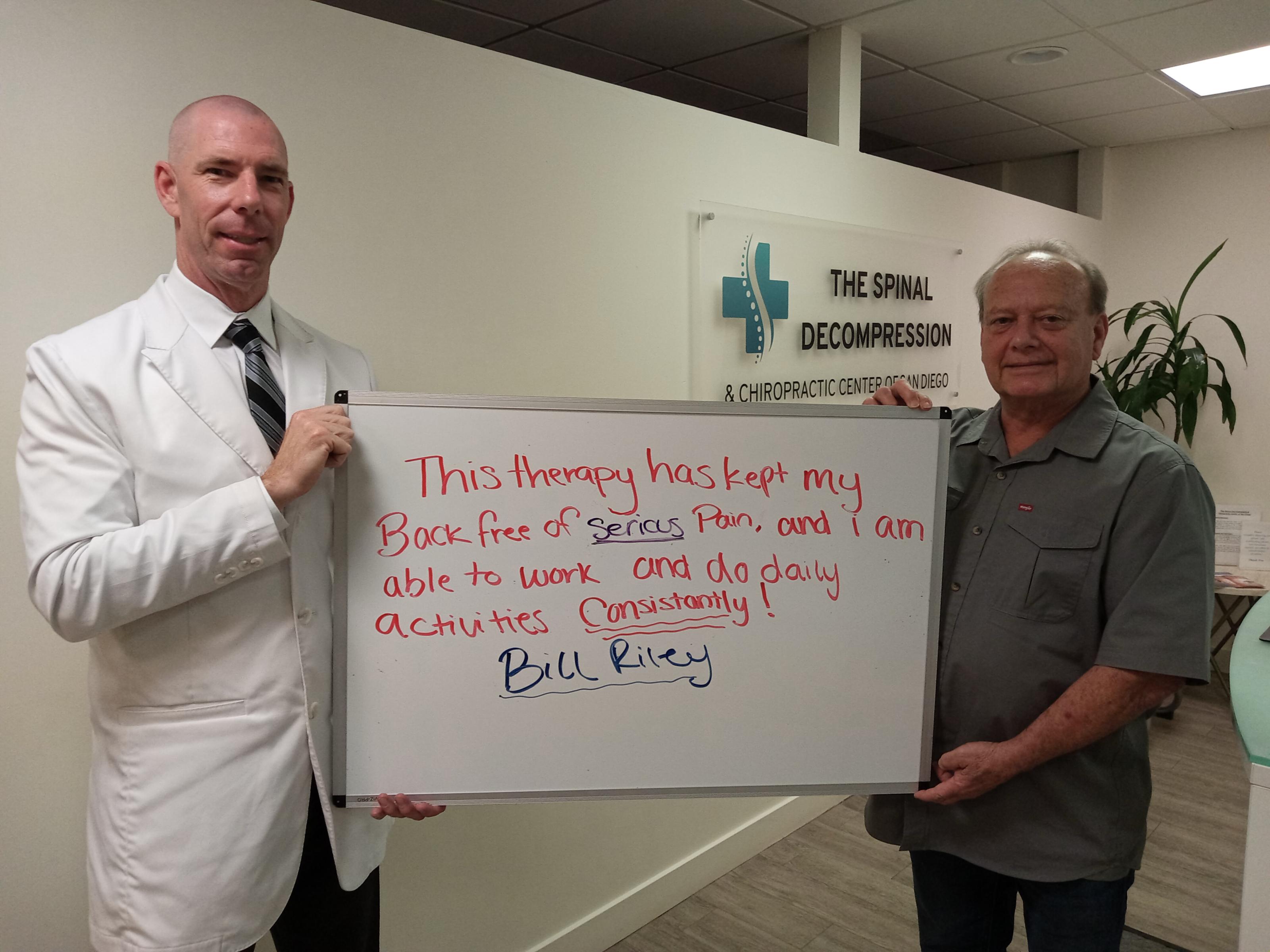
“I have been seeing Dr. Boelk since November for my back pain due to disc herniation. I lost mobility and had difficulty even putting shoes on. The pain was interfering with my everyday lifestyle. After reviewing the X-ray results, we agreed upon a treatment plan. Agreeing to this treatment plan was the best choice I've made for my back pain. The spinal decompression has relieved all the pain I felt in my lower back. I can walk, run and exercise without any pain and I'm able to get back in the gym and continue my daily routines. The office staff are very friendly and caring as well. I highly recommend Dr. Boelk's office to anyone seeking exceptional care.”
— Paul C
Paul's disc herniation had affected basic activities, including putting on his shoes. What mattered to him wasn't simply a lower pain number—it was being able to walk, run, exercise and return to his normal routine.
Your Epidural Wore Off—or Didn't Help. What Should You Do Now?
You don't need to assume another injection is your only choice.
You also don't need to assume the next step is surgery.
And you shouldn't assume spinal decompression is automatically the answer either.
The first step is figuring out what's going on.
Dr. Boelk offers a No-Charge Consultation so patients can sit down with him before making another treatment decision and find out whether he believes he may be able to help.
During the consultation, Dr. Boelk personally will:
-
Listen to how your sciatica started and how it has changed.
-
Go over exactly where the pain, burning, numbness or tingling travels.
-
Discuss what happened after your epidural injection.
-
Ask how much relief you experienced and how long it lasted.
-
Discuss whether the back pain improved but the leg symptoms remained.
-
Review physical therapy, medications, chiropractic care and other treatment you've tried.
-
Ask how long you can sit, stand or walk before symptoms increase.
-
Discuss weakness or other neurological changes.
-
Review your actual MRI images and report if available.
-
Compare your imaging with your symptoms.
-
Discuss whether further examination or imaging may be appropriate.
-
Determine whether Non-Surgical Spinal Decompression may be an option.
-
Tell you if he doesn't believe you're an appropriate candidate.
-
Answer your questions and explain what he believes makes sense next.
No MRI yet? That's okay.
There is no charge and no obligation to begin treatment.
You aren't scheduling the consultation because you've decided to start spinal decompression. You're coming in to find out whether Dr. Boelk believes another non-surgical option makes sense for your particular condition.
Dr. Boelk personally performs these consultations while also treating his existing patients throughout the week. Because of the time involved, only a limited number can be set aside in the clinic schedule.
Once those appointments are taken, new patients are offered the next available openings.
Call 619-298-0800 and ask about the next available No-Charge Consultation with Dr. Cassidy James Boelk, DC.
Why Would an Epidural Help and Then Wear Off?
An epidural steroid injection is generally used to reduce inflammation around an irritated spinal nerve.
For some patients, reducing that inflammation can make a substantial difference.
But sciatica isn't always just an inflammation problem.
A herniated or bulging lumbar disc may be affecting a nerve. Degenerative changes can reduce space around a nerve. Foraminal narrowing or spinal stenosis may also contribute to symptoms.
So it's possible for inflammation around a nerve to decrease while another factor contributing to the irritation remains.
That doesn't mean the injection failed.
If you had meaningful relief, even temporarily, Dr. Boelk wants to know about it.
“It Worked for Six Weeks” Is Useful Information
Patients sometimes dismiss temporary improvement because the pain eventually returned.
Dr. Boelk doesn't.
Suppose before your injection you could only walk for 10 minutes before your leg started burning.
After the injection, you could walk for 30 minutes.
Then six weeks later, the symptoms gradually returned.
That's different from an injection that produced absolutely no change.
The same applies if your leg pain improved but the numbness didn't, or if the back pain improved while the pain below the knee remained.
Tell Dr. Boelk exactly what changed.
The details can help him better understand the problem and determine what may or may not make sense next.
What If the Epidural Did Absolutely Nothing?
That matters too.
It doesn't automatically prove where your symptoms are coming from, and it doesn't mean you need surgery.
But it's another piece of the history Dr. Boelk considers.
He'll want to know where the injection was performed, what level was targeted if you know it, what your MRI showed and whether your symptoms changed at all afterward.
He'll also compare that history with where the symptoms travel and what positions or activities make them better or worse.
Bring the Actual MRI Images
If you already had an epidural injection, you probably have an MRI.
Whenever possible, bring the actual images along with the written report.
An MRI report may describe a disc bulge, herniation, extrusion, degenerative disc disease, foraminal narrowing or stenosis.
But Dr. Boelk doesn't want to treat a paragraph on a radiology report.
He wants to compare the imaging with the patient.
Does the level involved make sense with where your symptoms travel?
Does the side match?
What happens when you sit?
What happens when you stand or walk?
Is there numbness?
Is there weakness?
What relieves the symptoms?
Those questions help put the MRI findings into context.
⭐⭐⭐⭐⭐ “I Could Barely Walk”
“After treatment I am back to shoveling snow, teaching school, taking walks.”
“My name is Lynn. I am from Alaska, and I just want to say it was totally worth taking a trip to go to the Spinal Decompression & Chiropractic Center of San Diego. I was having pain radiating down my legs, I couldn’t sleep, I could barely walk.
After treatment I am back to shoveling snow, teaching school, taking walks. So, I just want to thank Dr. Boelk and the clinic, you guys are wonderful, and you have created such a wonderful, friendly, kind and truly caring atmosphere. I highly encourage anybody that might be considering spinal decompression therapy, it really makes a difference.”
— Lynn C., Alaska
Lynn traveled from Alaska after reaching the point where pain radiating down her legs was interfering with sleep and walking. She later described returning to teaching, walking and shoveling snow.
That is why Dr. Boelk asks patients about function. He wants to know what the sciatica is actually preventing you from doing.
Could Non-Surgical Spinal Decompression Be an Option?
Possibly, if you're an appropriate candidate.
Dr. Boelk commonly evaluates patients with:
-
Lumbar disc bulges.
-
Lumbar disc herniations.
-
L4-L5 and L5-S1 disc injuries.
-
Degenerative disc disease.
-
Disc-related sciatica.
-
Foraminal narrowing.
-
Selected cases of spinal stenosis.
The clinic uses the DRX9000 exclusively for Non-Surgical Spinal Decompression.
The goal of the consultation isn't to convince every patient with sciatica to start treatment.
Dr. Boelk considers your symptoms, neurological findings, imaging when available, spinal stability, bone health, previous surgery and response to prior treatment before determining whether spinal decompression is appropriate.
Are You Getting Better—or Just Getting Better at Avoiding the Pain?
This is something patients don't always notice.
Maybe your pain isn't as severe as it was six months ago.
But you're also not walking as far.
You stopped working out.
You don't sit through your kid's entire game anymore.
You avoid long drives.
You don't travel because you're worried about sitting on the plane.
You stopped golfing because you know how your leg will feel afterward.
When patients gradually remove the activities that trigger their symptoms, they may feel like they're managing the sciatica better.
But their world may also be getting smaller.
Compare what you're able to do today with what you could do three or six months ago.
That's often more useful than asking how your back feels on one particular morning.
Does a Failed Epidural Mean Surgery Is Next?
Not necessarily.
There isn't a rule that says you try PT, then medications, then an epidural and then automatically have surgery if those treatments don't solve the problem.
The decision depends on what's causing the symptoms, how severe they are, your neurological findings, your imaging and how much function you're losing.
There are also situations where continuing conservative treatment isn't appropriate.
Rapidly progressing weakness, significant neurological loss, new bowel or bladder dysfunction, difficulty initiating or controlling urination, or numbness involving the groin, inner thighs or saddle region requires prompt medical evaluation.
The goal isn't avoiding surgery at any cost.
It's determining the right next step.
★ Sometimes the Right Answer Is Surgery
“After a honest and forthright conversation, we both determined that surgery was my only option.”
“I found this terrific practice on social media. I followed up and did my own research so I decided to pay them a visit. The place is clean, well organized and run by a very efficient receptionist. I met with the doctor and after a honest and forthright conversation, we both determined that surgery was my only option to correct my back issues. I will return as a customer when the time is right.”
— Jeff J., Tucson, AZ
Jeff came to the office looking for another option. After reviewing his situation, he and Dr. Boelk determined surgery was appropriate.
That's an important part of Dr. Boelk's approach.
Not every patient who wants to avoid surgery should avoid surgery.
And not every patient who wants spinal decompression should receive it.
More Than 22 Years Focused on Non-Surgical Spinal Decompression
Dr. Cassidy James Boelk, DC has more than 22 years of experience with Non-Surgical Spinal Decompression and has performed more than 100,000 spinal decompression treatments.
His professional background includes:
-
Doctor of Chiropractic
-
Certified Spinal Decompression Doctor
-
Certified Pain-Free Performance Specialist (PPSC)
-
Founder, Non-Surgical Spinal Decompression Training Academy
-
Trains other doctors in spinal decompression protocols and techniques
-
Founding Member, American Spinal Decompression Society
-
Member, International Disc Education Association
-
California X-Ray Radiation Supervisor & Operator
Dr. Boelk also understands spinal injury personally. He suffered an L5 compression fracture at age 16 and later dealt with disc injuries and sciatica himself.
If the Epidural Didn't Help—or the Relief Didn't Last
Don't automatically assume you need another injection.
Don't automatically assume surgery is next.
And don't assume spinal decompression is right for you.
Find out.
Bring your MRI images and report if you have them. Tell Dr. Boelk exactly what happened after the injection, how much relief you experienced, how long it lasted and what you're still unable to do.
Then let him determine whether he believes another non-surgical option makes sense.
The consultation is personally performed by Dr. Boelk. There is no charge and no obligation to begin treatment.
Because Dr. Boelk sets aside this time himself while continuing to care for his existing patients, only a limited number of No-Charge Consultation appointments can be accommodated in the clinic schedule.
Call 619-298-0800 and ask about the next available No-Charge Consultation with Dr. Cassidy James Boelk, DC.
The Spinal Decompression & Chiropractic Center of San Diego
5095 Murphy Canyon Road, Suite 300
San Diego, CA 92123
619-298-0800
SanDiegoBackCare.com
Live 24/7 Answering Service • Hablamos Español