Does Spinal Decompression Work? – San Diego, CA
The Truth About Non-Surgical Spinal Decompression for Herniated Discs, Sciatica, Neck Pain & Chronic Back Pain
"I Don't Want Back Surgery… But I Can't Keep Living Like This."
Those are some of the most common words Dr. Cassidy James Boelk hears from new patients walking into The Spinal Decompression & Chiropractic Center of San Diego.
Most people never expect to develop chronic back or neck pain.
It often starts with something small.
A sore back after yard work.
A stiff neck after sleeping wrong.
A twinge while lifting a heavy box.
For others, it begins after a car accident, sports injury, or years of repetitive wear and tear.
At first, you assume it will get better.
Then weeks turn into months.
Maybe you've already tried chiropractic care, physical therapy, massage therapy, acupuncture, medications, injections, or simply resting and hoping time would solve the problem.
Instead, your pain continues.
Now you're wondering if surgery is your only option.
If that sounds familiar, you're not alone.
Every week, patients from throughout San Diego, Southern California, across the United States, and even internationally come to see Dr. Boelk asking one question:
"Does spinal decompression actually work?"
The honest answer is...
Yes—for the right patient.
But it's important to understand that non-surgical spinal decompression is not a miracle cure, and it isn't appropriate for everyone.
Like every medical treatment, success depends on making the correct diagnosis, choosing the right patients, and following a treatment plan designed specifically for your condition.
That's exactly what this guide will help you understand.
The Short Answer
If your pain is being caused by certain disc-related conditions, non-surgical spinal decompression may be one of the most effective conservative treatment options available before considering surgery.
However...
Not every patient qualifies.
Not every decompression machine is the same.
Not every doctor has extensive experience treating disc injuries.
Choosing the right provider can make a tremendous difference.
Why Are So Many People Searching for an Alternative to Surgery?
Back pain affects millions of Americans every year.
For many people, it becomes much more than an inconvenience.
It changes everything.
Simple activities suddenly become difficult.
You may find yourself:
- Avoiding long car rides.
- Struggling to sleep through the night.
- Missing work.
- Giving up golf, surfing, hiking, or exercising.
- Needing pain medication just to get through the day.
- Feeling frustrated because nothing seems to provide lasting relief.
Perhaps the most difficult part is uncertainty.
Many patients don't know what's actually causing their pain.
They've heard terms like:
- Herniated Disc
- Bulging Disc
- Degenerative Disc Disease
- Pinched Nerve
- Sciatica
- Spinal Stenosis
But nobody has really explained what those diagnoses mean—or whether surgery is truly necessary.
Understanding Why Disc Injuries Hurt
Your spine is made up of bones called vertebrae.
Between each vertebra sits a spinal disc.
Think of each disc as a shock absorber.
Every time you bend, twist, lift, walk, run, or even sit, those discs help distribute force throughout your spine.
Each disc has two primary parts.
The Outer Layer
The annulus fibrosus is a series of strong collagen fibers that hold the disc together.
Its job is to contain the inner portion of the disc while allowing movement.
The Inner Portion
Inside the disc is a softer, gel-like material called the nucleus pulposus.
This acts like a cushion, helping absorb forces placed on your spine throughout the day.
When healthy, these structures work together remarkably well.
Problems begin when the disc becomes damaged.
Why Disc Injuries Often Take So Long to Heal
One of the biggest reasons people continue suffering from chronic disc pain is something many have never been told.
Spinal discs have a very limited direct blood supply.
Why is that important?
When you cut your skin...
Blood immediately rushes to the injured tissue.
When you strain a muscle...
Blood delivers oxygen and nutrients needed for healing.
When you break a bone...
Your body sends an incredible healing response.
Discs are different.
Most of their nutrition reaches them through a process called diffusion, where nutrients slowly move through the vertebrae above and below the disc rather than arriving directly through blood vessels.
Because of this, disc injuries often heal much more slowly than muscles, tendons, or skin.
That doesn't mean they can't heal.
It simply means they often need the right environment.
What Is Non-Surgical Spinal Decompression?
Many people imagine spinal decompression as simply stretching the back.
It's much more sophisticated than that.
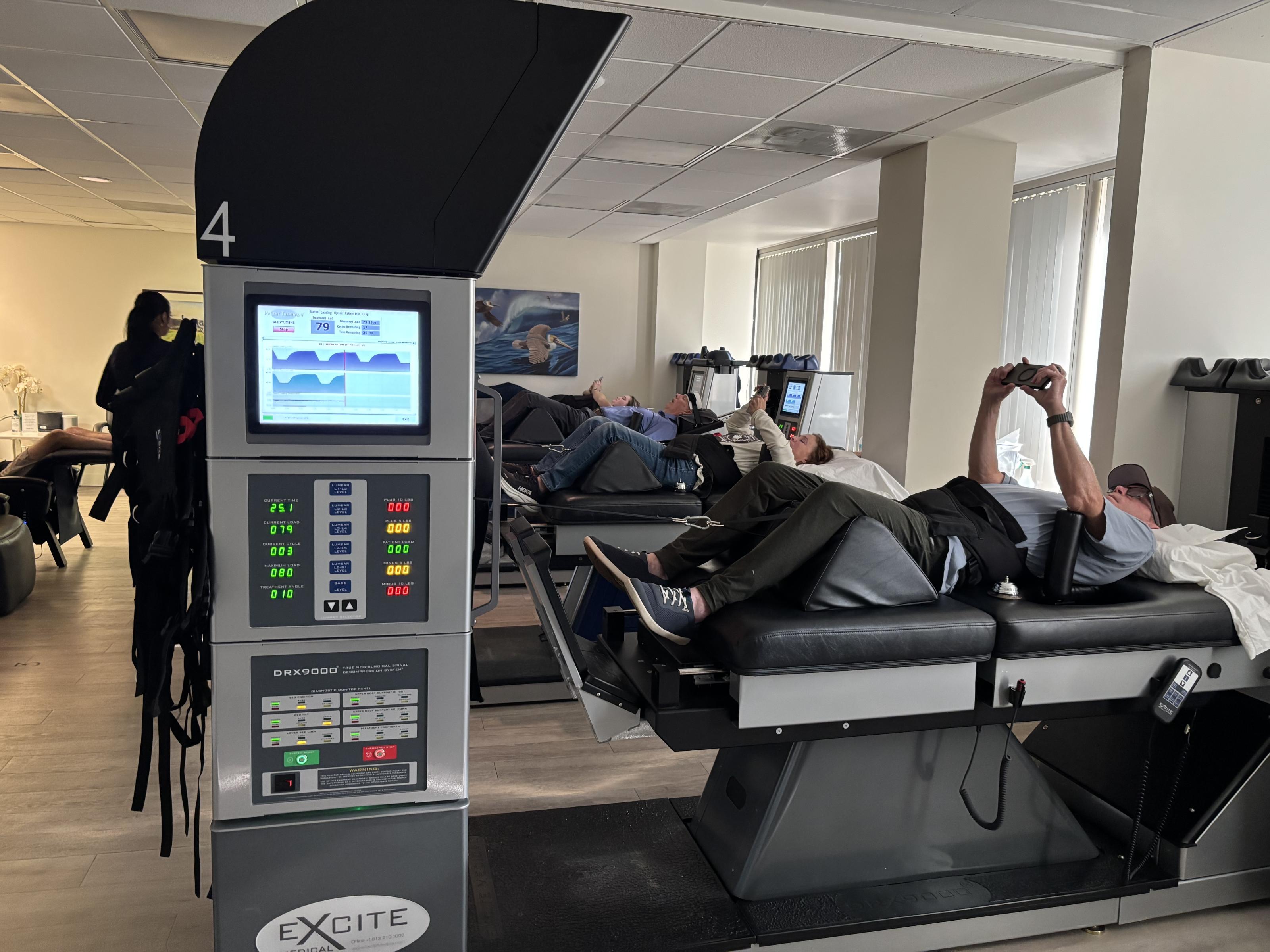
Modern computerized spinal decompression uses carefully controlled distraction forces designed to gently reduce pressure within the injured spinal disc.
The goal isn't simply to pull on your spine.
The goal is to create a healthier mechanical environment that may help:
- Reduce pressure on irritated nerves.
- Decrease stress inside the injured disc.
- Improve movement between spinal segments.
- Encourage the movement of oxygen, nutrients, and fluid into the disc through diffusion.
- Reduce muscle guarding around the injured area.
Treatment is comfortable.
In fact, many patients tell us it's one of the most relaxing parts of their day.
Some even fall asleep during treatment.
Is Spinal Decompression the Same as Traction?
No.
Although both involve gentle pulling forces, modern computerized spinal decompression is much more advanced than traditional traction.
Computerized systems carefully monitor:
- Treatment angle
- Pulling force
- Relaxation cycles
- Treatment time
- Patient positioning
These variables are adjusted based on the patient's diagnosis and response to care.
That level of precision simply wasn't possible with older traction devices.
What Conditions May Benefit from Non-Surgical Spinal Decompression?
Every patient is unique.
However, spinal decompression may be considered for conditions including:
- Herniated discs
- Bulging discs
- Disc protrusions
- Disc extrusions
- Degenerative disc disease
- Sciatica
- Cervical radiculopathy
- Lumbar radiculopathy
- Certain cases of foraminal stenosis
- Certain cases of spinal stenosis
- Chronic low back pain
- Chronic neck pain
Just because someone has back pain does not automatically mean spinal decompression is the right treatment.
That's one reason Dr. Boelk personally evaluates every patient before making treatment recommendations.
Why Experience Matters
Over the past 22 years, Dr. Cassidy James Boelk has dedicated his practice almost exclusively to helping patients suffering from spinal disc injuries.
Today he is recognized as:
- Certified Spinal Decompression Doctor
- Certified Pain-Free Performance Specialist
- Founder of the Spinal Decompression Training Academy
- Educator who trains other healthcare providers in spinal decompression protocols
His office has now performed more than 100,000 spinal decompression treatments using exclusively DRX9000 spinal decompression systems.
Why should that matter to you?
Because spinal decompression isn't simply placing someone on a machine.
Success depends on:
- Making the correct diagnosis.
- Reviewing MRI findings.
- Identifying who is—and isn't—a candidate.
- Selecting the proper treatment protocol.
- Monitoring progress.
- Knowing when another treatment option is more appropriate.
Experience matters.
Patients Travel to San Diego for Specialized Care
Most chiropractic offices perform spinal decompression only occasionally.
Dr. Boelk has built an entire practice around treating spinal disc injuries.
Patients regularly travel from:
- Throughout California
- Arizona
- Nevada
- Alaska
- Mexico
- Canada
- The United Kingdom
- And other countries
Many have already tried numerous treatments before arriving in San Diego.
Others have been told surgery is their only remaining option and simply want another opinion before making a life-changing decision.
While not everyone ultimately becomes a patient, many appreciate receiving an honest evaluation and learning all of their options.
One Patient's Story
⭐⭐⭐⭐⭐
"Last year, I spent three months constantly going back and forth between doctor's appointments and urgent care. The pain was unbearable—I was taking medication regularly just to get through the day. Getting out of bed was excruciating, and walking or standing felt like torture. Every step filled me with dread.
In December, my doctor finally ordered an MRI. That's when I learned I had an extruded disc pressing on my L5 nerve. My doctor scheduled two follow-up appointments: one for pain management (spinal injections), and another to evaluate me for surgery.
Then I discovered spinal decompression therapy. I never ended up needing either of those appointments.
Now, I'm walking regularly, standing up straight, lifting weights again, and completing two 45-minute workouts every day. Dr. Boelk and the staff are incredibly friendly, and I'm so thankful I found this place."
— Amanda, San Diego, CA
Can a Herniated or Bulging Disc Heal Without Surgery?
One of the biggest misconceptions about spinal disc injuries is that surgery is inevitable.
In reality, many people with disc injuries never require surgery.
That doesn't mean surgery isn't appropriate for some patients—it absolutely is. In certain situations, surgery can be life-changing and is the best option available.
The challenge is knowing which category you fall into.
That's why Dr. Cassidy James Boelk never recommends spinal decompression simply because an MRI shows a herniated or bulging disc.
Instead, he considers the entire picture:
- Your MRI findings
- Your symptoms
- Your neurological examination
- How long you've been in pain
- What treatments you've already tried
- Your goals
- Whether your condition is progressing or improving
Sometimes spinal decompression is an excellent option.
Sometimes another conservative treatment makes more sense.
And sometimes surgery truly is the right recommendation.
The goal isn't to sell treatment.
The goal is to recommend the treatment most likely to help you.
What Does the Research Actually Say?
Patients deserve more than opinions.
They deserve evidence.
Over the past two decades, researchers have studied non-surgical spinal decompression for patients with disc-related spinal conditions.
While no treatment works for everyone, published studies have reported improvements in pain, disability, function, and quality of life in many appropriately selected patients suffering from conditions such as herniated discs, degenerative disc disease, and sciatica.
Research is important.
But research alone doesn't treat patients.
Experience matters too.
After performing more than 100,000 spinal decompression treatments over the past 22 years, Dr. Boelk has learned something that every experienced clinician eventually realizes:
Choosing the right patient is every bit as important as choosing the right treatment.
Why Experience Matters
Imagine needing heart surgery.
Would you choose the surgeon who performs one procedure each month?
Or the surgeon who performs them every day?
Most people would choose experience.
The same principle applies when choosing someone to evaluate and treat complex spinal conditions.
Dr. Cassidy James Boelk is:
- A Certified Spinal Decompression Doctor
- A Certified Pain-Free Performance Specialist
- Founder of the Spinal Decompression Training Academy
- An educator who trains other healthcare providers in spinal decompression protocols and patient selection
His practice has now performed more than 100,000 spinal decompression treatments using exclusively DRX9000 spinal decompression systems.
Why should you care?
Because successful spinal decompression involves much more than lying on a treatment table.
It requires making the correct diagnosis, recognizing when spinal decompression is appropriate, knowing when it isn't, monitoring progress carefully, and adjusting treatment based on each patient's response.
Experience doesn't guarantee results.
But it often improves decision-making.
An Honest Recommendation Is Sometimes "No"
One of the things that surprises many new patients is that Dr. Boelk doesn't recommend treatment for everyone.
In fact, one of the strongest testimonials his office has ever received came from someone who never became a spinal decompression patient.
⭐⭐⭐⭐⭐
"I found this terrific practice on social media. I followed up and did my own research, so I decided to pay them a visit. The place is clean, well organized and run by a very efficient receptionist. I met with the doctor and after an honest and forthright conversation, we both determined that surgery was my only option to correct my back issues. I will return as a customer when the time is right."
— Jeff J., Tucson, Arizona
Healthcare should never be about convincing someone to begin treatment.
It should be about helping people make the best decision for their long-term health.
Sometimes that means recommending spinal decompression.
Sometimes it means recommending surgery.
Sometimes it means recommending another healthcare provider.
Patients appreciate honesty.
What Happens During Your No-Charge Consultation?
Many people wait months—or even years—to schedule a consultation because they're worried they'll be pressured into treatment.
That simply isn't how Dr. Boelk practices.
Your first visit is designed to answer one question:
"Can we genuinely help you?"
During your consultation, Dr. Boelk will personally:
- Listen carefully to your story.
- Review any MRI or imaging studies you already have.
- Perform a comprehensive examination.
- Explain what he believes is causing your symptoms.
- Discuss every reasonable treatment option.
- Answer all of your questions.
If spinal decompression appears to be a good option, he'll explain why.
If he doesn't believe it's the right choice, he'll tell you that too.
Many patients tell us the greatest value of the consultation isn't being told they need treatment.
It's finally understanding what's actually causing their pain.
Another Patient's Story
⭐⭐⭐⭐⭐
"Dr. Boelk and his team are the best in the business! I had lower back problems for over five years and had seen six other doctors looking for options besides surgery. I came in barely able to bend over and walking with a limp. Within a few months I was bending without pain and walking normally. I am EXTREMELY happy I didn't have surgery and found Dr. Boelk. From the beginning he told me that if I wasn't making progress, he would let me know. That honesty meant everything to me."
— Calder Pearce, San Diego, CA
A Personal Message from Dr. Cassidy James Boelk
"I've been fortunate to help thousands of patients over the past 22 years, but I never forget that every person walking through our doors has a unique story, unique goals, and unique concerns.
Some patients need spinal decompression.
Some don't.
My responsibility is to give you an honest evaluation, explain your options, answer your questions, and help you make the decision that's best for you.
Whether that leads to treatment in our office or somewhere else, my goal is exactly the same—to help you make an informed decision about your health."
Ready to Find Out Whether You're a Candidate?
If you've been living with chronic neck pain, low back pain, sciatica, a herniated disc, bulging disc, degenerative disc disease, or another disc-related spinal condition, you don't have to keep guessing.
The first step isn't committing to treatment.
It's getting an honest evaluation.
Dr. Cassidy James Boelk personally performs every consultation at The Spinal Decompression & Chiropractic Center of San Diego. He'll review your history, evaluate your imaging, explain what's causing your symptoms, answer your questions, and determine whether non-surgical spinal decompression is an appropriate option for your condition.
If you're a candidate, he'll explain why.
If you're not, he'll tell you honestly and help point you toward the treatment that makes the most sense for your situation.
To schedule your No-Charge Consultation, contact:
The Spinal Decompression & Chiropractic Center of San Diego
5095 Murphy Canyon Road, Suite 300
San Diego, CA 92123
Phone: (619) 298-0800
Website: www.SanDiegoBackCare.com