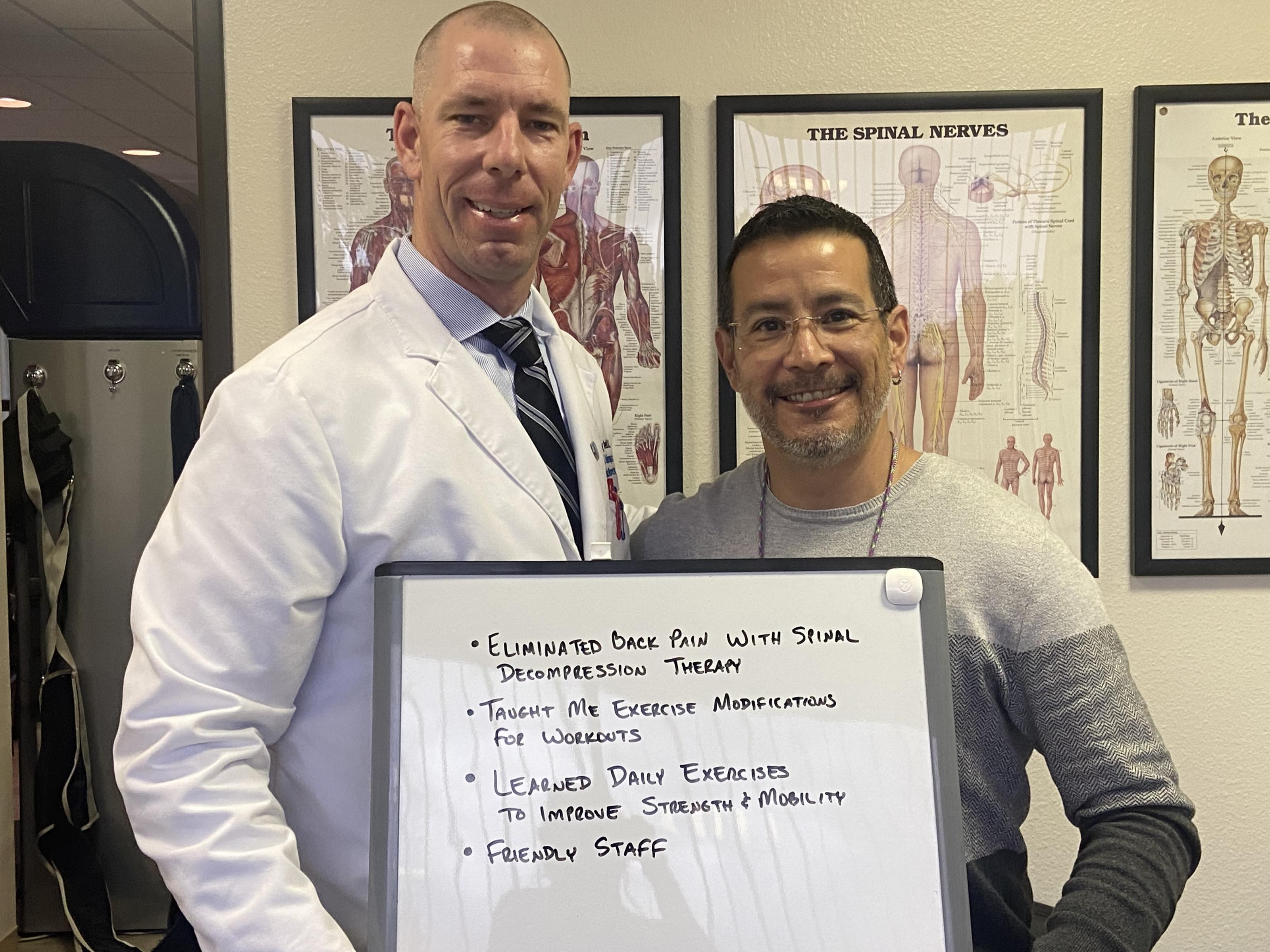
Does Spinal Decompression Help a Bulging Disc? | San Diego, CA
Yes, a bulging disc is one of the conditions Dr. Cassidy James Boelk, DC commonly evaluates for Non-Surgical Spinal Decompression.
But having a bulging disc on an MRI doesn't automatically mean you need spinal decompression—or that the bulging disc is even what's causing your pain.
That's an important distinction.
Dr. Boelk has focused on Non-Surgical Spinal Decompression for more than 22 years and has performed more than 100,000 spinal decompression treatments. His San Diego clinic has seven DRX9000 systems and is the largest known Non-Surgical Spinal Decompression clinic in Southern California.
He also trains other doctors in spinal decompression protocols and techniques.
After seeing this many disc patients, one thing Dr. Boelk does not do is treat an MRI report.
He treats the person.
If your MRI says you have an L4-L5 or L5-S1 disc bulge, Dr. Boelk wants to see the actual images, understand where you're hurting, find out whether the disc is affecting a nerve and determine whether the findings on the MRI make sense with your symptoms.
For the right patient, Non-Surgical Spinal Decompression may be an option.
For the wrong patient, it shouldn't be done.
⭐⭐⭐⭐⭐ “I Have 3 Bulging Disc and One Is Touching the Nerve”
“It really helps keep me in my active life.”
“I travel from the UK to see Dr Boelk and his wonderful team . I have 3 bulging disc and one is touching the nerve. I have the spinal decompression treatment and it really helps keep me in my active life . I will not go to anyone else for back treatment, this place is number one and they genuinely care about their patients.”
— Lisa S., United Kingdom
Lisa travels from the United Kingdom for care and describes three bulging discs, including one affecting a nerve. What matters to her is being able to maintain an active life.
That's a good example of why the MRI is only part of the story. Dr. Boelk also wants to know what the disc problem is doing to you.
Have an MRI Showing a Bulging Disc? Bring It With You.
If you've been told you have a bulging disc and you're trying to figure out whether spinal decompression makes sense, Dr. Boelk offers a No-Charge Consultation.
Bring the actual MRI images if you have them—not just the written report.
Dr. Boelk will personally go through your case and look at things such as:
-
Where the disc is bulging.
-
How significant the bulge appears.
-
Whether the disc is affecting or crowding a nerve.
-
Where your pain, numbness or tingling travels.
-
Whether you have weakness.
-
What makes the symptoms better or worse.
-
How long you can sit, stand or walk comfortably.
-
What treatment you've already tried.
-
Whether there is instability or another condition that changes the treatment decision.
-
Whether Non-Surgical Spinal Decompression makes sense for you.
If you're a candidate, he'll explain why.
If he doesn't believe you're a candidate, he'll tell you.
No MRI yet? That's okay. You can still schedule the consultation and discuss what may be appropriate next.
There is no charge and no obligation to begin treatment.
Dr. Boelk personally performs these consultations while also treating his existing patients throughout the week, so only a limited number can be set aside in the clinic schedule.
Call 619-298-0800 and ask about the next available No-Charge Consultation with Dr. Cassidy James Boelk, DC.
What Exactly Is a Bulging Disc?
Think of the disc as the cushion between two vertebrae.
The outside of the disc is made of tough fibrous tissue, while the center contains softer material.
With a disc bulge, part of the outer portion of the disc extends beyond its normal boundary.
The important question isn't simply whether a bulge exists.
It's where it is and what it's doing.
A person can have a disc bulge on an MRI and have no symptoms at all.
Another person may have a bulging disc in a location that irritates or crowds a spinal nerve and develops significant sciatica, numbness, tingling or weakness.
That's why Dr. Boelk doesn't look at the words “bulging disc” and automatically recommend treatment.
The MRI needs to be compared with the patient.
How Is Spinal Decompression Supposed to Help?
Non-Surgical Spinal Decompression uses controlled distraction of the spine.
At Dr. Boelk's office, treatment is performed using the DRX9000.
The goal is to reduce mechanical stress on the involved spinal segment and create a more favorable environment around the injured disc and surrounding structures.
This isn't the same thing as simply hanging from a bar, using an inversion table or having someone pull on your legs.
The DRX9000 allows the treatment to be delivered in a controlled manner based on the area being treated and the individual patient.
Dr. Boelk has seven DRX9000 systems in his clinic because spinal decompression isn't something the office occasionally adds to another treatment plan.
It has been a major focus of his practice for more than two decades.
Does Spinal Decompression “Put the Disc Back In”?
This is where Dr. Boelk likes to be careful with the language.
Patients sometimes come in after seeing advertisements claiming a machine will “suck the disc back into place.”
That's an oversimplification.
A bulging or herniated disc isn't like a drawer that simply gets pushed back into a cabinet.
The purpose of Non-Surgical Spinal Decompression is to change the mechanical environment around the involved spinal segment and reduce stress on the disc and surrounding structures.
What matters clinically is what happens to the patient.
Is the leg pain traveling less distance?
Can you sit longer?
Can you stand longer?
Can you walk farther?
Is numbness becoming less frequent?
Are you returning to activities you've stopped doing?
Those changes tell Dr. Boelk much more than a dramatic marketing claim about “putting a disc back.”
Bulging Disc or Herniated Disc—What's the Difference?
Patients often use these terms interchangeably, but they're not exactly the same thing.
A bulging disc generally involves a broader extension of the disc beyond its normal boundary.
A herniated disc involves a more focal displacement of disc material.
There are different types and degrees of disc herniation as well.
From a patient's perspective, though, the name by itself doesn't tell Dr. Boelk how much trouble you're having.
A relatively small disc problem in the wrong location can produce significant nerve symptoms.
A larger-looking abnormality may produce surprisingly little discomfort in another person.
Location matters.
Nerve involvement matters.
Your symptoms matter.
What If My Bulging Disc Is Touching a Nerve?
This is where the evaluation becomes more important.
If a lumbar disc bulge is affecting a nerve root, symptoms may travel away from the lower back and into the buttock, thigh, calf or foot.
Some people have very little back pain but terrible leg pain.
Others have numbness or tingling.
Some notice weakness.
Dr. Boelk wants to know where those symptoms go because different lumbar nerve roots can produce different patterns.
He then compares that pattern with the MRI.
If the symptoms and imaging line up, that gives him a much clearer picture of what may be causing the problem.
⭐⭐⭐⭐⭐ “I Came in Early January Not Able to Bend and Walking With a Limp”
“I am EXTREMELY happy I did not have surgery and found Dr. Boelk.”
“Dr. Boelk and his team are the best in the business! I have had lower back problems for over 5 years and been to 6 other doctors seeking options other than surgery. I came in early January not able to bend and walking with a limp. By February I was able to bend again with minimal pain and by March I am now able to bend without any pain and am able to walk normally.
I am EXTREMELY happy I did not have surgery and found Dr. Boelk. Trust him and the process and he will get you feeling better. He also said from the beginning that if at any stage in the process he felt like progress wasn't happening he would let me know which was not the case with other specialist I have seen in the past so I appreciate that.”
— Calder Pearce, San Diego, CA
Calder had dealt with lower-back problems for more than five years and had already seen six other doctors while looking for options other than surgery. He came to the office unable to bend normally and walking with a limp.
The last part of his review is something Dr. Boelk considers particularly important: if someone isn't progressing, that needs to be discussed.
How Does Dr. Boelk Know If Decompression Is Working?
Not just by asking, “What's your pain today from 1 to 10?”
Pain matters, but it can change from one day to another.
Dr. Boelk also watches function.
Maybe you could only sit for 20 minutes before the sciatica started and now you can sit for an hour.
Maybe you couldn't make it through the grocery store without your foot going numb and now you can.
Maybe the pain originally traveled all the way into the foot and now it stops around the buttock or thigh.
Maybe you're sleeping better.
Maybe you've returned to the gym.
Those are useful changes.
The goal is not simply to make somebody feel better for an hour after treatment. Dr. Boelk wants to see whether the patient's overall function is moving in the right direction.
Who May Be a Candidate for Spinal Decompression?
Dr. Boelk commonly evaluates patients with:
-
Lumbar disc bulges.
-
Lumbar disc herniations.
-
L4-L5 disc injuries.
-
L5-S1 disc injuries.
-
Degenerative disc disease.
-
Disc-related sciatica.
-
Foraminal narrowing.
-
Selected cases of spinal stenosis.
-
Certain cases of chronic disc-related lower-back pain.
But a diagnosis on that list does not automatically make someone a candidate.
Dr. Boelk also considers spinal stability, previous surgery, hardware, bone health, neurological findings and other medical factors before recommending treatment.
Who Should Not Have Spinal Decompression?
This is just as important as discussing who may benefit.
There are situations where Dr. Boelk will not recommend spinal decompression or where further medical evaluation is needed first.
Examples can include an unhealed spinal fracture, significant osteoporosis, certain cases involving surgical hardware at the treatment level, unstable spondylolisthesis, certain malignancies and other conditions where decompression would not be appropriate.
Pregnancy is also a contraindication for lumbar decompression.
Progressive neurological weakness needs to be taken seriously as well.
And new bowel or bladder dysfunction, difficulty controlling or initiating urination, or numbness involving the groin, inner thighs or saddle region requires prompt medical evaluation.
Dr. Boelk has turned patients away from spinal decompression when he doesn't believe it's appropriate.
★ “I'm Glad I Took the Time to Meet With Him”
“Just not in my personal case.”
“Very nice Dr. and Honest ! I would definitely recommend anyone who hasn't had metal put in there back in a surgery to go to him and give his program a shot. I believe it would definitely help. Just not in my personal case. As I have a lot of hardware in my back. But I'm glad I took the time to meet with him. It was very informative all around.”
— Toni W., Lake Elsinore, CA
Toni came in to find out whether spinal decompression was an option. Because of the amount of hardware in her back, Dr. Boelk did not accept her for treatment.
That's exactly why the consultation comes first.
You shouldn't have to decide whether you want spinal decompression before you even know whether Dr. Boelk thinks you're a candidate.
Why Experience With Spinal Decompression Matters
Non-Surgical Spinal Decompression isn't something Dr. Boelk started offering recently.
It has been a major focus of his practice for more than 22 years.
Dr. Cassidy James Boelk, DC has performed more than 100,000 spinal decompression treatments and trains other doctors in spinal decompression protocols and techniques.
His professional background includes:
-
Doctor of Chiropractic
-
Certified Spinal Decompression Doctor
-
Certified Pain-Free Performance Specialist (PPSC)
-
Founder, Non-Surgical Spinal Decompression Training Academy
-
Founding Member, American Spinal Decompression Society
-
Member, International Disc Education Association
-
California X-Ray Radiation Supervisor & Operator
Dr. Boelk also knows what it is like to deal with a significant spinal injury himself. He suffered an L5 compression fracture at age 16 and later dealt with disc injuries and sciatica.
Have a Bulging Disc? Let Dr. Boelk Look at the MRI.
If your MRI says you have a bulging disc and you're trying to decide what to do about it, don't make the decision based only on the wording of the report.
Bring the actual images.
Let Dr. Boelk look at where the disc is bulging, whether a nerve appears to be involved and whether the MRI makes sense with the symptoms you're experiencing.
Then let him tell you whether he believes Non-Surgical Spinal Decompression is worth considering.
The consultation is personally performed by Dr. Boelk. There is no charge and no obligation to begin treatment.
Because Dr. Boelk performs these consultations himself while continuing to care for his existing patients, only a limited number can be accommodated in the clinic schedule.
Call 619-298-0800 and ask about the next available No-Charge Consultation with Dr. Cassidy James Boelk, DC.
The Spinal Decompression & Chiropractic Center of San Diego
5095 Murphy Canyon Road, Suite 300
San Diego, CA 92123
619-298-0800
SanDiegoBackCare.com
Live 24/7 Answering Service • Hablamos Español