Does Spinal Decompression Help Foraminal Stenosis? | Mira Mesa, CA
If your MRI shows foraminal stenosis at L4-L5, L5-S1, C5-C6, or another spinal level, you may be wondering what can be done about it.
Perhaps you're experiencing pain traveling down your leg, numbness in your foot, or neck pain that extends into your shoulder and arm. Some patients notice that standing or walking makes their symptoms worse. Others struggle with certain neck movements or have difficulty finding a comfortable sleeping position.
These symptoms can be frustrating, especially when you've already tried physical therapy, medications, or injections.
The good news is that foraminal stenosis doesn't automatically mean surgery is necessary. Many patients can improve with conservative treatment, although the right approach depends on what's causing the nerve compression.
Non-Surgical Spinal Decompression may be an option for certain patients, particularly when disc degeneration or loss of disc height contributes to the narrowing.
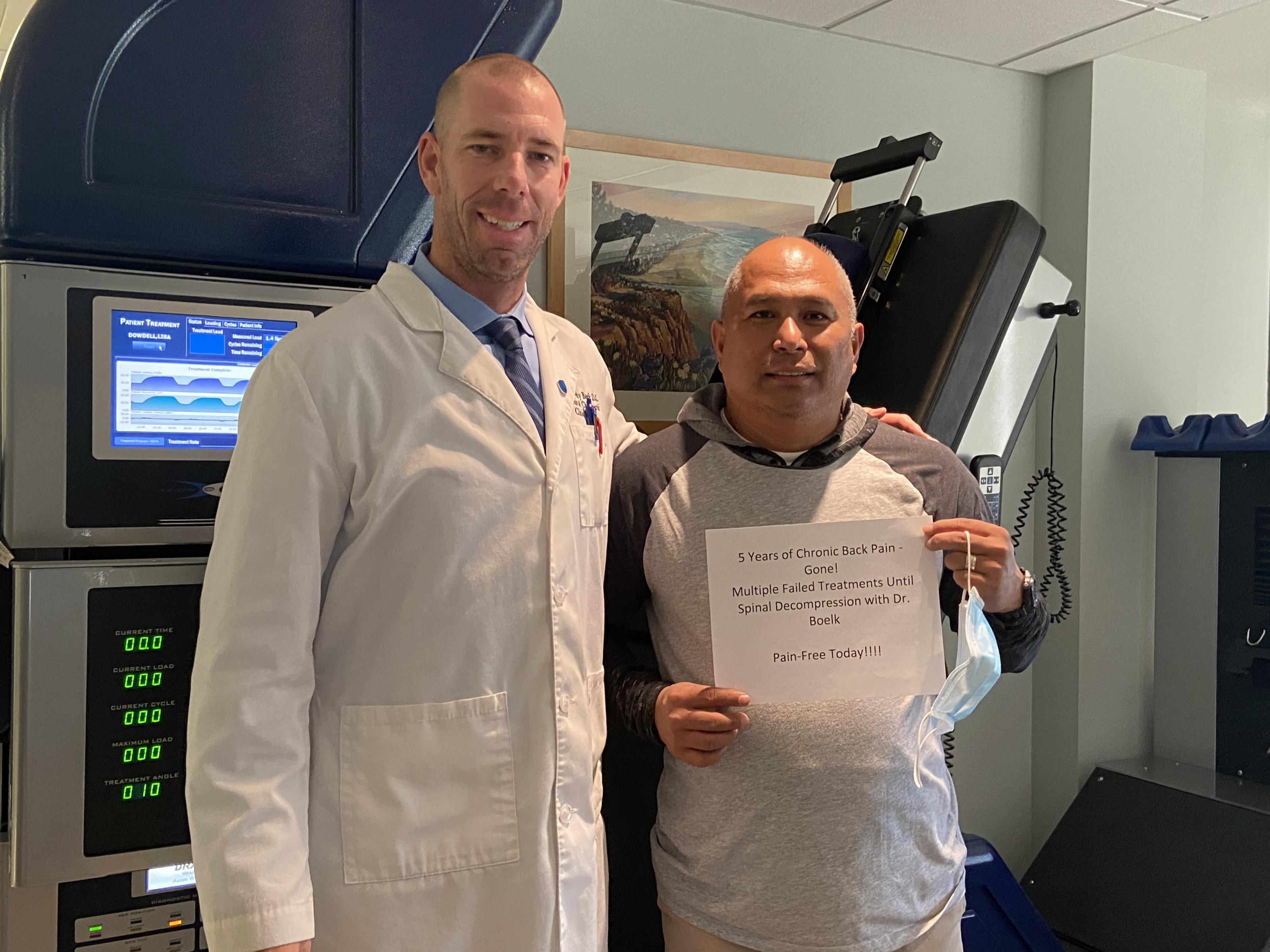
Dr. Cassidy James Boelk, DC, has spent more than 22 years specializing in spinal decompression and evaluating complicated cervical and lumbar spine conditions. His practice in Kearny Mesa is a short drive from Mira Mesa, Sorrento Valley, and Scripps Ranch.
A Patient's Experience With Sciatica and Nerve Pain
Persistent nerve pain can affect nearly everything someone does during the day, from sitting at work to exercising or getting a good night's sleep.
Yuri Fresia, a San Diego patient who experienced months of sciatica, shared his experience after undergoing spinal decompression treatment.
“I first came here suffering from sciatica pain for several months non stop. I tried many different non invasive treatments, pain killers but relief was just temporary. I heard about Dr. Boelk on social media and after reading other people testimonials about him I decided to try. It felt better since my first session. After 12 I felt I was improving a lot but still had room to get better so we decided trying 12 more. After 36 sessions I felt I was back to normal. I could get back to surf, jiu jitsu and work after 6 months away. Doctor helped me through the whole process, leaving me free to decide the next step and being honest about expectations. I totally recommend for all my friends that suffer from sciatica pain. It’s worth 100%.”
— Yuri Fresia, San Diego, CA
Yuri's testimonial describes sciatica, which can have several causes. His experience does not establish a confirmed diagnosis of foraminal stenosis, but it illustrates how significantly spinal nerve pain can affect someone's daily activities.
No-Charge Consultation for Mira Mesa Patients
If you've been diagnosed with cervical or lumbar foraminal stenosis and want to know whether spinal decompression may be appropriate, Dr. Boelk offers a limited number of No-Charge, No-Obligation Consultations each week.
These appointments are intended to help patients better understand their condition and determine what steps may be appropriate before committing to treatment.
During the consultation, patients can expect:
-
A discussion of their symptoms, including where the pain travels, when it began, and what activities make it better or worse.
-
A review of their medical history and previous treatments, such as physical therapy, chiropractic care, injections, and medications.
-
A discussion of MRI findings, when imaging is available, to help explain whether disc degeneration, herniations, arthritis, or other changes may be contributing to nerve irritation.
-
An explanation of the DRX9000 spinal decompression system, including how treatment works and what conditions may be appropriate.
-
An initial discussion of candidacy, including factors that could make spinal decompression unsuitable.
-
Recommendations for the next step, which may include a comprehensive examination, additional imaging, conservative care, or referral to another specialist.
Patients also have an opportunity to ask questions and learn about the treatment process, including typical scheduling and program options.
The No-Charge Consultation is not a complete examination or a final determination of candidacy. If additional testing is necessary, the office will explain the recommendations and any associated fees before proceeding.
Because Dr. Boelk personally conducts these consultations, only a limited number are offered each week. Appointments are scheduled on a first-come, first-served basis.
To request a consultation, call 619-298-0800.
The office has a 24/7 live answering service, and Spanish-speaking assistance is available.
What Is Foraminal Stenosis?
Along both sides of the spine are small openings called neural foramina. These openings allow spinal nerves to exit the spinal column and travel into different parts of the body.
Foraminal stenosis occurs when one or more of these openings become narrowed.
This narrowing can develop for several reasons.
Degenerative disc disease is one of the most common contributors. As a disc loses height, the space between the vertebrae decreases, which may reduce the room available for the nerve to exit.
Facet arthritis can also contribute. These joints sit toward the back of the spine and may enlarge or develop bone spurs over time.
Disc bulges and herniations can extend toward the nerve opening, while spondylolisthesis can change the alignment of the vertebrae and further reduce the available space.
Often, several of these changes occur together.
An MRI might show degenerative disc disease at L5-S1, reduced disc height, facet arthritis, and moderate bilateral foraminal stenosis.
The important question is whether those findings are actually responsible for the patient's symptoms.
Some people have significant narrowing on MRI without much pain. Others experience substantial nerve irritation with less dramatic imaging findings.
That's why Dr. Boelk considers the MRI findings alongside the patient's symptoms and neurological examination.
Why Foraminal Stenosis Can Cause Sciatica
When foraminal stenosis develops in the lower back, it can irritate or compress a nerve traveling into the leg.
At L5-S1, foraminal narrowing commonly affects the exiting L5 nerve root. Patients may experience pain traveling along the outside of the leg, sometimes reaching the top of the foot.
At L4-L5, narrowing may affect the exiting L4 nerve root, producing symptoms toward the front of the thigh, knee, or inner lower leg.
Some patients experience numbness, tingling, burning sensations, or weakness rather than significant back pain.
Others notice that standing or walking makes their symptoms worse.
One reason is that extending the lumbar spine can decrease the available space within the neural foramina.
However, symptoms vary considerably, especially when a patient has a combination of disc degeneration, arthritis, and a herniated disc.
The pattern of symptoms helps identify which nerve may be involved, but it doesn't replace a proper examination.
Can Foraminal Stenosis in the Neck Cause Arm Pain?
Yes. Cervical foraminal stenosis can cause pain, numbness, tingling, or weakness that travels into the shoulder, arm, or hand.
For example, narrowing at C5-C6 may affect the C6 nerve root. Symptoms can extend into the arm and toward the thumb.
Narrowing at C6-C7 may affect the C7 nerve root, sometimes causing symptoms toward the middle finger.
Some patients notice that turning or extending their neck increases the discomfort.
Others experience symptoms primarily when sitting at a desk, driving, or sleeping in certain positions.
However, shoulder conditions and peripheral nerve problems can cause similar symptoms.
Dr. Boelk evaluates the patient's history, neurological findings, and imaging before determining whether the cervical spine is responsible.
Can DRX9000 Spinal Decompression Help Foraminal Stenosis?
This depends on the cause of the narrowing.
Non-Surgical Spinal Decompression uses controlled mechanical traction to apply carefully regulated forces to the spine.
Traction can temporarily change spinal dimensions in certain circumstances and may reduce mechanical irritation associated with some disc-related conditions.
For patients whose foraminal narrowing is partly related to disc height loss or a disc bulge, spinal decompression may be considered as part of a conservative treatment program.
However, spinal decompression cannot remove bone spurs or reverse advanced facet arthritis.
It also cannot guarantee that a narrowed nerve opening will permanently enlarge.
Research specifically supporting motorized spinal decompression for foraminal stenosis remains limited. Some patients may experience symptom improvement, but treatment results vary.
At The Spinal Decompression & Chiropractic Center of San Diego, Dr. Boelk exclusively uses DRX9000 spinal decompression systems.
The clinic has seven tables for cervical and lumbar treatment, and treatment parameters are individualized according to the patient's condition and response.
Why Spinal Stability Matters
Two patients may have similar MRI reports but require very different treatment recommendations.
One patient may have moderate foraminal stenosis caused partly by disc degeneration and loss of disc height.
Another may have severe bony narrowing, advanced facet arthritis, and spondylolisthesis with abnormal movement between vertebrae.
Those are not necessarily appropriate candidates for the same treatment.
Dr. Boelk evaluates muscle strength, sensation, reflexes, spinal movement, and the relationship between symptoms and MRI findings.
When instability is suspected, standing lumbar X-rays, including flexion and extension views, may provide additional information.
This is particularly important when spondylolisthesis is present.
The objective is to determine whether the spine is stable enough for treatment and whether decompression is likely to be a reasonable option.
Some Patients Are Not Candidates for Spinal Decompression
Not everyone who visits Dr. Boelk's office is accepted for treatment.
Certain fractures, unstable spondylolisthesis, significant spinal instability, fusion hardware at the intended treatment level, and other medical conditions may make decompression inappropriate.
Patients with progressive neurological weakness may require prompt medical or surgical evaluation.
New bladder or bowel dysfunction, saddle anesthesia, or rapidly worsening leg weakness requires emergency medical assessment.
Sometimes surgery is the more appropriate recommendation.
Jeff J., a patient who traveled from Tucson, Arizona, described his experience after meeting with Dr. Boelk.
“I found this terrific practice on social media. I followed up and did my own research so I decided to pay them a visit. The place is clean, well organized and run by a very efficient receptionist. I met with the doctor and after a honest and forthright conversation, we both determined that surgery was my only option to correct my back issues. I will return as a customer when the time is right.”
— Jeff J., Tucson, AZ
Jeff's testimonial does not identify foraminal stenosis as his diagnosis. His experience illustrates the importance of recognizing when a different treatment approach is more appropriate.
What If Physical Therapy Hasn't Helped?
Physical therapy is often recommended for patients with foraminal stenosis.
Treatment may include strengthening, mobility exercises, activity modification, and movements designed to reduce nerve irritation.
Some patients respond well to flexion-based exercises. Others tolerate different movements depending on the location and cause of the narrowing.
If physical therapy hasn't provided adequate relief, the next step should be to reconsider what's causing the symptoms.
For some patients, traction-based treatment may be reasonable. Others may benefit more from continued rehabilitation, medications, injections, or a surgical consultation.
The goal is to improve function while avoiding unnecessary aggravation of the affected nerve.
Can Foraminal Stenosis Improve Without Surgery?
Yes. Many patients experience improvements in pain and daily function with conservative treatment, even when the structural narrowing remains.
For example, someone may be able to walk farther, sleep more comfortably, or experience less tingling without the MRI showing that the nerve opening has returned to normal.
However, significant bone spurs and advanced arthritic changes generally do not disappear through conservative treatment.
If symptoms remain disabling despite appropriate treatment, or if neurological deficits develop or progress, a surgical evaluation may be necessary.
Dr. Cassidy James Boelk, DC — Experience and Credentials
Dr. Boelk has spent more than 22 years specializing in Non-Surgical Spinal Decompression and evaluating patients with complicated cervical and lumbar spine conditions.
His professional background includes:
-
California Licensed Doctor of Chiropractic
-
Certified Spinal Decompression Doctor
-
Certified Pain-Free Performance Specialist (PPSC)
-
California X-ray Radiology Licensed Doctor
-
Founder, Non-Surgical Spinal Decompression Training Academy
-
Founding Member, American Spinal Decompression Society
-
Member, International Disc Education Association
Throughout his career, Dr. Boelk has accumulated experience with more than 100,000 spinal decompression sessions and has trained other healthcare professionals in spinal decompression protocols and patient selection.
His interest in spinal rehabilitation is also personal. After fracturing his back when he was younger and experiencing additional spinal injuries later in life, he developed a particular interest in spinal mechanics, rehabilitation, and conservative treatment options.
Today, his Kearny Mesa clinic has seven DRX9000 spinal decompression tables dedicated to treating cervical and lumbar conditions.
Patients from Mira Mesa, Sorrento Valley, Scripps Ranch, Rancho Peñasquitos, and throughout San Diego County visit the office for specialized evaluations.
Patients Travel From Outside San Diego for Spinal Decompression
Some patients travel from other parts of California, other states, and internationally to seek Dr. Boelk's expertise.
Lynn C., who traveled from Alaska, shared her experience with persistent leg pain.
“My name is Lynn. I am from Alaska, and I just want to say it was totally worth taking a trip to go to the Spinal Decompression & Chiropractic Center of San Diego. I was having pain radiating down my legs, I couldn’t sleep, I could barely walk.
After treatment I am back to shoveling snow, teaching school, taking walks. So, I just want to thank Dr. Boelk and the clinic, you guys are wonderful, and you have created such a wonderful, friendly, kind and truly caring atmosphere. I highly encourage anybody that might be considering spinal decompression therapy, it really makes a difference.”
— Lynn C., Alaska
Lynn's experience involved leg pain but does not establish a diagnosis of foraminal stenosis.
For patients traveling from outside San Diego, the office can explain the evaluation process, scheduling considerations, and which medical records may be helpful before arranging travel.
Not every patient will qualify for treatment.
Frequently Asked Questions About Foraminal Stenosis
Can foraminal stenosis cause numbness in the foot?
Yes. Lumbar foraminal stenosis can irritate a spinal nerve and cause numbness, tingling, or weakness in certain parts of the leg or foot.
Can cervical foraminal stenosis cause pain between the shoulder blades?
It can contribute to pain in the neck, shoulder blade region, or arm. However, other conditions can cause similar symptoms.
Is foraminal stenosis the same as a herniated disc?
No. Foraminal stenosis refers to narrowing of the nerve opening. A herniated disc is one possible cause of that narrowing.
Does spinal decompression remove bone spurs?
No. Spinal decompression cannot remove bone spurs or reverse advanced arthritis.
Can exercises make foraminal stenosis worse?
Certain movements may aggravate symptoms, particularly if they further narrow the affected nerve opening. Exercise recommendations should be individualized.
Does severe foraminal stenosis always require surgery?
No. Some patients improve with conservative care. However, persistent disabling symptoms or progressive neurological deficits may require surgical evaluation.
How many spinal decompression treatments are needed?
There is no single treatment schedule appropriate for everyone. Dr. Boelk considers the condition, neurological findings, severity of symptoms, and response to care before recommending a treatment plan.
Foraminal Stenosis Treatment Near Mira Mesa, CA
If you've been diagnosed with cervical or lumbar foraminal stenosis and continue experiencing sciatica, neck pain, arm pain, numbness, or tingling, understanding what's causing the nerve irritation is an important first step.
Dr. Cassidy James Boelk, DC, has spent more than 22 years helping patients with complicated spinal conditions explore appropriate non-surgical treatment options.
His approach begins with determining whether the patient's symptoms, imaging findings, and spinal stability make decompression reasonable.
Request a No-Charge Consultation
A limited number of No-Charge, No-Obligation Consultations are available each week.
During this appointment, Dr. Boelk will discuss your symptoms and treatment history, review available MRI findings when appropriate, explain how the DRX9000 system works, and discuss whether you may be a candidate or require further evaluation.
Patients can also ask questions about the treatment process and typical scheduling.
The consultation is not a comprehensive examination, and there is no obligation to begin treatment.
Because Dr. Boelk personally conducts these consultations, appointments are limited and scheduled on a first-come, first-served basis.
Call 619-298-0800 to request an appointment.
The office has a 24/7 live answering service. Hablamos Español.
The Spinal Decompression & Chiropractic Center of San Diego
Dr. Cassidy James Boelk, DC
5095 Murphy Canyon Road, Suite 300
San Diego, CA 92123
Phone: 619-298-0800
Website: www.SanDiegoBackCare.com
Serving Mira Mesa, Sorrento Valley, Scripps Ranch, Rancho Peñasquitos, Carmel Valley, and surrounding San Diego communities.