Does Spinal Decompression Help Foraminal Stenosis? | La Jolla, CA
If your MRI report mentions foraminal stenosis, you may have been told that one or more of the openings where nerves exit your spine have become narrowed.
For some people, this causes very little discomfort. For others, it can mean persistent neck pain, sciatica, numbness, tingling, or pain traveling into an arm or leg.
The question many patients ask is whether anything can be done to relieve the pressure on the nerve without surgery.
Non-Surgical Spinal Decompression may help certain patients with foraminal stenosis, but the cause and severity of the narrowing make a significant difference.
A narrowed nerve opening caused partly by disc height loss is different from one that has become severely restricted by bone spurs and advanced arthritis. Those conditions may look similar on an MRI report, but they don't necessarily respond to the same treatments.
Dr. Cassidy James Boelk, DC, has spent more than 22 years specializing in spinal decompression and evaluating patients with complicated cervical and lumbar spine conditions. Patients from La Jolla, University City, Pacific Beach, and throughout San Diego visit his Kearny Mesa clinic to find out whether they may be candidates for non-surgical care.
Start With a No-Charge Consultation
If you've been diagnosed with cervical or lumbar foraminal stenosis and continue to experience nerve pain, Dr. Boelk offers a limited number of No-Charge Consultations each week.
Patients can discuss their symptoms, learn about the DRX9000 spinal decompression system, and find out what information may be needed to determine whether treatment is appropriate.
If additional examination or imaging is necessary, the office can explain the next steps.
Call 619-298-0800 to schedule a No-Charge Consultation.
The Spinal Decompression & Chiropractic Center of San Diego is located at 5095 Murphy Canyon Road, Suite 300, San Diego, CA 92123.
What Happens When the Nerve Opening Becomes Narrowed?
The spinal nerves don't simply travel straight down the spine. At each level, nerves exit through small openings along the sides of the spinal column.
These openings are called neural foramina.
When there's enough room, the nerves can pass through without significant compression. But as the spine changes over time, the openings can become smaller.
One of the most common reasons is degenerative disc disease.
The discs between the vertebrae help maintain the space between the bones. As a disc loses height, the opening where the nerve exits may also become smaller.
Facet joint arthritis can contribute to the problem. These joints sit toward the back of the spine, and over time they may enlarge or develop bone spurs.
Disc bulges, herniations, and spondylolisthesis can also contribute to narrowing.
Sometimes several of these conditions are present at the same level.
For example, an MRI might describe severe bilateral foraminal stenosis at L5-S1 with significant disc height loss and facet arthropathy.
That tells us the openings are narrowed, but it doesn't automatically tell us how much of the patient's pain is coming from those findings.
Some people have considerable narrowing on MRI without significant symptoms.
Others experience substantial nerve pain with less dramatic imaging findings.
That's why the examination matters.
Why Foraminal Stenosis Can Cause Sciatica
When foraminal stenosis develops in the lumbar spine, it can irritate or compress a nerve traveling into the leg.
At L5-S1, foraminal stenosis commonly affects the exiting L5 nerve root.
Patients may experience pain traveling into the buttock, along the outside of the leg, or toward the top of the foot. Some also experience numbness, tingling, or weakness.
At L4-L5, narrowing of the neural foramen may affect the exiting L4 nerve root, potentially producing symptoms toward the front of the thigh, knee, or inner lower leg.
Not everyone experiences the same symptoms.
Some patients feel worse when standing or walking. Others notice discomfort when arching backward or standing upright for extended periods.
Extension can reduce the available space within the neural foramina, which may aggravate certain types of nerve compression.
But if a patient also has a disc herniation, their symptoms may behave differently.
Dr. Boelk evaluates these patterns rather than assuming every patient with stenosis should perform the same exercises or receive the same treatment.
What If the Foraminal Stenosis Is in Your Neck?
Cervical foraminal stenosis can produce symptoms that travel into the shoulder, arm, or hand.
Patients sometimes describe a burning sensation down one arm, tingling in their fingers, or weakness when lifting or gripping objects.
For example, narrowing at C5-C6 may affect the C6 nerve root, while narrowing at C6-C7 may affect C7.
Certain neck positions may increase symptoms, particularly movements that further reduce space around the affected nerve.
However, shoulder injuries and peripheral nerve problems can cause similar complaints.
Before recommending cervical spinal decompression, Dr. Boelk considers the patient's symptoms, neurological examination, and MRI findings.
The goal is to determine whether the nerve is actually being affected by the cervical spine.
Can the DRX9000 Create More Space Around the Nerve?
This is an important question, and the answer depends on what's causing the narrowing.
Non-Surgical Spinal Decompression uses controlled mechanical traction to apply specific forces to the spine.
Traction can temporarily change spinal dimensions in some circumstances. For selected patients, it may reduce mechanical irritation associated with disc-related conditions.
When foraminal narrowing is partly related to loss of disc height or a disc bulge, decompression may be considered as part of conservative care.
However, it is important to understand what spinal decompression cannot do.
It cannot remove bone spurs, reverse advanced facet arthritis, or guarantee permanent enlargement of a narrowed neural foramen.
The clinical evidence specifically supporting motorized spinal decompression for foraminal stenosis remains limited. Some patients report improvement, but there is no guarantee that the treatment will relieve nerve compression.
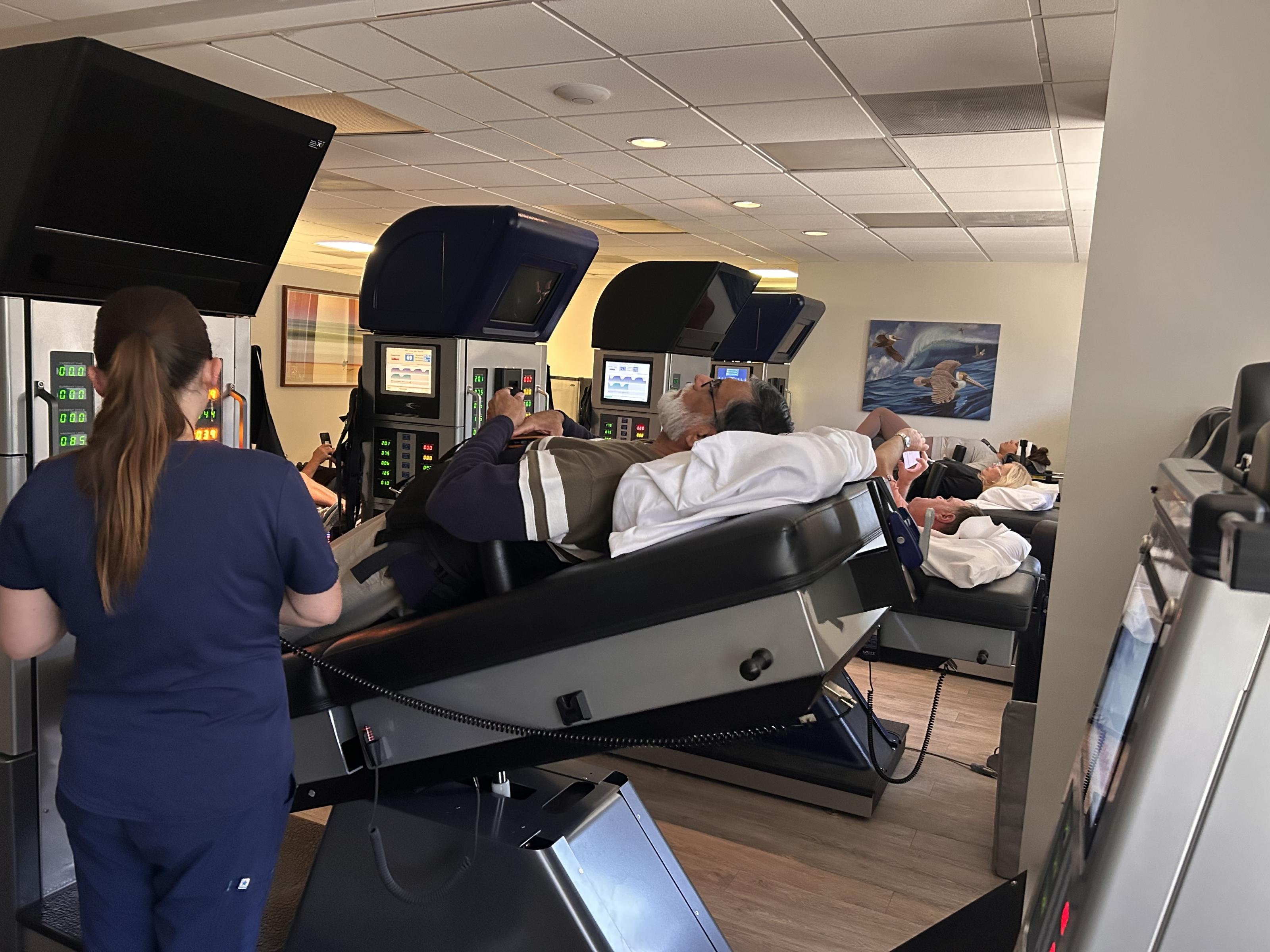
Dr. Boelk exclusively uses DRX9000 spinal decompression systems at his San Diego clinic, which has seven tables for cervical and lumbar treatment.
He emphasizes careful patient selection because the same treatment is not appropriate for every type of stenosis.
What Patients With Persistent Nerve Pain Have Experienced
Nerve pain can affect much more than the area where the symptoms begin.
Some patients have difficulty sleeping, driving, exercising, or getting through a normal workday.
Brian Perrotta, a San Diego patient who experienced severe sciatica associated with a herniated disc, shared his experience:
⭐⭐⭐⭐⭐
“I highly recommend Dr. Cassidy Boelk, DC and the team at The Spinal Decompression and Chiropractic Center. I came in with severe sciatica and a herniated disc, and his treatments have made a world of difference. He and his staff are both professional and genuinely caring, creating a welcoming and supportive environment. The treatments were not only highly effective but also tailored to my specific needs. I’m grateful for the care I received and the significant improvement in my quality of life.”
— Brian Perrotta, San Diego, CA
Brian's condition involved a herniated disc and sciatica. His testimonial does not establish that he had foraminal stenosis, but it illustrates how significantly lumbar nerve irritation can affect daily life.
Why Two Patients With Foraminal Stenosis May Need Different Treatments
Imagine two patients whose MRI reports both describe moderate foraminal stenosis.
The first has narrowing related primarily to disc degeneration and loss of disc height. Their spine is stable, and their symptoms match the affected nerve.
The second has advanced facet arthritis, substantial bone spurs, and spondylolisthesis with abnormal movement between vertebrae.
Although both patients have foraminal stenosis, their conditions are quite different.
For the first patient, conservative treatment may be reasonable, and spinal decompression might be considered after a proper evaluation.
For the second, instability and significant bony narrowing may make decompression inappropriate.
Dr. Boelk reviews the MRI, evaluates muscle strength and sensation, checks reflexes, and considers how symptoms respond to different movements.
When spinal instability is suspected, standing X-rays, including flexion and extension views, may provide additional information.
These findings help determine whether a patient may be a candidate or should be referred for another type of care.
Why Some Patients Are Not Candidates for Spinal Decompression
Not everyone who visits Dr. Boelk's office is accepted for treatment.
Certain fractures, unstable spondylolisthesis, significant spinal instability, fusion hardware at the intended treatment level, and other medical conditions can make spinal decompression inappropriate.
Patients with progressive neurological weakness may require prompt medical or surgical evaluation.
New bladder or bowel dysfunction, saddle anesthesia, or rapidly worsening leg weakness requires emergency medical assessment.
Sometimes surgery is the more appropriate option.
Jan H., a patient from San Marcos, shared his experience after Dr. Boelk determined that he should not undergo treatment while a cervical fracture was healing.
⭐⭐⭐⭐⭐
“I decided to see Dr. Boelk after a pretty gnarly motocoss neck injury. At the Hospital I was at, I felt I was getting pressured into a surgery which I refused. A friend of a friend referred him after Dr. Boelk successfully treated his broken back.
Dr. Boelk is a compassionate individual who truly cares about his patients. He looked at my MRI images, explained what he saw and potential routes for recovery. He could not treat me as I have to wait until the fracture in my neck heals, but the level of professionalism, compassion, caring and knowledge displayed by him was exceptional.
He also recommended to seek an additional opinion form another neurosurgeon. My experience was that he really cares and he's not someone who would take advantage of the situation someone's in (unlike some other doctors). I will definitely be back and already recommended him to others as well! Thank you Dr. Boelk!”
— Jan H., San Marcos, CA
Although Jan's injury was not foraminal stenosis, his experience reflects the importance of identifying patients who should not undergo spinal decompression.
Can Foraminal Stenosis Improve Without Surgery?
Yes. Many patients experience improvements in pain and function with conservative treatment, even when the underlying structural narrowing remains.
Physical therapy, appropriate strengthening, activity modification, medications, and other treatments may help reduce symptoms.
Some patients benefit from epidural steroid injections, although these do not remove the narrowing itself.
For selected patients, traction-based care may also be considered.
However, advanced bone spurs and significant arthritic changes generally do not disappear through conservative treatment.
The important distinction is that symptom improvement does not necessarily mean the neural foramen has returned to its original size.
If symptoms remain disabling despite appropriate treatment, or if neurological deficits develop or progress, a surgical evaluation may be necessary.
Dr. Cassidy James Boelk, DC — More Than 22 Years of Spinal Decompression Experience
Dr. Boelk has devoted more than two decades to evaluating and treating patients with complicated cervical and lumbar conditions.
His professional credentials and affiliations include:
-
Certified Spinal Decompression Doctor.
-
Certified Pain-Free Performance Specialist (PPSC).
-
California X-ray Radiology Licensed Doctor.
-
Founder of the Non-Surgical Spinal Decompression Training Academy.
-
Founding Member of the American Spinal Decompression Society.
-
Member of the International Disc Education Association.
Throughout his career, Dr. Boelk has accumulated experience with more than 100,000 spinal decompression sessions and has trained other healthcare professionals in spinal decompression protocols and techniques.
His interest in spinal rehabilitation is also personal.
After fracturing his back when he was younger and dealing with additional spinal problems later in life, he developed a strong interest in spinal mechanics, rehabilitation, and non-surgical treatment approaches.
Today, his Kearny Mesa clinic exclusively uses DRX9000 spinal decompression systems, with seven tables available for cervical and lumbar treatment.
Patients from La Jolla, University City, Pacific Beach, and throughout San Diego County visit the office for specialized evaluations.
Patients Travel to San Diego for Spinal Decompression
Some patients travel from other parts of California, other states, and internationally to seek Dr. Boelk's expertise.
Lynn C., who traveled from Alaska, shared her experience:
⭐⭐⭐⭐⭐
“My name is Lynn. I am from Alaska, and I just want to say it was totally worth taking a trip to go to the Spinal Decompression & Chiropractic Center of San Diego. I was having pain radiating down my legs, I couldn’t sleep, I could barely walk.
After treatment I am back to shoveling snow, teaching school, taking walks. So, I just want to thank Dr. Boelk and the clinic, you guys are wonderful, and you have created such a wonderful, friendly, kind and truly caring atmosphere. I highly encourage anybody that might be considering spinal decompression therapy, it really makes a difference.”
— Lynn C., Alaska
Lynn's testimonial describes leg pain but does not establish a diagnosis of foraminal stenosis.
Patients traveling from outside San Diego are encouraged to contact the office before arranging travel. The team can explain the evaluation process, scheduling considerations, and what medical records may be useful.
Not every patient will qualify for treatment.
Common Questions About Foraminal Stenosis
Can foraminal stenosis cause pain down one arm or leg?
Yes. Foraminal stenosis can irritate or compress a spinal nerve, producing symptoms that travel into an arm or leg depending on the affected spinal level.
Is foraminal stenosis the same as a pinched nerve?
Foraminal stenosis refers to narrowing of the nerve opening. If that narrowing irritates or compresses a nerve, it may cause symptoms commonly described as a pinched nerve.
Can exercises make foraminal stenosis worse?
Certain movements may aggravate symptoms, particularly if they further narrow the affected nerve opening. Exercise recommendations should be based on the individual condition.
Can spinal decompression reverse foraminal stenosis?
There is not strong evidence that motorized spinal decompression permanently reverses foraminal narrowing. Some patients may experience symptom improvement, but significant bone spurs and advanced arthritic changes generally remain.
Does severe foraminal stenosis always require surgery?
No. The decision depends on symptoms, neurological findings, functional limitations, and response to conservative treatment. Progressive neurological deficits or persistent disabling symptoms may warrant surgical evaluation.
Can foraminal stenosis occur at multiple spinal levels?
Yes. Degenerative changes can affect several levels of the cervical or lumbar spine. Identifying which level is responsible for symptoms is an important part of the evaluation.
Looking for Foraminal Stenosis Treatment Near La Jolla?
If you've been diagnosed with cervical or lumbar foraminal stenosis and continue to experience neck pain, lower back pain, sciatica, or symptoms traveling into an arm or leg, it may be worth having your condition evaluated more closely.
Dr. Cassidy James Boelk, DC, has spent more than 22 years helping patients with complicated spinal conditions understand their treatment options.
Not everyone with foraminal stenosis is a candidate for spinal decompression. Determining whether treatment is appropriate begins with understanding the cause of the narrowing and the patient's neurological findings.
A limited number of No-Charge Consultations are available each week.
Call 619-298-0800 to schedule your consultation.
The Spinal Decompression & Chiropractic Center of San Diego
Dr. Cassidy James Boelk, DC
Certified Spinal Decompression Doctor
Certified Pain-Free Performance Specialist
5095 Murphy Canyon Road, Suite 300
San Diego, CA 92123
Phone: 619-298-0800
Website: www.SanDiegoBackCare.com
Serving La Jolla, University City, Pacific Beach, Bird Rock, Torrey Pines, and surrounding San Diego communities.