Do I Need Surgery for a Herniated Disc? – Mira Mesa, CA
Pain Alone Does Not Determine Whether You Need Surgery
A herniated disc can cause extraordinary pain. It may make sitting, standing, sleeping, driving, or walking nearly impossible.
When the pain becomes severe, many patients understandably believe surgery must be the next step. However, the intensity of the pain does not, by itself, determine whether an operation is necessary.
The more important questions include:
-
Is the affected nerve still functioning normally?
-
Is muscle weakness developing or progressing?
-
Is the spine stable?
-
Do the symptoms match the disc injury shown on the MRI?
-
Are emergency neurological symptoms present?
-
Can the condition be treated safely without surgery?
Some patients with severe pain remain reasonable candidates for non-surgical treatment. Other patients may report less pain but have progressing weakness that requires prompt surgical evaluation.
That is why an individual examination is more valuable than making the decision based only on pain intensity or the wording of an MRI report.
She Was Using a Cane and Scheduled for a Surgical Evaluation
⭐⭐⭐⭐⭐
“Last year, I spent three months constantly going back and forth between doctor’s appointments and urgent care. The pain was unbearable. I was taking medication regularly just to get through the day.
Getting out of bed was excruciating, and walking or standing felt like torture. Every step filled me with dread.
In December, my doctor finally ordered an MRI. That’s when I learned I had an extruded disc pressing on my L5 nerve, which affects the leg and foot. My doctor scheduled two follow-up appointments: one for pain management and spinal injections, and another to evaluate me for surgery.
Then I discovered spinal decompression therapy. I was thrilled to find a non-invasive alternative. I never ended up needing either of those appointments.
Now, I’m walking regularly and standing up straight—something I couldn’t do before. When I first sought help, I was so hunched over that I had to use a cane just to move forward.
Because of the pain, I hadn’t exercised in months. But now, I’m doing a program called 75 Hard, which requires not one but two 45-minute workouts per day, and I've even gotten back to lifting weights!
I’m so thankful I found this place. Dr. Boelk and the staff are incredibly friendly and polite—it’s always a pleasure to come in.
The environment is so relaxing that I look forward to each visit. I truly thank God for leading me to this alternative. It’s made such a difference in my life.”
— Amanda, San Diego, CA
Amanda’s experience does not mean every extruded disc can be treated without surgery, nor can another patient be promised the same result.
Her story does demonstrate something important: even severe pain, difficulty walking, an extruded disc, and a scheduled surgical evaluation do not automatically mean surgery is the only appropriate option.
Find Out Whether You Are a Candidate Before Making the Decision
If you have a bulging, herniated, or extruded disc, call 619-298-0800 to schedule a no-charge, no-obligation consultation with Dr. Cassidy Boelk, DC.
Bring your MRI images if you have them—not only the written report. Dr. Boelk will review your condition and tell you honestly whether non-surgical spinal decompression may be appropriate or whether you should pursue another direction.
The office is located in Kearny Mesa, a convenient drive from Mira Mesa.
Call 619-298-0800. Our answering service is available 24 hours a day, seven days a week. Hablamos Español.
Severe Pain Is Not the Same as Progressive Nerve Damage
Pain is a warning signal, but it does not always reveal how well a spinal nerve is functioning.
A herniated lumbar disc may irritate a nerve and cause:
-
Lower-back pain
-
Sciatica
-
Burning pain in the leg
-
Numbness or tingling
-
Pain while sitting
-
Difficulty standing upright
-
Pain while coughing or sneezing
A cervical disc herniation may cause:
-
Neck or shoulder-blade pain
-
Pain traveling down the arm
-
Hand or finger numbness
-
Tingling
-
Reduced grip strength
-
Difficulty sleeping or turning the head
These symptoms need to be evaluated, but they do not automatically require surgery.
Progressive loss of nerve function is more concerning. Increasing difficulty lifting the foot, gripping an object, controlling an arm or leg, or walking normally may indicate that the nerve is losing function.
The distinction between pain and progressing neurological loss can significantly change the recommended course of care.
When a Herniated Disc May Require Urgent Medical Attention
Certain symptoms should not be treated as a routine back or neck problem.
Seek urgent medical evaluation for:
-
New loss of bladder or bowel control
-
Numbness in the groin, inner thighs, or saddle region
-
Rapidly progressing muscle weakness
-
Sudden loss of coordination
-
Significant symptoms following a serious accident or trauma
-
New difficulty controlling an arm or leg
These symptoms can indicate serious neurological involvement. Delaying appropriate medical or surgical evaluation may place nerve function at risk.
The goal is not to avoid surgery at all costs. It is to help appropriate patients avoid unnecessary surgery while recognizing when an operation or surgical consultation is the safer choice.
Why Dr. Boelk Personally Reviews MRI Images
An MRI report summarizes what the radiologist sees, but the report does not always identify which finding is producing the symptoms.
A report may describe multiple bulging discs, degenerative changes, narrowing, protrusions, or arthritis. Some of those findings may be clinically important, while others may not be contributing to the patient’s current pain.
Dr. Boelk compares the actual MRI images with:
-
The patient’s pain pattern
-
Where numbness or tingling occurs
-
Muscle-strength findings
-
Reflex changes
-
Orthopedic and neurological examination findings
-
Positions that increase or decrease symptoms
-
Previous treatment and its results
-
Prior spinal surgery
-
Weight-bearing spinal alignment
-
Evidence of instability
When indicated, weight-bearing and flexion-extension X-rays can provide additional information about how the spine behaves while standing and moving.
This helps answer two essential questions: Does the disc injury match the symptoms, and can the patient be treated safely?
What If the MRI Says the Herniation Is Large?
Patients frequently assume that the size of a herniation automatically determines whether surgery is necessary.
Size matters, but location can be just as important.
A smaller herniation positioned directly against a nerve may cause intense sciatica, numbness, or weakness. A larger-appearing herniation may produce fewer symptoms when it is not pressing on a sensitive structure.
Dr. Boelk also considers whether the injury is:
-
A broad disc bulge
-
A contained protrusion
-
A focal herniation
-
An extrusion
-
Pressing against or displacing a nerve
-
Associated with spinal or foraminal narrowing
The complete clinical picture—not one measurement—should guide the decision.
When Non-Surgical Treatment May Be Reasonable
Non-surgical treatment may be considered when:
-
The spine appears stable
-
Symptoms and imaging indicate a disc-related condition
-
Muscle weakness is not rapidly progressing
-
No neurological emergency is present
-
Surgery has been discussed but is not considered urgent
-
The patient has not improved sufficiently with other conservative care
-
Decompression can be performed safely
Some patients seek an evaluation immediately after receiving their MRI. Others have already tried medication, chiropractic adjustments, physical therapy, acupuncture, or spinal injections.
Failure to improve with one type of treatment does not necessarily mean every non-surgical option has been exhausted. Different approaches affect the injured area in different ways.
It also does not mean spinal decompression will help every patient. Proper patient selection remains one of the most important parts of care.
How Non-Surgical Spinal Decompression May Help
A herniated disc may produce symptoms through a combination of mechanical pressure and inflammation around a spinal nerve.
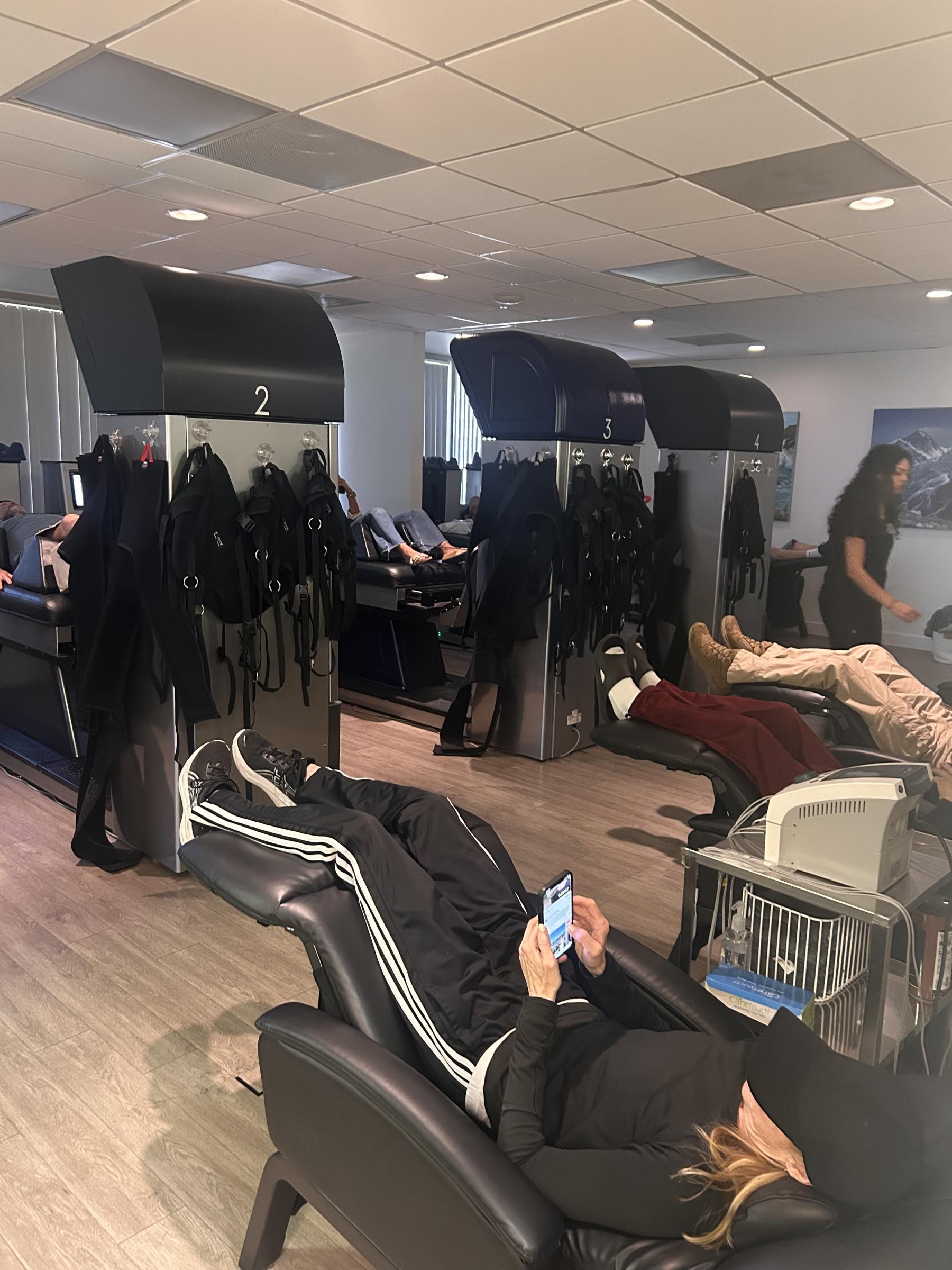
Non-surgical spinal decompression uses controlled pulling and releasing cycles directed toward a targeted spinal level. It is more specific than simply stretching the entire back or neck.
Dr. Boelk uses DRX9000 systems designed for lumbar and cervical disc conditions. Treatment variables may include:
-
The spinal level being targeted
-
Patient positioning
-
Treatment angle
-
Starting force
-
Length and number of cycles
-
Progression from one visit to the next
-
The patient’s response to treatment
The objective is to improve the environment around the injured disc and irritated nerve without surgery.
As the patient becomes ready, appropriate rehabilitation is added to improve strength, movement, and spinal stability. Reducing pain is important, but it is not the end of the process. The patient must also rebuild the capacity needed for work, exercise, recreation, and everyday life.
When Spinal Decompression Is Not Appropriate
Not everyone who wants to avoid surgery will qualify for decompression.
Treatment may be inappropriate or require additional medical clearance when a patient has:
-
An unstable spinal condition
-
An unhealed spinal fracture
-
Surgical hardware or fusion at the intended treatment level
-
A neurological emergency
-
Certain severe bone, vascular, or systemic conditions
-
Pregnancy when lumbar decompression is being considered
-
Another diagnosis that does not match a disc-related problem
Previous spinal surgery does not automatically exclude every patient. The type of surgery, location of hardware, intended treatment level, and stability of the spine must all be considered.
If Dr. Boelk does not believe decompression is safe or appropriate, he will explain why.
An Honest Consultation May Lead to a Surgical Referral
⭐⭐⭐⭐⭐
“I found this terrific practice on social media. I followed up and did my own research, so I decided to pay them a visit.
The place is clean, well organized and run by a very efficient receptionist.
I met with the doctor and after an honest and forthright conversation, we both determined that surgery was my only option to correct my back issues.
I will return as a customer when the time is right.”
— Jeff J., Tucson, AZ
Jeff hoped to find a non-surgical solution, but Dr. Boelk did not recommend placing him into a decompression program.
They agreed that surgery was the appropriate direction.
A no-charge consultation should provide useful, honest guidance. It should not be used to pressure every person into the same treatment.
Why Mira Mesa Patients Seek Out Dr. Cassidy Boelk, DC
Dr. Boelk has focused his professional career on spinal decompression, disc injuries, sciatica, radiating arm pain, and difficult neck and lower-back conditions.
His experience includes:
-
Certified Spinal Decompression Doctor
-
Certified Pain-Free Performance Specialist
-
More than 22 years of clinical experience
-
More than 100,000 spinal decompression treatments performed
-
Founder of the Non-Surgical Spinal Decompression Training Academy
-
Trains other doctors in spinal decompression protocols and techniques
-
Founding Member of the American Spinal Decompression Society
-
Member of the International Disc Education Association
-
California-licensed doctor with X-ray radiography certification
-
Seven DRX9000 systems: four lumbar and three cervical
Dr. Boelk has also spent thousands of hours rehabilitating his own serious neck and lower-back injuries. That personal experience has shaped how he combines decompression with rehabilitation, spinal-stability training, and realistic activity guidance.
Patients travel to the practice from throughout San Diego County, other parts of California, other states, Mexico, Canada, Spain, and the United Kingdom.
You May Have More Than One Reasonable Option
A recommendation for surgery deserves to be taken seriously. However, if your condition is not an emergency, you may have time to determine whether an appropriate non-surgical option remains available.
A consultation does not obligate you to start treatment. If Dr. Boelk does not believe spinal decompression is appropriate, he will tell you.
Schedule a No-Charge, No-Obligation Consultation
The Spinal Decompression & Chiropractic Center of San Diego
5095 Murphy Canyon Road, Suite 300
San Diego, CA 92123
Call: 619-298-0800
Website: www.SanDiegoBackCare.com
24/7 Answering Service
Hablamos Español
Call 619-298-0800 to schedule a no-charge, no-obligation consultation with Dr. Cassidy Boelk, DC. Bring your MRI images if available and find out whether non-surgical spinal decompression may be a reasonable option before committing to surgery.