Do I Need Surgery for a Herniated Disc? – Kearny Mesa, CA
Surgery Is Not the Only Possible Next Step
When an MRI shows a herniated disc, many patients immediately assume they need surgery.
That fear becomes even stronger when the pain travels into an arm or leg, walking becomes difficult, or numbness and tingling start to appear.
A herniated disc can be serious, but the diagnosis by itself does not determine whether surgery is necessary. Many patients can begin with non-surgical treatment when the spine is stable and there are no signs of a neurological emergency.
The decision depends on several factors: where the disc is injured, whether it is pressing on a nerve, the severity of the symptoms, muscle strength, spinal stability, previous treatment, and any history of spinal surgery.
His Disc Bulged Again After Surgery
⭐⭐⭐⭐⭐
“I have been dealing with back pain for several years. It got so bad that I had surgery five years ago for a bulging disc.
About five months ago, the disc bulged again, hitting my sciatic nerve and creating pain in my legs that made me want to cry—it hurt so bad.
After trying so many other options, I was fortunate enough to find The Spinal Decompression & Chiropractic Center of San Diego.
After just a few sessions, I noticed a difference. Now, after being there for the past few months, I'm able to go about my normal life again.
What a blessing it was to find a doctor who genuinely cares and knows how to help people in my situation.
Thank you, Dr. Boelk!”
— Anthony K., San Diego, CA
Anthony had already undergone surgery, but the disc problem and sciatic nerve pain returned. His experience is a good example of why every reasonable option should be considered before deciding what to do next.
No treatment can guarantee the same result for another patient, and previous surgery can affect whether decompression is appropriate.
Find Out Whether You Have a Non-Surgical Option
If you have been diagnosed with a bulging, herniated, or extruded disc, call 619-298-0800 to schedule a no-charge, no-obligation consultation with Dr. Cassidy Boelk, DC.
Bring your MRI images if available. Dr. Boelk will review your condition and tell you honestly whether you appear to be a candidate for non-surgical spinal decompression or whether another direction makes more sense.
The office is located in Kearny Mesa.
Call 619-298-0800 to schedule. Hablamos Español.
What Does a Herniated Disc Actually Mean?
The spinal discs sit between the vertebrae. They help absorb force while allowing the spine to bend and move.
A disc has a tough outer layer surrounding a softer center. When the outer portion becomes damaged, disc material can extend outward. Depending on the appearance and severity, the MRI may describe the injury as a bulge, protrusion, herniation, or extrusion.
The disc itself can be painful, but symptoms often become more severe when the injury irritates a nearby spinal nerve.
A lumbar herniation may cause sciatica, leg pain, numbness, tingling, or weakness in the foot.
A cervical herniation may cause pain near the shoulder blade, pain traveling down the arm, hand numbness, tingling, or reduced grip strength.
These symptoms do not automatically mean surgery is necessary, but they do need to be properly evaluated.
When Non-Surgical Treatment May Be Reasonable
A patient may be able to begin with non-surgical treatment when:
-
The spine appears stable
-
Weakness is not rapidly progressing
-
There is no loss of bladder or bowel control
-
Symptoms and imaging suggest a disc-related problem
-
Surgery has been discussed but is not considered urgent
-
The patient has tried other conservative treatments without enough improvement
-
The condition can be treated safely
The size of the herniation is only one part of the decision. Dr. Boelk also needs to know where the disc material is located, which nerve is affected, how long the symptoms have been present, and whether the physical examination matches the MRI.
When Surgery May Be the Better Choice
There are situations in which surgery should not be delayed.
Seek urgent medical attention for new loss of bladder or bowel control, numbness in the groin or saddle region, rapidly progressing weakness, or sudden difficulty controlling an arm or leg.
Surgery may also be the right direction when the spine is unstable, the condition cannot be safely treated with decompression, or a reasonable course of non-surgical treatment has failed.
Dr. Boelk’s goal is not to tell every patient to avoid surgery. It is to help appropriate patients avoid an unnecessary operation while directing others to a surgeon when that is the safer choice.
How Non-Surgical Spinal Decompression May Help
A herniated disc can create both pressure and inflammation around a spinal nerve.
Non-surgical spinal decompression uses controlled pulling and releasing cycles to reduce pressure at a targeted spinal level. The treatment is adjusted according to the disc involved, the patient’s symptoms, imaging, body type, and response.
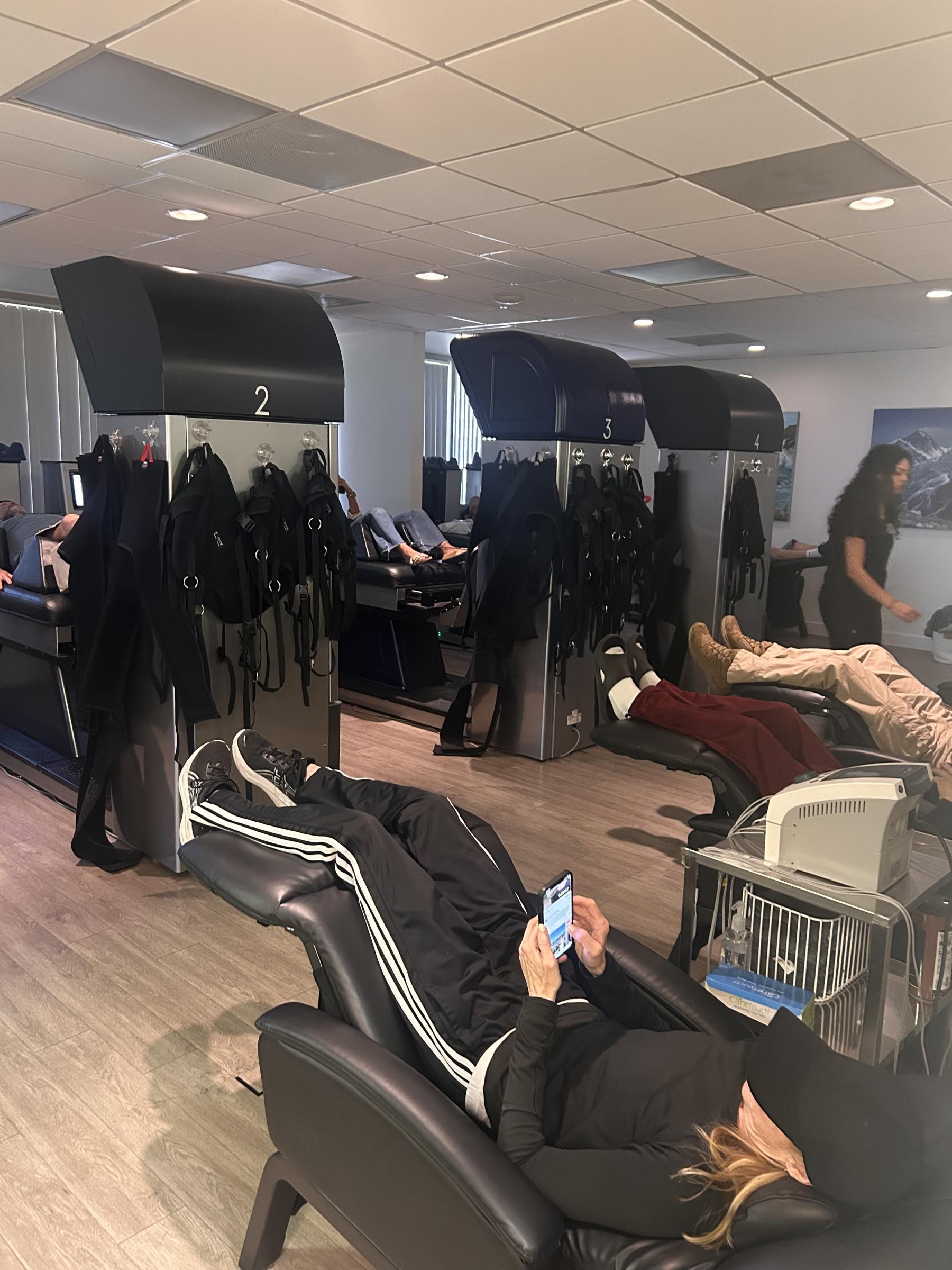
Dr. Boelk uses DRX9000 systems specifically configured for lumbar and cervical treatment. His office has four lumbar and three cervical DRX9000 machines.
The goal is to improve the environment surrounding the injured disc and irritated nerve. When symptoms begin settling, rehabilitation can then be used to improve strength, movement, and spinal stability.
The machine alone is not the treatment plan. Patient selection, accurate settings, treatment frequency, activity changes, and rehabilitation all matter.
Why Some People Continue Hurting After Surgery
Surgery can be necessary and highly beneficial for certain patients. However, it does not make the spine immune to future problems.
Pain may return because:
-
The same disc becomes irritated again
-
A nearby disc becomes damaged
-
Scar tissue affects a spinal nerve
-
Weakness or instability was never fully addressed
-
The patient returns to demanding activity without enough rehabilitation
-
The original pain had more than one cause
A patient who has already undergone surgery must be evaluated carefully. Some postsurgical patients may still qualify for decompression, while others should not receive it because of hardware, fusion, instability, or other factors.
Why Dr. Boelk Reviews the MRI Himself
The written MRI report is helpful, but it does not always explain which finding is producing the symptoms.
Some people have large-looking disc injuries with relatively manageable symptoms. Others have a smaller injury in exactly the wrong location and develop severe nerve pain.
Dr. Boelk compares the actual images with the patient’s pain pattern, numbness, weakness, reflexes, examination findings, and previous treatment.
When appropriate, weight-bearing and flexion-extension X-rays may also be used to evaluate alignment and spinal stability.
The goal is to determine whether the disc injury matches the patient’s symptoms and whether decompression can be performed safely.
Not Every Postsurgical Patient Is a Candidate
⭐⭐⭐⭐⭐
“Very nice Dr. and honest! I would definitely recommend anyone who hasn't had metal put in their back in a surgery to go to him and give his program a shot.
I believe it would definitely help—just not in my personal case, as I have a lot of hardware in my back.
But I'm glad I took the time to meet with him. It was very informative all around.”
— Toni W., Lake Elsinore, CA
Toni wanted to explore spinal decompression, but the hardware in her back made her condition unsuitable for treatment.
She was not placed into a program simply because she wanted to avoid another operation.
Not every person who has undergone spinal surgery is automatically excluded. The location of the surgery, presence of hardware, spinal stability, and intended treatment level all need to be reviewed.
If Dr. Boelk does not believe decompression is appropriate, he will explain why.
Why Patients Seek Out Dr. Cassidy Boelk, DC
Dr. Boelk’s practice is focused on spinal decompression, herniated discs, sciatica, radiating arm pain, and difficult neck and back conditions.
His background includes:
-
Certified Spinal Decompression Doctor
-
Certified Pain-Free Performance Specialist
-
More than 21 years of clinical experience
-
Over 100,000 spinal decompression treatments performed
-
Founder of the Non-Surgical Spinal Decompression Training Academy
-
Trains other doctors in spinal decompression protocols and techniques
-
Founding Member of the American Spinal Decompression Society
-
Member of the International Disc Education Association
-
California-licensed doctor with X-ray radiography certification
-
Seven DRX9000 systems: four lumbar and three cervical
Dr. Boelk has also spent thousands of hours rehabilitating his own neck and lower-back injuries. That experience has influenced how he combines decompression with rehabilitation and spinal-stability training.
Patients seek his help from throughout California, other states, Mexico, Spain, and the United Kingdom.
Before You Commit to Surgery, Understand Your Options
If surgery has been recommended but your condition is not an emergency, it is reasonable to find out whether a non-surgical option may still be available.
A consultation does not commit you to treatment.
Schedule a No-Charge, No-Obligation Consultation
The Spinal Decompression & Chiropractic Center of San Diego
5095 Murphy Canyon Road, Suite 300
San Diego, CA 92123
Call: 619-298-0800
Website: www.SanDiegoBackCare.com
Hablamos Español
Call 619-298-0800 to schedule a no-charge, no-obligation consultation with Dr. Cassidy Boelk, DC. Bring your MRI if available and find out whether non-surgical spinal decompression may be a reasonable option before moving forward with surgery.