DO ALL HERNIATED DISCS NEED SURGERY? – SAN DIEGO, CA
Sciatica, Disc Herniations, MRI Findings & Non-Surgical Treatment Options Explained
One of the most common questions I hear from patients suffering from a herniated disc is:
"Do I Need Surgery?"
It's a fair question.
Many patients arrive in our office scared, frustrated, and exhausted after months—or even years—of suffering.
They may have already tried:
-
Physical Therapy
-
Chiropractic Care
-
Massage Therapy
-
Acupuncture
-
Pain Medication
-
Epidural Injections
Some have already met with surgeons.
Others have been told surgery is their next option.
Many are experiencing:
✔ Sciatica
✔ Burning Leg Pain
✔ Numbness
✔ Tingling
✔ Weakness
✔ Difficulty Sitting
✔ Difficulty Driving
✔ Difficulty Sleeping
The good news is that not every herniated disc requires surgery.
The challenge is determining which patients may benefit from conservative treatment and which patients require surgical intervention.
"IT HURT SO BAD THAT IT MADE ME WANT TO CRY"
**“I have been dealing with back pain for several years. It got so bad that I had surgery 5 years ago for a bulging disc. About 5 months ago the disc bulged again hitting my sciatic nerve creating pain in my legs that made me want to cry it hurt so bad. After trying so many other options I was fortunate enough to find the spinal decompression and chiropractic center of San Diego. After just a few sessions I noticed a difference. Now after being there for the past few months I'm able to go about my normal life again.
What a blessing it was to find a Dr that genuinely cares and knows how to help people in my situation. Thank you Dr Boelk!”**
— Anthony K., San Diego, CA
SCHEDULE A NO-CHARGE CONSULTATION TO SEE IF YOU MAY BE A CANDIDATE
Many patients searching for:
Do All Herniated Discs Need Surgery?
simply want an honest answer from someone experienced in treating disc injuries.
Your no-charge consultation with Dr. Cassidy Boelk DC may include:
✔ Review Of Symptoms
✔ MRI Review (If Available)
✔ Discussion Of Previous Treatment
✔ Discussion Of Potential Treatment Options
✔ Determination Of Whether You May Be A Candidate
Please Note:
⚠️ Not Every Patient Qualifies
⚠️ Not Every Disc Injury Can Avoid Surgery
⚠️ Not Every Patient Is A Candidate
⚠️ Dr. Boelk Will Always Be Honest About Whether He Believes He Can Help
Because Dr. Boelk personally performs consultations and MRI reviews himself, appointment availability is limited.
WHAT IS A HERNIATED DISC?
Your spinal discs act as shock absorbers between the bones of your spine.
Think of them like cushions that help absorb force during:
-
Walking
-
Running
-
Bending
-
Twisting
-
Lifting
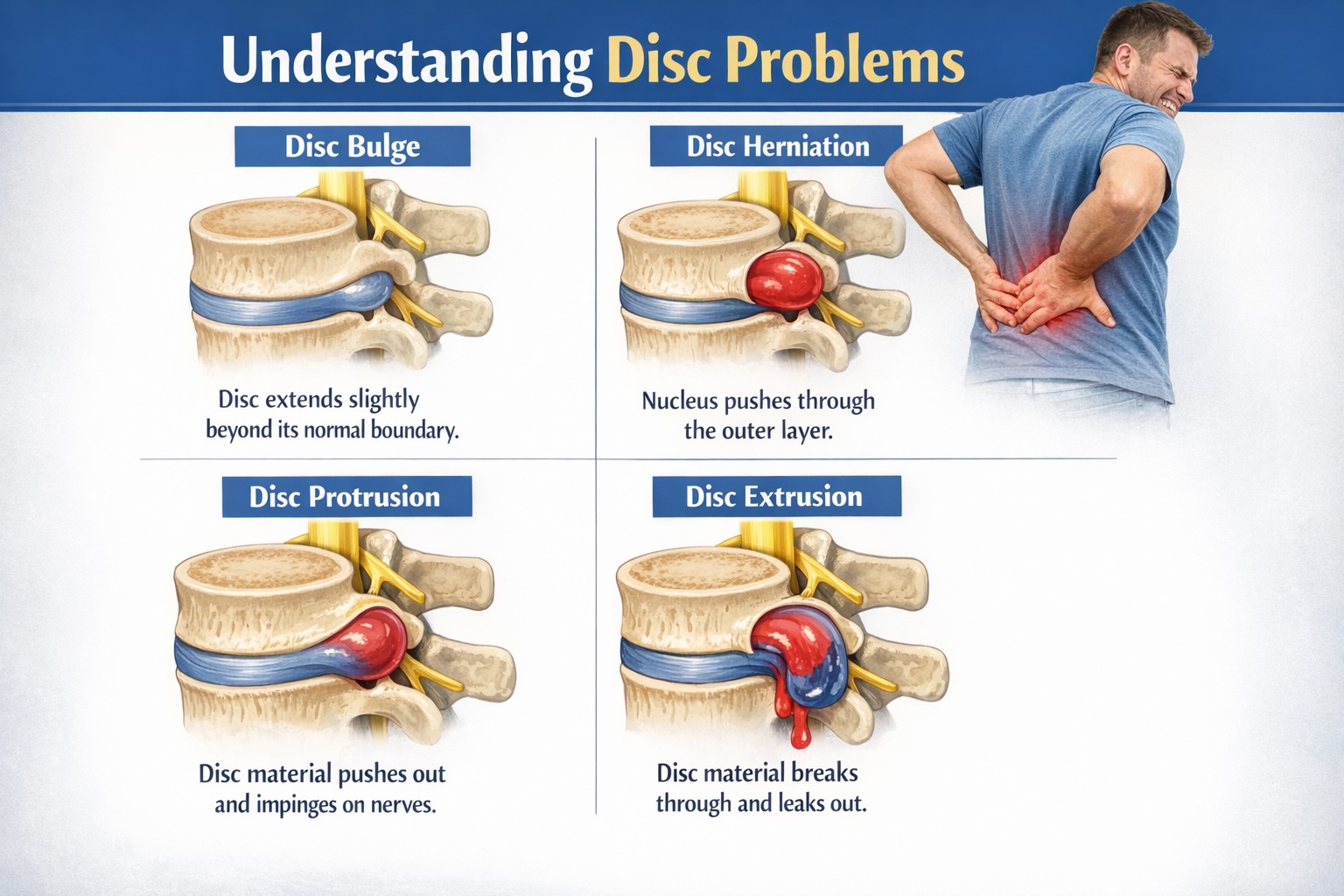
Over time, injury, repetitive stress, sports, falls, car accidents, and degeneration can place stress on the disc.
When the outer fibers weaken, disc material may begin pushing outward.
MRI reports may describe this as:
-
Disc Bulge
-
Disc Protrusion
-
Disc Herniation
-
Disc Extrusion
One of the biggest misconceptions patients have is believing the MRI finding alone determines whether surgery is necessary.
It does not.
I've seen patients with large herniations doing remarkably well.
I've also seen patients with smaller herniations experiencing significant symptoms.
The MRI is only one piece of the puzzle.
WHY HERNIATED DISCS OFTEN CAUSE SCIATICA
Many patients are confused because their symptoms are in the leg rather than the back.
The reason is often nerve irritation.
When a disc begins irritating a nearby nerve, symptoms may travel:
✔ Into The Buttock
✔ Down The Thigh
✔ Into The Calf
✔ Into The Foot
✔ Into The Toes
This may create:
-
Burning Pain
-
Tingling
-
Numbness
-
Electrical Sensations
-
Weakness
This is why many patients with sciatica believe they have a leg problem when the source may actually be located in the lower back.
WHY DISC INJURIES CAN BE SO DIFFICULT TO HEAL
This is where things become interesting.
Most tissues in your body receive direct blood flow.
Blood carries:
-
Oxygen
-
Nutrients
-
Growth Factors
-
Healing Components
Spinal discs are different.
They have a very limited blood supply.
Instead, discs rely heavily on:
-
Fluid Exchange
-
Nutrient Diffusion
-
Oxygen Diffusion
-
Movement
Think of a sponge.
If you repeatedly compress a sponge and never allow it to re-expand, fluid movement becomes limited.
Many researchers believe a similar concept may occur with injured spinal discs.
This is one reason disc injuries can become chronic.
And it's one reason patients often continue suffering despite trying multiple forms of treatment.
WHY SOME PATIENTS FEEL BETTER BUT THE PAIN KEEPS COMING BACK
This is another common frustration.
Patients often tell me:
"Physical therapy helped for a while."
"The injection worked for a few weeks."
"The adjustment felt great but the pain came back."
This doesn't mean those treatments were wrong.
In fact, many can be extremely helpful.
The challenge is that many patients have multiple overlapping problems.
A patient may have:
-
Disc Injury
-
Nerve Irritation
-
Core Weakness
-
Hip Weakness
-
Poor Movement Patterns
-
Limited Mobility
Addressing only one piece of the problem may not completely resolve the issue.
This is why many patients experience:
-
Temporary Relief
-
Flare-Up
-
Temporary Relief
-
Another Flare-Up
for months or even years.
"I NEVER ENDED UP NEEDING EITHER OF THOSE APPOINTMENTS"
**“Last year, I spent three months constantly going back and forth between doctor’s appointments and urgent care. The pain was unbearable—I was taking medication regularly just to get through the day. Getting out of bed was excruciating, and walking or standing felt like torture. Every step filled me with dread.
In December, my doctor finally ordered an MRI. That’s when I learned I had an extruded disc pressing on my L5 nerve, which affects the leg and foot. My doctor scheduled two follow-up appointments: one for pain management (spinal injections), and another to evaluate me for surgery.
Then I discovered spinal decompression therapy. I was thrilled to find a non-invasive alternative.
I never ended up needing either of those appointments.
Now, I’m walking regularly, standing up straight—something I couldn’t do before. When I first sought help, I was so hunched over that I had to use a cane just to move forward. Because of the pain, I hadn’t exercised in months. But now, I’m doing a program called 75 hard which requires not one but 2 45-minute workouts per day, and I've even gotten back to lifting weights!
I’m so thankful I found this place. It’s conveniently located near my work, which makes it easy to fit sessions into my lunch break. Dr. Boelk and the staff are incredibly friendly and polite—it’s always a pleasure to come in.
The environment is so relaxing that I look forward to each visit. I truly thank God for leading me to this alternative. It’s made such a difference in my life.”**
— Amanda, San Diego, CA
WHY WAS SPINAL DECOMPRESSION DEVELOPED?
One goal of spinal decompression is to reduce pressure affecting injured discs and nearby nerves.
The goal is not to magically fix every problem.
The goal is to create a more favorable environment around the injured area.
One proposed mechanism involves reducing pressure within the disc itself.
Many clinicians believe improving the environment surrounding the injured disc may be an important component of recovery.
While no treatment can guarantee healing, this concept is one reason spinal decompression has become increasingly popular among patients seeking conservative options before considering surgery.
WHY WE EXCLUSIVELY USE DRX9000 SPINAL DECOMPRESSION
At The Spinal Decompression & Chiropractic Center Of San Diego, we exclusively utilize:
DRX9000 Spinal Decompression Systems
We currently operate:
7 DRX9000 Systems
-
4 Lumbar Systems
-
3 Cervical Systems
making us one of the largest spinal decompression facilities in California.
Over the years, Dr. Boelk has personally performed:
More Than 100,000 Spinal Decompression Treatments
Many doctors now travel to San Diego to learn his protocols through:
The Spinal Decompression Training Academy
Not all spinal decompression systems are the same.
Not all treatment protocols are the same.
Success often depends on:
✔ Proper Diagnosis
✔ Proper MRI Review
✔ Appropriate Patient Selection
✔ Correct Treatment Parameters
✔ Active Rehabilitation
✔ Progress Evaluation
MY PERSONAL EXPERIENCE WITH DISC INJURIES
Part of the reason I became so passionate about helping disc patients is because I've personally lived through significant spinal injuries myself.
At age 16, I fractured my L5 vertebra.
Later in life I experienced significant neck and back disc injuries as well.
I understand firsthand:
-
Chronic Pain
-
Fear Of Surgery
-
Activity Limitations
-
Frustration
-
Recovery Setbacks
Those experiences ultimately inspired me to spend nearly 22 years helping patients suffering from disc-related conditions.
5 THINGS SOME DISC PATIENTS MAY TRY AT HOME
⚠️ These suggestions are not intended to replace proper evaluation.
1. Avoid Prolonged Sitting
Many disc patients notice symptoms worsen while sitting.
2. Walk Frequently
Walking is often tolerated better than prolonged sitting.
3. Stay Hydrated
Healthy discs rely heavily on fluid exchange.
4. Pay Attention To Symptom Triggers
Identify activities that consistently aggravate symptoms.
5. Try Gentle Self-Decompression
Some patients report temporary relief by sitting in a sturdy chair and gently pushing upward through the armrests for 15–60 seconds if comfortable and tolerated.
WHY PATIENTS SEEK OUT DR. CASSIDY BOELK DC
✔ Nearly 22 Years Of Clinical Experience
✔ Certified Spinal Decompression Doctor
✔ Certified Pain-Free Performance Specialist
✔ Founder, Spinal Decompression Training Academy
✔ Founder Of One Of California's Largest Non-Surgical Spinal Decompression Practices
✔ Founding Member, American Spinal Decompression Society
✔ Member, International Disc Education Association
✔ California X-Ray Radiation Supervisor & Operator
✔ More Than 100,000 Spinal Decompression Treatments Performed
✔ Operates 7 DRX9000 Systems
✔ Trains Doctors Nationwide In Spinal Decompression Protocols
✔ Has Helped Thousands Of Patients Suffering From Disc Herniations, Sciatica, Chronic Neck Pain And Chronic Low Back Pain
NOT EVERY PATIENT IS A CANDIDATE
One reason doctors, therapists, surgeons, former patients, and family members continue referring difficult cases to Dr. Boelk is because he is willing to tell patients when treatment is not appropriate.
“I found this terrific practice on social media. I followed up and did my own research so I decided to pay them a visit. The place is clean, well organized and run by a very efficient receptionist. I met with the doctor and after a honest and forthright conversation, we both determined that surgery was my only option to correct my back issues. I will return as a customer when the time is right.”
— Jeff J., Tucson, AZ
Not everyone qualifies.
Not everyone can avoid surgery.
And not everyone should undergo spinal decompression treatment.
SCHEDULE A NO-CHARGE CONSULTATION TO SEE IF YOU MAY BE A CANDIDATE
📞 619-298-0800
📍 5095 Murphy Canyon Road, Suite 300
San Diego, CA 92123
If you've been diagnosed with a herniated disc and are wondering whether surgery is truly necessary, the first step is understanding your diagnosis and determining whether a non-surgical option may be available.
Because Dr. Boelk personally performs consultations and MRI reviews himself, consultation availability is limited.