Can a Herniated Disc in My Neck Heal Without Surgery in Chula Vista, CA?
If you've been diagnosed with a herniated disc in your neck, you may be asking yourself an important question: Can this actually get better without surgery?
Maybe your neck pain started gradually. At first, it was just stiffness when you woke up or discomfort after spending hours at a computer. Then you began noticing pain traveling into your shoulder, down your arm, or into your fingers.
Perhaps you're experiencing tingling, numbness, burning sensations, or weakness. You might have difficulty sleeping, driving, lifting weights, or doing activities that used to feel completely normal.
For many patients, the most frustrating part isn't just the pain. It's not knowing whether the condition is going to improve or whether they'll eventually need cervical spine surgery.
Here's what you should understand: Many cervical disc herniations improve without surgery, and some actually decrease in size through the body's natural healing processes.
However, the appropriate treatment depends on several factors, including the location of the herniation, which nerves are involved, the severity of your symptoms, and whether there is pressure on the spinal cord.
At The Spinal Decompression & Chiropractic Center of San Diego, Dr. Cassidy James Boelk, DC, has spent more than 22 years helping patients with herniated discs, pinched nerves, and other spinal conditions explore non-surgical treatment options.
Located in Kearny Mesa, the practice welcomes patients from Chula Vista, Eastlake, Otay Ranch, Bonita, and throughout South San Diego County.
When a Pinched Nerve Starts Affecting Your Sleep and Everyday Life
One of the most common complaints from patients with cervical nerve irritation is that they can't find a comfortable sleeping position.
Some wake up with pain traveling into their shoulder or arm. Others experience numbness or tingling that becomes worse when lying in certain positions.
And when sleep suffers, everything else becomes more difficult.
One patient described how nerve-related pain affected his sleep, exercise, and confidence before seeking care with Dr. Boelk.
⭐⭐⭐⭐⭐
"I initially saw Dr. Boelk for a pinched nerve in my shoulder that would flare up in the middle of the night, causing severe pain and disrupting my sleep. It even started affecting my confidence during workouts because I was worried about triggering another episode.
During my first visit, Dr. Boelk performed a thorough examination and quickly identified the source of the problem. After only a few treatments, the flare-ups completely stopped and I was able to return to my normal routine.
He also gave me valuable tools and exercises to help prevent future issues and provided helpful advice regarding my extremely tight shoulders.
I've continued to return periodically for adjustments and always leave feeling better.
Dr. Boelk and his staff are professional, knowledgeable, and genuinely care about their patients. I highly recommend him."
— Amir Rezai
Amir's experience highlights something important: patients aren't simply looking for temporary pain relief. They want to sleep comfortably, return to exercise, and feel confident participating in their normal activities again.
His review describes a pinched nerve in the shoulder region rather than a confirmed cervical disc herniation, but the impact of nerve-related pain on daily life is familiar to many people with cervical conditions.
Your First Step: A Complimentary, No-Charge, No-Obligation Consultation
If you're dealing with persistent neck pain, arm numbness, or a diagnosed cervical disc herniation, you may have questions before deciding whether to begin another treatment program.
Dr. Boelk offers a Complimentary, No-Charge, No-Obligation Consultation so you can meet with him personally, discuss your condition, and learn more about your options.
What Can You Expect During Your Consultation?
-
Meet personally with Dr. Boelk. Discuss your symptoms, concerns, and what you're hoping to accomplish.
-
Explain your neck and arm symptoms. Describe where the pain travels, when it occurs, and whether you're experiencing numbness, tingling, or weakness.
-
Review your medical history. Discuss previous injuries, surgeries, and other health conditions that may influence treatment.
-
Talk about previous treatments. This includes physical therapy, medications, injections, chiropractic care, or other approaches you've already tried.
-
Discuss existing MRI or X-ray findings. Bring your imaging if available so you can ask questions about the results.
-
Learn about DRX9000 cervical decompression. Dr. Boelk will explain how the equipment works, what treatment involves, and its potential benefits and limitations.
-
Discuss whether further evaluation is appropriate. Learn what a comprehensive examination may involve and how treatment candidacy is determined.
-
Ask questions without pressure. Understand your options before deciding whether to proceed.
Is the Consultation Really No Charge?
Yes. There is no charge and no obligation to begin treatment.
The consultation is an informational discussion. It does not include a comprehensive diagnostic physical examination, new X-rays, or treatment. Those services are separately charged when appropriate.
If you're ready to investigate the cause of your symptoms more thoroughly, you can schedule a comprehensive new patient examination instead.
Call 619-298-0800 to schedule your examination or request your complimentary consultation.
Our answering service is available 24 hours a day, seven days a week.
¡Hablamos Español!
How Does a Herniated Disc in Your Neck Cause Arm Pain?
Your cervical spine contains seven vertebrae, labeled C1 through C7.
Between most of these vertebrae are intervertebral discs that help distribute forces and allow movement.
Each disc has a tougher outer structure called the annulus fibrosus and a softer central region called the nucleus pulposus.
When disc material extends beyond its normal boundaries, it may be described as a protrusion, extrusion, or another type of herniation.
If that material irritates or compresses a nearby nerve root, symptoms can travel beyond the neck into the shoulder, arm, or hand.
This condition is often called cervical radiculopathy.
Common Symptoms of Cervical Radiculopathy
Patients may experience:
-
Neck pain that travels into one shoulder or arm
-
Burning or electric-like sensations extending down the arm
-
Tingling or numbness in the fingers
-
Weakness in certain arm or hand muscles
-
Symptoms that worsen with particular neck positions
-
Difficulty sleeping because of shoulder or arm discomfort
Interestingly, some patients have very little neck pain.
Their primary complaint may be tingling in the hand or aching in the forearm.
That's because the irritated nerve can produce symptoms along its distribution, even when the source of the problem is in the cervical spine.
Can the Body Reabsorb a Herniated Cervical Disc?
Yes, in some cases.
When disc material becomes exposed to tissues outside its normal location, the immune system may recognize it and initiate a biological response.
Specialized immune cells called macrophages can help break down and clear portions of the exposed disc material.
New blood vessels may also develop around the herniation, supporting the process of tissue remodeling and resorption.
Over time, some cervical disc herniations decrease in size.
These changes can occasionally be observed on follow-up MRI examinations.
Larger extruded or sequestered disc fragments may be more likely to undergo spontaneous resorption than certain contained protrusions, although individual outcomes vary.
However, not every herniation shrinks, and the presence of a herniation on MRI doesn't always correspond directly with the severity of symptoms.
Can Symptoms Improve Even if the Disc Doesn't Disappear?
Absolutely.
Pain from a cervical disc herniation isn't caused solely by the size of the disc abnormality.
Inflammation around the nerve root, chemical irritation, mechanical compression, and nerve sensitivity can all contribute to symptoms.
As inflammation and nerve irritation decrease, patients may experience meaningful improvement even when the disc remains visible on imaging.
That's why clinical improvement should be assessed through symptoms, neurological findings, and functional abilities rather than relying entirely on the MRI report.
C5-C6 vs. C6-C7: Why the Location of Your Herniated Disc Matters
Two commonly affected levels in the cervical spine are C5-C6 and C6-C7.
Understanding which level is involved can help explain why symptoms travel into different parts of the arm or hand.
C5-C6 Disc Herniation
A typical posterolateral herniation at C5-C6 may irritate the C6 nerve root.
Possible symptoms include:
-
Pain traveling into the shoulder or outer arm
-
Tingling or numbness extending toward the thumb
-
Altered sensation in the thumb or index finger
-
Weakness involving elbow flexion or wrist extension
C6-C7 Disc Herniation
A typical posterolateral herniation at C6-C7 may irritate the C7 nerve root.
Possible symptoms include:
-
Pain traveling through the shoulder and down the arm
-
Tingling or numbness extending toward the middle finger
-
Weakness involving the triceps
-
Difficulty with certain pushing movements
These patterns aren't universal.
Carpal tunnel syndrome, peripheral nerve entrapment, shoulder disorders, and other conditions can produce similar symptoms.
A careful examination helps determine whether the symptoms are actually coming from the cervical spine.
What Are the Best Non-Surgical Treatment Options?
For many patients without significant or progressive neurological deficits, conservative treatment is considered before surgery.
However, the appropriate approach depends on the underlying diagnosis and clinical findings.
1. Physical Therapy and Rehabilitation
Exercise-based rehabilitation may help improve neck movement, shoulder strength, postural endurance, and tolerance for daily activities.
Depending on the patient's condition, treatment may include gentle cervical movements, deep neck flexor exercises, scapular strengthening, and progressive upper-body conditioning.
Not every exercise is appropriate for every patient.
Some movements may reduce symptoms, while others can aggravate an irritated nerve.
The goal is to identify exercises that improve function without repeatedly increasing radiating pain, numbness, or weakness.
2. Activity Modification
Prolonged computer work, looking down at a phone, or maintaining the neck in one position for extended periods may aggravate symptoms.
Practical changes can include:
-
Adjusting monitor height to reduce prolonged neck flexion
-
Taking regular movement breaks
-
Modifying exercises that increase arm symptoms
-
Avoiding prolonged positions that consistently aggravate the nerve
-
Gradually returning to normal activities as symptoms improve
The goal isn't to avoid movement indefinitely.
It's to reduce repeated irritation while maintaining as much normal activity as possible.
3. Medications and Injections
Medications may help manage symptoms while the underlying condition improves.
For selected patients with persistent cervical radicular pain, epidural steroid injections may be considered by an appropriately qualified medical specialist.
These injections may provide symptom relief in some cases, although benefits vary and cervical injections carry risks that should be carefully discussed.
They don't physically remove the herniated disc.
4. DRX9000 Computerized Cervical Spinal Decompression
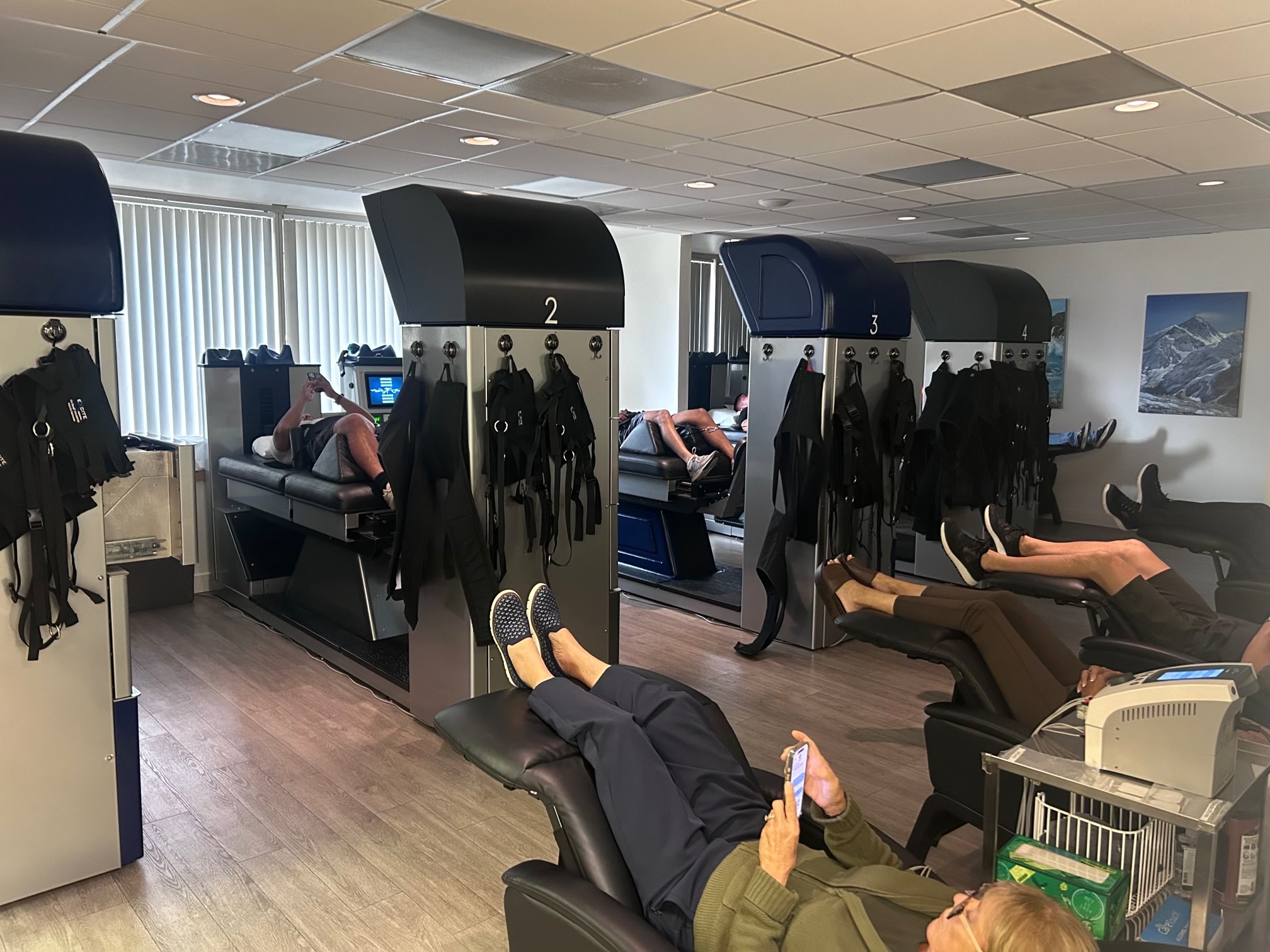
For appropriately selected patients, Dr. Boelk may consider DRX9000 computerized cervical spinal decompression as part of an individualized conservative treatment approach.
During treatment, the patient lies on a specialized table while controlled distraction forces are applied to the cervical spine.
The DRX9000 uses programmed pulling and relaxation cycles, with treatment settings selected according to the patient's condition and clinical assessment.
The treatment doesn't require surgery, anesthesia, or injections.
The intention is to provide controlled mechanical unloading of spinal structures and potentially reduce symptoms in patients who respond favorably to traction-based care.
Dr. Boelk's San Diego facility has seven DRX9000 spinal decompression tables, including three dedicated cervical units.
Evidence for computerized spinal decompression remains limited and mixed. Although some patients may benefit from traction-based care, it hasn't been established as a reliable method of reversing cervical disc herniations or preventing surgery.
Not everyone is a candidate. A comprehensive examination and appropriate imaging review are important before considering treatment.
A Patient's Experience With Cervical Disc Bulging and Arm Numbness
For some patients, cervical disc symptoms persist despite trying multiple conservative treatments.
One patient described her experience with severe cervical disc bulging, neck pain, and numbness traveling into her arms and hands.
⭐⭐⭐⭐⭐
"I've been seeing Dr. Boelk for almost four years, and it has been one of the best healthcare decisions I've ever made.
I was diagnosed with severe cervical disc bulging, dizziness, neck pain, and numbness and tingling into my arms and hands. After trying multiple chiropractors, traction machines, and pain management specialists, I was told surgery was likely my next option.
Then I found Dr. Boelk. He explained how spinal decompression could help and developed a treatment plan specific to my condition. My pain level dropped from a 7 down to a 3 after several intensive sessions and eventually improved to a 1–2 with maintenance care.
During my most recent MRI, the images showed my cervical spine had returned to a much more normal position.
I continue with maintenance care and am incredibly thankful I found Dr. Boelk. He is practical, professional, and one of my favorite doctors. I highly recommend giving him a chance."
— Justine Lai
Justine's experience illustrates why patients often seek additional treatment options when previous approaches haven't provided the improvement they hoped for.
Her reported improvement is encouraging, although an individual testimonial cannot establish that decompression caused the MRI changes or predict another patient's results.
Three Things You Can Do at Home to Reduce Neck and Arm Irritation
While home strategies should be individualized, there are several practical steps that may help reduce aggravation.
1. Pay Attention to Your Sleeping Position
Sleeping with your neck in an uncomfortable position may aggravate symptoms.
Some patients find that sleeping on their back or side with appropriate pillow support helps maintain a more comfortable neck position.
The goal is to avoid prolonged positions that consistently increase arm pain or tingling.
2. Take Breaks From Prolonged Neck Flexion
Looking down at a phone, tablet, or laptop for extended periods may increase discomfort in some patients.
Try raising your screen closer to eye level and taking regular breaks to change positions.
Small adjustments throughout the day may be more helpful than trying to maintain one rigid posture.
3. Don't Push Through Increasing Arm Symptoms
If a movement or exercise repeatedly causes pain, tingling, or numbness to travel farther down your arm, that may be a sign that the irritated nerve isn't tolerating the activity well.
Rather than pushing harder, modify the movement and discuss the response with a qualified healthcare professional.
New or progressive weakness deserves prompt medical evaluation.
When Cervical Disc Symptoms Require Urgent Medical Attention
One important distinction is the difference between cervical radiculopathy and cervical myelopathy.
Cervical radiculopathy involves irritation or compression of a nerve root as it exits the spine.
Cervical myelopathy involves dysfunction of the spinal cord itself, often associated with compression within the spinal canal.
Symptoms of cervical myelopathy may include:
-
Increasing difficulty with balance or walking
-
Hand clumsiness or trouble with fine motor tasks
-
Weakness affecting multiple limbs
-
Changes in coordination
-
Progressive neurological problems
These symptoms require prompt medical evaluation.
New bowel or bladder dysfunction associated with neurological symptoms requires emergency assessment.
Patients with suspected cervical myelopathy should receive appropriate medical evaluation rather than beginning cervical traction or decompression without clearance.
Why Dr. Boelk Doesn't Recommend Decompression to Every Patient
An important part of spinal evaluation is recognizing when a particular treatment isn't appropriate.
Some patients have fractures, spinal instability, spinal cord compression, or other conditions that require medical evaluation or a different treatment approach.
Dr. Boelk doesn't believe every patient who visits his office should automatically begin a decompression program.
One patient described how he approached her case after a serious neck injury.
⭐⭐⭐⭐⭐
“I decided to see Dr. Boelk after a pretty gnarly motocoss neck injury. At the Hospital I was at, I felt I was getting pressured into a surgery which I refused. A friend of a friend referred him after Dr. Boelk successfully treated his broken back.
Dr. Boelk is a compassionate individual who truly cares about his patients. He looked at my MRI images, explained what he saw and potential routes for recovery. He could not treat me as I have to wait until the fracture in my neck heals, but the level of professionalism, compassion, caring and knowledge displayed by him was exceptional.
He also recommended to seek an additional opinion form another neurosurgeon. My experience was that he really cares and he's not someone who would take advantage of the situation someone's in (unlike some other doctors). I will definitely be back and already recommended him to others as well! Thank you Dr. Boelk!”
— Jan H., San Marcos, CA
Jan's experience illustrates why appropriate patient selection matters.
Sometimes the most responsible recommendation is additional imaging, medical clearance, a specialist consultation, or postponing treatment until the underlying condition has been appropriately addressed.
Why Patients From Chula Vista Choose Dr. Cassidy James Boelk, DC
Dr. Boelk has spent more than 22 years focusing on non-surgical spinal care, including the evaluation and management of patients with herniated discs, pinched nerves, and other spinal conditions.
His clinical experience also extends beyond treating patients.
Through the Spinal Decompression Training Academy, he teaches other doctors about non-surgical spinal decompression protocols, treatment techniques, and patient selection.
Dr. Boelk's Credentials, Experience & Professional Affiliations
-
Doctor of Chiropractic (DC)
-
Certified Spinal Decompression Doctor
-
Certified Pain-Free Performance Specialist
-
Member, International Disc Education Association
-
Founding Member, American Spinal Decompression Society
-
Founder, Spinal Decompression Training Academy
-
California X-Ray Supervisor and Operator License
-
22+ Years as a Spinal Decompression Specialist
-
100,000+ Spinal Decompression Treatments Performed
-
Seven DRX9000 Spinal Decompression Tables (4 Lumbar, 3 Cervical)
Personal Experience With Serious Spinal Injuries
Dr. Boelk's interest in spinal rehabilitation is also rooted in his own experience recovering from significant back injuries.
As a teenager, he sustained fractures involving his lower lumbar spine and developed spondylolisthesis. Later in life, he experienced lumbar disc herniations and sciatica.
These experiences contributed to his interest in spinal rehabilitation and non-surgical treatment options.
Over the years, he has devoted thousands of hours to studying spinal rehabilitation, improving his own spinal health, and helping patients work toward returning to the activities they enjoy.
This personal experience continues to influence his approach to patient education, rehabilitation, and long-term spinal health.
What Happens During Your Comprehensive Cervical Spine Examination?
A comprehensive new patient examination helps investigate the source of your symptoms and determine whether spinal decompression or another treatment approach may be appropriate.
Depending on your condition, the evaluation may include:
-
A detailed medical history and discussion of your symptoms
-
Assessment of cervical movement and functional limitations
-
Neurological testing of strength, reflexes, and sensation
-
Review of existing cervical MRI images or reports
-
Weight-bearing cervical X-rays, including flexion and extension views, when clinically indicated
-
Discussion of previous treatments and your goals
-
Recommendations for appropriate treatment or further medical evaluation
If additional imaging or specialist referral is necessary, that can be addressed during the process.
The comprehensive examination is separate from the complimentary consultation and has its own fees.
Frequently Asked Questions About Cervical Disc Herniations in Chula Vista
Can a herniated disc in the neck heal without surgery?
Yes. Many patients improve with conservative treatment. Some cervical disc herniations also decrease in size through natural biological processes, although this doesn't happen in every case.
Can a C5-C6 disc herniation cause numbness in my hand?
Yes. A C5-C6 disc herniation may irritate the C6 nerve root, potentially producing pain, tingling, or numbness extending toward the thumb and index finger.
How long does a cervical disc herniation take to improve?
Recovery varies. Some patients experience improvement within several weeks, while others have symptoms lasting months or longer. The underlying condition, neurological findings, and response to treatment all influence recovery.
Can I continue exercising with a herniated disc in my neck?
It depends on your symptoms and neurological findings. Some activities may be well tolerated, while others may aggravate the nerve. Exercise should be modified and progressed according to your condition.
Can cervical spinal decompression help?
Some selected patients may experience symptom relief with traction-based treatment, but research remains limited and mixed. Computerized cervical decompression hasn't been established as a reliable way to reverse disc herniations or prevent surgery.
When should I consider neck surgery?
Surgical evaluation may be appropriate when symptoms remain disabling despite suitable conservative treatment, when significant or progressive weakness develops, or when spinal cord compression is suspected.
Looking for Non-Surgical Cervical Disc Treatment Near Chula Vista, CA?
If you've been experiencing persistent neck pain, arm numbness, tingling, or weakness, understanding the underlying cause is an important first step toward choosing appropriate treatment.
A cervical disc herniation doesn't automatically mean surgery is necessary. Many patients improve with conservative care, and some herniations decrease in size naturally over time.
At The Spinal Decompression & Chiropractic Center of San Diego, Dr. Cassidy James Boelk, DC, has spent more than 22 years helping patients with disc-related spinal conditions explore non-surgical treatment options.
His Kearny Mesa practice offers comprehensive spinal evaluations, individualized rehabilitation recommendations, and DRX9000 computerized cervical spinal decompression for appropriately selected patients.
If you're ready to move forward, schedule a comprehensive new patient examination.
If you'd prefer to meet Dr. Boelk and ask questions before proceeding, you can begin with a Complimentary, No-Charge, No-Obligation Consultation.
Contact The Spinal Decompression & Chiropractic Center of San Diego
Dr. Cassidy James Boelk, DC
Certified Spinal Decompression Doctor
Certified Pain-Free Performance Specialist
Founder, Spinal Decompression Training Academy
The Spinal Decompression & Chiropractic Center of San Diego
5095 Murphy Canyon Road, Suite 300
San Diego, CA 92123
Phone: 619-298-0800
Email: frontdesk@sandiegobackcare.com
Website: www.SanDiegoBackCare.com
24/7 Answering Service | ¡Hablamos Español!
Call 619-298-0800 to schedule your new patient examination or request your Complimentary, No-Charge, No-Obligation Consultation.
Understanding your diagnosis is the first step toward making an informed decision about your treatment options.