Can a Bulging Disc Become a Herniated Disc? – San Diego, CA
Understanding the Difference Between a Bulging Disc and a Herniated Disc
Can a Bulging Disc Become a Herniated Disc?
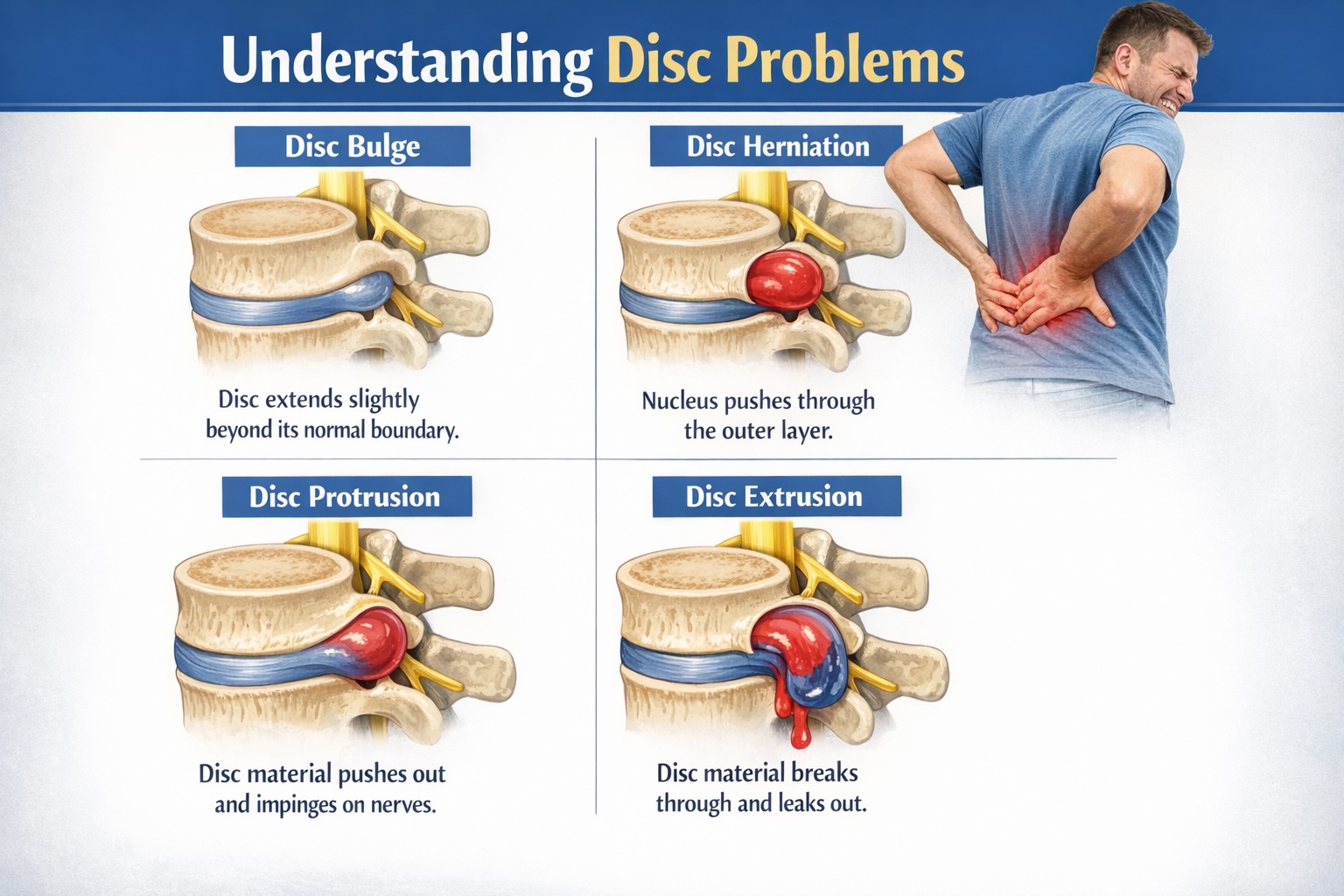
Yes, a bulging disc can progress into a herniated disc, but it doesn't always happen. Many people live for years with a bulging disc that never worsens, while others experience a tear in the outer portion of the disc that allows the inner gel-like material to push outward. This is known as a herniated disc and can irritate nearby nerves, often leading to pain, numbness, tingling, or sciatica.
The good news is that having a bulging disc does not automatically mean you'll need surgery. In many cases, conservative treatment may help reduce symptoms and improve function, depending on your specific diagnosis and whether you're an appropriate candidate.
Is Your Bulging Disc Becoming Something More?
Maybe your MRI originally showed a bulging disc.
Your symptoms were manageable.
Then something changed.
Perhaps you bent over to pick something up.
Maybe you twisted while lifting.
Or maybe you simply woke up one morning with severe pain shooting down your leg.
Now you're wondering...
"Did my bulging disc turn into a herniated disc?"
It's a question I hear in my office almost every week.
The answer is yes—it certainly can happen—but understanding why it happens can help you make better decisions about your treatment and recovery.
No-Charge Consultation
If you've recently been diagnosed with a bulging disc, herniated disc, sciatica, or degenerative disc disease and would like to know whether you may be a candidate for treatment in our office, we invite you to schedule a No-Charge, No-Obligation Consultation.
During your consultation we'll discuss:
- Your symptoms and health history
- Review any MRI studies you've already had
- Explain your diagnosis in plain English
- Determine whether additional imaging is necessary
- Discuss whether you're a candidate for treatment—or whether another option would be more appropriate
If Dr. Cassidy James Boelk, DC does not believe you're a candidate for care in our office, he'll tell you honestly and help point you in the appropriate direction.
The Spinal Decompression & Chiropractic Center of San Diego
5095 Murphy Canyon Road, Suite 300
San Diego, CA 92123
Office: 619-298-0800
24-Hour Answering Service Available
Hablamos Español
**“I have been dealing with back pain for several years. It got so bad that I had surgery 5 years ago for a bulging disc. About 5 months ago the disc bulged again hitting my sciatic nerve creating pain in my legs that made me want to cry it hurt so bad. After trying so many other options I was fortunate enough to find the spinal decompression and chiropractic center of San Diego. After just a few sessions I noticed a difference. Now after being there for the past few months I'm able to go about my normal life again.
What a blessing it was to find a Dr that genuinely cares and knows how to help people in my situation. Thank you Dr Boelk!”**
— Anthony K., San Diego, CA
What Is a Bulging Disc?
Think of your spinal disc like a jelly-filled doughnut.
The outer layer is made of strong fibers that help contain the softer center.
Over time, due to aging, repetitive stress, poor lifting mechanics, sports injuries, or trauma, the outer portion may begin to weaken.
Instead of remaining perfectly round, the disc starts to spread outward.
This is called a bulging disc.
Importantly, the outer wall of the disc remains intact.
The disc simply extends beyond its normal boundary.
Many bulging discs never cause pain.
In fact, millions of people have bulging discs and don't even know it because they have no symptoms whatsoever.
What Is a Herniated Disc?
A herniated disc occurs when the outer fibers develop a tear or weakness, allowing some of the softer inner material to push through.
When this material comes into contact with a nearby nerve root, it may produce:
- Sciatica
- Burning leg pain
- Numbness
- Tingling
- Weakness
- Neck pain
- Arm pain
- Difficulty sitting
- Pain while coughing or sneezing
This is why two people with very similar MRI findings can have completely different symptoms.
It's often the relationship between the disc and the nearby nerve—not simply the size of the disc—that determines how someone feels.
Can a Bulging Disc Turn Into a Herniated Disc?
Yes.
But it doesn't happen overnight.
Most herniated discs develop gradually as the outer fibers continue to weaken over time.
Sometimes the final event seems minor.
Patients often tell me:
"I wasn't even lifting anything heavy."
Or...
"I just bent over to tie my shoe."
The reality is that the disc has usually been undergoing changes for months—or even years—before that final movement causes the symptoms to appear.
Often, that movement isn't the true cause.
It's simply the event that finally exceeded what the damaged disc could tolerate.
Why Does This Happen?
Several factors may increase the likelihood that a bulging disc progresses to a herniation:
- Repetitive bending
- Heavy lifting with poor mechanics
- Smoking
- Obesity
- Prolonged sitting
- Repeated vibration
- Previous spinal injuries
- Degenerative disc disease
- Genetics
These factors don't guarantee a herniation.
They simply increase the stress placed on an already compromised disc.
Why Sitting Often Makes It Worse
One of the biggest surprises for patients is learning that sitting often places more pressure on the lumbar discs than standing.
When you sit—especially with poor posture—the pressure inside the disc can increase significantly.
If the disc is already weakened, prolonged sitting may aggravate symptoms.
That's why many people notice worsening pain during:
- Driving
- Office work
- Airplane flights
- Long commutes
- Watching television
Can a Herniated Disc Heal?
One of the first questions patients ask after learning they have a herniated disc is:
"Will it heal?"
The answer isn't always a simple yes or no.
In many cases, the body can gradually reduce inflammation surrounding the injured disc, and in some individuals, the herniated material may partially shrink over time. As the inflammation settles, pressure on the irritated nerve can decrease, allowing symptoms such as sciatica, numbness, and weakness to improve.
However, not every herniated disc follows the same path.
Some people recover within a few months.
Others continue struggling with recurring flare-ups for years because the injured disc never regains its normal function.
This is one reason why simply masking the pain with medication or injections doesn't necessarily solve the underlying mechanical problem.
The goal should always be identifying why the nerve continues to become irritated.
Why Do Some Bulging Discs Progress While Others Never Do?
No two patients are identical.
Several factors may influence whether a bulging disc eventually progresses into a herniation.
These include:
- Genetics
- Age-related disc degeneration
- Repetitive bending and twisting
- Heavy lifting
- Smoking
- Poor core strength
- Excess body weight
- Previous spinal injuries
- Occupations requiring prolonged sitting or driving
Many patients believe one specific movement "caused" their injury.
More often, that movement was simply the final straw after months—or years—of gradual degeneration.
What Happens If You Ignore It?
Sometimes...
Nothing.
Many bulging discs remain completely stable.
But if symptoms continue to worsen, ignoring the problem can occasionally allow additional irritation of the spinal nerve.
Patients may begin noticing:
- Increasing leg pain
- Numbness into the foot
- Tingling
- Muscle weakness
- Difficulty walking
- Reduced ability to sit
- Trouble sleeping
Fortunately, many people improve with conservative care before surgery ever becomes necessary.
The key is obtaining an accurate diagnosis and determining exactly what's causing the symptoms.
What Can You Do?
While every patient is different, there are several things that may help reduce unnecessary stress on an injured lumbar disc.
These include:
- Avoid repeated bending and twisting.
- Practice proper lifting mechanics.
- Change positions frequently rather than sitting for prolonged periods.
- Take short walking breaks throughout the day.
- Stay as active as your symptoms reasonably allow.
- Follow a structured rehabilitation program when appropriate.
- Obtain an accurate diagnosis before beginning treatment.
Trying random exercises found online without understanding the source of your symptoms can sometimes make matters worse.
Common Misconception
"A Bulging Disc Always Turns Into a Herniated Disc."
Fortunately, this simply isn't true.
Millions of adults have bulging discs that never become symptomatic.
Likewise, many people with herniated discs improve without surgery.
The MRI is only one piece of the puzzle.
Your symptoms, neurological examination, physical findings, health history, and imaging all need to be considered together before determining the most appropriate treatment plan.
Why Patients Choose Dr. Cassidy James Boelk, DC
✔ Board-Certified Doctor of Chiropractic
Over two decades of experience evaluating and treating complex spinal conditions.
✔ Certified Spinal Decompression Doctor
Advanced training in non-surgical spinal decompression and the treatment of disc-related conditions.
✔ Certified Pain-Free Performance Specialist (PPSC)
Extensive education in movement, biomechanics, rehabilitation, and helping patients return to the activities they enjoy.
✔ Founder, Non-Surgical Spinal Decompression Training Academy
Trains doctors in advanced spinal decompression protocols, patient selection, and rehabilitation strategies.
✔ Founding Member, American Spinal Decompression Society
✔ California Licensed X-Ray Supervisor & Operator
✔ More Than 22 Years Treating Spinal Disc Injuries
✔ More Than 100,000 Spinal Decompression Treatments Performed
✔ Personally Reviews MRI Studies
✔ Operates Seven DRX9000® Spinal Decompression Systems
- Four Lumbar DRX9000 Systems
- Three Cervical DRX9000 Systems
✔ Patients Travel from Throughout California, Across the United States, and Internationally to seek his expertise.
✔ Honest Candidate Selection
If Dr. Boelk believes you're not a candidate for treatment, he'll tell you honestly and discuss other appropriate options.
Non-Candidate Testimonial
"Very nice Dr. and Honest! I would definitely recommend anyone who hasn't had metal put in their back in a surgery to go to him and give his program a shot. I believe it would definitely help. Just not in my personal case. As I have a lot of hardware in my back. But I'm glad I took the time to meet with him. It was very informative all around."
— Toni W., Lake Elsinore, CA
A Personal Message from Dr. Cassidy James Boelk, DC
One of the biggest misconceptions I hear is that a bulging disc automatically means surgery is inevitable.
In reality, every patient is different.
Some people have very large disc injuries with surprisingly little pain, while others have relatively small disc injuries that create significant symptoms because of where the disc is contacting a nerve.
My goal is never to convince someone that they need treatment.
My job is to carefully review your history, examine you, evaluate your imaging, explain what I believe is causing your symptoms, and honestly tell you whether I think you're a candidate for treatment in our office.
If I don't believe we are the right fit for you, I'll tell you that as well and do my best to help guide you toward the care you need.
Herniated Disc Success Story
"I highly recommend Dr. Cassidy Boelk, DC and the team at The Spinal Decompression and Chiropractic Center. I came in with severe sciatica and a herniated disc, and his treatments have made a world of difference. He and his staff are both professional and genuinely caring, creating a welcoming and supportive environment. The treatments were not only highly effective but also tailored to my specific needs. I'm grateful for the care I received and the significant improvement in my quality of life."
— Brian Perrotta, San Diego, CA
Frequently Asked Questions
Can a bulging disc become a herniated disc?
Yes. If the outer fibers of the disc weaken or tear, the inner material can protrude outward and create a herniated disc.
Does every bulging disc become a herniated disc?
No. Many bulging discs remain stable for years and never cause symptoms.
Is surgery always necessary?
No. Many patients improve with conservative treatment, although some conditions do require surgical evaluation.
How can I tell if my bulging disc has worsened?
Increasing leg pain, numbness, tingling, weakness, or changes in bowel or bladder function should be evaluated promptly by a healthcare professional.
Can spinal decompression help a bulging disc?
Some patients with bulging or herniated discs may be appropriate candidates for non-surgical spinal decompression, while others may not. A thorough evaluation and review of your imaging are necessary to determine candidacy.
Should I continue exercising?
That depends on your diagnosis. Some activities can be beneficial, while others may aggravate the injury. An individualized treatment plan is generally the safest approach.
Wondering Whether You're a Candidate?
If you've been diagnosed with a bulging disc, herniated disc, sciatica, degenerative disc disease, or chronic back pain and would like to find out whether you may be a candidate for treatment in our office, we'd be happy to meet with you for a No-Charge, No-Obligation Consultation.
We'll listen to your concerns, review your MRI if you've already had one, explain your diagnosis in clear, understandable terms, and honestly let you know whether we believe our treatment approach is appropriate for your condition.
If we don't believe you're a candidate, we'll tell you—and we'll do our best to help point you in the right direction.
The Spinal Decompression & Chiropractic Center of San Diego
5095 Murphy Canyon Road, Suite 300
San Diego, CA 92123
Office: 619-298-0800
Website: www.SanDiegoBackCare.com
24-Hour Answering Service Available • Hablamos Español